Paper II — Q1
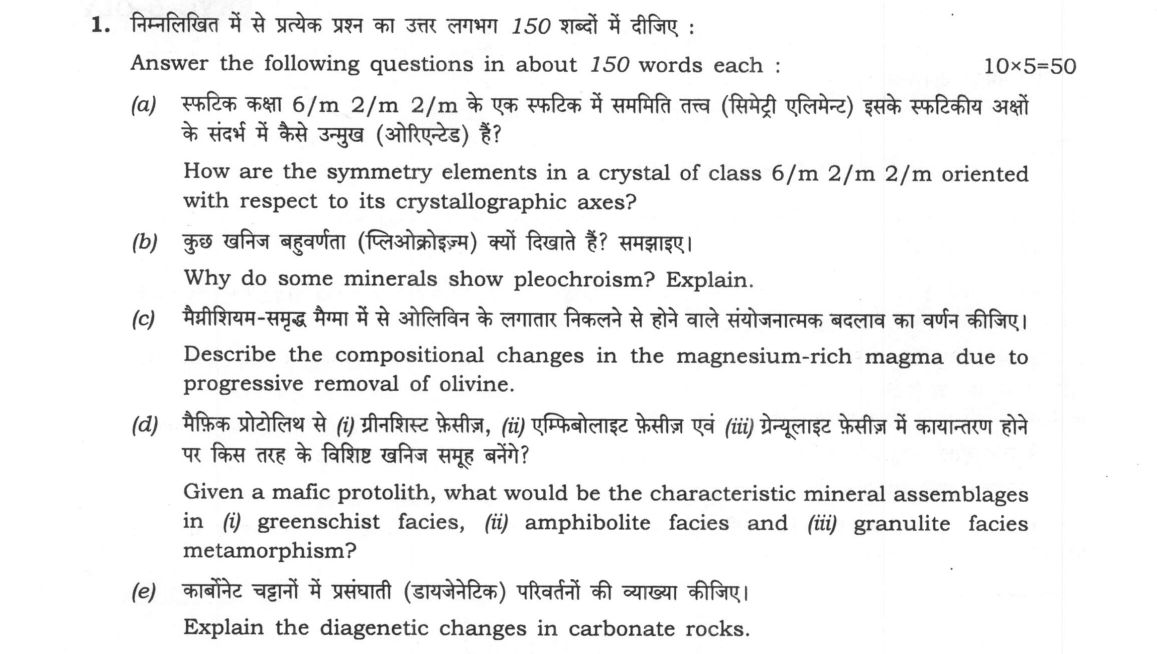
Answer the following questions in about 150 words each: (a) How are the symmetry elements in a crystal of class 6/m 2/m 2/m…
Answer the following questions in about 150 words each: How are the symmetry elements in a crystal of class 6/m 2/m 2/m oriented with respect to its crystallographic axes? 10 marks
Why do some minerals show pleochroism? Explain. 10 marks
Describe the compositional changes in the magnesium-rich magma due to progressive removal of olivine. 10 marks
Given a mafic protolith, what would be the characteristic mineral assemblages in (i) greenschist facies, (ii) amphibolite facies and (iii) granulite facies metamorphism? 10 marks
Explain the diagenetic changes in carbonate rocks. 10 marks
हिंदी में प्रश्न पढ़ें
निम्नलिखित में से प्रत्येक प्रश्न का उत्तर लगभग 150 शब्दों में दीजिए : स्फटिक कक्ष 6/m 2/m 2/m के एक स्फटिक में सममिति तत्त्व (सिमेट्री एलिमेंट) इसके स्फटिकीय अक्षों के संदर्भ में कैसे अनुयुक्त (ओरिएन्टेड) हैं? (10 अंक)
कुछ खनिज बहुवर्णता (प्लियोक्रोइज्म) क्यों दिखाते हैं? समझाइए। (10 अंक)
मैग्नीशियम-समृद्ध मैग्मा में से ओलिविन के लगातार निकलने से होने वाले संयोजनात्मक बदलाव का वर्णन कीजिए। (10 अंक)
मैफिक प्रोटोलिथ से (i) ग्रीन्सचिस्ट फेसीज, (ii) एम्फीबोलाइट फेसीज एवं (iii) ग्रैन्यूलाइट फेसीज में कायांतरण होने पर किस तरह के विशिष्ट खनिज समूह बनेंगे? (10 अंक)
कार्बोनेट चट्टानों में प्रसायाती (डायजेनेटिक) परिवर्तनों की व्याख्या कीजिए। (10 अंक)
Model answer
Written by UPSC Answer Check against this question's marking rubric, to the 150-word length. UPSC does not publish answers for Mains — this is one way to score well, not an official key.
(a) In the hexagonal setting, the 6-fold axis with its perpendicular mirror, written 6/m, lies along the c-axis, the unique vertical axis. The basal a1, a2 and a3 axes are 120° apart. The first 2/m direction gives three 2-fold axes in the basal plane, perpendicular to c, along a1, a2 and a3; each is perpendicular to a diagonal vertical mirror plane, σd, whose trace bisects the angle between two a-axis lines. The second 2/m direction gives three 2-fold axes bisecting the a-axis lines; each is perpendicular to a vertical mirror plane, σv, that contains the c-axis and one a-axis. In a stereogram projected down c, the c-axis is at the centre; the a-axis lines and σv traces coincide, the bisecting 2-axes and σd traces lie midway between the a-axis lines, and the horizontal mirror is the plane of projection.
(b) Pleochroism is the change in colour of a mineral when light is observed along different crystallographic directions. It occurs only in anisotropic, coloured crystals because their electronic structure, bond strengths and polarizability differ along different axes. A light ray has an electric vibration direction; when that direction is parallel to one principal vibration direction of the crystal, a particular set of wavelengths is absorbed, while a ray vibrating parallel to another direction experiences a different absorption coefficient. Thus the transmitted or reflected colour varies with orientation. Uniaxial minerals have two principal absorption directions, ordinary and extraordinary, while biaxial minerals have three, X, Y and Z. The effect is strongest when the mineral is thick enough to absorb selectively and when the crystal is oriented so that the vibration directions are resolved. Biotite shows brown to black pleochroism, hornblende green to brown, and tourmaline commonly has its strongest absorption parallel to the c-axis. Isotropic minerals lack distinct vibration directions and therefore do not show pleochroism.
(c) In a magnesium-rich magma, olivine crystallizes first along the forsterite-fayalite join of Bowen's reaction series. Early olivine is Mg-rich, so progressive removal of olivine removes both MgO and FeO, but MgO is removed faster; the residual melt is depleted in MgO, Mg# falls, and FeO is relatively enriched, so FeO/MgO rises. Because olivine is silica-poor, the liquid also becomes enriched in SiO2, Al2O3, Na2O, K2O and incompatible elements. This Fe-enrichment drives the magma toward the tholeiitic side of the olivine-pyroxene field; with continued fractionation, clinopyroxene, especially augite, and later orthopyroxene or Fe-Ti oxides enter the liquidus. If water content and pressure favour plagioclase and hydrous phases, the differentiation path can shift toward calc-alkaline compositions. This is why olivine-bearing cumulates are Mg-rich while the residual liquid evolves toward basaltic or andesitic compositions, with eventual pyroxene saturation.
(d) For a mafic protolith such as basalt or gabbro, the facies assemblages record increasing temperature, pressure and dehydration. Greenschist facies, about 300-500 °C and 0.3-0.6 GPa, produces chlorite, actinolite, albite, epidote and quartz; chlorite and actinolite indicate hydrous, low-grade conditions. At amphibolite facies, about 500-700 °C and 0.5-1.0 GPa, chlorite and actinolite break down to hornblende, plagioclase of andesine to labradorite composition, quartz, epidote, and plus or minus garnet or ilmenite; hornblende-plagioclase is diagnostic. In granulite facies, about 700-900 °C and greater than 0.8-1.0 GPa, hydrous minerals disappear; the assemblage is orthopyroxene, clinopyroxene, garnet, plagioclase and quartz, often with ilmenite, reflecting high temperature, low water activity and anhydrous pyroxene stability. Epidote may persist into amphibolite, but is absent in granulite. The sequence is causal: rising P-T drives chlorite and actinolite to hornblende, then hornblende to pyroxene, garnet, plagioclase and quartz, so hydrous minerals are progressively expelled.
(e) Diagenesis in carbonate rocks transforms primary sediment into rock through compaction, cementation, recrystallization and dissolution. Early, shallow diagenesis begins in marine and meteoric settings: micritization coats grains in fine micrite, neomorphism recrystallizes aragonite or high-Mg calcite to low-Mg calcite, and marine cements such as aragonite or high-Mg calcite, or meteoric cements such as low-Mg calcite or dolomite, fill pores. These early cements can preserve primary porosity, while meteoric dissolution can create vadose porosity. Burial diagenesis increases temperature and pressure, causing compaction, pressure solution, and burial cements such as calcite, dolomite, anhydrite or pyrite. Late diagenesis includes dissolution and stylolitization, which reduce porosity and create stylolite seams, and dolomitization, which may create vugs or reduce porosity. In Indian cratonic carbonates, early marine micrite and calcite cements are commonly overgrown by burial calcite and cut by stylolites. Primary interparticle porosity is thus reduced by cementation and compaction, while secondary porosity can form by dissolution, stylolite development or dolomitization. This porosity evolution controls reservoir quality.
What "Explain" is asking you to do
Make the working of something clear — what sets it off, what follows from what, and what it produces. Explain is the Commission's mechanism word: it dominates the technical papers and the “explain why” stems, where the marks sit in the causal chain and not in the label.
Structure that answers it
State what it is → the initiating condition → the chain of cause, step by step → an instance where it plays out → what the chain produces
Where marks are lost
Describing what something looks like instead of why it works that way. Naming the stages without linking them reads as description too.
How this answer will be evaluated
Approach
Framework: Geology Paper 2: Define > Process > Field/Petrographic Evidence > Indian Example. (a) explain: definition/context > points in order > small example > short close | (b) explain: definition/context > points in order > small example > short close | (c) describe: define > structure or process in order > labelled diagram > significance | (d) describe: define > structure or process in order > labelled diagram > significance | (e) explain: definition/context > points in order > small example > short close Full marks: Precise mineral names, correct P-T/facies, Indian examples, clear causal chains, labelled diagrams where relevant.
Key points expected
- Identify 6-fold axis along c-axis
- Identify 2-fold axes along a-axes
- Identify 2-fold axes at 60° to a-axes
- Mention mirror planes perpendicular to axes
- Link to anisotropy of absorption
- Mention different absorption in different directions
- Relate to crystal structure (non-cubic)
- Mention Fe2+/Fe3+ or Mn2+ ions
Evaluation rubric
Each sub-part is marked on its own, against the marks and word limit printed on the paper.
- (a) Orientation of symmetry elements in class 6/m 2/m 2/m relative to crystallographic axes. · 150 words
explain— definition/context → points in order → small example → short close
Must cover
- Identify 6-fold axis along c-axis
- Identify 2-fold axes along a-axes
- Identify 2-fold axes at 60° to a-axes
- Mention mirror planes perpendicular to axes
Loses marks
- Confusing 6-fold with 3-fold axis
- Missing orientation of 2-fold axes
- No reference to crystallographic axes
Earns more
- Sketch of hexagonal prism with axes
- Mention of point group notation
- Reference to hexagonal crystal system
Extra mark
- Example of mineral (e.g., quartz, beryl)
- (b) Reason for pleochroism in some minerals. · 150 words
explain— definition/context → points in order → small example → short close
Must cover
- Link to anisotropy of absorption
- Mention different absorption in different directions
- Relate to crystal structure (non-cubic)
- Mention Fe2+/Fe3+ or Mn2+ ions
Loses marks
- Confusing pleochroism with iridescence
- No mention of crystal structure
- Generic description without mechanism
Earns more
- Example: biotite, hornblende, tourmaline
- Mention of pleochroic colors
- Reference to thin section observation
Extra mark
- Specific Indian occurrence (e.g., biotite in Deccan traps)
- (c) Compositional changes in Mg-rich magma due to progressive olivine removal. · 150 words
describe— define → structure or process in order → labelled diagram → significance
Must cover
- Mention decrease in MgO content
- Mention increase in SiO2 content
- Mention evolution from ultramafic to mafic
- Reference to Bowen's reaction series
Loses marks
- No mention of MgO decrease
- Confusing with eutectic crystallization
- Missing link to Bowen's reaction series
Earns more
- Mention of forsterite to fayalite series
- Reference to fractional crystallization
- Mention of residual melt composition
Extra mark
- Example: Deccan traps or Kilauea basalt
- (d) Characteristic mineral assemblages in greenschist, amphibolite, and granulite facies for mafic protolith. · 150 words
describe— define → structure or process in order → labelled diagram → significance
Must cover
- Greenschist: chlorite, actinolite, epidote, plagioclase
- Amphibolite: hornblende, plagioclase, quartz
- Granulite: orthopyroxene, clinopyroxene, plagioclase
- Mention of increasing temperature/pressure
Loses marks
- Missing key mineral in any facies
- Confusing facies boundaries
- No mention of P-T progression
Earns more
- Mention of specific P-T conditions
- Reference to metamorphic index minerals
- Mention of texture (e.g., porphyroblastic)
Extra mark
- Example: Aravalli or Eastern Ghats metamorphic belt
- (e) Diagenetic changes in carbonate rocks. · 150 words
explain— definition/context → points in order → small example → short close
Must cover
- Mention of cementation (calcite, dolomite)
- Mention of compaction and grain size reduction
- Mention of recrystallization
- Mention of dissolution and porosity changes
Loses marks
- No mention of cementation
- Confusing diagenesis with metamorphism
- Missing porosity/permeability changes
Earns more
- Mention of early vs. late diagenesis
- Reference to marine vs. burial diagenesis
- Mention of stylolites or vugs
Extra mark
- Example: Cambay basin or Krishna-Godavari basin carbonates
Practice this exact question
Write your answer and it is marked point by point against the model answer above — what you covered, what you missed, what you got wrong.
Evaluate my answer →More from Geology 2023 Paper II
- Q1 Answer the following questions in about 150 words each: (a) How are the symmetry elements…
- Q2 (a) How does the Bragg equation explain X-ray diffraction from a crystal? (20 marks) (b)…
- Q3 (a) Describe the changes in crystallized solid composition in albite-anorthite system at…
- Q4 (a) Classify the conglomerate rocks on the basis of clast composition and grain-matrix ra…