Paper II — Q5
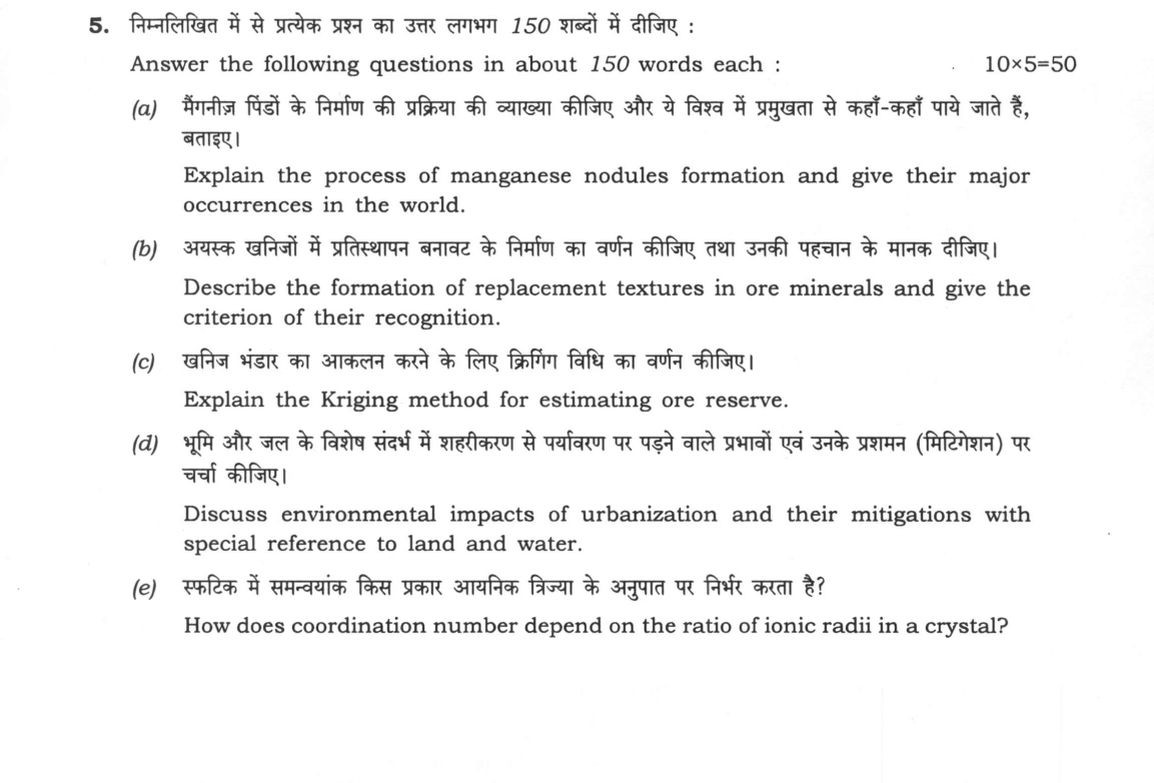
Answer the following questions in about 150 words each: (a) Explain the process of manganese nodules formation and give their…
Answer the following questions in about 150 words each: Explain the process of manganese nodules formation and give their major occurrences in the world. 10 marks
Describe the formation of replacement textures in ore minerals and give the criterion of their recognition. 10 marks
Explain the Kriging method for estimating ore reserve. 10 marks
Discuss environmental impacts of urbanization and their mitigations with special reference to land and water. 10 marks
How does coordination number depend on the ratio of ionic radii in a crystal? 10 marks
हिंदी में प्रश्न पढ़ें
निम्नलिखित में से प्रत्येक प्रश्न का उत्तर लगभग 150 शब्दों में दीजिए : मैंगनीज पिंडों के निर्माण की प्रक्रिया की व्याख्या कीजिए और ये विश्व में प्रमुखता से कहाँ-कहाँ पाये जाते हैं, बताइए। (10 अंक)
अयस्क खनिजों में प्रतिस्थापन बनावट के निर्माण का वर्णन कीजिए तथा उनकी पहचान के मानक दीजिए। (10 अंक)
खनिज भंडार का आकलन करने के लिए क्रिगिंग विधि का वर्णन कीजिए। (10 अंक)
भूमि और जल के विशेष संदर्भ में शहरीकरण से पर्यावरण पर पड़ने वाले प्रभावों एवं उनके प्रशमन (मिटिगेशन) पर चर्चा कीजिए। (10 अंक)
स्फटिक में समन्वयांक किस प्रकार आयनिक त्रिज्या के अनुपात पर निर्भर करता है? (10 अंक)
Model answer
Written by UPSC Answer Check against this question's marking rubric, to the 150-word length. UPSC does not publish answers for Mains — this is one way to score well, not an official key.
(a) Manganese nodules Manganese nodules form on deep-sea floors by slow accretion around hard nuclei such as volcanic debris, basaltic fragments, shark teeth or fossil shells. Two mechanisms operate. In hydrogenous formation, metals (Mn, Fe, Ni, Co, Cu) precipitate directly from seawater onto the nucleus; this is favoured by oxidative, low-sedimentation abyssal plains and controlled by redox, hydrolysis and biological activity. In diagenetic formation, metals are remobilised from overlying sediments by organic-matter decomposition and pore-water chemistry, then precipitate around the nucleus; because pore fluids can be metal-rich, diagenetic nodules may grow significantly faster, up to about 100 mm per million years, whereas hydrogenous growth is slower, of order 1–10 mm per million years. Continued growth produces concentric layers enriched in Mn and trace metals. Major occurrences in the world include the Clarion-Clipperton Zone in the equatorial Pacific, the Peru Basin in the eastern Pacific, and Indian Ocean nodule fields, especially the Central Indian Basin and Andaman Sea.
(b) Replacement textures Replacement textures in ore minerals form when one mineral dissolves and another precipitates in its place, often by volume-for-volume substitution during metasomatism, hydrothermal alteration or diagenesis. The original mineral is consumed while the replacing mineral grows inward or around relict material. Common textures include pseudomorphs, where the new mineral preserves the external shape of the old mineral; atoll textures, where a rim of replacement surrounds a surviving core; and relict cores or embayments, where the original mineral remains as irregular fragments. A sketch would show pyrite replaced by marcasite retaining the pyrite habit, or olivine replaced by serpentine with a preserved outline. Recognition relies on preservation of original crystal outlines, cross-cutting relationships showing which mineral replaced which, compositional zoning between core and rim, and reaction rims or resorption surfaces. These textures record the direction of chemical change and relative mineral stability under changing fluid, temperature and pressure conditions.
(c) Kriging method Kriging is a geostatistical interpolation method used to estimate ore grade or reserve from sparse sample data. It treats grade as a spatially correlated random field and uses a weighted moving average of nearby samples, where weights are derived from the variogram rather than simple inverse distance. The variogram quantifies how grade changes with distance and direction, capturing spatial correlation, continuity, range, sill and nugget effect. A model fitted to the experimental variogram allows Kriging to solve for weights that give the best linear unbiased estimate while minimizing estimation variance. Ordinary Kriging assumes a constant local mean; simple Kriging assumes a known global mean; universal Kriging incorporates a trend. In ore reserve estimation, block Kriging assigns grade to blocks and propagates uncertainty, making it useful for mine planning and resource classification. Its key advantage is that it provides an estimate with a measure of reliability.
(d) Environmental impacts of urbanization Urbanization alters land and water cycles. Expansion of impervious surfaces such as roads, roofs and pavements reduces infiltration, increases surface runoff, and accelerates flooding. It also promotes the urban heat island effect, where built surfaces and waste heat raise local temperatures. In water systems, over-extraction of groundwater for municipal and industrial use lowers water tables, while untreated sewage, industrial effluents and road runoff contaminate rivers, lakes and aquifers. In India, Chennai, Delhi and Bengaluru face groundwater depletion, waterlogging and river pollution. Mitigations must be land- and water-based. Permeable pavements, green roofs, parks and urban forests restore infiltration and reduce heat stress. Stormwater drainage, retention ponds and sustainable urban drainage systems (SUDS) reduce flood peaks. Rainwater harvesting, as mandated and practised in Chennai and other Indian cities, recharges aquifers and reduces demand on surface water. Urban planning norms, groundwater regulation and wastewater treatment are essential for sustainable growth.
(e) Coordination number and ionic radii Coordination number in a crystal depends on the radius ratio r⁺/r⁻, where r⁺ and r⁻ are cation and anion radii. The cation occupies interstitial voids in a close-packed anion array; if it is too small, anions touch and the structure is unstable, while if it is large enough, it can be surrounded by more anions without anion-anion overlap. Geometric packing constraints set critical radius ratios. A sketch shows more anions as the ratio rises. A ratio of about 0.155 allows three anions around a cation, giving trigonal planar coordination; 0.225 permits tetrahedral four-fold coordination; 0.414 permits octahedral six-fold coordination, as in NaCl; and 0.732 permits cubic eight-fold coordination, as in CsCl. These limits are expressed in Pauling’s radius ratio rules and help predict crystal structures. Thus, as the cation becomes larger relative to the anion, the stable coordination number increases from 3 to 4, 6 and 8.
What "Explain" is asking you to do
Make the working of something clear — what sets it off, what follows from what, and what it produces. Explain is the Commission's mechanism word: it dominates the technical papers and the “explain why” stems, where the marks sit in the causal chain and not in the label.
Structure that answers it
State what it is → the initiating condition → the chain of cause, step by step → an instance where it plays out → what the chain produces
Where marks are lost
Describing what something looks like instead of why it works that way. Naming the stages without linking them reads as description too.
How this answer will be evaluated
Approach
(a) explain: definition/context > points in order > small example > short close | (b) describe: define > structure or process in order > labelled diagram > significance | (c) explain: definition/context > points in order > small example > short close | (d) discuss: intro > 3-4 dimensions > example > balanced close | (e) explain: definition/context > points in order > small example > short close Full marks: Precise technical terminology, correct ratios/mechanisms, and specific examples.
Key points expected
- Hydrothermal precipitation mechanism
- Biogenic contribution (diatoms)
- Major occurrence: Pacific Ocean
- Major occurrence: Indian Ocean
- Definition of replacement texture
- Mechanism: dissolution and re-precipitation
- Criterion: preservation of original shape
- Criterion: chemical difference from host
Evaluation rubric
Each sub-part is marked on its own, against the marks and word limit printed on the paper.
- (a) Process of nodule formation and global distribution. · 150 words
explain— definition/context → points in order → small example → short close
Must cover
- Hydrothermal precipitation mechanism
- Biogenic contribution (diatoms)
- Major occurrence: Pacific Ocean
- Major occurrence: Indian Ocean
Loses marks
- Confusing with phosphorite nodules
- No mention of ocean basins
Earns more
- Manganese oxide composition
- Depth range (abyssal plains)
- Accretion rate (mm/million years)
Extra mark
- Specific basin name (e.g., Clarion-Clipperton)
- (b) Formation of replacement textures and recognition criteria. · 150 words
describe— define → structure or process in order → labelled diagram → significance
Must cover
- Definition of replacement texture
- Mechanism: dissolution and re-precipitation
- Criterion: preservation of original shape
- Criterion: chemical difference from host
Loses marks
- Confusing with porphyritic texture
- No mention of recognition criteria
Earns more
- Example: pseudomorphs
- Petrographic evidence (thin section)
Extra mark
- Specific Indian ore example (e.g., Khetri)
- (c) Kriging method for ore reserve estimation. · 150 words
explain— definition/context → points in order → small example → short close
Must cover
- Definition: geostatistical interpolation
- Concept of spatial correlation
- Variogram calculation
- Weighted average of samples
Loses marks
- Treating it as simple grid interpolation
- No mention of variogram
Earns more
- Mention of Ordinary vs Universal Kriging
- Advantage over simple averaging
Extra mark
- Mention of software (e.g., Surpac)
- (d) Environmental impacts of urbanization on land/water and mitigations. · 150 words
discuss— intro → 3-4 dimensions → example → balanced close
Must cover
- Land impact: loss of green cover
- Water impact: groundwater depletion
- Mitigation: rainwater harvesting
- Mitigation: green building norms
Loses marks
- Ignoring the 'mitigation' part
- Generic environmental talk without land/water focus
Earns more
- Mention of heat island effect
- Mention of sewage treatment
Extra mark
- Specific Indian city example (e.g., Delhi)
- (e) Relationship between coordination number and ionic radii ratio. · 150 words
explain— definition/context → points in order → small example → short close
Must cover
- Definition of radius ratio rule
- Tetrahedral coordination (0.225-0.414)
- Octahedral coordination (0.414-0.732)
- Cubic coordination (0.732-1.0)
Loses marks
- Missing specific ratio limits
- Confusing with valency
Earns more
- Mention of Pauling's rules
- Example: NaCl vs ZnS structure
Extra mark
- Sketch of cation-anion contact geometry
Practice this exact question
Write your answer and it is marked point by point against the model answer above — what you covered, what you missed, what you got wrong.
Evaluate my answer →More from Geology 2023 Paper II
- Q2 (a) How does the Bragg equation explain X-ray diffraction from a crystal? (20 marks) (b)…
- Q3 (a) Describe the changes in crystallized solid composition in albite-anorthite system at…
- Q4 (a) Classify the conglomerate rocks on the basis of clast composition and grain-matrix ra…
- Q5 Answer the following questions in about 150 words each: (a) Explain the process of mangan…
- Q6 (a) Describe the formation of Banded Iron Formation (BIF) during Precambrian metallogenic…
- Q7 (a) Give an account of external changes in flora due to the presence of anomalous concent…
- Q8 (a) Discuss the causes of various seismic discontinuities in the upper mantle. (20 marks)…