Paper II — Q4
(a) Classify the conglomerate rocks on the basis of clast composition and grain-matrix ratio and discuss their genetic…
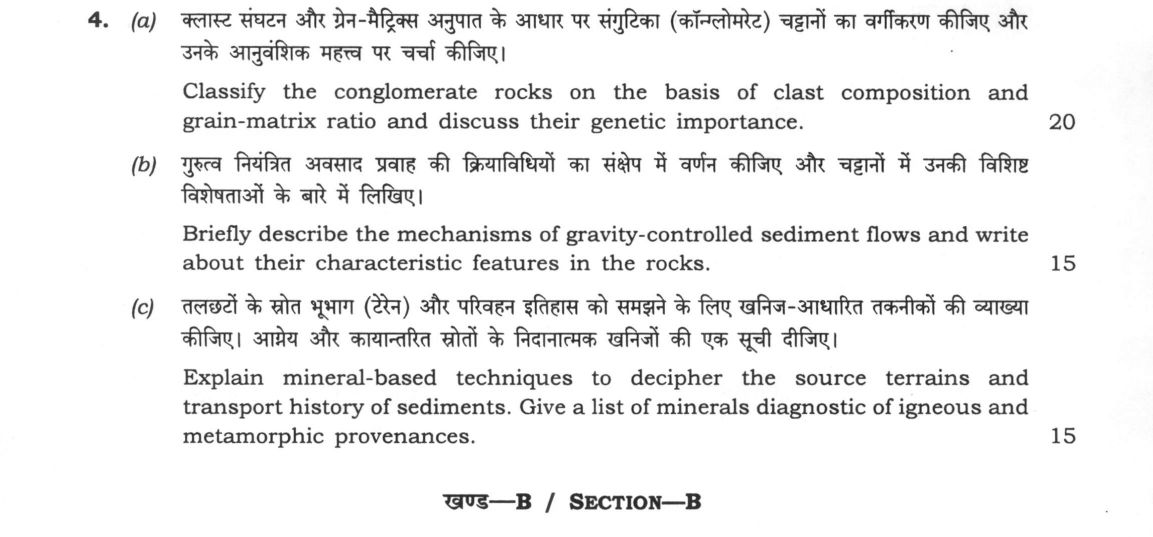
Classify the conglomerate rocks on the basis of clast composition and grain-matrix ratio and discuss their genetic importance. 20 marks
Briefly describe the mechanisms of gravity-controlled sediment flows and write about their characteristic features in the rocks. 15 marks
Explain mineral-based techniques to decipher the source terrains and transport history of sediments. Give a list of minerals diagnostic of igneous and metamorphic provenances. 15 marks
हिंदी में प्रश्न पढ़ें
क्लास्ट संघटन और ग्रेन-मैट्रिक्स अनुपात के आधार पर संगुटिका (कांग्लोमरेट) चट्टानों का वर्गीकरण कीजिए और उनके आनुवंशिक महत्व पर चर्चा कीजिए। (20 अंक)
गुरुत्व नियंत्रित अवसाद प्रवाह की क्रियाविधियों का संक्षेप में वर्णन कीजिए और चट्टानों में उनकी विशिष्ट विशेषताओं के बारे में लिखिए। (15 अंक)
तलछटों के स्रोत भूभाग (टेरेन) और परिवहन इतिहास को समझने के लिए खनिज-आधारित तकनीकों की व्याख्या कीजिए। आग्नेय और कायांतरित स्रोतों के निदानात्मक खनिजों की एक सूची दीजिए। (15 अंक)
Model answer
Written by UPSC Answer Check against this question's marking rubric, to the expected length. UPSC does not publish answers for Mains — this is one way to score well, not an official key.
Sedimentary petrology utilizes clast dynamics, flow rheology, and detrital mineralogy to reconstruct basin evolution, paleoclimate, and paleotectonics.
Classification and Genetic Importance of Conglomerates
Conglomerates are coarse-grained siliciclastic rocks categorized by clast composition and matrix proportion. Based on clast composition, they are classified into:
- Monomict/Oligomict conglomerates: Composed of a single, highly durable clast type (e.g., vein quartz, chert, or quartzite), reflecting prolonged transport, intensive chemical weathering, or multiple recycling cycles in tectonically stable cratonic regimes.
- Polymict/Petromict conglomerates: Containing diverse, unstable to metastable rock fragments (such as basalts, granites, schists, and carbonates), signifying rapid erosion, short transport distances, and high-relief, tectonically active source terrains.
Based on the grain-to-matrix ratio and framework fabric:
- Orthoconglomerates: Framework-supported rocks containing less than 15% sand-mud matrix. They represent deposition under high-energy fluid traction currents (e.g., braided river channels, alluvial fan streamways, and wave-worked beach shorefaces) where turbulent waters winnow away the fine fraction.
- Paraconglomerates (Diamictites): Matrix-supported rocks containing over 15% matrix. They originate from high-viscosity, non-turbulent mass transport mechanisms, including subaerial or subaqueous cohesive debris flows on alluvial fans, mass wasting, and glacial transport/deposition (e.g., glacial tillites like the Talchir Boulder Bed).
Genetically, conglomerates document depositional environments, source terrane lithology, and unroofing history. Progressive stratigraphical variations in clast composition directly record tectonic uplift, fault scarps, and the erosional stripping of successive crustal layers.
Mechanisms and Characteristic Features of Sediment Gravity Flows
Sediment gravity flows are driven downslope under the direct influence of gravity, distinct from fluid-driven flows. They are categorized based on their sediment-support mechanisms and rheology:
- Turbidity currents: Newtonian fluids in which particles are held in suspension by fluid turbulence.
- Debris flows: Non-Newtonian, Bingham plastic slurries supported by matrix yield strength, cohesive mud, and buoyancy.
- Grain flows: Cohesionless flows supported by grain-to-grain dispersive pressure generated by shearing.
- Liquefied and fluidized flows: Supported by transient, upward-escaping pore fluids during sediment settling.
Flow transformations occur as rheology changes downslope; for example, cohesive debris flows dilute into turbulent turbidity currents via ambient water entrainment.
In sedimentary rocks, turbidity currents produce classic Bouma sequences (Tₐ massive/graded division, T_b lower parallel lamination, T_c ripple/convolute lamination, T_d upper parallel lamination, Tₑ hemipelagic pelite) along with distinct erosional sole structures (flute casts, groove casts). Debris flows yield thick, unstratified, matrix-supported beds with rafted outsized clasts and lack of sorting. Grain flows leave well-sorted sandstones displaying inverse grading, while fluidized flows are characterized by dewatering structures like dish and pillar formations.
Mineral-Based Provenance Techniques and Diagnostic Minerals
Mineral-based techniques unravel sediment routing, weathering intensity, and crustal evolution:
- Heavy Mineral Analysis and ZTR Index: The proportion of ultrastable minerals via the Zircon-Tourmaline-Rutile (ZTR) index evaluates hydrodynamic maturity and recycling history.
- Single-Mineral Geochemistry and Geochronology: Detrital zircon U-Pb geochronology combined with Lu-Hf isotopes fingerprints source magmatic crystallization ages and crustal residence times; garnet major-element mapping and rutile trace-element thermometry pinpoint specific host-rock conditions.
- Bulk and Mineral Geochemical Proxies: Indices like the Chemical Index of Alteration (CIA) assess paleoweathering, while Th/Sc, La/Th, and rare earth element (REE) patterns differentiate felsic from mafic-ultramafic sources.
Diagnostic minerals defining provenances include:
- Igneous provenance: Olivine, pyroxene, and chromite (ultramafic to mafic); hornblende, biotite, sphene (titanite), apatite, and zircon (intermediate to felsic plutonic/volcanic rocks).
- Metamorphic provenance: Epidote and chlorite (low-grade greenschist facies); garnet, staurolite, and kyanite (medium-grade amphibolite facies); sillimanite and andalusite (high-grade granulite or contact facies); and glaucophane, lawsonite, and jadeite (high-pressure, low-temperature subduction/blueschist facies).
An integrated approach linking clast sedimentology, gravity-flow dynamics, and high-resolution mineral provenance serves as the essential foundation for deciphering the geodynamic and paleogeographic evolution of sedimentary basins.
What "Discuss" is asking you to do
Lay the issue out from more than one side — how it arose, what is claimed for it, what is held against it, and where it now stands. UPSC attaches discuss to broad topics with several live dimensions, so coverage of the dimensions earns more than the strength of your opinion.
Structure that answers it
Set the issue up → the case as it is made → the case against → the dimension both sides leave out → where the balance now lies
Where marks are lost
Listing facts with no thread between them, or arguing one side throughout and calling it a discussion.
How this answer will be evaluated
Approach
Framework: Geology Paper 2: Define > Process > Field/Petrographic Evidence > Indian Example. (a) discuss: intro > 3-4 dimensions > example > balanced close | (b) describe: define > structure or process in order > labelled diagram > significance | (c) explain: definition/context > points in order > small example > short close Full marks: Precise classification, mechanisms, and mineral lists with named Indian examples and stratigraphic context.
Key points expected
- Classification by clast composition (monomictic/polymictic)
- Classification by grain-matrix ratio (conglomerate vs breccia)
- Genetic importance: source proximity and transport energy
- Indian example: Deccan or Vindhyan conglomerates
- Mechanisms: debris flow, turbidity current, slumping
- Characteristic features: grading, cross-bedding, load casts
- Link between flow mechanism and rock texture
- Indian example: Deccan or Himalayan deposits
Evaluation rubric
Each sub-part is marked on its own, against the marks and word limit printed on the paper.
- (a) Classification of conglomerates by clast/matrix and their genetic significance. 20 marks
discuss— intro → 3-4 dimensions → example → balanced close
Must cover
- Classification by clast composition (monomictic/polymictic)
- Classification by grain-matrix ratio (conglomerate vs breccia)
- Genetic importance: source proximity and transport energy
- Indian example: Deccan or Vindhyan conglomerates
Loses marks
- Generic description without Indian example
- Missing distinction between clast types
Earns more
- Distinction between conglomerate and breccia
- Mention of specific Indian formations (e.g., Vindhyan)
Extra mark
- Sketch of grain-matrix ratio spectrum
- Specific stratigraphic age of Indian example
- (b) Mechanisms of gravity flows and their characteristic rock features. 15 marks
describe— define → structure or process in order → labelled diagram → significance
Must cover
- Mechanisms: debris flow, turbidity current, slumping
- Characteristic features: grading, cross-bedding, load casts
- Link between flow mechanism and rock texture
- Indian example: Deccan or Himalayan deposits
Loses marks
- Generic description without Indian example
- Missing link between mechanism and rock features
Earns more
- Mention of Bouma sequence for turbidites
- Specific Indian basin or formation name
Extra mark
- Labelled diagram of flow mechanism
- Stratigraphic age of Indian example
- (c) Mineral-based techniques for source/transport and diagnostic mineral lists. 15 marks
explain— definition/context → points in order → small example → short close
Must cover
- Techniques: heavy mineral analysis, detrital zircon U-Pb
- List of igneous diagnostic minerals (e.g., olivine, pyroxene)
- List of metamorphic diagnostic minerals (e.g., garnet, staurolite)
- Link between mineral assemblage and source terrain
Loses marks
- Generic description without Indian example
- Missing specific mineral lists for igneous/metamorphic
Earns more
- Mention of specific Indian craton or basin
- Specific mineral names for igneous/metamorphic sources
Extra mark
- Specific Indian occurrence of diagnostic minerals
- Stratigraphic age of sedimentary unit
Practice this exact question
Write your answer and it is marked point by point against the model answer above — what you covered, what you missed, what you got wrong.
Evaluate my answer →More from Geology 2023 Paper II
- Q1 Answer the following questions in about 150 words each: (a) How are the symmetry elements…
- Q2 (a) How does the Bragg equation explain X-ray diffraction from a crystal? (20 marks) (b)…
- Q3 (a) Describe the changes in crystallized solid composition in albite-anorthite system at…
- Q4 (a) Classify the conglomerate rocks on the basis of clast composition and grain-matrix ra…
- Q5 Answer the following questions in about 150 words each: (a) Explain the process of mangan…
- Q6 (a) Describe the formation of Banded Iron Formation (BIF) during Precambrian metallogenic…
- Q7 (a) Give an account of external changes in flora due to the presence of anomalous concent…