Paper II — Q2
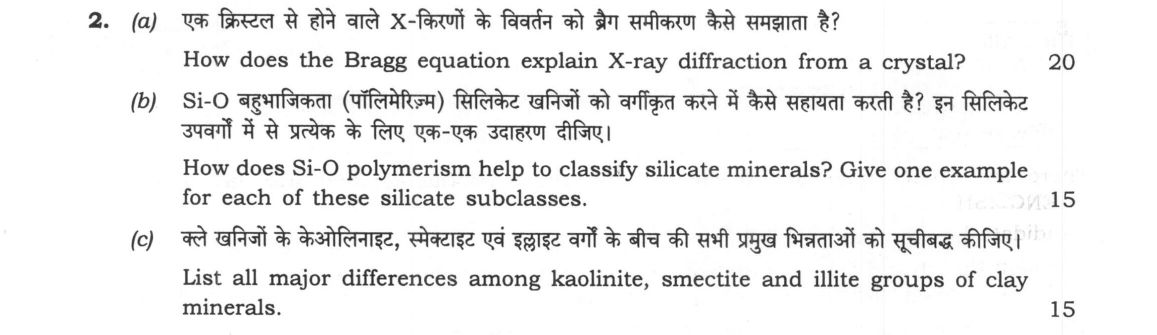
(a) How does the Bragg equation explain X-ray diffraction from a crystal? (20 marks) (b) How does Si-O polymerism help to…
How does the Bragg equation explain X-ray diffraction from a crystal? 20 marks
How does Si-O polymerism help to classify silicate minerals? Give one example for each of these silicate subclasses. 15 marks
List all major differences among kaolinite, smectite and illite groups of clay minerals. 15 marks
हिंदी में प्रश्न पढ़ें
एक क्रिस्टल से होने वाले X-किरणों के विवर्तन को ब्रैग समीकरण कैसे समझाता है? (20 अंक)
Si-O बहुभाजिकता (पॉलिमेरिज्म) सिलिकेट खनिजों को वर्गीकृत करने में कैसे सहायता करती है? इन सिलिकेट उपवर्गों में से प्रत्येक के लिए एक-एक उदाहरण दीजिए। (15 अंक)
क्ले खनिजों के केओलिनाइट, स्मेक्टाइट एवं इल्लाइट वर्गों के बीच की सभी प्रमुख भिन्नताओं को सूचीबद्ध कीजिए। (15 अंक)
Model answer
Written by UPSC Answer Check against this question's marking rubric, to the expected length. UPSC does not publish answers for Mains — this is one way to score well, not an official key.
Part (a): Bragg equation and XRD X-rays are electromagnetic waves with wavelengths comparable to atomic spacings. When a monochromatic beam strikes a crystal, it is scattered by electrons in parallel atomic planes separated by d. For a plane inclined at θ to the incident beam, two rays reflected from successive planes travel an extra distance 2d sinθ. Constructive interference occurs only when this path difference equals an integral number of wavelengths: nλ = 2d sinθ, where n is order and λ is wavelength. This is Bragg’s law. For a fixed λ, each set of lattice planes gives a peak at a particular θ, so d = nλ/(2 sinθ). An X-ray diffractometer contains an X-ray source (commonly Cu Kα, λ = 1.5418 Å), a monochromator/collimator, a sample holder, and a detector that scans 2θ. The diffractometer may use a goniometer to vary θ and 2θ, allowing the full pattern to be recorded. The recorded pattern of peak positions and intensities gives interplanar spacings, lattice parameters, crystallinity, preferred orientation, and mineral identity, because each mineral has a characteristic set of d-spacings. Peak intensities also reflect the arrangement of atoms in the unit cell, so patterns act as fingerprints; shifts in peaks can indicate strain or chemical substitution.
Part (b): Si–O polymerism and silicate subclasses Silicate minerals are built from SiO₄ tetrahedra. Polymerism is the sharing of apical oxygen atoms between tetrahedra; the degree of sharing controls the anion charge, cation requirements, and structural class. As more oxygens are shared, the net negative charge per Si decreases, requiring fewer or different cations, which affects hardness, cleavage, and weathering. In nesosilicates tetrahedra are isolated, e.g. olivine (Mg,Fe)₂SiO₄. In sorosilicates two tetrahedra share one oxygen, e.g. epidote Ca₂(Al,Fe)₃(SiO₄)₃(OH). In cyclosilicates tetrahedra form closed rings, e.g. beryl Be₃Al₂Si₆O₁₈. In inosilicates tetrahedra form chains: single chains give pyroxenes such as MgSiO₃, while double chains give amphiboles such as Ca₂Mg₅Si₈O₂₂(OH)₂. In phyllosilicates tetrahedra share three oxygens to make sheets, e.g. muscovite KAl₂(AlSi₃O₁₀)(OH)₂. In tectosilicates all four oxygens are shared, producing a three-dimensional framework, e.g. quartz SiO₂ or feldspar KAlSi₃O₈. The same tetrahedral building block therefore produces a spectrum of silicate structures. Thus polymerism explains why silicates range from discrete groups to continuous frameworks and why their chemistry and properties differ.
Part (c): Differences among kaolinite, smectite and illite Kaolinite is a 1:1 clay, with one tetrahedral sheet linked to one octahedral sheet, formula Al₂Si₂O₅(OH)₄. Its octahedral sheet may be written [Al₂(OH)₄]²⁺, or [Al₂O₂(OH)₄]²⁺ when shared apical oxygens are included. It has no interlayer cations, a basal spacing near 7.1–7.2 Å, low cation exchange capacity, little swelling, and forms mainly by chemical weathering of feldspars. Smectite is a 2:1 expandable clay, with two tetrahedral sheets enclosing one octahedral sheet, commonly montmorillonite. Its interlayer contains variable cations and water, so basal spacing changes from about 9.6 Å when dehydrated to 18–20 Å when hydrated; it has high cation exchange capacity, strong swelling, and often forms from volcanic ash or weathering of mafic minerals. Illite is a 2:1 non-expandable mica-like clay, a K-deficient mica, with potassium fixed in the interlayer. Its basal spacing is about 10 Å, cation exchange capacity is moderate, swelling is limited, and it commonly forms by alteration of feldspars and micas. Kaolinite’s 1:1 structure gives stable, non-swelling particles; smectite’s 2:1 structure with high interlayer water gives plasticity and shrinkage; illite’s fixed K gives intermediate behaviour. These differences are diagnostic in XRD and in engineering behaviour of clays. Hence kaolinite, smectite and illite differ in layer stoichiometry, interlayer chemistry, expandability, charge, and genesis.
Thus Bragg’s law converts crystal symmetry into measurable peaks, while Si–O polymerism and clay layer structure explain mineral classification, identification, and behaviour in Indian ceramic, brick, and exploration work.
What "Explain" is asking you to do
Make the working of something clear — what sets it off, what follows from what, and what it produces. Explain is the Commission's mechanism word: it dominates the technical papers and the “explain why” stems, where the marks sit in the causal chain and not in the label.
Structure that answers it
State what it is → the initiating condition → the chain of cause, step by step → an instance where it plays out → what the chain produces
Where marks are lost
Describing what something looks like instead of why it works that way. Naming the stages without linking them reads as description too.
How this answer will be evaluated
Approach
Framework: Geology, Paper 2. (a) explain: definition/context > points in order > small example > short close | (b) explain: definition/context > points in order > small example > short close | (c) compare: paired headings or table > key differences > significance > conclusion Full marks: Complete derivation with diagrams; all subclasses with examples; comprehensive comparison table with Indian context
Key points expected
- State Bragg's equation: nλ = 2d sin θ
- Define d-spacing and glancing angle θ
- Explain path difference between rays from successive planes
- Describe constructive interference condition
- Define Si-O tetrahedron as basic unit
- List silicate subclasses by polymerisation degree
- Give one mineral example per subclass
- Explain classification basis (isolated to 3D)
Evaluation rubric
Each sub-part is marked on its own, against the marks and word limit printed on the paper.
- (a) Derive Bragg's law and explain the condition for constructive interference in crystals. 20 marks
explain— definition/context → points in order → small example → short close
Must cover
- State Bragg's equation: nλ = 2d sin θ
- Define d-spacing and glancing angle θ
- Explain path difference between rays from successive planes
- Describe constructive interference condition
Loses marks
- Missing derivation of path difference
- No diagram of diffraction geometry
- Confusing Bragg angle with incidence angle
Earns more
- Include labelled diagram of X-ray diffraction
- Mention Miller indices for crystal planes
- Link to crystal structure determination
- Reference to X-ray diffraction apparatus
Extra mark
- Mention specific Indian mineral analysis using XRD
- Reference to specific Indian research on crystallography
- (b) Explain how Si-O polymerism classifies silicates and give one example for each subclass. 15 marks
explain— definition/context → points in order → small example → short close
Must cover
- Define Si-O tetrahedron as basic unit
- List silicate subclasses by polymerisation degree
- Give one mineral example per subclass
- Explain classification basis (isolated to 3D)
Loses marks
- Missing any silicate subclass
- No examples provided for subclasses
- Confusing polymerisation types
Earns more
- Include structural diagrams of each subclass
- Mention specific Indian silicate occurrences
- Note chemical formula of examples
- Reference to Indian geological formations
Extra mark
- Mention specific Indian craton with silicate examples
- Reference to stratigraphic age of Indian silicate deposits
- (c) List major differences among kaolinite, smectite and illite clay mineral groups. 15 marks
compare— paired headings or table → key differences → significance → conclusion
Must cover
- Compare crystal structure (1:1 vs 2:1)
- Note interlayer spacing and cation exchange
- Mention swelling properties differences
- State chemical composition variations
Loses marks
- Missing any of the three clay types
- No structural comparison
- Confusing interlayer properties
Earns more
- Include comparison table format
- Mention Indian clay occurrences
- Note economic importance in India
- Reference to specific Indian basins
Extra mark
- Mention specific Indian clay mine locations
- Reference to stratigraphic age of Indian clay deposits
Practice this exact question
Write your answer and it is marked point by point against the model answer above — what you covered, what you missed, what you got wrong.
Evaluate my answer →More from Geology 2023 Paper II
- Q1 Answer the following questions in about 150 words each: (a) How are the symmetry elements…
- Q2 (a) How does the Bragg equation explain X-ray diffraction from a crystal? (20 marks) (b)…
- Q3 (a) Describe the changes in crystallized solid composition in albite-anorthite system at…
- Q4 (a) Classify the conglomerate rocks on the basis of clast composition and grain-matrix ra…
- Q5 Answer the following questions in about 150 words each: (a) Explain the process of mangan…