Paper II — Q6
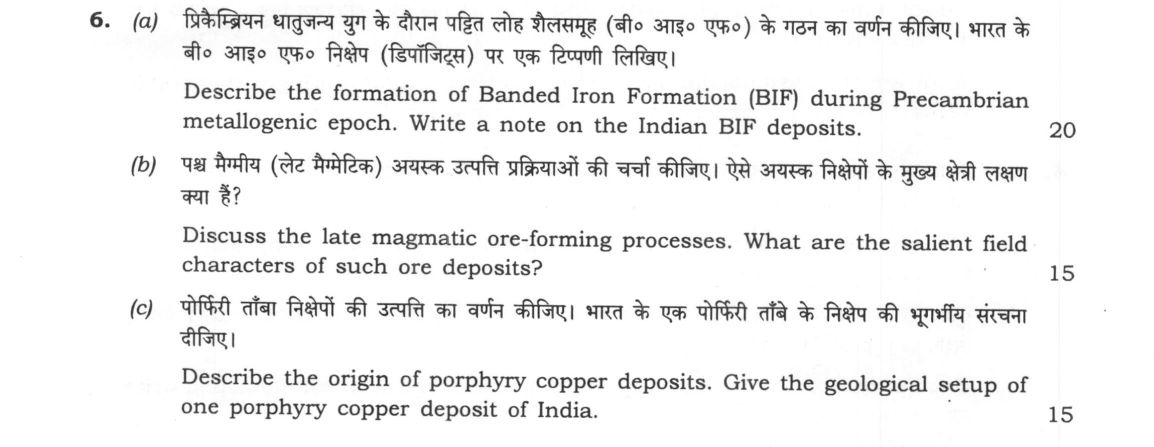
(a) Describe the formation of Banded Iron Formation (BIF) during Precambrian metallogenic epoch. Write a note on the Indian BIF…
Describe the formation of Banded Iron Formation (BIF) during Precambrian metallogenic epoch. Write a note on the Indian BIF deposits. 20 marks
Discuss the late magmatic ore-forming processes. What are the salient field characters of such ore deposits? 15 marks
Describe the origin of porphyry copper deposits. Give the geological setup of one porphyry copper deposit of India. 15 marks
हिंदी में प्रश्न पढ़ें
प्रिकैम्ब्रियन धातुजन्य युग के दौरान पटित लोह शैलसमूह (बी० आई० एफ०) के गठन का वर्णन कीजिए। भारत के बी० आई० एफ० निक्षेप (डिपोजिट्स) पर एक टिप्पणी लिखिए। (20 अंक)
पश्च मैग्मीय (लेट मैग्मेटिक) अयस्क उत्पत्ति प्रक्रियाओं की चर्चा कीजिए। ऐसे अयस्क निक्षेपों के मुख्य क्षेत्रीय लक्षण क्या हैं? (15 अंक)
पोर्फिरी ताँबा निक्षेपों की उत्पत्ति का वर्णन कीजिए। भारत के एक पोर्फिरी ताँबे के निक्षेप की भूवैज्ञानिक संरचना दीजिए। (15 अंक)
Model answer
Written by UPSC Answer Check against this question's marking rubric, to the expected length. UPSC does not publish answers for Mains — this is one way to score well, not an official key.
Precambrian metallogeny records profound shifts in planetary thermodynamics, atmospheric oxygenation, and crustal evolution, giving rise to distinctive iron, chromite, and copper systems.
Banded Iron Formation Genesis and Indian Deposits
Banded Iron Formations (BIFs) are rhythmically laminated chemical sedimentary rocks composed of alternating iron-rich (magnetite, hematite) and silica-rich (chert, jasper) layers. Their deposition was temporally focused between 3.8 and 1.8 Ga, peaking around the Great Oxidation Event (~2.4 Ga), followed by a brief Neoproterozoic reappearance tied to Snowball Earth glaciations.
BIF genesis required anoxic deep oceans charged with hydrothermal Fe²⁺ input from mid-oceanic ridges. Photosynthetic cyanobacteria in the shallow photic zone produced free dissolved oxygen, establishing a dynamic redoxcline. When Fe²⁺-bearing deep waters upwelled across this chemocline, soluble ferrous iron oxidized to insoluble ferric iron, precipitating as ferric hydroxide precursor gels. Fluctuations in biogenic oxygen productivity, seasonal ocean currents, and silica saturation led to the rhythmic alternation of iron-rich bands and chert lamina.
BIFs are classified into Algoma-type, which are thin, volcanogenic-associated units deposited in Archean greenstone belts, and Lake Superior-type, which represent laterally extensive shelf deposits on stable Paleoproterozoic continental margins.
In India, BIFs are distributed across four major cratonic provinces. The Western Dharwar Craton contains Algoma-to-Superior transitions in the Bababudan Group and Sandur belt. The Singhbhum-North Orissa Craton hosts world-class Lake Superior-type deposits within the Iron Ore Group, notably at Noamundi, Joda, and the Daitari ridges of the Keonjhar district. The Bastar Craton preserves high-grade hematite deposits in the Bailadila Group, while the Southern Granulite and Eastern Ghats terranes contain metamorphosed magnetite quartzites.
Late Magmatic Ore-Forming Processes and Field Characters
Late magmatic (orthomagmatic) processes operate during the closing stages of fractional crystallization in silicate magmas, distinguishing them from early gravity cumulates and low-temperature hydrothermal fluids. They proceed through two main mechanisms: liquid immiscibility and residual melt accumulation. In cooling mafic-ultramafic magmas, sulfur saturation generates an immiscible, dense sulfide-oxide liquid that settles to the floor of magma chambers. Concurrently, fractional crystallization enriches residual melts in iron, titanium, and volatile fluxes, allowing these dense residual liquids to filter-press and inject into fractures within the consolidating host rock.
The salient field characters of late magmatic ore deposits include:
- Stratiform, concordant sheets or sharply discordant injected vein geometries exhibiting sharp contacts against host rocks.
- Textures ranging from net-textured matrix disseminations enclosing early silicate cumulates to massive, coarse-grained oxide-sulfide bands.
- Exclusive spatial and genetic association with differentiated, layered mafic-ultramafic complexes, characterized by a geochemical Cr-Ni-PGE-Ti-V affinity.
Globally, classic examples include the Bushveld Complex in South Africa and the Stillwater Complex in the USA. In India, this process is represented by the stratiform and injected chromite deposits of Sukinda and Nausahi in Odisha.
Porphyry Copper Deposits and the Malanjkhand Setting
Porphyry copper deposits originate in convergent plate margins characterized by subduction-related calc-alkaline magmatism. Fluid exsolution occurs as water-saturated, hydrous dioritic-to-granitic magmas ascend to shallow crustal levels (1–4 km). Decompression and cooling at the plutonic cupola trigger retrograde boiling, releasing hot, metal-rich hypersaline magmatic-hydrothermal fluids. The resultant fluid overpressure hydrofractures the cooling intrusion and wall rocks, forming dense stockwork vein systems. Fluid-wall rock interaction establishes concentric alteration zones: a core of potassic alteration (K-feldspar, biotite), grading outward through phyllic (quartz-sericite) and argillic (clay) zones, to an outer propylitic halo (chlorite, epidote, calcite). These systems yield low-grade, high-tonnage disseminated and veinlet-hosted chalcopyrite-bornite-pyrite ores.
In India, the Malanjkhand deposit represents the country’s largest porphyry copper deposit. Located within the Central Indian tectonic zone of the Bastar-Bundelkhand cratonic margin, it is hosted within the Paleoproterozoic Malanjkhand calc-alkaline granitoid. Mineralization occurs within a massive, steeply dipping, arcuate quartz-reef stockwork system. The primary ore suite comprises chalcopyrite, pyrite, and minor bornite and molybdenite, structurally controlled by brittle-ductile shear fractures. Wall-rock alteration displays intense pink K-feldspathization and sericitization, confirming its calc-alkaline porphyry-type hydrothermal affiliation.
The evolutionary transition from Precambrian anoxic water-column precipitation (BIFs) and deep-seated magmatic segregation to focused, subduction-driven hydrofracturing systems (porphyry copper) reflects the progressive cooling, oxygenation, and tectonic maturation of the Earth's lithosphere.
What "Describe" is asking you to do
Give a full, ordered account of the thing named — its parts, stages or mechanism — in the sequence in which it actually exists or occurs. Most describe questions come from the science optionals, where the marks sit in correct technical detail and, where the stem says so, a labelled diagram.
Structure that answers it
One-line identification of the subject → the parts or stages in their real order, each with its defining detail → labelled diagram where the subject is structural → closing line on function or significance
Where marks are lost
Loose general prose where the examiner is ticking named parts, correct terminology and their sequence; and in the General Studies papers, turning to evaluation before the description is finished.
How this answer will be evaluated
Approach
Framework: Geology Paper 2: Define > Process > Field/Petrographic Evidence > Indian Example. (a) describe: define > structure or process in order > labelled diagram > significance | (b) discuss: intro > 3-4 dimensions > example > balanced close | (c) describe: define > structure or process in order > labelled diagram > significance Full marks: Precise process, field evidence, and named Indian examples with stratigraphic age.
Key points expected
- Precambrian metallogenic epoch context
- Formation mechanism (e.g., chemical precipitation)
- Indian BIF deposits (e.g., Dharwar Craton)
- Stratigraphic age of Indian BIFs
- Late magmatic processes (e.g., pegmatites)
- Salient field characters of deposits
- Link process to economic deposit
- Balanced close on significance
Evaluation rubric
Each sub-part is marked on its own, against the marks and word limit printed on the paper.
- (a) Explain BIF formation during Precambrian and detail Indian deposits. 20 marks
describe— define → structure or process in order → labelled diagram → significance
Must cover
- Precambrian metallogenic epoch context
- Formation mechanism (e.g., chemical precipitation)
- Indian BIF deposits (e.g., Dharwar Craton)
- Stratigraphic age of Indian BIFs
Loses marks
- Generic description without Indian example
- Missing formation process
Earns more
- Sketch of BIF layering
- Mineral composition (magnetite/hematite)
- Link to iron ore economy
Extra mark
- Specific formation name (e.g., Bhilwara)
- Precise stratigraphic position
- (b) Discuss late magmatic ore-forming processes and field characters. 15 marks
discuss— intro → 3-4 dimensions → example → balanced close
Must cover
- Late magmatic processes (e.g., pegmatites)
- Salient field characters of deposits
- Link process to economic deposit
- Balanced close on significance
Loses marks
- Confusing late magmatic with hydrothermal
- Missing field characters
Earns more
- Sketch of pegmatite structure
- Mineral composition (e.g., Li, Be)
- Indian example (e.g., Nellore)
Extra mark
- Specific pegmatite type
- Precise field texture description
- (c) Describe porphyry copper origin and geological setup of Indian deposit. 15 marks
describe— define → structure or process in order → labelled diagram → significance
Must cover
- Origin of porphyry copper deposits
- Geological setup of one Indian deposit
- Mineral composition and texture
- Link to economic significance
Loses marks
- Generic description without Indian example
- Missing geological setup
Earns more
- Sketch of porphyry structure
- Named Indian deposit (e.g., Kolar)
- Stratigraphic context
Extra mark
- Specific mineral assemblage
- Precise geological age
Practice this exact question
Write your answer and it is marked point by point against the model answer above — what you covered, what you missed, what you got wrong.
Evaluate my answer →More from Geology 2023 Paper II
- Q3 (a) Describe the changes in crystallized solid composition in albite-anorthite system at…
- Q4 (a) Classify the conglomerate rocks on the basis of clast composition and grain-matrix ra…
- Q5 Answer the following questions in about 150 words each: (a) Explain the process of mangan…
- Q6 (a) Describe the formation of Banded Iron Formation (BIF) during Precambrian metallogenic…
- Q7 (a) Give an account of external changes in flora due to the presence of anomalous concent…
- Q8 (a) Discuss the causes of various seismic discontinuities in the upper mantle. (20 marks)…