Paper II — Q7
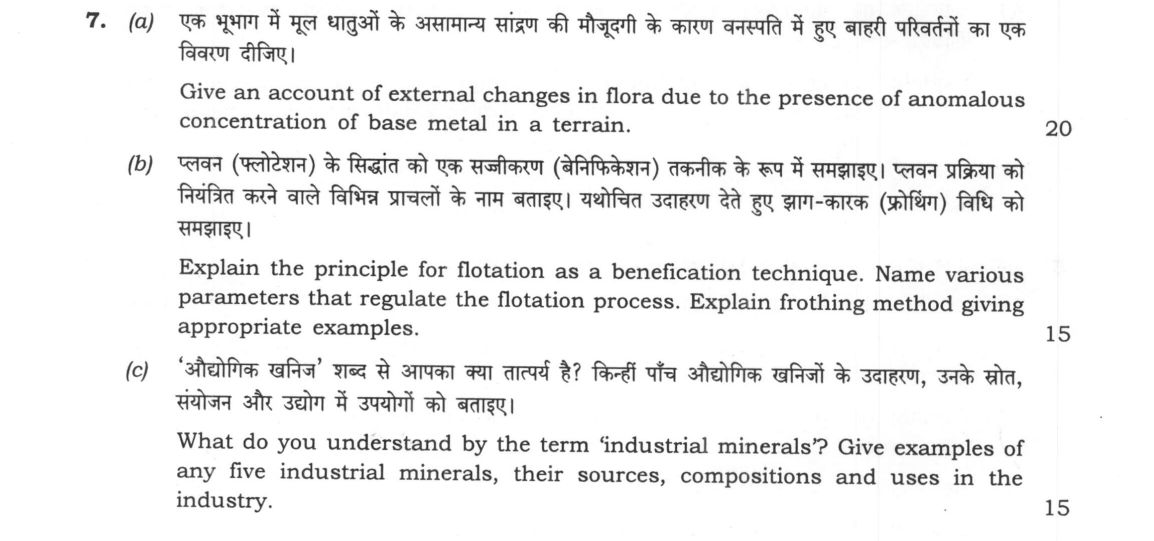
(a) Give an account of external changes in flora due to the presence of anomalous concentration of base metal in a terrain. (20…
Give an account of external changes in flora due to the presence of anomalous concentration of base metal in a terrain. 20 marks
Explain the principle for flotation as a benefication technique. Name various parameters that regulate the flotation process. Explain frothing method giving appropriate examples. 15 marks
What do you understand by the term 'industrial minerals'? Give examples of any five industrial minerals, their sources, compositions and uses in the industry. 15 marks
हिंदी में प्रश्न पढ़ें
एक भूभाग में मूल धातुओं के असामान्य सांद्रण की मौजूदगी के कारण वनस्पति में हुए बाहरी परिवर्तनों का एक विवरण दीजिए। (20 अंक)
प्लवन (फ्लोटेशन) के सिद्धांत को एक सज्जीकरण (बेनिफिकेशन) तकनीक के रूप में समझाइए। प्लवन प्रक्रिया को नियंत्रित करने वाले विभिन्न प्राचलों के नाम बताइए। यथोचित उदाहरण देते हुए झाग-कारक (फ्रोथिंग) विधि को समझाइए। (15 अंक)
'औद्योगिक खनिज' शब्द से आपका क्या तात्पर्य है? किन्हीं पाँच औद्योगिक खनिजों के उदाहरण, उनके स्रोत, संयोजन और उद्योग में उपयोगों को बताइए। (15 अंक)
Model answer
Written by UPSC Answer Check against this question's marking rubric, to the expected length. UPSC does not publish answers for Mains — this is one way to score well, not an official key.
Geobotany links anomalous base-metal concentrations in rocks and soils to visible plant responses, because metals enter root systems and alter physiology. In terrains enriched in Cu, Zn, Pb or Ni, plants may show chlorosis, stunted growth, reduced leaf area, leaf necrosis, delayed or altered flowering, and modified root systems, such as shorter roots, fewer root hairs or accumulation in root tips. These external changes occur because excess metals can inhibit enzymes, disturb Fe, Mn and Zn homeostasis, generate reactive oxygen species, damage cell membranes, and reduce chlorophyll synthesis or stability; chlorophyll itself contains Mg at its centre, so metal stress affects it indirectly rather than by displacing Mg. The metal anomaly changes soil solution chemistry, and if uptake exceeds tolerance, symptoms appear above ground; copper-rich soils may show bronzed or reddish leaves, while zinc-rich soils may show interveinal chlorosis. Some species are tolerant or hyperaccumulating, forming geobotanical zonation: normal vegetation, stressed vegetation, and a tolerant zone over mineralisation. Field transects and aerial observation can map the halo before drilling. The copper flower Becium homblei in the Zambian/Zairean Copperbelt is a classic indicator; Indian analogues occur in Singhbhum and Khetri copper terrains, where tolerant grasses and shrubs show similar discoloration and stunting. Such visual symptoms can guide exploration, but they are limited by soil pH, climate, season, plant species and non-mineral stress such as drought or salinity, so they must be confirmed by soil, rock and plant geochemistry and geophysical surveys.
Flotation is a benefication technique based on selective hydrophobicity and hydrophilicity, i.e. differential wetting of mineral surfaces. Gangue particles are usually hydrophilic and remain in the pulp, while valuable mineral particles are made hydrophobic by collectors and attach to air bubbles, rising as a froth. Frothers stabilise bubbles, modifiers depress gangue or activate target minerals, and pH regulators control surface charge and reagent action. Key parameters are particle size, pulp density, pH, aeration rate, temperature, reagent dosage and froth depth. Particle size must be fine enough for liberation but not so fine that it reports to tailings; pulp density affects bubble load; pH controls collector adsorption; aeration controls bubble size and froth stability; temperature affects reagent kinetics; reagent dosage controls selectivity; froth depth controls recovery and grade. These parameters are adjusted in laboratory tests before plant scale. Frothing methods include mechanical, pneumatic and vacuum flotation. Mechanical cells use an impeller to disperse air and are used for sulfide ores such as Malanjkhand copper sulfide and Rampura Agucha zinc-lead sulfide, commonly floated with xanthates. Pneumatic flotation uses air spargers and suits fine particles; vacuum flotation uses reduced pressure to generate fine bubbles and is used for fine particles or specialty ores. Oxide ores, such as copper oxide or lateritic nickel, are floated with fatty acids or soaps.
Industrial minerals are non-metallic, non-fuel minerals valued for physical or chemical properties rather than metal content, distinct from metallic ores and gemstones. Their value lies in properties such as softness, inertness, crystallinity, plasticity, insulation or absorbency, and they are typically processed by crushing, grinding, washing or calcination rather than smelting. Talc or steatite, Mg₃Si₄O₁₀(OH)₂, occurs in Rajasthan and Andhra Pradesh and is used in ceramics, paper and cosmetics. Limestone, CaCO₃, from Madhya Pradesh and Rajasthan, is used in cement and steelmaking. Mica, mainly muscovite KAl₂(AlSi₃O₁₀)(OH)₂, from Jharkhand and Bihar, is used in electrical insulation and electronics. Gypsum, CaSO₄·2H₂O, from Rajasthan and Tamil Nadu, is used in cement and fertilizer. Bentonite, mainly montmorillonite, from Gujarat and Rajasthan, is used in drilling mud and foundry. Together they show how non-metallic minerals support construction, electronics, agriculture and manufacturing. Thus, exploration-applied mineralogy connects geobotanical indicators, mineral processing and industrial mineral use.
What "Explain" is asking you to do
Make the working of something clear — what sets it off, what follows from what, and what it produces. Explain is the Commission's mechanism word: it dominates the technical papers and the “explain why” stems, where the marks sit in the causal chain and not in the label.
Structure that answers it
State what it is → the initiating condition → the chain of cause, step by step → an instance where it plays out → what the chain produces
Where marks are lost
Describing what something looks like instead of why it works that way. Naming the stages without linking them reads as description too.
How this answer will be evaluated
Approach
Framework: Geology Paper 2: Define > Process > Field/Petrographic Evidence > Indian Example. (a) account for: state the phenomenon > the causes in order of weight > conclusion | (b) explain: definition/context > points in order > small example > short close | (c) define: precise definition > the distinguishing feature > one example Full marks: Precise definitions, specific Indian examples, clear causal chains, and accurate technical terminology throughout.
Key points expected
- Define anomalous base metal concentration in terrain
- Describe specific external changes in flora (e.g., chlorosis, stunted growth)
- Explain mechanism of metal uptake and toxicity in plants
- Link specific metals (Cu, Zn, Pb) to specific plant responses
- Define flotation principle (differential wettability/hydrophobicity)
- Name parameters: pH, reagents, particle size, aeration
- Explain frothing method mechanism (bubble attachment)
- Give appropriate example (e.g., sulphide ore concentration)
Evaluation rubric
Each sub-part is marked on its own, against the marks and word limit printed on the paper.
- (a) State the phenomenon of flora changes and list causes of anomalous base metal concentration in order of weight. 20 marks
account for— state the phenomenon → the causes in order of weight → conclusion
Must cover
- Define anomalous base metal concentration in terrain
- Describe specific external changes in flora (e.g., chlorosis, stunted growth)
- Explain mechanism of metal uptake and toxicity in plants
- Link specific metals (Cu, Zn, Pb) to specific plant responses
Loses marks
- Generic description of pollution without specific metal-plant link
- Missing the causal chain from soil to plant tissue
- No mention of specific base metals (Cu, Zn, Pb, Ni)
Earns more
- Mention bio-indicators (e.g., mosses, lichens)
- Reference specific Indian mining areas (e.g., Singhbhum, Khetri)
- Discuss soil pH interaction with metal availability
- Mention phytoremediation potential
Extra mark
- Cite specific Indian study on flora in Khetri copper belt
- Provide data on metal concentration in specific plant tissues
- (b) Define flotation principle, list regulating parameters, and explain the frothing method with examples. 15 marks
explain— definition/context → points in order → small example → short close
Must cover
- Define flotation principle (differential wettability/hydrophobicity)
- Name parameters: pH, reagents, particle size, aeration
- Explain frothing method mechanism (bubble attachment)
- Give appropriate example (e.g., sulphide ore concentration)
Loses marks
- Confusing flotation with magnetic separation
- Missing the role of frothers in the process
- No specific example of ore type or mineral
Earns more
- Mention specific reagents (xanthates, collectors)
- Describe frother function (stabilize bubbles)
- Reference Indian application (e.g., Kolar gold field)
- Sketch of flotation cell or process flow
Extra mark
- Mention specific Indian plant using flotation (e.g., Bellary)
- Detail specific reagent dosage or pH range for a specific ore
- (c) Define 'industrial minerals' and provide five examples with sources, compositions, and uses. 15 marks
define— precise definition → the distinguishing feature → one example
Must cover
- Define 'industrial minerals' (non-metallic, non-fuel)
- List five distinct industrial minerals
- State source (geological formation or location) for each
- State composition and industrial use for each
Loses marks
- Listing metallic ores (iron, copper) as industrial minerals
- Missing composition or use for any of the five examples
- Vague sources (e.g., 'found in rocks' instead of specific formation)
Earns more
- Include Indian sources (e.g., Barite from Andhra Pradesh)
- Mention specific industrial applications (e.g., paint, drilling)
- Differentiate from metallic ores clearly
- Mention specific mineral composition (e.g., CaCO3 for limestone)
Extra mark
- Cite specific Indian mine or quarry for a mineral
- Mention specific industrial grade or purity requirement
Practice this exact question
Write your answer and it is marked point by point against the model answer above — what you covered, what you missed, what you got wrong.
Evaluate my answer →More from Geology 2023 Paper II
- Q4 (a) Classify the conglomerate rocks on the basis of clast composition and grain-matrix ra…
- Q5 Answer the following questions in about 150 words each: (a) Explain the process of mangan…
- Q6 (a) Describe the formation of Banded Iron Formation (BIF) during Precambrian metallogenic…
- Q7 (a) Give an account of external changes in flora due to the presence of anomalous concent…
- Q8 (a) Discuss the causes of various seismic discontinuities in the upper mantle. (20 marks)…