Paper II — Q3
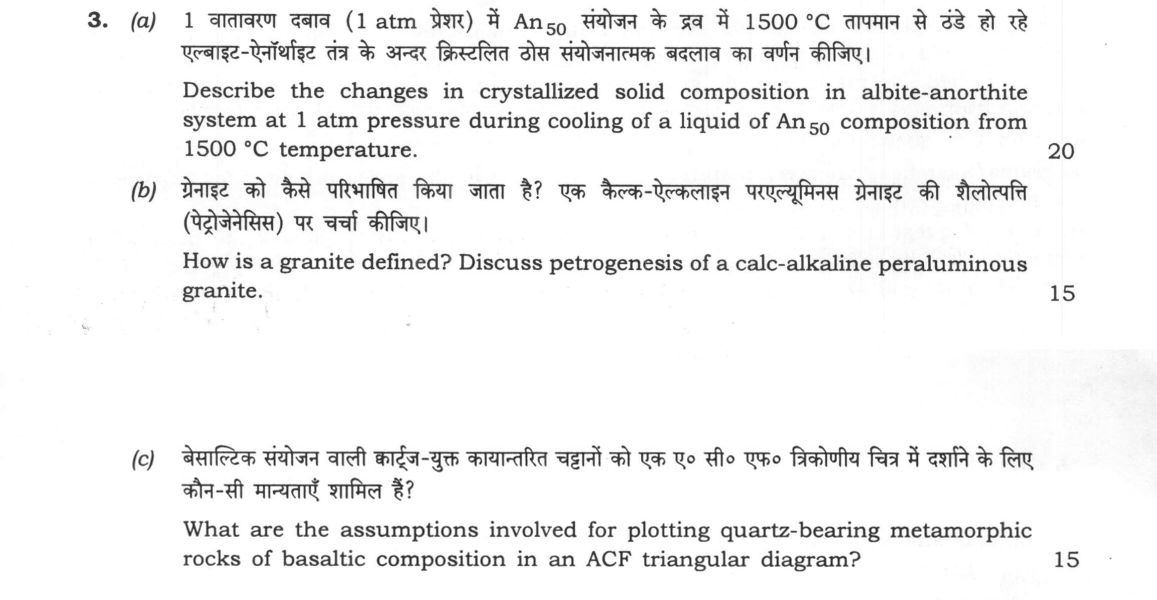
(a) Describe the changes in crystallized solid composition in albite-anorthite system at 1 atm pressure during cooling of a…
Describe the changes in crystallized solid composition in albite-anorthite system at 1 atm pressure during cooling of a liquid of An₅₀ composition from 1500 °C temperature. 20 marks
How is a granite defined? Discuss petrogenesis of a calc-alkaline peraluminous granite. 15 marks
What are the assumptions involved for plotting quartz-bearing metamorphic rocks of basaltic composition in an ACF triangular diagram? 15 marks
हिंदी में प्रश्न पढ़ें
1 वातावरण दबाव (1 atm प्रेशर) में An₅₀ संयोजन के द्रव में 1500 °C तापमान से ठंडे हो रहे एल्बाइट-एनोर्थाइट तंत्र के अंदर क्रिस्टलीकृत ठोस संयोजनात्मक बदलाव का वर्णन कीजिए। (20 अंक)
ग्रेनाइट को कैसे परिभाषित किया जाता है? एक कैल्क-एल्कलाइन परएल्यूमिनस ग्रेनाइट की शैलोत्पत्ति (पेट्रोजेनेसिस) पर चर्चा कीजिए। (15 अंक)
बेसाल्टिक संयोजन वाली क्वार्ट्ज-युक्त कायांतरित चट्टानों को एक ए० सी० एफ० त्रिकोणीय चित्र में दर्शाने के लिए कौन-सी मान्यताएँ शामिल हैं? (15 अंक)
Model answer
Written by UPSC Answer Check against this question's marking rubric, to the expected length. UPSC does not publish answers for Mains — this is one way to score well, not an official key.
Phase equilibria in the albite–anorthite system explain plagioclase zonation in felsic magmas, while ACF projections simplify metamorphic equilibria in quartz-saturated mafic rocks.
(a) At 1 atm, albite (An₀) and anorthite (An₁₀₀) form a continuous high-temperature solid solution. A liquid of An₅₀ cooled from 1500 °C is first entirely liquid. On reaching its liquidus, about 1450 °C, the first plagioclase is more anorthite-rich than the liquid, say An₆₅–₇₀, because anorthite has the higher melting point. With further cooling the solid composition moves continuously along the solidus toward albite, while the residual liquid becomes progressively more albite-rich. The lever rule is applied on each isothermal tie line: the solid fraction equals the distance from the liquid composition to the bulk composition divided by the total tie-line length. At 1400 °C, if the coexisting liquid is about An₄₅ and the solid about An₇₀, the bulk An₅₀ lies between them; the solid fraction is (50−45)/(70−45)=20%. At 1300 °C, take liquid An₁₅ and solid An₆₅; then the solid fraction is (50−15)/(65−15)=35/50=70%. Near the solidus, about 1200 °C, the solid approaches An₅₀ and the vanishing liquid is strongly albite-rich, e.g. An₅; at completion the solid fraction is effectively 100%. Thus the crystallized solid changes from An-rich to An₅₀, the liquid from An₅₀ to Ab-rich, and the system shows continuous solid-solution behaviour without a eutectic arrest; only the onset and completion of crystallization mark thermal breaks.
(b) In the IUGS classification, granite is a granitoid with Q+A+P >90% of total, quartz 20–60 vol% of Q+A+P and alkali feldspar/(alkali feldspar+plagioclase) = 35–90; this includes monzogranite where plagioclase may exceed alkali feldspar, and syenogranite where alkali feldspar dominates. It is distinguished from granodiorite by a higher alkali feldspar/plagioclase ratio and from syenite by sufficient quartz. It is felsic, usually SiO₂ >70 wt%, with quartz, feldspars and Fe–Mg minerals. A peraluminous granite has A/CNK = Al₂O₃/(CaO+Na₂O+K₂O) >1, is corundum-normative, and commonly contains muscovite, garnet or tourmaline. A calc-alkaline peraluminous granite plots in the calc-alkaline field on SiO₂–K₂O or FeO*/MgO diagrams, indicating subduction-related crustal melting rather than peralkaline alkaline affinity. Its petrogenesis is commonly S-type: partial melting of hydrated metapelitic or metasedimentary crust at amphibolite to granulite facies, followed by fractional crystallisation of plagioclase and Fe–Mg minerals, crustal assimilation, and possible mixing with mantle-derived basaltic or andesitic melts. Indian examples include calc-alkaline granites of the Malani Igneous Complex, Rajasthan, peraluminous granites of the Bundelkhand craton, and Himalayan leucogranites such as Lepcha Group rocks.
(c) The ACF diagram uses A = Al₂O₃, C = CaO and F = FeO+MgO. For quartz-bearing metabasites, the bulk composition is assumed to be SiO₂-saturated, so quartz is treated as an excess phase and the composition is projected from the quartz apex of the relevant four-component A-C-F-Q (AFMQ-type) system onto the ACF plane; it is not projected from AFM, which is a different ternary in which Ca is omitted. Na₂O and K₂O are ignored or not treated as separate components, and MnO is neglected. Fe is taken as FeO, with Fe³⁺ ignored or reduced, and Fe and Mg are combined as F. Because basaltic rocks contain appreciable Al₂O₃ as well as CaO and Fe–Mg oxides, their ACF positions lie inside the triangle, not near the C–F join; a position near C–F would imply very low Al₂O₃. The diagram is therefore useful for interpreting amphibolite- and granulite-facies assemblages such as plagioclase, amphibole, garnet and pyroxene with quartz, but it cannot represent Na/K feldspar chemistry, Fe³⁺/Fe²⁺ variations, Mn, or volatile components.
Thus, phase diagrams provide a common framework: the plagioclase binary tracks igneous crystallisation, while ACF projection summarises metamorphic equilibria in quartz-saturated mafic rocks.
What "Describe" is asking you to do
Give a full, ordered account of the thing named — its parts, stages or mechanism — in the sequence in which it actually exists or occurs. Most describe questions come from the science optionals, where the marks sit in correct technical detail and, where the stem says so, a labelled diagram.
Structure that answers it
One-line identification of the subject → the parts or stages in their real order, each with its defining detail → labelled diagram where the subject is structural → closing line on function or significance
Where marks are lost
Loose general prose where the examiner is ticking named parts, correct terminology and their sequence; and in the General Studies papers, turning to evaluation before the description is finished.
How this answer will be evaluated
Approach
Framework: Geology, Paper 2. (a) describe: define > structure or process in order > labelled diagram > significance | (b) discuss: intro > 3-4 dimensions > example > balanced close | (c) explain: definition/context > points in order > small example > short close Full marks: Precise phase diagrams, correct mineral names, specific Indian examples, clear causal chains.
Key points expected
- Identifies eutectic temperature and composition
- Describes initial crystallization of An-rich plagioclase
- Explains liquid composition shift along liquidus
- Describes final eutectic crystallization of Ab+An
- Defines granite (Q+A+P ratio)
- Explains peraluminous nature (A/CNK > 1)
- Links to subduction/collision tectonics
- Mentions source rock (metasediments)
Evaluation rubric
Each sub-part is marked on its own, against the marks and word limit printed on the paper.
- (a) Sequence of solid composition changes during cooling of An50 liquid in albite-anorthite system. 20 marks
describe— define → structure or process in order → labelled diagram → significance
Must cover
- Identifies eutectic temperature and composition
- Describes initial crystallization of An-rich plagioclase
- Explains liquid composition shift along liquidus
- Describes final eutectic crystallization of Ab+An
Loses marks
- Confuses liquid and solid composition paths
- Fails to mention eutectic point
Earns more
- Draws labelled phase diagram
- Mentions solid solution (plagioclase) nature
- Notes 1 atm pressure condition
Extra mark
- Mentions specific eutectic temperature (1315°C)
- (b) Definition of granite and petrogenesis of calc-alkaline peraluminous variety. 15 marks
discuss— intro → 3-4 dimensions → example → balanced close
Must cover
- Defines granite (Q+A+P ratio)
- Explains peraluminous nature (A/CNK > 1)
- Links to subduction/collision tectonics
- Mentions source rock (metasediments)
Loses marks
- Confuses peraluminous with peralkaline
- Generic description without tectonic setting
Earns more
- Mentions specific Indian example (e.g., Aravalli)
- Notes mineral assemblage (muscovite, garnet)
Extra mark
- Mentions specific Indian craton (e.g., Dharwar)
- (c) Assumptions for plotting quartz-bearing basaltic rocks in ACF diagram. 15 marks
explain— definition/context → points in order → small example → short close
Must cover
- Defines ACF components (Al2O3, CaO, FeO)
- Explains removal of Na2O and K2O
- Explains removal of SiO2 (quartz)
- Justifies removal for metamorphic plotting
Loses marks
- Fails to explain why SiO2 is removed
- Confuses ACF with AFM diagram
Earns more
- Mentions basaltic composition context
- Notes effect on rock classification
Extra mark
- Mentions specific metamorphic facies
Practice this exact question
Write your answer and it is marked point by point against the model answer above — what you covered, what you missed, what you got wrong.
Evaluate my answer →More from Geology 2023 Paper II
- Q1 Answer the following questions in about 150 words each: (a) How are the symmetry elements…
- Q2 (a) How does the Bragg equation explain X-ray diffraction from a crystal? (20 marks) (b)…
- Q3 (a) Describe the changes in crystallized solid composition in albite-anorthite system at…
- Q4 (a) Classify the conglomerate rocks on the basis of clast composition and grain-matrix ra…
- Q5 Answer the following questions in about 150 words each: (a) Explain the process of mangan…
- Q6 (a) Describe the formation of Banded Iron Formation (BIF) during Precambrian metallogenic…