Paper II — Q8
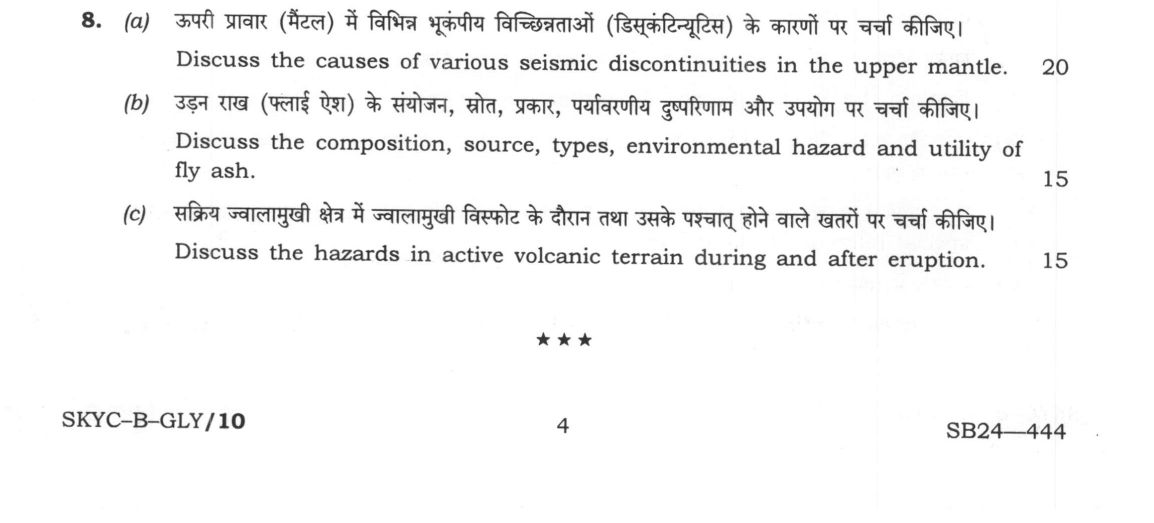
(a) Discuss the causes of various seismic discontinuities in the upper mantle. (20 marks) (b) Discuss the composition, source…
Discuss the causes of various seismic discontinuities in the upper mantle. 20 marks
Discuss the composition, source, types, environmental hazard and utility of fly ash. 15 marks
Discuss the hazards in active volcanic terrain during and after eruption. 15 marks
हिंदी में प्रश्न पढ़ें
ऊपरी प्रावार (मेंटल) में विभिन्न भूकंपीय विच्छिन्नताओं (डिस्कन्टिन्यूटीज) के कारणों पर चर्चा कीजिए। (20 अंक)
उड़न राख (फ्लाई ऐश) के संयोजन, स्रोत, प्रकार, पर्यावरणीय दुष्परिणाम और उपयोग पर चर्चा कीजिए। (15 अंक)
सक्रिय ज्वालामुखी क्षेत्र में ज्वालामुखी विस्फोट के दौरान तथा उसके पश्चात् होने वाले खतरों पर चर्चा कीजिए। (15 अंक)
Model answer
Written by UPSC Answer Check against this question's marking rubric, to the expected length. UPSC does not publish answers for Mains — this is one way to score well, not an official key.
The Earth’s dynamic internal and surface processes manifest across varied scales, ranging from deep mantle phase changes and surface volcanism to industrial by-product generation. A systematic understanding of these phenomena requires examining their fundamental petrological, environmental, and geophysical dimensions.
Seismic Discontinuities in the Upper Mantle
Seismic discontinuities represent sharp velocity gradients caused either by isochemical, pressure-temperature (P-T) driven polymorphic phase transitions or by compositional and rheological variations.
The 410 km discontinuity marks the boundary of the mantle transition zone, primarily caused by the pressure-induced phase transformation of alpha-olivine to the denser wadsleyite (β-spinel structure) and subsequently ringwoodite (γ-spinel) at ~520 km. At the 660 km discontinuity, representing the base of the upper mantle, ringwoodite undergoes an endothermic post-spinel phase breakdown into bridgmanite (magnesium silicate perovskite) and ferropericlase. These polymorphic transformations cause abrupt jumps in seismic wave velocities (Vp and Vs) and density.
Compositional and rheological layering also produces distinct discontinuities. The Lithosphere-Asthenosphere Boundary (LAB) and the associated Low Velocity Zone (LVZ), typically situated between 80 km and 220 km depth, arise from partial melting (0.1–1%), high thermal gradients, and hydration of peridotite, which reduce shear modulus and velocity. At ~220 km, the Lehmann discontinuity is observed regionally, attributed to changes in mantle flow anisotropy or the transition from deformed to undeformed olivine. Furthermore, while the Gutenberg discontinuity (~2900 km) defines the core-mantle boundary, mantle seismology collectively reflects how depth-dependent P-T regimes control mineral stability and mantle convection.
Fly Ash: Characterization, Hazards, and Utility
Fly ash is the fine particulate residue captured by electrostatic precipitators from flue gases during pulverized coal combustion in thermal power plants. Chemically, it predominantly comprises silica (SiO₂), alumina (Al_2O₃), iron oxide (Fe_2O₃), and calcium oxide (CaO). According to ASTM C618, it is classified into:
- Class F Fly Ash: Produced from anthracite or bituminous coal; contains less than 10% CaO and is pozzolanic in nature.
- Class C Fly Ash: Derived from lignite or sub-bituminous coal; contains more than 20% CaO, exhibiting both pozzolanic and self-cementing properties.
Environmental hazards include fugitive particulate emissions (PM₂.5 and PM₁₀), land degradation from ash pond establishment, leaching of toxic heavy metals (arsenic, lead, mercury, cadmium) into groundwater, and ash dyke breaches. Conversely, fly ash has substantial utility as a pozzolanic supplementary cementitious material in Portland Pozzolana Cement (PPC), geotechnical fill for highway embankments, structural bricks, backfilling in underground mine voids, and as a soil ameliorant in agriculture to improve texture and water retention under Central Pollution Control Board (CPCB) guidelines.
Volcanic Hazards: Eruptive and Post-Eruptive Dynamics
Volcanic hazard severity depends largely on eruption style. Effusive eruptions (low-viscosity, mafic magmas, e.g., basaltic flows at Barren Island) present localized risks, whereas explosive eruptions (high-viscosity, volatile-rich felsic/intermediate magmas) yield widespread catastrophic impacts.
Hazards during eruption include pyroclastic density currents (PDCs)—high-speed, superheated gas-ash avalanches; primary syn-eruptive lahars (hot volcanic mudflows from melted ice caps or crater lakes); tephra and ballistic falls damaging aviation and infrastructure; lava flows causing localized devastation; and toxic gas exsolution (SO₂, CO₂, H_2S, HF), posing asphyxiation and respiratory hazards.
Hazards after eruption involve secondary, rain-triggered lahars remobilizing loose pyroclastic debris for years; volcanic winter effects through stratospheric sulfate aerosol injection that scatters solar radiation; persistent acid rain causing soil and ecosystem toxicity; and progressive volcanic slope instability leading to structural edifice collapse. Effective mitigation demands multi-parametric real-time monitoring via seismic networks, satellite InSAR, and gas spectroscopy to establish exclusion zones and early evacuation frameworks.
A unified approach integrating deep-Earth geophysics, comprehensive volcanic monitoring, and industrial waste circularity provides the scientific baseline for disaster risk reduction and sustainable resource management.
What "Discuss" is asking you to do
Lay the issue out from more than one side — how it arose, what is claimed for it, what is held against it, and where it now stands. UPSC attaches discuss to broad topics with several live dimensions, so coverage of the dimensions earns more than the strength of your opinion.
Structure that answers it
Set the issue up → the case as it is made → the case against → the dimension both sides leave out → where the balance now lies
Where marks are lost
Listing facts with no thread between them, or arguing one side throughout and calling it a discussion.
How this answer will be evaluated
Approach
Framework: Geology Paper 2: Define > Process > Field/Petrographic Evidence > Indian Example. (a) discuss: intro > 3-4 dimensions > example > balanced close | (b) discuss: intro > 3-4 dimensions > example > balanced close | (c) discuss: intro > 3-4 dimensions > example > balanced close Full marks: Precise mineralogy, named Indian examples, clear causal chains, labelled diagrams.
Key points expected
- Moho discontinuity and crust-mantle density contrast
- 410 km and 660 km phase transitions (olivine to spinel)
- Lithosphere-asthenosphere boundary (LAB) and rheological changes
- Seismic velocity changes (P-wave and S-wave)
- Source: Thermal power plants (coal combustion)
- Composition: Silica, alumina, iron oxide, calcium oxide
- Types: Class C (high calcium) vs Class F (low calcium)
- Utility: Cement, bricks, road construction, soil amendment
Evaluation rubric
Each sub-part is marked on its own, against the marks and word limit printed on the paper.
- (a) Causal analysis of seismic discontinuities in the upper mantle. 20 marks
discuss— intro → 3-4 dimensions → example → balanced close
Must cover
- Moho discontinuity and crust-mantle density contrast
- 410 km and 660 km phase transitions (olivine to spinel)
- Lithosphere-asthenosphere boundary (LAB) and rheological changes
- Seismic velocity changes (P-wave and S-wave)
Loses marks
- Confusing upper mantle with lower mantle features
- Describing only the Moho without deeper discontinuities
- Lack of causal link between mineralogy and seismicity
Earns more
- Mention of Lehmann discontinuity (220 km)
- Reference to Indian shield Moho depth variations
- Sketch of seismic velocity profile with depth
Extra mark
- Specific seismic data from Indian cratons
- Mention of specific mineral assemblages at phase boundaries
- (b) Comprehensive overview of fly ash: composition, source, types, hazards, utility. 15 marks
discuss— intro → 3-4 dimensions → example → balanced close
Must cover
- Source: Thermal power plants (coal combustion)
- Composition: Silica, alumina, iron oxide, calcium oxide
- Types: Class C (high calcium) vs Class F (low calcium)
- Utility: Cement, bricks, road construction, soil amendment
Loses marks
- Omitting environmental hazards
- Confusing fly ash with bottom ash
- Generic description without specific composition
Earns more
- Environmental hazards: Leaching, heavy metals, dust
- Indian context: NTPC plants, fly ash utilization targets
- Diagram of fly ash generation process
Extra mark
- Specific Indian fly ash utilization statistics
- Mention of specific environmental regulations (CPCB)
- (c) Hazards in active volcanic terrain during and after eruption. 15 marks
discuss— intro → 3-4 dimensions → example → balanced close
Must cover
- During eruption: Lava flows, pyroclastic flows, ash fall
- During eruption: Volcanic gases (SO2, CO2), lahars
- After eruption: Post-eruptive hazards (fumaroles, mudflows)
- Long-term: Geothermal hazards, ground instability
Loses marks
- Focusing only on lava flows, ignoring other hazards
- No distinction between during and after eruption
- Generic description without specific volcanic processes
Earns more
- Indian example: Barren Island (Andaman) or Deccan Traps
- Sketch of volcanic hazard zones
- Mention of specific volcanic processes (e.g., Plinian eruption)
Extra mark
- Specific case study of a recent eruption
- Mention of monitoring techniques (seismic, gas)
Practice this exact question
Write your answer and it is marked point by point against the model answer above — what you covered, what you missed, what you got wrong.
Evaluate my answer →More from Geology 2023 Paper II
- Q5 Answer the following questions in about 150 words each: (a) Explain the process of mangan…
- Q6 (a) Describe the formation of Banded Iron Formation (BIF) during Precambrian metallogenic…
- Q7 (a) Give an account of external changes in flora due to the presence of anomalous concent…
- Q8 (a) Discuss the causes of various seismic discontinuities in the upper mantle. (20 marks)…