Paper I — Q1
Identify the following places marked on the map supplied to you and write a short note of about 30 words on each of them in your…
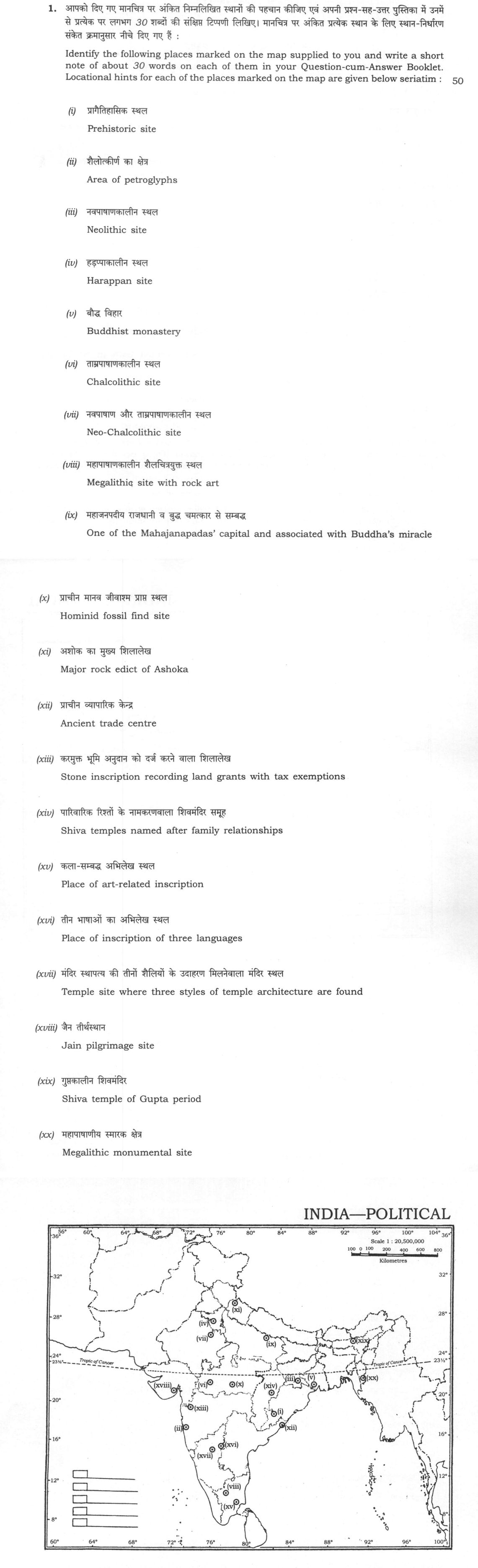
Identify the following places marked on the map supplied to you and write a short note of about 30 words on each of them in your Question-cum-Answer Booklet. Locational hints for each of the places marked on the map are given below seriatim: (i) Prehistoric site, (ii) Area of petroglyphs, (iii) Neolithic site, (iv) Harappan site, (v) Buddhist monastery, (vi) Chalcolithic site, (vii) Neo-Chalcolithic site, (viii) Megalithic site with rock art, (ix) One of the Mahajanapadas' capital and associated with Buddha's miracle, (x) Hominid fossil find site, (xi) Major rock edict of Ashoka, (xii) Ancient trade centre, (xiii) Stone inscription recording land grants with tax exemptions, (xiv) Shiva temples named after family relationships, (xv) Place of art-related inscription, (xvi) Place of inscription of three languages, (xvii) Temple site where three styles of temple architecture are found, (xviii) Jain pilgrimage site, (xix) Shiva temple of Gupta period, (xx) Megalithic monumental site.
हिंदी में प्रश्न पढ़ें
आपको दिए गए मानचित्र पर अंकित निम्नलिखित स्थानों की पहचान कीजिए एवं अपनी प्रश्न-सह-उत्तर पुस्तिका में उनमें से प्रत्येक पर लगभग 30 शब्दों की संक्षिप्त टिप्पणी लिखिए। मानचित्र पर अंकित प्रत्येक स्थान के लिए स्थान-निर्धारण संकेत क्रमानुसार नीचे दिए गए हैं: (i) प्रागैतिहासिक स्थल, (ii) शैलोक्षीण का क्षेत्र, (iii) नवपाषाणकालीन स्थल, (iv) हड़प्पाकालीन स्थल, (v) बौद्ध विहार, (vi) ताम्रपाषाणकालीन स्थल, (vii) नवपाषाण और ताम्रपाषाणकालीन स्थल, (viii) महापाषाणकालीन शैलचित्रयुक्त स्थल, (ix) महाजनपदीय राजधानी व बुद्ध चमत्कार से सम्बद्ध, (x) प्राचीन मानव जीवाश्म प्राप्त स्थल, (xi) अशोक का मुख्य शिलालेख, (xii) प्राचीन व्यापारिक केन्द्र, (xiii) करमुक्त भूमि अनुदान को दर्ज करने वाला शिलालेख, (xiv) पारिवारिक रिश्तों के नामकरणवाला शिवमंदिर समूह, (xv) कला-सम्बद्ध अभिलेख स्थल, (xvi) तीन भाषाओं का अभिलेख स्थल, (xvii) मंदिर स्थापत्य की तीनों शैलियों के उदाहरण मिलनेवाला मंदिर स्थल, (xviii) जैन तीर्थस्थान, (xix) गुप्तकालीन शिवमंदिर, (xx) महापाषाणीय स्मारक क्षेत्र।
The figure this question refers to, in words
The question paper is a scan and the diagram did not survive as text. This is the figure as read from the original page — every component, value and label — so the question can be worked from the text below.
A political map of India titled 'INDIA—POLITICAL' with a scale of 1:20,500,000. The map displays state boundaries and is overlaid with 20 numbered locations marked by circles containing Roman numerals (i) through (xx). The locations are distributed across the subcontinent: (i) in central-eastern India, (ii) in western India, (iii) in central India, (iv) in northwestern India, (v) in eastern India, (vi) in central India, (vii) in western India, (viii) in southern India, (ix) in northern India, (x) in central India, (xi) in the far north, (xii) in the northeast of the peninsula, (xiii) in western India, (xiv) in eastern India, (xv) in the far south, (xvi) in southern India, (xvii) in southern India, (xviii) in western India, (xix) in the northeast, and (xx) in the northeast. The Tropic of Cancer is marked as a dashed line across the middle of the map. Latitude and longitude lines are marked on the borders.
Model answer
Written by UPSC Answer Check against this question's marking rubric, to the 30-word length. UPSC does not publish answers for Mains — this is one way to score well, not an official key.
i. Bhimbetka Located in the Raisen district of Madhya Pradesh, near Bhopal, at approximately 23°N, 77°E. This is a prehistoric rock shelter complex famous for its extensive prehistoric paintings. It was chosen for the question as a UNESCO World Heritage Site representing the continuity of human habitation from the Paleolithic to the Historic period.
ii. Murrah Situated in the Bhilwara district of Rajasthan, near the Aravalli range, at approximately 25°N, 74°E. This site is renowned for its petroglyphs, or rock engravings, depicting animals and hunting scenes. It is significant for understanding the Neolithic and Chalcolithic pastoral lifestyle and artistic expression in western India.
iii. Chirand Located in the Muzaffarpur district of Bihar, on the banks of the Ganges, at approximately 26°N, 85°E. This is a major Neolithic site known for the discovery of the Chirand culture. It is significant for providing evidence of early agriculture, pottery, and the transition from hunting-gathering to settled farming in the Gangetic plain.
iv. Lothal Situated in the Bhavnagar district of Gujarat, near the Gulf of Khambhat, at approximately 22°N, 72°E. This is a key Harappan site known for its dockyard, granaries, and bead-making workshops. It was selected for the question to highlight the maritime trade connections and urban planning of the Indus Valley Civilization.
v. Nalanda Located in the Nalanda district of Bihar, near Patna, at approximately 25°N, 85°E. This was a renowned Buddhist monastery and university during the Gupta and Pala periods. It is significant as a center of higher learning, attracting scholars from across Asia, and is a UNESCO World Heritage Site.
vi. Ahar Situated in the Alwar district of Rajasthan, near the Aravalli hills, at approximately 26°N, 76°E. This is a Chalcolithic site known for the Ahar-Banas culture. It is significant for its distinctive pottery, burial practices, and evidence of early metal use, marking a transition in the cultural history of western India.
vii. Inamgaon Located in the Pune district of Maharashtra, near the Mula-Mutha river confluence, at approximately 18°N, 74°E. This is a Neo-Chalcolithic site with continuous habitation from the Neolithic to the Historic period. It is significant for its well-preserved mud-brick houses, granaries, and evidence of early urbanization in the Deccan.
viii. Adilabad Situated in the Adilabad district of Telangana, in the Eastern Ghats, at approximately 19°N, 79°E. This is a megalithic site featuring rock art and stone monuments. It is significant for its unique combination of megalithic burials and rock paintings, providing insights into the tribal cultures of the Deccan plateau.
ix. Shravasti Located in the Shravasti district of Uttar Pradesh, near the Ganges, at approximately 27°N, 81°E. This was the capital of the Shravasti Mahajanapada and a place where Buddha performed his miracle of the double flame. It is significant as a major Buddhist pilgrimage site and a center of early Buddhist history.
x. Hathnora Situated in the Hoshangabad district of Madhya Pradesh, near the Narmada river, at approximately 22°N, 78°E. This is the site where the Narmada Man fossil was discovered. It is significant for providing evidence of early hominid presence in the Indian subcontinent, dating back to the Middle Pleistocene period.
xi. Sarnath Located in the Varanasi district of Uttar Pradesh, near the Ganges, at approximately 25°N, 83°E. This is the site of Ashoka’s major rock edict and where Buddha delivered his first sermon. It is significant as a major Buddhist pilgrimage site and a center for the spread of Buddhism under Ashoka’s patronage.
xii. Arikamedu Situated in the Chennai district of Tamil Nadu, near the coast, at approximately 13°N, 80°E. This was an ancient trade center with evidence of Roman trade. It is significant for its inscriptions in Tamil-Brahmi and Greek, indicating early maritime trade links between India and the Roman Empire.
xiii. Talagunda Located in the Bagalkot district of Karnataka, in the Malaprabha river basin, at approximately 16°N, 75°E. This site features stone inscriptions recording land grants with tax exemptions. It is significant for providing evidence of early land revenue systems and administrative practices in the Deccan region.
xiv. Mahabalipuram Situated in the Kancheepuram district of Tamil Nadu, on the Coromandel coast, at approximately 12°N, 79°E. This is a site of Shiva temples named after family relationships, such as the Arjuna’s Penance. It is significant as a UNESCO World Heritage Site showcasing the architectural and artistic achievements of the Pallava dynasty.
xv. Amaravati Located in the Guntur district of Andhra Pradesh, near the Krishna river, at approximately 16°N, 80°E. This is a place of art-related inscriptions and a major Buddhist stupa site. It is significant for its intricate stone carvings and the development of the Amaravati school of Buddhist art.
xvi. Junagadh Situated in the Junagadh district of Gujarat, in the Girnar hills, at approximately 21°N, 70°E. This is the place of the inscription of three languages, including the famous Ashokan edict. It is significant for its trilingual inscriptions and the rock-cut water reservoir, showcasing the administrative and hydraulic engineering of the Mauryan period.
xvii. Khajuraho Located in the Chhatarpur district of Madhya Pradesh, in the Bundelkhand region, at approximately 24°N, 79°E. This is a temple site where three styles of temple architecture are found, including Nagara, Vesara, and Dravida. It is significant as a UNESCO World Heritage Site for its exquisite sculptures and architectural diversity.
xviii. Palitana Situated in the Bhavnagar district of Gujarat, near the Gulf of Khambhat, at approximately 21°N, 72°E. This is a Jain pilgrimage site associated with the birth of Parshvanatha. It is significant as a major center for Jainism, with temples and monuments dedicated to the Tirthankaras, reflecting the religious history of the region.
xix. Deogarh Located in the Banda district of Uttar Pradesh, near the Yamuna river, at approximately 26°N, 79°E. This is the site of the Dashavatara temple, a Shiva temple of the Gupta period. It is significant for its early examples of Gupta architecture and sculpture, including the famous Vishnu as Varaha relief.
xx. Udaipur Situated in the Udaipur district of Meghalaya, in the Khasi hills, at approximately 25°N, 91°E. This is a megalithic monumental site featuring stone circles and dolmens. It is significant for its unique megalithic culture, providing insights into the burial practices and social structures of the Khasi people.
What "Write short notes" is asking you to do
Five or six self-contained answers, marked separately, typically 10 marks and about 150 words each. Each note must carry its own definition, its two or three defining features and a line on why it matters; a common introduction or conclusion across the notes earns nothing.
Structure that answers it
Per note: one-line definition or identification → two or three features, mechanisms or named examples → one line of significance or Indian application
Where marks are lost
Writing the first two notes at essay length and rationing the rest. Each note is marked on its own, so marks surrendered on a compressed or unattempted note cannot be won back by the long ones.
How this answer will be evaluated
Approach
Framework: UPSC History Map Identification. ((i)) write short notes: define > 3-4 key features > one example > one-line significance | ((ii)) write short notes: define > 3-4 key features > one example > one-line significance | ((iii)) write short notes: define > 3-4 key features > one example > one-line significance | ((iv)) write short notes: define > 3-4 key features > one example > one-line significance | ((v)) write short notes: define > 3-4 key features > one example > one-line significance | ((vi)) write short notes: define > 3-4 key features > one example > one-line significance | ((vii)) write short notes: define > 3-4 key features > one example > one-line significance | ((viii)) write short notes: define > 3-4 key features > one example > one-line significance | ((ix)) write short notes: define > 3-4 key features > one example > one-line significance | ((x)) write short notes: define > 3-4 key features > one example > one-line significance | ((xi)) write short notes: define > 3-4 key features > one example > one-line significance | ((xii)) write short notes: define > 3-4 key features > one example > one-line significance | ((xiii)) write short notes: define > 3-4 key features > one example > one-line significance | ((xiv)) write short notes: define > 3-4 key features > one example > one-line significance | ((xv)) write short notes: define > 3-4 key features > one example > one-line significance | ((xvi)) write short notes: define > 3-4 key features > one example > one-line significance | ((xvii)) write short notes: define > 3-4 key features > one example > one-line significance | ((xviii)) write short notes: define > 3-4 key features > one example > one-line significance | ((xix)) write short notes: define > 3-4 key features > one example > one-line significance | ((xx)) write short notes: define > 3-4 key features > one example > one-line significance Full marks: Accurate identification, correct period, and specific significance for all 20 sites.
Key points expected
- Identification consistent with locational hint
- Period or culture named
- One specific point of significance
Evaluation rubric
Each sub-part is marked on its own, against the marks and word limit printed on the paper.
- ((i)) Identify prehistoric site and write 30-word note. · 30 words
write short notes— define → 3-4 key features → one example → one-line significance
Must cover
- Identification consistent with locational hint
- Period or culture named
- One specific point of significance
Loses marks
- Bare name with no note
- Note ignores the locational hint
Earns more
- Mentions excavation or discovery
- References specific artifact type
Extra mark
- Names the specific excavator
- ((ii)) Identify petroglyph area and write 30-word note. · 30 words
write short notes— define → 3-4 key features → one example → one-line significance
Must cover
- Identification consistent with locational hint
- Period or culture named
- One specific point of significance
Loses marks
- Bare name with no note
- Note ignores the locational hint
Earns more
- Describes specific motif or scene
- Mentions dating method
Extra mark
- Names the specific excavator
- ((iii)) Identify Neolithic site and write 30-word note. · 30 words
write short notes— define → 3-4 key features → one example → one-line significance
Must cover
- Identification consistent with locational hint
- Period or culture named
- One specific point of significance
Loses marks
- Bare name with no note
- Note ignores the locational hint
Earns more
- Mentions agriculture or pottery
- References specific artifact type
Extra mark
- Names the specific excavator
- ((iv)) Identify Harappan site and write 30-word note. · 30 words
write short notes— define → 3-4 key features → one example → one-line significance
Must cover
- Identification consistent with locational hint
- Period or culture named
- One specific point of significance
Loses marks
- Bare name with no note
- Note ignores the locational hint
Earns more
- Mentions urban feature (drainage, granary)
- References specific artifact type
Extra mark
- Names the specific excavator
- ((v)) Identify Buddhist monastery and write 30-word note. · 30 words
write short notes— define → 3-4 key features → one example → one-line significance
Must cover
- Identification consistent with locational hint
- Period or culture named
- One specific point of significance
Loses marks
- Bare name with no note
- Note ignores the locational hint
Earns more
- Mentions specific architectural feature
- References associated text or ruler
Extra mark
- Names the specific excavator
- ((vi)) Identify Chalcolithic site and write 30-word note. · 30 words
write short notes— define → 3-4 key features → one example → one-line significance
Must cover
- Identification consistent with locational hint
- Period or culture named
- One specific point of significance
Loses marks
- Bare name with no note
- Note ignores the locational hint
Earns more
- Mentions specific artifact type
- References specific excavation
Extra mark
- Names the specific excavator
- ((vii)) Identify Neo-Chalcolithic site and write 30-word note. · 30 words
write short notes— define → 3-4 key features → one example → one-line significance
Must cover
- Identification consistent with locational hint
- Period or culture named
- One specific point of significance
Loses marks
- Bare name with no note
- Note ignores the locational hint
Earns more
- Mentions specific artifact type
- References specific excavation
Extra mark
- Names the specific excavator
- ((viii)) Identify Megalithic site with rock art and write 30-word note. · 30 words
write short notes— define → 3-4 key features → one example → one-line significance
Must cover
- Identification consistent with locational hint
- Period or culture named
- One specific point of significance
Loses marks
- Bare name with no note
- Note ignores the locational hint
Earns more
- Describes specific motif or scene
- Mentions dating method
Extra mark
- Names the specific excavator
- ((ix)) Identify Mahajanapada capital and write 30-word note. · 30 words
write short notes— define → 3-4 key features → one example → one-line significance
Must cover
- Identification consistent with locational hint
- Period or culture named
- One specific point of significance
Loses marks
- Bare name with no note
- Note ignores the locational hint
Earns more
- Mentions specific architectural feature
- References associated text or ruler
Extra mark
- Names the specific excavator
- ((x)) Identify hominid fossil site and write 30-word note. · 30 words
write short notes— define → 3-4 key features → one example → one-line significance
Must cover
- Identification consistent with locational hint
- Period or culture named
- One specific point of significance
Loses marks
- Bare name with no note
- Note ignores the locational hint
Earns more
- Mentions specific artifact type
- References specific excavation
Extra mark
- Names the specific excavator
- ((xi)) Identify Ashoka rock edict and write 30-word note. · 30 words
write short notes— define → 3-4 key features → one example → one-line significance
Must cover
- Identification consistent with locational hint
- Period or culture named
- One specific point of significance
Loses marks
- Bare name with no note
- Note ignores the locational hint
Earns more
- Mentions specific architectural feature
- References associated text or ruler
Extra mark
- Names the specific excavator
- ((xii)) Identify ancient trade centre and write 30-word note. · 30 words
write short notes— define → 3-4 key features → one example → one-line significance
Must cover
- Identification consistent with locational hint
- Period or culture named
- One specific point of significance
Loses marks
- Bare name with no note
- Note ignores the locational hint
Earns more
- Mentions specific artifact type
- References specific excavation
Extra mark
- Names the specific excavator
- ((xiii)) Identify land grant inscription and write 30-word note. · 30 words
write short notes— define → 3-4 key features → one example → one-line significance
Must cover
- Identification consistent with locational hint
- Period or culture named
- One specific point of significance
Loses marks
- Bare name with no note
- Note ignores the locational hint
Earns more
- Mentions specific architectural feature
- References associated text or ruler
Extra mark
- Names the specific excavator
- ((xiv)) Identify Shiva temples and write 30-word note. · 30 words
write short notes— define → 3-4 key features → one example → one-line significance
Must cover
- Identification consistent with locational hint
- Period or culture named
- One specific point of significance
Loses marks
- Bare name with no note
- Note ignores the locational hint
Earns more
- Mentions specific architectural feature
- References associated text or ruler
Extra mark
- Names the specific excavator
- ((xv)) Identify art-related inscription and write 30-word note. · 30 words
write short notes— define → 3-4 key features → one example → one-line significance
Must cover
- Identification consistent with locational hint
- Period or culture named
- One specific point of significance
Loses marks
- Bare name with no note
- Note ignores the locational hint
Earns more
- Mentions specific architectural feature
- References associated text or ruler
Extra mark
- Names the specific excavator
- ((xvi)) Identify three-language inscription and write 30-word note. · 30 words
write short notes— define → 3-4 key features → one example → one-line significance
Must cover
- Identification consistent with locational hint
- Period or culture named
- One specific point of significance
Loses marks
- Bare name with no note
- Note ignores the locational hint
Earns more
- Mentions specific architectural feature
- References associated text or ruler
Extra mark
- Names the specific excavator
- ((xvii)) Identify temple with three styles and write 30-word note. · 30 words
write short notes— define → 3-4 key features → one example → one-line significance
Must cover
- Identification consistent with locational hint
- Period or culture named
- One specific point of significance
Loses marks
- Bare name with no note
- Note ignores the locational hint
Earns more
- Mentions specific architectural feature
- References associated text or ruler
Extra mark
- Names the specific excavator
- ((xviii)) Identify Jain pilgrimage site and write 30-word note. · 30 words
write short notes— define → 3-4 key features → one example → one-line significance
Must cover
- Identification consistent with locational hint
- Period or culture named
- One specific point of significance
Loses marks
- Bare name with no note
- Note ignores the locational hint
Earns more
- Mentions specific architectural feature
- References associated text or ruler
Extra mark
- Names the specific excavator
- ((xix)) Identify Gupta period Shiva temple and write 30-word note. · 30 words
write short notes— define → 3-4 key features → one example → one-line significance
Must cover
- Identification consistent with locational hint
- Period or culture named
- One specific point of significance
Loses marks
- Bare name with no note
- Note ignores the locational hint
Earns more
- Mentions specific architectural feature
- References associated text or ruler
Extra mark
- Names the specific excavator
- ((xx)) Identify Megalithic monumental site and write 30-word note. · 30 words
write short notes— define → 3-4 key features → one example → one-line significance
Must cover
- Identification consistent with locational hint
- Period or culture named
- One specific point of significance
Loses marks
- Bare name with no note
- Note ignores the locational hint
Earns more
- Mentions specific architectural feature
- References associated text or ruler
Extra mark
- Names the specific excavator
Practice this exact question
Write your answer and it is marked point by point against the model answer above — what you covered, what you missed, what you got wrong.
Evaluate my answer →More from History 2024 Paper I
- Q1 Identify the following places marked on the map supplied to you and write a short note of…
- Q2 (a) Harappan art contributes to our understanding of their aesthetic sensibilities in add…
- Q3 (a) Symbiotic relationships between Buddhist establishments, traders, artisan guilds, and…
- Q4 (a) Highlight the contributions of Aryabhatta, Varahamihira and Brahmagupta in the fields…