Paper I — Q3
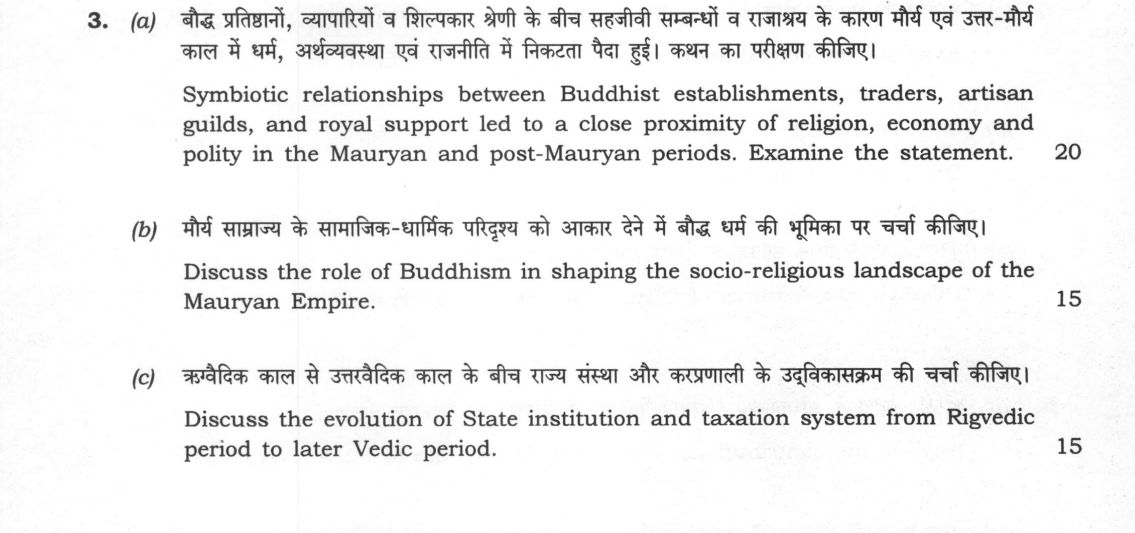
(a) Symbiotic relationships between Buddhist establishments, traders, artisan guilds, and royal support led to a close proximity…
Symbiotic relationships between Buddhist establishments, traders, artisan guilds, and royal support led to a close proximity of religion, economy and polity in the Mauryan and post-Mauryan periods. Examine the statement. 20 marks
Discuss the role of Buddhism in shaping the socio-religious landscape of the Mauryan Empire. 15 marks
Discuss the evolution of State institution and taxation system from Rigvedic period to later Vedic period. 15 marks
हिंदी में प्रश्न पढ़ें
बौद्ध प्रतिष्ठानों, व्यापारियों व शिल्पकार श्रेणी के बीच सहजीवी संबंधों व राजाश्रय के कारण मौर्य एवं उत्तर-मौर्य काल में धर्म, अर्थव्यवस्था एवं राजनीति में निकटता पैदा हुई। कथन का परीक्षण कीजिए। (20 अंक)
मौर्य साम्राज्य के सामाजिक-धार्मिक परिदृश्य को आकार देने में बौद्ध धर्म की भूमिका पर चर्चा कीजिए। (15 अंक)
ऋग्वैदिक काल से उत्तरवैदिक काल के बीच राज्य संस्था और करप्रणाली के उद्विकासक्रम की चर्चा कीजिए। (15 अंक)
Model answer
Written by UPSC Answer Check against this question's marking rubric, to the expected length. UPSC does not publish answers for Mains — this is one way to score well, not an official key.
The convergence of monastic institutions, mercantile capital, and political authority shaped early historic India.
Symbiosis of Monasticism, Trade, and Polity
As argued by historians like R.S. Sharma and Uma Chakravarti, Buddhist monastic establishments (viharas and chaityas) were deeply integrated into commercial networks along the uttarapatha and dakshinapatha. Monasteries functioned as storehouses and provided credit to merchants (sresthis). In return, artisan guilds (shrenis) and traders financed monastic expansion, evidenced by votive inscriptions at Sanchi and Bharhut. Royal support solidified this nexus. The Mauryan state under Ashoka appointed dhamma-mahamattas and patronized ascetic sects, donating the Barabar caves. In the post-Mauryan period, despite sectarian shifts, the Shungas, Satavahanas (patronizing Western Deccan rock-cut caves), and Kushanas extended royal patronage to Buddhist institutions to legitimize rule across vital trade corridors, confirming that religious prestige, commercial wealth, and political power operated in structural interdependence.
Buddhism and the Mauryan Socio-Religious Landscape
Buddhism transformed the socio-religious environment by offering an ethical framework that transcended rigid varna distinctions. It challenged Brahmanical ritual hegemony, animal sacrifice, and purity-pollution hierarchies, creating an inclusive space for shudras and women within the sangha. Monastic organization provided an alternative social structure based on egalitarian fraternity. By utilizing Prakrit rather than elitist Sanskrit, Buddhist teachings became socially accessible. The period also initiated a transition in visual culture from aniconic representations (dharmachakra, stupas) toward monumental public art, embedding non-violence and civic morality into public consciousness via royal edicts.
State Evolution and Taxation: Rigvedic to Later Vedic
The Vedic polity evolved from a pastoral-tribal formation into a stratified, territorial state. The Rigvedic polity centered around a tribal war-chief (rajan) restrained by popular assemblies like the sabha and samiti. Resource mobilization was voluntary, consisting of customary gifts (bali) and war booty, without regular taxation or a standing army.
By the later Vedic period, the expansion into the Gangetic plains fostered territorial entities (janapadas). Kingship became hereditary and absolute, legitimized through elaborate Vedic rituals like the rajasuya and asvamedha. An embryonic administrative apparatus emerged with functionaries such as the purohita, senani, and samgrahitri (treasurer). Consequently, voluntary tribute crystallized into compulsory agrarian taxation via institutionalized levies like bhaga (customary share of produce) and shulka.
While the Vedic trajectory highlights the gradual institutionalization of monarchical coercion and tribute extraction, the Mauryan and post-Mauryan polities synthesized religious ideology, guild networks, and fiscal administration into a coherent, cosmopolitan state system.
What "Examine" is asking you to do
Test the proposition the question puts to you and return a finding on how far it holds. Examine stems carry a claim, or ask whether something has happened, and expect evidence weighed both ways before the extent is stated — often with remedial measures attached.
Structure that answers it
Restate the claim as the question frames it → evidence that supports it → evidence that undercuts it → the conditions under which it holds → verdict on how far it stands
Where marks are lost
Stopping at description. An examination has to reach a finding, and “examine with justification” means the extent must be stated, not implied.
How this answer will be evaluated
Approach
Framework: Context > Thesis > Evidence > Historiography. (a) examine: intro > how/why with reasoning > evidence > conclusion | (b) discuss: intro > 3-4 dimensions > example > balanced close | (c) discuss: intro > 3-4 dimensions > example > balanced close Full marks: Thesis-driven, cites specific sources, names historians, deep analysis of linkages.
Key points expected
- Detail symbiotic links between Buddhist establishments and royal patronage.
- Explain economic role of traders and artisan guilds.
- Demonstrate how these factors created close proximity of spheres.
- Provide specific evidence from Mauryan and post-Mauryan periods.
- Identify key socio-religious changes driven by Buddhism.
- Discuss the role of royal patronage (Ashoka).
- Analyze the spread of Buddhist institutions and ideas.
- Assess the impact on existing religious structures.
Evaluation rubric
Each sub-part is marked on its own, against the marks and word limit printed on the paper.
- (a) Analyze the interdependence of religion, economy, and polity in Mauryan/post-Mauryan periods. 20 marks
examine— intro → how/why with reasoning → evidence → conclusion
Must cover
- Detail symbiotic links between Buddhist establishments and royal patronage.
- Explain economic role of traders and artisan guilds.
- Demonstrate how these factors created close proximity of spheres.
- Provide specific evidence from Mauryan and post-Mauryan periods.
Loses marks
- Narrative retelling without analytical reasoning.
- Ignoring the 'symbiotic' nature of the relationship.
- Failing to distinguish Mauryan from post-Mauryan contexts.
Earns more
- Cite specific inscriptions or archaeological sites.
- Name specific guilds or trade routes.
- Reference specific royal edicts or policies.
- Discuss the political implications of religious support.
Extra mark
- Quote a specific line from an Ashokan edict.
- Name a specific historian's interpretation of these links.
- (b) Evaluate Buddhism's impact on the socio-religious landscape of the Mauryan Empire. 15 marks
discuss— intro → 3-4 dimensions → example → balanced close
Must cover
- Identify key socio-religious changes driven by Buddhism.
- Discuss the role of royal patronage (Ashoka).
- Analyze the spread of Buddhist institutions and ideas.
- Assess the impact on existing religious structures.
Loses marks
- Generalizing without specific Mauryan examples.
- Focusing only on religion, ignoring socio-economic aspects.
- Lack of critical analysis of the 'shaping' process.
Earns more
- Mention specific Buddhist texts or councils.
- Discuss the role of monks in society.
- Reference specific archaeological evidence of spread.
- Compare pre- and post-Buddhist social norms.
Extra mark
- Cite a specific Ashokan edict on religious tolerance.
- Name a specific scholar's view on this transformation.
- (c) Trace the evolution of state institutions and taxation from Rigvedic to Later Vedic periods. 15 marks
discuss— intro → 3-4 dimensions → example → balanced close
Must cover
- Describe the Rigvedic tribal state structure.
- Explain the transition to Later Vedic Janapadas.
- Detail the evolution of taxation systems.
- Highlight the shift from tribal to territorial governance.
Loses marks
- Chronology without analysis of change.
- Failing to distinguish Rigvedic from Later Vedic features.
- Ignoring the economic basis of state evolution.
Earns more
- Cite specific Vedic texts for evidence.
- Name specific state institutions (e.g., Sabha, Samiti).
- Discuss the role of the king in both periods.
- Mention specific types of taxes or tributes.
Extra mark
- Reference a specific archaeological site of a Janapada.
- Name a specific historian's theory on this transition.
Practice this exact question
Write your answer and it is marked point by point against the model answer above — what you covered, what you missed, what you got wrong.
Evaluate my answer →More from History 2024 Paper I
- Q1 Identify the following places marked on the map supplied to you and write a short note of…
- Q2 (a) Harappan art contributes to our understanding of their aesthetic sensibilities in add…
- Q3 (a) Symbiotic relationships between Buddhist establishments, traders, artisan guilds, and…
- Q4 (a) Highlight the contributions of Aryabhatta, Varahamihira and Brahmagupta in the fields…
- Q5 Answer the following questions in about 150 words each: (a) Illustrate the main features…
- Q6 (a) Analyze the contributions of Acharya Triumvirate to Indian Vedanta. (20 marks) (b) Co…