Paper I — Q2
(a) Harappan art contributes to our understanding of their aesthetic sensibilities in addition to spiritual and ritualistic life…
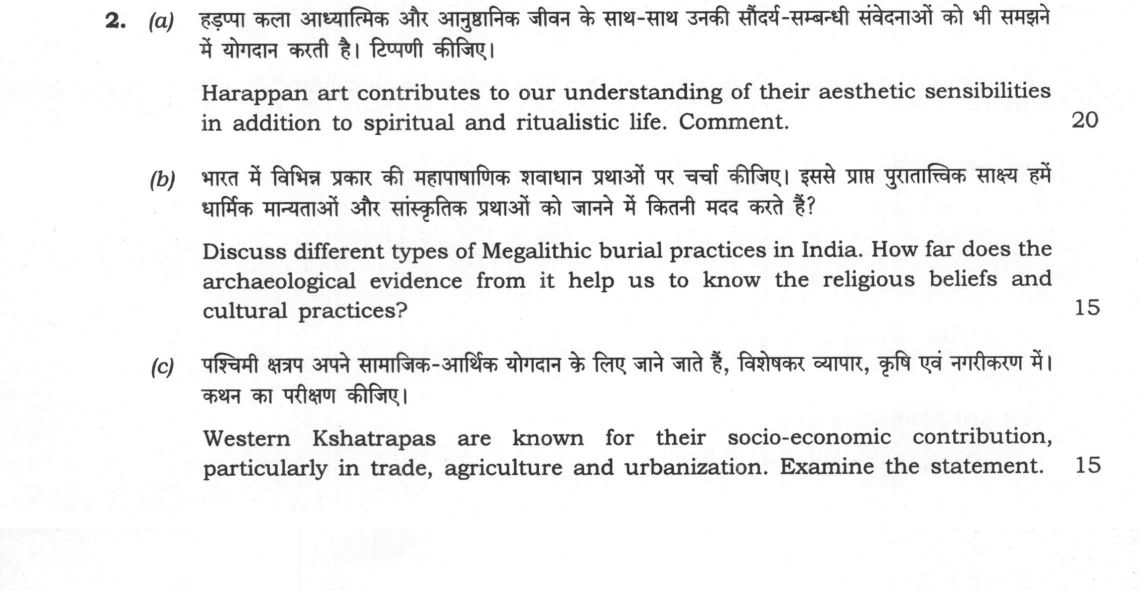
Harappan art contributes to our understanding of their aesthetic sensibilities in addition to spiritual and ritualistic life. Comment. 20 marks
Discuss different types of Megalithic burial practices in India. How far does the archaeological evidence from it help us to know the religious beliefs and cultural practices? 15 marks
Western Kshatrapas are known for their socio-economic contribution, particularly in trade, agriculture and urbanization. Examine the statement. 15 marks
हिंदी में प्रश्न पढ़ें
हड़प्पा कला आध्यात्मिक और अनुष्ठानिक जीवन के साथ-साथ उनकी सौंदर्य-संबंधी संवेदनाओं को भी समझने में योगदान करती है। टिप्पणी कीजिए। (20 अंक)
भारत में विभिन्न प्रकार की महापाषाणिक शवाधान प्रथाओं पर चर्चा कीजिए। इससे प्राप्त पुरातात्विक साक्ष्य हमें धार्मिक मान्यताओं और सांस्कृतिक प्रथाओं को जानने में कितनी मदद करते हैं? (15 अंक)
पश्चिमी क्षत्रप अपने सामाजिक-आर्थिक योगदान के लिए जाने जाते हैं, विशेषकर व्यापार, कृषि एवं नगरीकरण में। कथन का परीक्षण कीजिए। (15 अंक)
Model answer
Written by UPSC Answer Check against this question's marking rubric, to the expected length. UPSC does not publish answers for Mains — this is one way to score well, not an official key.
Harappan material culture, Megalithic burials and Saka coinage show that artefacts, not texts, are primary evidence for ancient India’s inner life. In non-literate or poorly documented societies, art, burial archaeology and numismatics become comparative windows.
Harappan aesthetic and ritual life. The statement is broadly valid. Harappan art reveals a refined aesthetic sensibility through the naturalistic terracotta Mother Goddess figurines, the confident bronze ‘dancing girl’, finely drilled carnelian and steatite beads, and small seals whose linear precision suggests an aesthetic order reinforced by standardized weights and measures. Yet the same objects are ritualistic: unicorn seals, probable fire altars, the Great Bath’s ritual purity, and phallic symbolism in stone linga-like objects and terracotta forms show sacred meaning. The tension is real—craftsmanly utility and sacred symbolism coexist. The coexistence of domestic craft and ritual iconography suggests aesthetics were not separate from religion. Historiographically, Marshall’s temple-civilization reading overstates ritual uniformity, while Possehl’s more cautious view treats religion as embedded in domestic and craft life.
Megalithic burial practices. Megalithic India includes dolmens, menhirs, cairn circles, cists and passage graves, distributed across the Deccan, South India and the Northeast. The regional variation—Deccan, South India, Northeast—prevents a single ‘Megalithic culture’ label. Grave goods—iron tools, pottery, gold ornaments—suggest afterlife preparation, ancestor veneration and beliefs in a continuing soul. Varied grave sizes and wealth indicate social stratification, while large megaliths imply collective labour and community ritual. Gurukkal’s reading of megaliths as social formation, not merely primitive monumentality, is useful. Continuity with later local traditions shows these practices shaped regional cultural memory.
Western Kshatrapa economy. The Kshatrapas’ contribution is evident in trade, agriculture and urbanization. Control of Gujarat ports and references in the Periplus show Indo-Roman trade, while Saka irrigation works and dam construction supported agriculture. Ujjain, Bharuch and Malwa became commercial nodes; Mathura, though a major contemporary centre, was Kushana, not Kshatrapa. Rudradaman’s Greek-Brahmi coins reveal monetary integration, and Shrimali’s Saka-Parthian economic framework helps explain this. Their coinage system standardized value and facilitated market exchange. Yet urban decline after the third century CE limits the claim to a regional, not pan-Indian, transformation.
Thus, material culture is not merely decorative evidence; it reconstructs belief, hierarchy and economy where texts are absent or silent. Archaeology supplies the base; texts and inscriptions, where available, only supplement it, making art, burial archaeology and numismatics a comparative key to ancient India across all three regions.
What "Comment" is asking you to do
Take a position on the statement and support it. Comment usually attaches to a quoted line in the short slots, so the reasoning must be compressed — an opening view, a few load-bearing reasons, and the limit of the claim.
Structure that answers it
Unpack what the statement asserts → your stance → two or three supporting reasons → the qualification that limits it
Where marks are lost
Neutral summary; a comment without a stance has not answered. Equally costly is accepting the quoted line wholesale and never testing where it fails.
How this answer will be evaluated
Approach
Framework: UPSC History Paper 1. (a) comment: context > arguments both sides > judgment > close | (b) discuss: intro > 3-4 dimensions > example > balanced close | (c) examine: intro > how/why with reasoning > evidence > conclusion Full marks: Comprehensive, analytical, and well-supported with specific evidence and historiographical context.
Key points expected
- Contextualize Harappan art within the Indus Valley Civilization.
- Analyze aesthetic sensibilities through specific artifacts (e.g., seals, pottery).
- Discuss spiritual and ritualistic life (e.g., Pashupati seal, mother goddess).
- Provide a balanced judgment on the dual nature of the art.
- Identify different types of Megalithic burial practices (e.g., dolmens, cists).
- Discuss the geographical distribution of these practices in India.
- Analyze how evidence reveals religious beliefs (e.g., ancestor worship).
- Evaluate the extent to which evidence informs cultural practices.
Evaluation rubric
Each sub-part is marked on its own, against the marks and word limit printed on the paper.
- (a) Contextualize Harappan art and provide a balanced judgment on its aesthetic and ritualistic significance. 20 marks
comment— context → arguments both sides → judgment → close
Must cover
- Contextualize Harappan art within the Indus Valley Civilization.
- Analyze aesthetic sensibilities through specific artifacts (e.g., seals, pottery).
- Discuss spiritual and ritualistic life (e.g., Pashupati seal, mother goddess).
- Provide a balanced judgment on the dual nature of the art.
Loses marks
- Narrating history without analytical commentary.
- Ignoring the 'aesthetic' aspect of the question.
- Failing to provide a balanced judgment.
Earns more
- Mention specific sites like Mohenjo-daro or Harappa.
- Reference specific artifacts like the Dancing Girl or Priest-King.
- Discuss the role of art in trade and administration.
- Compare with contemporary Mesopotamian or Egyptian art.
Extra mark
- Cite a specific historian's interpretation (e.g., S.R. Rao).
- Include a small diagram of a seal or artifact.
- (b) Discuss types of Megalithic burials and evaluate their significance for understanding religious and cultural practices. 15 marks
discuss— intro → 3-4 dimensions → example → balanced close
Must cover
- Identify different types of Megalithic burial practices (e.g., dolmens, cists).
- Discuss the geographical distribution of these practices in India.
- Analyze how evidence reveals religious beliefs (e.g., ancestor worship).
- Evaluate the extent to which evidence informs cultural practices.
Loses marks
- Listing types without discussing their significance.
- Failing to address the 'how far' aspect of the question.
- Ignoring the cultural and religious implications.
Earns more
- Mention specific regions like Kerala, Tamil Nadu, or Northeast India.
- Discuss the transition from megalithic to non-megalithic practices.
- Reference specific archaeological findings or excavations.
- Discuss the social stratification implied by burial goods.
Extra mark
- Cite a specific archaeological report or historian.
- Include a map showing the distribution of megalithic sites.
- (c) Examine the socio-economic contributions of Western Kshatrapas in trade, agriculture, and urbanization. 15 marks
examine— intro → how/why with reasoning → evidence → conclusion
Must cover
- Contextualize the Western Kshatrapas (Saka rulers) in Indian history.
- Examine their contributions to trade (e.g., maritime routes, coins).
- Examine their contributions to agriculture (e.g., irrigation, land grants).
- Examine their contributions to urbanization (e.g., city planning, architecture).
Loses marks
- Failing to address all three areas (trade, agriculture, urbanization).
- Providing a general overview without specific evidence.
- Ignoring the 'examine' command word and just narrating.
Earns more
- Mention specific rulers like Nahapana or Rudradaman.
- Reference specific inscriptions like the Nasik or Junagadh inscriptions.
- Discuss the impact of their rule on the local economy.
- Compare their contributions with other contemporary dynasties.
Extra mark
- Cite a specific historian or archaeological source.
- Include a map of the Western Kshatrapa territory.
Practice this exact question
Write your answer and it is marked point by point against the model answer above — what you covered, what you missed, what you got wrong.
Evaluate my answer →More from History 2024 Paper I
- Q1 Identify the following places marked on the map supplied to you and write a short note of…
- Q2 (a) Harappan art contributes to our understanding of their aesthetic sensibilities in add…
- Q3 (a) Symbiotic relationships between Buddhist establishments, traders, artisan guilds, and…
- Q4 (a) Highlight the contributions of Aryabhatta, Varahamihira and Brahmagupta in the fields…
- Q5 Answer the following questions in about 150 words each: (a) Illustrate the main features…