Paper I — Q5
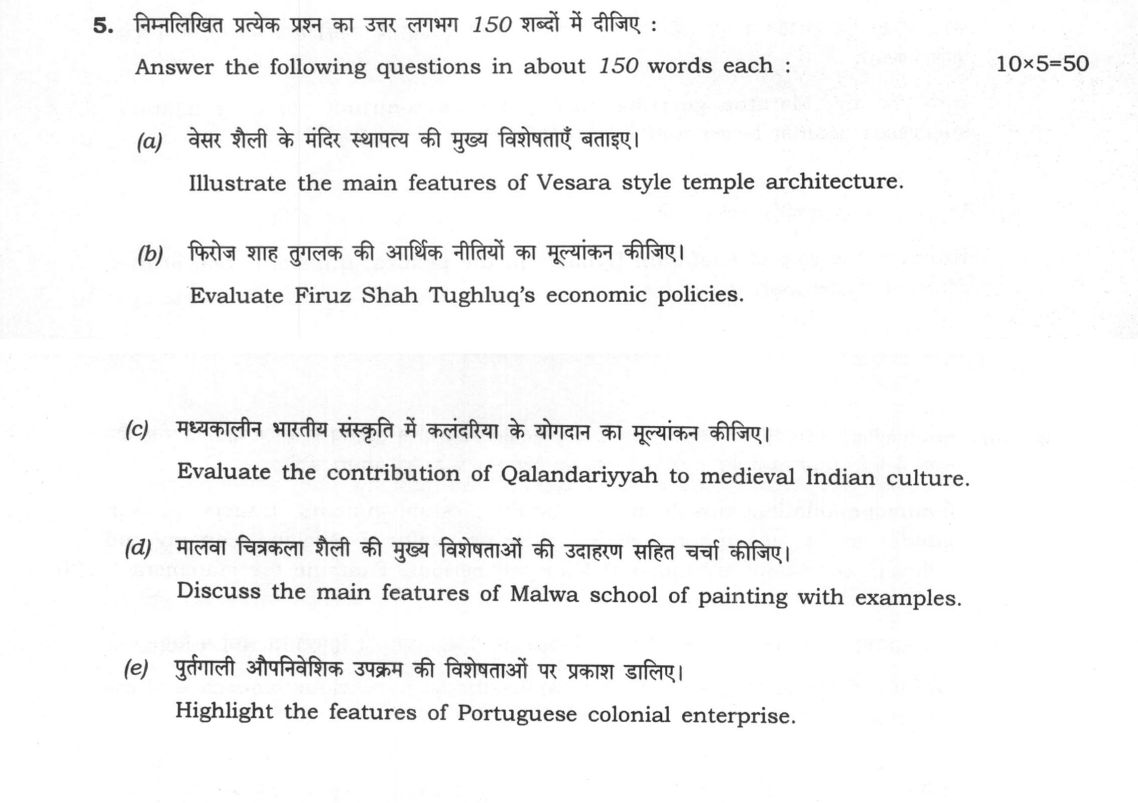
Answer the following questions in about 150 words each: (a) Illustrate the main features of Vesara style temple architecture. (b)…
Answer the following questions in about 150 words each: (a) Illustrate the main features of Vesara style temple architecture. (b) Evaluate Firuz Shah Tughluq's economic policies. (c) Evaluate the contribution of Qalandariyyah to medieval Indian culture. (d) Discuss the main features of Malwa school of painting with examples. (e) Highlight the features of Portuguese colonial enterprise.
हिंदी में प्रश्न पढ़ें
निम्नलिखित प्रत्येक प्रश्न का उत्तर लगभग 150 शब्दों में दीजिए: (a) वेसर शैली के मंदिर स्थापत्य की मुख्य विशेषताएं बताइए। (b) फिरोज शाह तुगलक की आर्थिक नीतियों का मूल्यांकन कीजिए। (c) मध्यकालीन भारतीय संस्कृति में कलंदरिया के योगदान का मूल्यांकन कीजिए। (d) मालवा चित्रकला शैली की मुख्य विशेषताओं की उदाहरण सहित चर्चा कीजिए। (e) पुर्तगाली औपनिवेशिक उपक्रम की विशेषताओं पर प्रकाश डालिए।
Model answer
Written by UPSC Answer Check against this question's marking rubric, to the 150-word length. UPSC does not publish answers for Mains — this is one way to score well, not an official key.
Vesara: A Nagara-Dravida hybrid from Aihole, Badami, Pattadakal, with ornate vimanas, intricate carvings and stellate Hoysala plans (Halebidu, Belur, Somnathpura); Aihole's Durga and Lad Khan temples show early synthesis.
Firuz Shah: He built Firozabad, Hissar-Firoza and Jaunpur, dug Yamuna-Sutlej canals, fixed land assessment, granted hereditary rights and controlled markets; short-term welfare but fiscally unsustainable.
Qalandariyyah: An unorthodox Sufi order rejecting formalism, it used music, poetry and asceticism to challenge orthodox Islam, enriching Delhi-Bengal popular culture and resonating with Bhakti, notably Kabir, while Sufi-Bhakti synthesis touched Nanak.
Malwa: From Mandu under Khaljis and Malwa sultans, it blended indigenous and Persian styles with delicate lines, vibrant bold colours, flat compositions and naturalistic landscapes, as in Nimatnama and Gitagovinda.
Portuguese: Estado da India used fortified Goa, Daman and Diu, cartaz system, spice-horse monopolies and conversion to control the Indian Ocean; decline became pronounced in the 17th century under Dutch-English competition, reshaping trade networks.
What "Evaluate" is asking you to do
Judge how well something has performed against the standard it set for itself — its stated aim, mandate or promise — and commit to a verdict. Name the yardstick before you judge; an unanchored judgement reads as opinion.
Structure that answers it
Name the yardstick — stated aim, mandate or benchmark → performance against it → shortfall against it → why the gap exists → verdict
Where marks are lost
Presenting both sides and then declining to decide, or delivering a verdict against a standard you never stated, which makes it look arbitrary.
How this answer will be evaluated
Approach
Framework: Context > Thesis > Evidence > Historiography. (a) explain: definition/context > points in order > small example > short close | (b) discuss: intro > 3-4 dimensions > example > balanced close | (c) discuss: intro > 3-4 dimensions > example > balanced close | (d) discuss: intro > 3-4 dimensions > example > balanced close | (e) explain: definition/context > points in order > small example > short close Full marks: Precise, analytical, and well-supported with specific examples and sources.
Key points expected
- Vesara: Shikhara, Mandapa, Granite
- Firuz Shah: Iqta, Price Control, Ibn Battuta
- Qalandariyyah: Asceticism, Syncretism, Lal Ded
- Malwa: Colors, Courtly Life, Padmavat
- Portuguese: Trade, Goa, Cartaz, Jesuits
Evaluation rubric
Each sub-part is marked on its own, against the marks and word limit printed on the paper.
- (a) Identify and describe the specific architectural elements that define the Vesara style. 10 marks · 150 words
explain— definition/context → points in order → small example → short close
Must cover
- Shikhara with curved profile (Amalaka)
- Mandapa and Garbhagriha layout
- Use of granite and sandstone
- Distinctive bracketing and pilasters
Loses marks
- General description of Indian temples
- Confusing Vesara with Badami Chalukya
Earns more
- Comparison with Nagara and Dravida styles
- Mention of Hoysala or Chalukya examples
- Reference to specific temple (e.g., Lakkundi)
Extra mark
- Sketch of shikhara profile
- Citation of specific architectural treatise
- (b) Critically assess the impact and nature of Firuz Shah's economic reforms. 10 marks · 150 words
discuss— intro → 3-4 dimensions → example → balanced close
Must cover
- Iqta system and land revenue
- Price control (fixed prices)
- Labor laws and forced labor
- Critique of authoritarianism (Ibn Battuta)
Loses marks
- Listing policies without evaluation
- Ignoring the social cost of reforms
Earns more
- Mention of 'Fath-i-Firuzi' as source
- Analysis of impact on trade
- Comparison with Alauddin Khalji
Extra mark
- Specific quote from Ibn Battuta
- Map of his administrative divisions
- (c) Analyze the cultural and social impact of the Qalandariyyah Sufi order. 10 marks · 150 words
discuss— intro → 3-4 dimensions → example → balanced close
Must cover
- Rejection of orthodox rituals
- Emphasis on asceticism and wandering
- Role in social integration
- Influence on Bhakti movement
Loses marks
- Treating as a political movement
- Ignoring the 'madness' aspect of Qalandars
Earns more
- Mention of specific Qalandar (e.g., Lal Ded)
- Connection to syncretism
- Reference to 'Qalandar' poetry
Extra mark
- Comparison with Chishti order
- Specific verse or text citation
- (d) Describe the stylistic characteristics of Malwa painting with specific examples. 10 marks · 150 words
discuss— intro → 3-4 dimensions → example → balanced close
Must cover
- Vibrant color palette
- Influence of Persian and Indian styles
- Depiction of courtly life
- Specific example (e.g., 'Rani of Malwa')
Loses marks
- Confusing with Rajput painting
- Lack of specific examples
Earns more
- Mention of 'Padmavat' illustrations
- Comparison with Mughal school
- Reference to specific patron (e.g., Hoshang Shah)
Extra mark
- Image reference of a specific painting
- Mention of specific artist
- (e) Outline the key characteristics of the Portuguese colonial model in India. 10 marks · 150 words
explain— definition/context → points in order → small example → short close
Must cover
- Focus on trade monopoly
- Establishment of fortified bases (Goa)
- Use of naval power
- Religious mission (Jesuits)
Loses marks
- Focusing on territorial conquest
- Ignoring the economic aspect
Earns more
- Mention of 'Cartaz' system
- Reference to specific viceroy (e.g., Albuquerque)
- Comparison with other European powers
Extra mark
- Map of Portuguese holdings
- Specific treaty or agreement
Practice this exact question
Write your answer and it is marked point by point against the model answer above — what you covered, what you missed, what you got wrong.
Evaluate my answer →More from History 2024 Paper I
- Q2 (a) Harappan art contributes to our understanding of their aesthetic sensibilities in add…
- Q3 (a) Symbiotic relationships between Buddhist establishments, traders, artisan guilds, and…
- Q4 (a) Highlight the contributions of Aryabhatta, Varahamihira and Brahmagupta in the fields…
- Q5 Answer the following questions in about 150 words each: (a) Illustrate the main features…
- Q6 (a) Analyze the contributions of Acharya Triumvirate to Indian Vedanta. (20 marks) (b) Co…
- Q7 (a) "Instead of bringing credit, the Ibadat Khana brought growing discredit to Akbar." Co…
- Q8 (a) Discuss the contributions of Bahmani Sultans to the development of Indo-Islamic archi…