Paper I — Q4
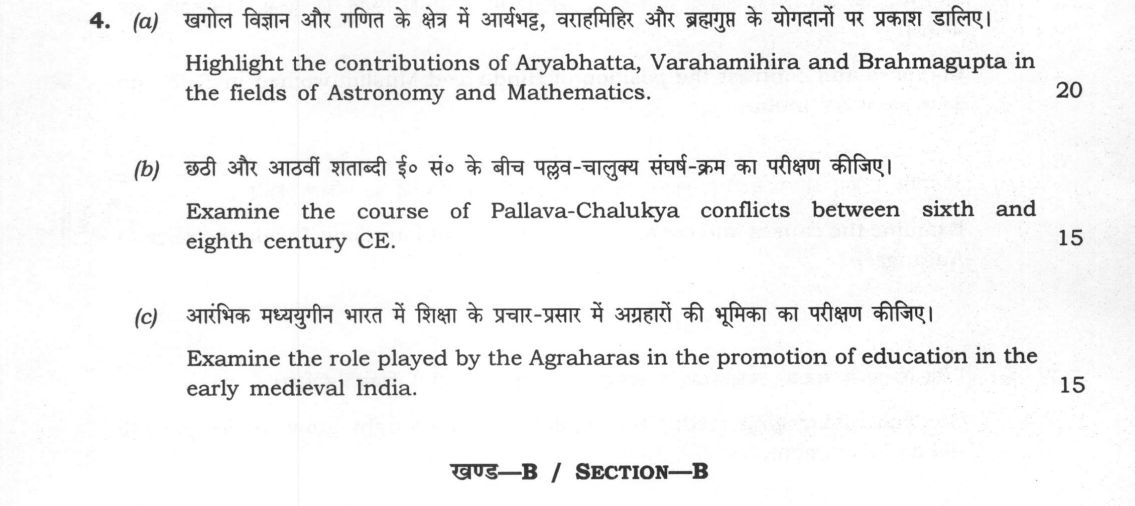
(a) Highlight the contributions of Aryabhatta, Varahamihira and Brahmagupta in the fields of Astronomy and Mathematics. (20…
Highlight the contributions of Aryabhatta, Varahamihira and Brahmagupta in the fields of Astronomy and Mathematics. 20 marks
Examine the course of Pallava-Chalukya conflicts between sixth and eighth century CE. 15 marks
Examine the role played by the Agraharas in the promotion of education in the early medieval India. 15 marks
हिंदी में प्रश्न पढ़ें
खगोल विज्ञान और गणित के क्षेत्र में आर्यभट्ट, वराहमिहिर और ब्रह्मगुप्त के योगदानों पर प्रकाश डालिए। (20 अंक)
छठी और आठवीं शताब्दी ई० सं० के बीच पल्लव-चालुक्य संघर्ष-क्रम का परीक्षण कीजिए। (15 अंक)
आरंभिक मध्ययुगीन भारत में शिक्षा के प्रचार-प्रसार में अग्रहारों की भूमिका का परीक्षण कीजिए। (15 अंक)
Model answer
Written by UPSC Answer Check against this question's marking rubric, to the expected length. UPSC does not publish answers for Mains — this is one way to score well, not an official key.
The classical and early medieval epochs witnessed seminal intellectual advancements alongside transformative political rivalries and institutional growth.
Astronomy and Mathematics: Aryabhatta, Varahamihira, and Brahmagupta
Aryabhatta (Aryabhatiya, 499 CE) laid the foundations of Indian classical mathematics and astronomy. He accurately calculated π to 3.1416, developed the place-value system with a functional zero concept, and formulated algebraic identities. In astronomy, he proposed that the Earth is spherical and rotates on its axis (offering proto-heliocentric hints), while providing correct scientific explanations for solar and lunar eclipses rather than mythological causes.
Varahamihira synthesized diverse astronomical traditions in his Panchasiddhantika, preserving Indian, Greco-Roman (Romaka and Paulisa), and Alexandrian systems. His encyclopedic work, Brihatsamhita, integrated planetary motions with meteorology, hydrology, and geography, bridging mathematical computation with natural sciences.
Brahmagupta (Brahmasphutasiddhanta, 628 CE) formalized operational rules for zero, including negative numbers and basic algebra. He introduced pioneering formulas for the area and diagonals of cyclic quadrilaterals, advanced solutions for indeterminate equations (Nx² + 1 = y²), and established early interpolation formulas in spherical astronomy.
Course of Pallava-Chalukya Conflicts (6th–8th Century CE)
Driven by imperial prestige, strategic control over the fertile Krishna-Tungabhadra doab, and supremacy over the Vengi region, the Pallava-Chalukya conflict began when Chalukya Pulakeshin II invaded the Tamil country and defeated Mahendravarman I (c. 630 CE). Pallava Narasimhavarman I reversed this loss in 642 CE by defeating Pulakeshin II, capturing and sacking the Chalukya capital Vatapi, and assuming the title Vatapikonda.
The struggle continued through alternating campaigns under Vikramaditya I and Parameshvaravarman I. This protracted warfare stimulated advanced siege operations, naval logistics (demonstrated in Narasimhavarman’s Sri Lankan expeditions), and competitive architectural patronages—exemplified by the monolithic rathas of Mamallapuram and the Virupaksha temple at Pattadakal. Ultimately, continuous mutual warfare drained the material resources of both empires, enabling the Rashtrakutas to replace the Chalukyas and facilitating the eventual rise of the imperial Cholas.
Role of Agraharas in Early Medieval Education
Agraharas (tax-free brahmadeya land grants endowed to Brahmins) under the Pallavas (such as the ghatikas of Kanchi), Badami Chalukyas, and Rashtrakutas functioned as prime centers of higher learning. They supported scholars who taught the Vedas, Dharmashastras, grammar, astronomy, and philosophy. These settlements maintained manuscript libraries and integrated temple-centered pedagogical spaces (mathas and salais).
However, critically, Agraharas fostered institutional elitism. Education was strictly confined to upper castes, utilizing Sanskrit as the sole medium while excluding vernacular dialects, technical crafts, and practical vocational knowledge. As Marxist historian D.D. Kosambi observed, Agraharas acted primarily as feudal instruments of ideological legitimation and socio-economic dominance, which restricted educational access and reinforced rigid social hierarchies.
Conclusion
The scientific rigor of Aryabhatta, Varahamihira, and Brahmagupta, the geopolitical dynamism of the Pallava-Chalukya conflicts, and the institutional framework of Agraharas collectively shaped the socio-political and intellectual infrastructure of early medieval Indian civilization.
What "Highlight" is asking you to do
Bring the notable features of the named material forward and make their weight visible — what each feature is, and what gives it importance. Highlight expects substantive coverage of the features, not a thin selection from them.
Structure that answers it
The material and what makes a feature notable within it → feature, with the point that gives it weight → the same for each further feature → the composite picture they form
Where marks are lost
Naming features flatly as a list and never showing why any one of them signifies.
How this answer will be evaluated
Approach
Framework: Context > Thesis > Evidence > Historiography. (a) highlight: name the salient points > one line of substance each > close | (b) examine: intro > how/why with reasoning > evidence > conclusion | (c) examine: intro > how/why with reasoning > evidence > conclusion Full marks: Thesis-driven, specific evidence, historiographical awareness, clear reasoning.
Key points expected
- Aryabhatta: Zero, decimal system, sine table, solar/lunar eclipses
- Varahamihira: Pancha-Siddhantika, planetary positions, astronomical calculations
- Brahmagupta: Zero as number, negative numbers, quadratic equations
- Specific works: Aryabhatiya, Pancha-Siddhantika, Brahmasphutasiddhanta
- Key battles: Mahendrapuri, Kanchipuram, Vengi
- Key rulers: Narasimhavarman I, Vikramaditya II, Dantidurga
- Reasoning: Strategic importance of Kanchipuram and Vengi
- Evidence: Inscriptions (e.g., Aihole, Kanchipuram)
Evaluation rubric
Each sub-part is marked on its own, against the marks and word limit printed on the paper.
- (a) Salient points of contributions of Aryabhatta, Varahamihira, and Brahmagupta in Astronomy and Mathematics. 20 marks
highlight— name the salient points → one line of substance each → close
Must cover
- Aryabhatta: Zero, decimal system, sine table, solar/lunar eclipses
- Varahamihira: Pancha-Siddhantika, planetary positions, astronomical calculations
- Brahmagupta: Zero as number, negative numbers, quadratic equations
- Specific works: Aryabhatiya, Pancha-Siddhantika, Brahmasphutasiddhanta
Loses marks
- General statements without specific contributions
- Confusing the three scholars' works
- Lack of distinction between astronomy and mathematics
Earns more
- Mention of specific formulas or theorems (e.g., Brahmagupta's formula)
- Context of their works (e.g., Gupta period, post-Gupta period)
- Influence on later Islamic and European mathematics
Extra mark
- Quotation from a primary source (e.g., Aryabhatiya)
- Reference to a specific modern historian's interpretation
- (b) Course of Pallava-Chalukya conflicts (6th-8th c. CE) with reasoning and evidence. 15 marks
examine— intro → how/why with reasoning → evidence → conclusion
Must cover
- Key battles: Mahendrapuri, Kanchipuram, Vengi
- Key rulers: Narasimhavarman I, Vikramaditya II, Dantidurga
- Reasoning: Strategic importance of Kanchipuram and Vengi
- Evidence: Inscriptions (e.g., Aihole, Kanchipuram)
Loses marks
- Chronology without analysis
- Lack of specific battles or rulers
- Textbook retelling without reasoning
Earns more
- Mention of specific inscriptions (e.g., Aihole inscription)
- Analysis of the political dynamics (e.g., shifting alliances)
- Impact on the region (e.g., cultural exchange)
Extra mark
- Map showing the conflict zones
- Timeline of the major battles
- (c) Role of Agraharas in promoting education in early medieval India with reasoning and evidence. 15 marks
examine— intro → how/why with reasoning → evidence → conclusion
Must cover
- Definition of Agrahara (land grants to Brahmins)
- Reasoning: Economic support for education, social status
- Evidence: Inscriptions (e.g., Chola, Rashtrakuta)
- Impact: Spread of Sanskrit, preservation of knowledge
Loses marks
- Lack of specific examples
- General statements without reasoning
- Confusing Agraharas with other land grants
Earns more
- Mention of specific Agraharas (e.g., Nripatunga Agrahara)
- Analysis of the social and economic context
- Comparison with other educational institutions (e.g., temples)
Extra mark
- Quotation from an inscription
- Reference to a specific historian's work
Practice this exact question
Write your answer and it is marked point by point against the model answer above — what you covered, what you missed, what you got wrong.
Evaluate my answer →More from History 2024 Paper I
- Q1 Identify the following places marked on the map supplied to you and write a short note of…
- Q2 (a) Harappan art contributes to our understanding of their aesthetic sensibilities in add…
- Q3 (a) Symbiotic relationships between Buddhist establishments, traders, artisan guilds, and…
- Q4 (a) Highlight the contributions of Aryabhatta, Varahamihira and Brahmagupta in the fields…
- Q5 Answer the following questions in about 150 words each: (a) Illustrate the main features…
- Q6 (a) Analyze the contributions of Acharya Triumvirate to Indian Vedanta. (20 marks) (b) Co…
- Q7 (a) "Instead of bringing credit, the Ibadat Khana brought growing discredit to Akbar." Co…