Paper I — Q6
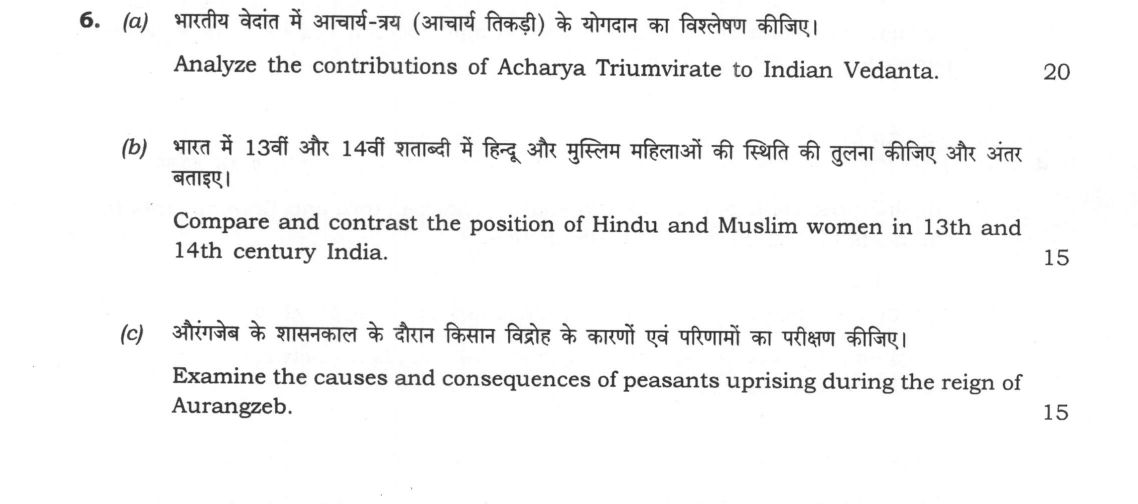
(a) Analyze the contributions of Acharya Triumvirate to Indian Vedanta. (20 marks) (b) Compare and contrast the position of Hindu…
Analyze the contributions of Acharya Triumvirate to Indian Vedanta. 20 marks
Compare and contrast the position of Hindu and Muslim women in 13th and 14th century India. 15 marks
Examine the causes and consequences of peasants uprising during the reign of Aurangzeb. 15 marks
हिंदी में प्रश्न पढ़ें
भारतीय वेदांत में आचार्य-त्रय (आचार्य तिकड़ी) के योगदान का विश्लेषण कीजिए। (20 अंक)
भारत में 13वीं और 14वीं शताब्दी में हिंदू और मुस्लिम महिलाओं की स्थिति की तुलना कीजिए और अंतर बताइए। (15 अंक)
औरंगजेब के शासनकाल के दौरान किसान विद्रोह के कारणों एवं परिणामों का परीक्षण कीजिए। (15 अंक)
Model answer
Written by UPSC Answer Check against this question's marking rubric, to the expected length. UPSC does not publish answers for Mains — this is one way to score well, not an official key.
Acharya Triumvirate. The Acharya Triumvirate reshaped Vedanta by making Brahman-jiva relation the axis of philosophy, ethics and social access. Shankara’s Advaita posited non-dual Brahman, treated the world as maya, and made moksha attainable through jnana; this elevated scriptural authority and rational discrimination but tended to locate liberation in knowledge rather than social action. Ramanuja’s Vishishtadvaita qualified monism: Brahman is real, souls and matter are its modes, and devotion (bhakti) with karma and divine grace opens salvation to shudras, thereby broadening Vedanta’s social horizon. Madhva’s Dvaita insisted on rigorous theism and eternal distinction between jiva and Brahman; his pancha-bheda—fivefold distinctions among God and souls, God and matter, souls and matter, soul and soul, and matter and matter—made difference ontologically central. Their divergences are not merely metaphysical: Shankara’s epistemology privileges shruti and negation, Ramanuja balances pramana, devotion and grace, while Madhva stresses Vedic authority, devotion and the reality of difference; soteriologically they move from jnana to bhakti to theistic surrender.
Women. In the 13th–14th centuries under the Delhi Sultanate, Hindu and Muslim women occupied overlapping but unequal social fields. Hindu women faced practices such as sati, child marriage, and purdah influence in some elite settings, which constrained mobility and widow remarriage; yet regional variations and class distinctions were sharp, with lower-caste and rural women often having more practical agency in labour and household management. Muslim women, under Sharia, had clearer property rights through mehr and inheritance, and elite households sometimes allowed educational access and patronage; yet seclusion and patriarchal interpretation limited public life. Urban centres showed syncretism: shared domestic norms, Sufi-Vedantic interactions, and class-based emulation meant that “Hindu” and “Muslim” womanhood were not monolithic.
Peasant uprisings. Aurangzeb’s agrarian crisis produced peasant uprisings because jizya’s reimposition (1679), revenue farming (ijara), forced conversions, and temple destruction disrupted village ritual and fiscal stability. Jat revolts (1669–70, 1672, 1688–89) and Satnami resistance (1672) were rooted in peasant-taxation grievances; Sikh uprisings (1675–1707) fused religious persecution with agrarian distress. Bundela resistance under Chhatrasal (from the 1670s) was chiefly Rajput/regional rather than a peasant revolt, but it reflected the same fiscal and ritual pressures. Consequences included accelerated Maratha and Sikh militarization, administrative decentralization, ideological shift toward regional identities, and long-term weakening of the Mughal agrarian base.
Thus the Triumvirate’s Vedanta supplied frameworks of difference, devotion and access that later social actors could mobilize, while women’s and peasants’ experiences show that philosophical egalitarianism did not erase caste, gender or fiscal exploitation.
What "Analyse" is asking you to do
Break the subject into its working parts and show how they act on each other. The marks are in the interconnections — which factor drives which, and what the resulting structure explains — not in the inventory of factors.
Structure that answers it
Define the whole → separate it into its parts → show which part drives which → what that interaction produces → what the structure implies
Where marks are lost
A flat list of causes with no account of which drives which. An answer of neatly separated headings, each self-contained, scores as description.
How this answer will be evaluated
Approach
Framework: UPSC History Paper 1 (Context > Thesis > Evidence > Historiography). (a) analyse: intro > causes > effects > stakeholders/linkages > way forward | (b) compare: paired headings or table > key differences > significance > conclusion | (c) examine: intro > how/why with reasoning > evidence > conclusion Full marks: Precise philosophical/legal distinctions; specific sources cited; strong analytical linkages.
Key points expected
- Identify the three specific Acharyas (Shankara, Ramanuja, Madhva)
- Define the specific Vedanta school each represents (Advaita, Vishishtadvaita, Dvaita)
- Analyze the core ontological difference (Brahman vs. Ishvara)
- Explain the epistemological stance (Pratyaksha, Anumana, Shabda)
- Contrast legal rights (inheritance, divorce, dower)
- Compare social practices (Sati vs. Purdah)
- Discuss the role of the state (Sultanate vs. Rajput courts)
- Highlight the concept of 'Jahil' or 'Purdah' for Muslim women
Evaluation rubric
Each sub-part is marked on its own, against the marks and word limit printed on the paper.
- (a) Critical analysis of the specific philosophical contributions of the Acharya Triumvirate to Vedanta. 20 marks
analyse— intro → causes → effects → stakeholders/linkages → way forward
Must cover
- Identify the three specific Acharyas (Shankara, Ramanuja, Madhva)
- Define the specific Vedanta school each represents (Advaita, Vishishtadvaita, Dvaita)
- Analyze the core ontological difference (Brahman vs. Ishvara)
- Explain the epistemological stance (Pratyaksha, Anumana, Shabda)
Loses marks
- Narrative biography instead of philosophical analysis
- Confusing the tenets of the three schools
- Generalizing 'Vedanta' without specific school details
Earns more
- Mention specific texts (Brahma Sutra Bhashya, Sri Bhashya)
- Reference the concept of 'Mukti' or liberation
- Discuss the role of Bhakti in the later two schools
- Mention the concept of 'Maya' in Advaita
Extra mark
- Cite a specific verse from Brahma Sutra
- Name a specific modern scholar (e.g., Radhakrishnan)
- (b) Comparative assessment of the social and legal status of Hindu and Muslim women in 13th-14th century India. 15 marks
compare— paired headings or table → key differences → significance → conclusion
Must cover
- Contrast legal rights (inheritance, divorce, dower)
- Compare social practices (Sati vs. Purdah)
- Discuss the role of the state (Sultanate vs. Rajput courts)
- Highlight the concept of 'Jahil' or 'Purdah' for Muslim women
Loses marks
- Generalizing 'women' without religious distinction
- Ignoring the 13th-14th century specific context
- Focusing only on elite women without mentioning commoners
Earns more
- Mention the 'Sati' practice in Rajput courts
- Reference the 'Mahr' (dower) in Islamic law
- Discuss the 'Zihar' or 'Talaq' rights
- Mention the 'Jahil' or 'Purdah' system
Extra mark
- Cite a specific chronicle (e.g., Minhaj-i-Siraj)
- Reference a specific inscription or legal text
- (c) Examination of the causes and consequences of peasant uprisings during Aurangzeb's reign. 15 marks
examine— intro → how/why with reasoning → evidence → conclusion
Must cover
- Identify specific causes (Zakat, Jizya, land revenue)
- Name specific uprisings (Marathas, Jats, Satnamis)
- Analyze the consequences (fiscal crisis, military overstretch)
- Link the uprisings to the decline of the Mughal Empire
Loses marks
- Listing uprisings without analyzing causes
- Ignoring the economic/fiscal dimension
- Focusing only on one region (e.g., only Deccan)
Earns more
- Mention the 'Zakat' tax on non-Muslims
- Reference the 'Jizya' tax
- Discuss the 'Zabt' or land revenue system
- Mention the 'Maratha' guerrilla warfare
Extra mark
- Cite a specific Mughal document or chronicle
- Reference a specific historian (e.g., Jadunath Sarkar)
Practice this exact question
Write your answer and it is marked point by point against the model answer above — what you covered, what you missed, what you got wrong.
Evaluate my answer →More from History 2024 Paper I
- Q3 (a) Symbiotic relationships between Buddhist establishments, traders, artisan guilds, and…
- Q4 (a) Highlight the contributions of Aryabhatta, Varahamihira and Brahmagupta in the fields…
- Q5 Answer the following questions in about 150 words each: (a) Illustrate the main features…
- Q6 (a) Analyze the contributions of Acharya Triumvirate to Indian Vedanta. (20 marks) (b) Co…
- Q7 (a) "Instead of bringing credit, the Ibadat Khana brought growing discredit to Akbar." Co…
- Q8 (a) Discuss the contributions of Bahmani Sultans to the development of Indo-Islamic archi…