Paper I — Q7
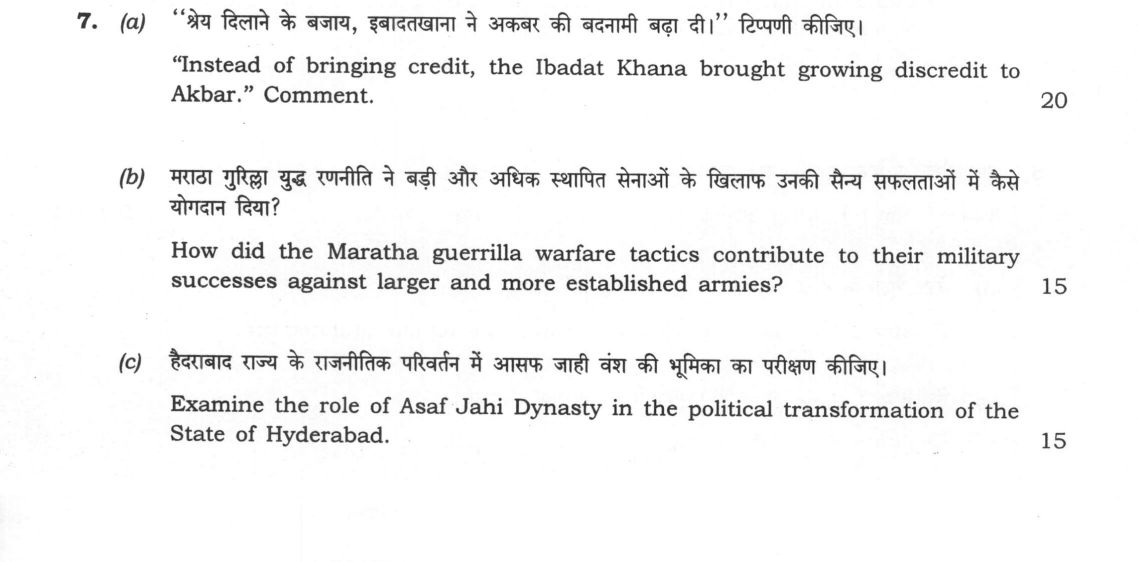
(a) "Instead of bringing credit, the Ibadat Khana brought growing discredit to Akbar." Comment. (20 marks) (b) How did the…
"Instead of bringing credit, the Ibadat Khana brought growing discredit to Akbar." Comment. 20 marks
How did the Maratha guerrilla warfare tactics contribute to their military successes against larger and more established armies? 15 marks
Examine the role of Asaf Jahi Dynasty in the political transformation of the State of Hyderabad. 15 marks
हिंदी में प्रश्न पढ़ें
"श्रेय दिलाने के बजाय, इबादतखाना ने अकबर की बदनामी बढ़ा दी।" टिप्पणी कीजिए। (20 अंक)
मराठा गुरिल्ला युद्ध रणनीति ने बड़ी और अधिक स्थापित सेनाओं के खिलाफ उनकी सैन्य सफलताओं में कैसे योगदान दिया? (15 अंक)
हैदराबाद राज्य के राजनीतिक परिवर्तन में आसफ जाही वंश की भूमिका का परीक्षण कीजिए। (15 अंक)
Model answer
Written by UPSC Answer Check against this question's marking rubric, to the expected length. UPSC does not publish answers for Mains — this is one way to score well, not an official key.
Ibadat Khana: Credit versus Discredit
Established in 1575 at Fatehpur Sikri, the Ibadat Khana initially sought to resolve theological questions within Sunni Islam. However, the bitter squabbling among the ulema compelled Akbar to expand debates to Christians, Jains, Zoroastrians, and Hindus. While modern historiography views this intellectual openness as the foundation for Sulh-i-Kul (universal peace), in contemporary terms it brought Akbar growing discredit. The orthodox Sunni establishment interpreted these debates, the Mahzar of 1579, and the later Din-i-Ilahi (1582) as state apostasy and an assault on Islamic orthodoxy. Contemporary chroniclers like Abdul Qadir Badauni articulated deep conservative hostility, which directly fueled the dangerous 1580–81 rebellions in Bengal and Bihar backed by fatwas in support of Mirza Hakim. Thus, although Akbar sustained administrative functionality and political consolidation through Rajput alliances and mansabdari reforms, the Ibadat Khana generated severe domestic discredit among influential orthodox elites.
Maratha Guerrilla Warfare and Asymmetric Success
The Marathas neutralized the numerical and technological superiority of imperial forces by deploying Ganimi Kawa (guerrilla tactics). Operating within the rugged Sahyadri terrain and anchored by formidable hill forts like Raigad and Sinhagad, Maratha forces systematically avoided pitched, open-field battles. Instead, they relied on highly mobile light cavalry (Bargirs), rapid hit-and-run strikes, night ambushes, and the severing of extended Mughal supply lines, backed by superior local logistics. This doctrine produced celebrated successes against far larger armies, such as the destruction of Afzal Khan’s Bijapuri force (1659) and the surprise raid on Shaista Khan at Pune (1663). During Aurangzeb’s prolonged Deccan campaigns (1681–1707), this decentralised guerrilla resistance exhausted imperial treasuries, demoralised Mughal troops, and ultimately broke the empire's military momentum.
Asaf Jahi Dynasty and Hyderabad's Statehood
The Asaf Jahi dynasty orchestrated the political transformation of the Deccan from a Mughal administrative province into an autonomous regional entity. In 1724, Nizam-ul-Mulk (Mir Qamar-ud-din) defeated the imperial governor at the Battle of Shakar Kheda, establishing de facto independence and hereditary rule while maintaining symbolic Mughal suzerainty. The dynasty provided institutional stability by retaining Mughal mansabdari, jagirdari, and revenue structures. To survive aggressive Maratha expansion and European rivalries, Hyderabad under Nizam Ali Khan became the first state to enter Lord Wellesley's Subsidiary Alliance in 1798 and 1800. This diplomatic realignment transformed Hyderabad into the premier protected princely state, ensuring its political survival until its integration into independent India in 1948.
In verdict, while the Ibadat Khana exposed the limits of imperial theological mediation by provoking orthodox backlash, the rise of Maratha guerrilla warfare and the emergence of the Asaf Jahi state in Hyderabad illustrate the military and political decentralisation that dismantled Mughal hegemony across India.
What "Comment" is asking you to do
Take a position on the statement and support it. Comment usually attaches to a quoted line in the short slots, so the reasoning must be compressed — an opening view, a few load-bearing reasons, and the limit of the claim.
Structure that answers it
Unpack what the statement asserts → your stance → two or three supporting reasons → the qualification that limits it
Where marks are lost
Neutral summary; a comment without a stance has not answered. Equally costly is accepting the quoted line wholesale and never testing where it fails.
How this answer will be evaluated
Approach
Framework: Context > Thesis > Evidence > Historiography. (a) comment: context > arguments both sides > judgment > close | (b) explain: definition/context > points in order > small example > short close | (c) examine: intro > how/why with reasoning > evidence > conclusion Full marks: Thesis-driven, cites specific sources/historians, clear judgment.
Key points expected
- Define Ibadat Khana's purpose and membership
- Arguments for its credit (syncretism, policy)
- Arguments for its discredit (orthodox backlash)
- Final judgment on the statement
- Definition of guerrilla tactics (hit-and-run)
- Use of terrain (Western Ghats) for advantage
- Disruption of enemy supply lines
- Psychological impact on established armies
Evaluation rubric
Each sub-part is marked on its own, against the marks and word limit printed on the paper.
- (a) Contextualize Ibadat Khana and judge its impact on Akbar's reputation. 20 marks
comment— context → arguments both sides → judgment → close
Must cover
- Define Ibadat Khana's purpose and membership
- Arguments for its credit (syncretism, policy)
- Arguments for its discredit (orthodox backlash)
- Final judgment on the statement
Loses marks
- Narrative retelling without judgment
- Ignoring the 'discredit' aspect of the prompt
Earns more
- Mention of specific debates (e.g., cow slaughter)
- Reference to Abul Fazl or court chronicles
- Link to Sulh-i-kul policy
Extra mark
- Citation of a specific historian's view
- Mention of the Din-i-Ilahi connection
- (b) Explain how guerrilla tactics enabled Maratha success against larger armies. 15 marks
explain— definition/context → points in order → small example → short close
Must cover
- Definition of guerrilla tactics (hit-and-run)
- Use of terrain (Western Ghats) for advantage
- Disruption of enemy supply lines
- Psychological impact on established armies
Loses marks
- Generalizing without tactical specifics
- Focusing only on Shivaji's biography
Earns more
- Reference to specific battles (e.g., Panipat 1761)
- Mention of 'Ganimat' (plunder) as a resource
- Comparison with Mughal standing army
Extra mark
- Mention of specific Maratha commanders
- Reference to a specific historical source
- (c) Examine the Asaf Jahi role in Hyderabad's political transformation. 15 marks
examine— intro → how/why with reasoning → evidence → conclusion
Must cover
- Transition from Mughal Nizam to independent ruler
- Establishment of the Nizam's administrative system
- Relationship with the British (subsidiary alliance)
- Consolidation of the Deccan region
Loses marks
- Chronological list without analysis
- Ignoring the 'political transformation' aspect
Earns more
- Mention of the Treaty of Bassein
- Reference to specific Nizams (e.g., Nizam I, Nizam II)
- Discussion of the 'Nizam's Army' structure
Extra mark
- Citation of a specific treaty date
- Mention of a specific administrative reform
Practice this exact question
Write your answer and it is marked point by point against the model answer above — what you covered, what you missed, what you got wrong.
Evaluate my answer →More from History 2024 Paper I
- Q4 (a) Highlight the contributions of Aryabhatta, Varahamihira and Brahmagupta in the fields…
- Q5 Answer the following questions in about 150 words each: (a) Illustrate the main features…
- Q6 (a) Analyze the contributions of Acharya Triumvirate to Indian Vedanta. (20 marks) (b) Co…
- Q7 (a) "Instead of bringing credit, the Ibadat Khana brought growing discredit to Akbar." Co…
- Q8 (a) Discuss the contributions of Bahmani Sultans to the development of Indo-Islamic archi…