Paper I — Q8
(a) Discuss the contributions of Bahmani Sultans to the development of Indo-Islamic architecture. (20 marks) (b) Evaluate the…
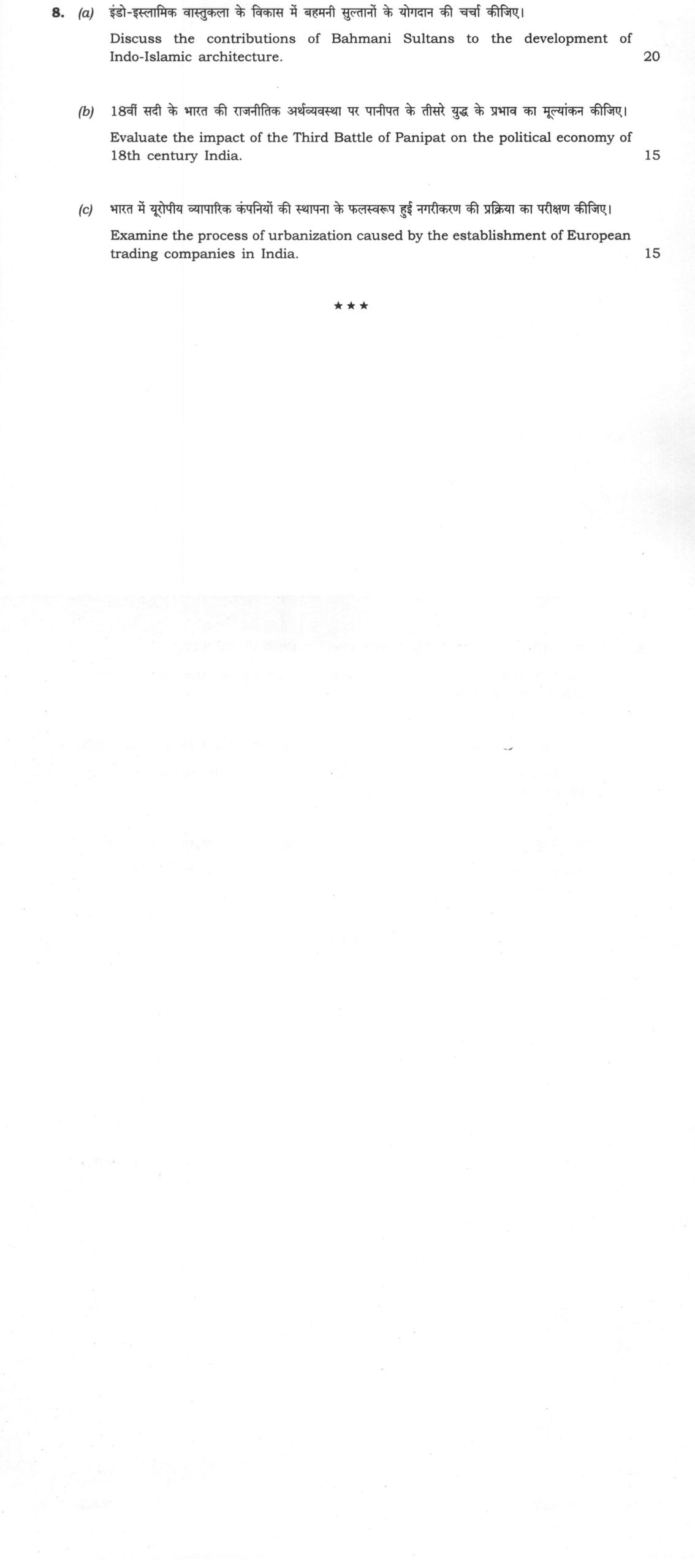
Discuss the contributions of Bahmani Sultans to the development of Indo-Islamic architecture. 20 marks
Evaluate the impact of the Third Battle of Panipat on the political economy of 18th century India. 15 marks
Examine the process of urbanization caused by the establishment of European trading companies in India. 15 marks
हिंदी में प्रश्न पढ़ें
इंडो-इस्लामिक वास्तुकला के विकास में बहमनी सुल्तानों के योगदान की चर्चा कीजिए। (20 अंक)
18वीं सदी के भारत की राजनीतिक अर्थव्यवस्था पर पानीपत के तीसरे युद्ध के प्रभाव का मूल्यांकन कीजिए। (15 अंक)
भारत में यूरोपीय व्यापारिक कंपनियों की स्थापना के फलस्वरूप हुई नगरीकरण की प्रक्रिया का परीक्षण कीजिए। (15 अंक)
Model answer
Written by UPSC Answer Check against this question's marking rubric, to the expected length. UPSC does not publish answers for Mains — this is one way to score well, not an official key.
The Bahmani Sultans developed a Deccani Indo-Islamic idiom drawing on Persian, Central Asian and local Hindu elements. Under Ahmad Shah Wali and Firuz Shah, patronage produced monumental mosques, tombs and forts with bulbous domes, minarets, arched portals and bands of Arabic/Persian calligraphy. The Jama Masjid at Gulbarga, with its large domed prayer hall and no conventional courtyard, shows a distinctive Bahmani plan. Their forts and tombs used granite and lime plaster, while calligraphic inscriptions asserted royal legitimacy. This patronage linked courtly power to public architecture, making mosques and tombs instruments of statecraft. The synthesis of Persian-Deccan forms, with tilework and chhatris, made Bahmani architecture distinct from Delhi Sultanate precedents and a bridge to later Deccani schools. Later Deccani works, such as Bijapur’s Gol Gumbaz under Muhammad Adil Shah and Bidar Fort’s Rangin Mahal, reflect the same bulbous-dome and tilework vocabulary, but belong to Adil Shahi and Barid Shahi phases rather than the Bahmani state itself.
The Third Battle of Panipat (1761) was a shock to Maratha power: heavy casualties, loss of leaders and temporary Afghan ascendancy under Ahmad Shah Durrani disrupted the Gangetic plain. Yet it did not destroy Maratha capacity; under Peshwa Madhavrao I the Marathas recovered, re-entered Delhi in 1771 and remained a major force. Economically, the battle increased insecurity along Punjab–Haryana–Uttar Pradesh routes, disturbed trade and revenue collection, and encouraged states to seek protection. This fragmentation of Mughal successor states created a context in which the Company, consolidated after Plassey (1757) and Buxar (1764), could later use subsidiary alliances from Wellesley’s period (1798) to bind states to its fiscal-military system. Panipat thus accelerated resource mobilisation for Company-backed states, but was not the sole cause of British expansion.
European trading companies transformed Indian towns by linking ports to inland markets. Fort St George at Madras, Fort William at Calcutta and Bombay Castle became fortified administrative nuclei. Around them, spatial segregation developed: White Towns for Europeans and Black Towns for Indian merchants, artisans and labour, with walls, gates and customs controls. These port-cities became nodal points for textile procurement, opium trade infrastructure, banking, insurance and agency houses. Demand for cloth, arms, food and ship supplies drew artisans, weavers, moneylenders and migrants, creating labour markets and urban hierarchies. Company towns thus reorganised settlement patterns, credit networks and consumption, making urban growth an instrument of colonial trade rather than organic expansion.
Together, these show early modern transformation: Bahmani patronage shaped state identity, Panipat deepened fragmentation, and Company towns redirected commerce toward colonial power.
What "Discuss" is asking you to do
Lay the issue out from more than one side — how it arose, what is claimed for it, what is held against it, and where it now stands. UPSC attaches discuss to broad topics with several live dimensions, so coverage of the dimensions earns more than the strength of your opinion.
Structure that answers it
Set the issue up → the case as it is made → the case against → the dimension both sides leave out → where the balance now lies
Where marks are lost
Listing facts with no thread between them, or arguing one side throughout and calling it a discussion.
How this answer will be evaluated
Approach
Framework: UPSC History Paper 1 Rubric. (a) discuss: intro > 3-4 dimensions > example > balanced close | (b) evaluate: criteria > evidence > balanced judgment | (c) examine: intro > how/why with reasoning > evidence > conclusion Full marks: Comprehensive, analytical, and well-supported with specific examples and sources.
Key points expected
- Identify Bahmani style as a distinct Indo-Islamic synthesis
- Cite specific monuments (e.g., Gol Gumbaz, Qutub Shahi links)
- Analyze structural features (e.g., octagonal domes, local materials)
- Contextualize within broader Deccan architectural evolution
- Assess impact on Mughal central authority and revenue
- Analyze rise of regional powers (Marathas, Nizam, etc.)
- Discuss economic consequences (trade, taxation, land revenue)
- Provide a balanced judgment on long-term political fragmentation
Evaluation rubric
Each sub-part is marked on its own, against the marks and word limit printed on the paper.
- (a) Analytical discussion of Bahmani architectural contributions to Indo-Islamic synthesis. 20 marks
discuss— intro → 3-4 dimensions → example → balanced close
Must cover
- Identify Bahmani style as a distinct Indo-Islamic synthesis
- Cite specific monuments (e.g., Gol Gumbaz, Qutub Shahi links)
- Analyze structural features (e.g., octagonal domes, local materials)
- Contextualize within broader Deccan architectural evolution
Loses marks
- Generic description of Islamic architecture without Bahmani specifics
- Chronological listing of buildings without analysis
- Confusing Bahmani with later Qutub Shahi or Adil Shahi styles
Earns more
- Mention specific Sultans (e.g., Muhammad Shah, Ibrahim Adil Shah)
- Reference specific architectural elements (e.g., jali work, minarets)
- Compare with contemporary Mughal or Vijayanagara styles
- Discuss the role of local craftsmen and traditions
Extra mark
- Cite a specific architectural historian (e.g., S. G. Chandra)
- Reference a specific inscription or chronicle
- (b) Evaluation of Panipat's impact on 18th-century political economy. 15 marks
evaluate— criteria → evidence → balanced judgment
Must cover
- Assess impact on Mughal central authority and revenue
- Analyze rise of regional powers (Marathas, Nizam, etc.)
- Discuss economic consequences (trade, taxation, land revenue)
- Provide a balanced judgment on long-term political fragmentation
Loses marks
- Focusing only on the military aspects of the battle
- Ignoring the economic dimension of the question
- Presenting a one-sided view without evaluation
Earns more
- Mention specific economic changes (e.g., decline of Mughal trade)
- Reference specific regional powers and their economic policies
- Discuss the role of the Maratha Confederacy
- Analyze the impact on the agrarian economy
Extra mark
- Cite a specific economic historian (e.g., Irfan Habib)
- Reference a specific economic source or document
- (c) Examination of urbanization caused by European trading companies. 15 marks
examine— intro → how/why with reasoning → evidence → conclusion
Must cover
- Identify key trading companies (e.g., EIC, VOC)
- Analyze the growth of port cities (e.g., Bombay, Calcutta, Madras)
- Discuss the economic and social changes in these cities
- Examine the impact on traditional urban centers
Loses marks
- Focusing only on the political aspects of the trading companies
- Ignoring the economic and social dimensions of urbanization
- Presenting a one-sided view without examination
Earns more
- Mention specific trading companies and their roles
- Reference specific port cities and their development
- Discuss the role of the EIC in urban planning
- Analyze the impact on the local population and economy
Extra mark
- Cite a specific urban historian (e.g., R. E. F. Smith)
- Reference a specific urban plan or document
Practice this exact question
Write your answer and it is marked point by point against the model answer above — what you covered, what you missed, what you got wrong.
Evaluate my answer →More from History 2024 Paper I
- Q5 Answer the following questions in about 150 words each: (a) Illustrate the main features…
- Q6 (a) Analyze the contributions of Acharya Triumvirate to Indian Vedanta. (20 marks) (b) Co…
- Q7 (a) "Instead of bringing credit, the Ibadat Khana brought growing discredit to Akbar." Co…
- Q8 (a) Discuss the contributions of Bahmani Sultans to the development of Indo-Islamic archi…