Paper II — Q1
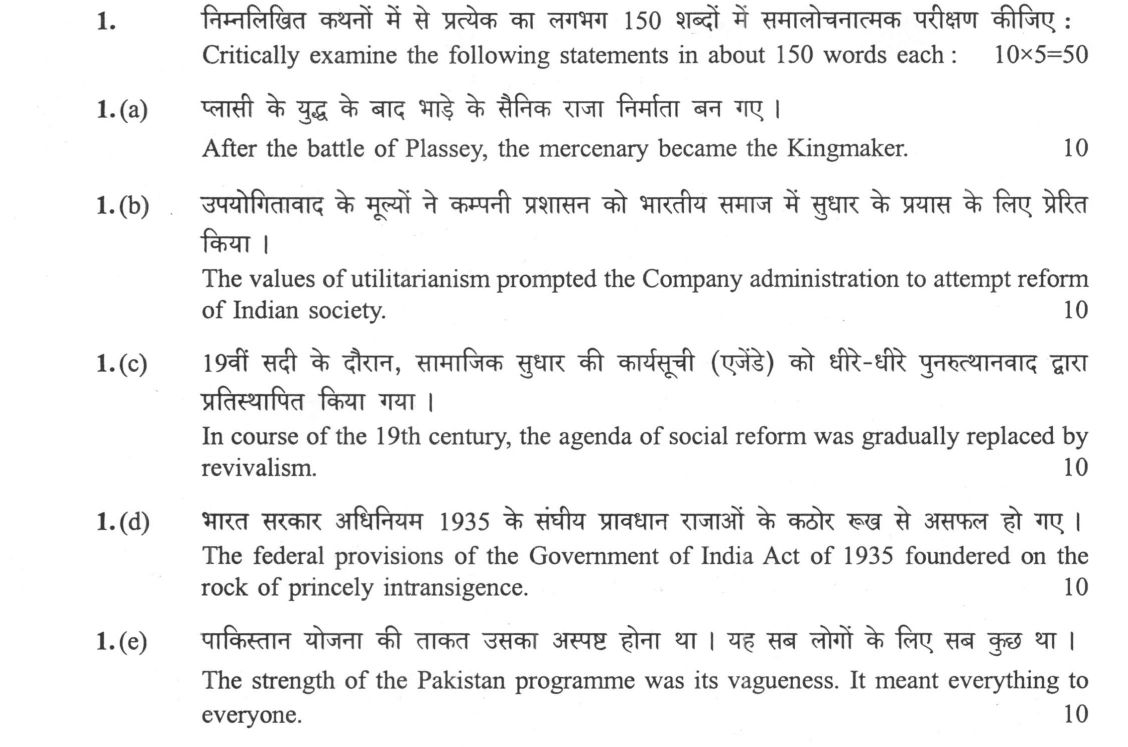
Critically examine the following statements in about 150 words each: (a) After the battle of Plassey, the mercenary became the…
Critically examine the following statements in about 150 words each: After the battle of Plassey, the mercenary became the Kingmaker. 10 marks
The values of utilitarianism prompted the Company administration to attempt reform of Indian society. 10 marks
In course of the 19th century, the agenda of social reform was gradually replaced by revivalism. 10 marks
The federal provisions of the Government of India Act of 1935 foundered on the rock of princely intransigence. 10 marks
The strength of the Pakistan programme was its vagueness. It meant everything to everyone. 10 marks
हिंदी में प्रश्न पढ़ें
निम्नलिखित कथनों में से प्रत्येक का लगभग 150 शब्दों में समालोचनात्मक परीक्षण कीजिए : प्लासी के युद्ध के बाद भाड़े के सैनिक राजा निर्माता बन गए । 10 marks
उपयोगितावाद के मूल्यों ने कम्पनी प्रशासन को भारतीय समाज में सुधार के प्रयास के लिए प्रेरित किया । 10 marks
19वीं सदी के दौरान, सामाजिक सुधार की कार्यसूची (एजेंडे) को धीरे-धीरे पुनरुत्थानवाद द्वारा प्रतिस्थापित किया गया । 10 marks
भारत सरकार अधिनियम 1935 के संघीय प्रावधान राजाओं के कठोर रूख से असफल हो गए । 10 marks
पाकिस्तान योजना की ताकत उसका अस्पष्ट होना था । यह सब लोगों के लिए सब कुछ था । 10 marks
Model answer
Written by UPSC Answer Check against this question's marking rubric, to the 150-word length. UPSC does not publish answers for Mains — this is one way to score well, not an official key.
Post-Plassey Mercenarism and Kingmaking
The 1757 Battle of Plassey transformed the English East India Company from an armed trading corporation into a decisive political power broker. Deploying disciplined mercenary sepoy battalions and financial leverage, Robert Clive manipulated internal court rivalries in Bengal, deposing Siraj-ud-Daulah to install client rulers—initially Mir Jafar and subsequently Mir Qasim. When Mir Qasim attempted to assert administrative independence, the Company defeated the combined indigenous forces at Buxar (1764). The resulting Treaty of Allahabad (1765) formalized this kingmaker role by securing the Diwani of Bengal, Bihar, and Orissa, yielding immense fiscal and military hegemony. However, characterising the Company merely as a kingmaker captures only a transitory phase. Through Lord Wellesley’s Subsidiary Alliance and subsequent direct annexations under the Doctrine of Lapse, the British systematically demobilized indigenous military labor markets and dismantled native monarchies. The mercenary did not merely make Indian kings; the Company permanently eclipsed indigenous kingship to institute centralized colonial sovereignty.
Utilitarianism and Company Social Reform
Influenced by the philosophical radicalism of Jeremy Bentham and James Mill, the Company administration in the 1820s and 1830s adopted an interventionist stance toward Indian society. Under Lord William Bentinck and Thomas Babington Macaulay, Utilitarian tenets prioritizing rational governance, legal uniformity, and societal utility prompted major social legislation: the abolition of Sati (Regulation XVII, 1829), the suppression of Thuggee, the introduction of Western education (1835), and the initiation of legal codification through the Law Commission. Nevertheless, this reformist impulse had clear structural limits. Utilitarian engineering was fundamentally deployed to establish administrative efficiency, legal predictability, and social order essential for revenue extraction and commercial dominance, rather than uncompromised human emancipation. Moreover, whenever social intervention risked triggering widespread political unrest or military mutiny, the colonial state readily subordinated reformist zeal to imperial security. Utilitarianism thus functioned primarily as a modernising rationale to legitimate and stabilize colonial dominion.
Transition from Reform to Revivalism
The nineteenth-century socio-religious landscape experienced an ideological shift from early liberal rationalism to late-century cultural revivalism. Early reformers like Raja Rammohan Roy and Ishwar Chandra Vidyasagar relied on rationalist inquiry, individual rights, and colonial legislative support to eradicate social evils like Sati and child marriage. By the late nineteenth century, growing disillusionment with Westernization, colonial racial arrogance, and controversies like the Age of Consent Act (1891) generated reform fatigue. Figures such as Dayanand Saraswati (Arya Samaj) and Swami Vivekananda shifted focus toward indigenous civilizational pride, Vedic authority, and Vedantic self-assertion, aligning social regeneration with nascent cultural nationalism. However, revivalism was not an outright repudiation of reform. Revivalist movements consistently retained modernizing components, aggressively promoting female education, social service, and the eradication of untouchability. Rather than a total replacement, revivalism represented an internal evolution—shifting social reform from colonial dependency toward self-reliant, nationalist-oriented mobilization.
The 1935 Federal Scheme and Princely Resistance
The Government of India Act of 1935 proposed an All-India Federation comprising British Indian provinces and princely states, introducing Dyarchy at the Centre. This federal scheme foundered substantially on princely resistance. Accession to the federation was voluntary for the rulers, and prominent states—including Hyderabad, Travancore, and Junagadh—prevaricated indefinitely. Princes feared that integration would erode their treaty rights, compromise fiscal autonomy, and expose their autocracies to popular democratic pressures spilling over from British India. Even so, princely intransigence was not the sole cause of failure. The Indian National Congress rejected the federal provisions because the Act granted disproportionate representation to autocratic, nominated princely delegates and retained sweeping viceregal vetoes. Concurrently, the Muslim League feared a permanent Hindu-majority central legislature. Thus, the federal structure collapsed not merely due to princely recalcitrance, but due to an irreconcilable tripartite deadlock among the Princes, the Congress, and the colonial state.
Tactical Ambiguity of the Pakistan Programme
The Pakistan programme derived its primary political momentum from its calculated lack of precise definition. The 1940 Lahore Resolution deliberately used ambiguous phraseology—calling for geographically contiguous units to be demarcated into "Independent States"—without defining exact territorial boundaries or institutional mechanics. This strategic vagueness enabled Muhammad Ali Jinnah to construct a broad, heterogeneous Muslim coalition. Landlords in Punjab and Sindh saw it as a shield against Congress’s redistributive agrarian agenda; the minority-province Muslim elite in UP and Bihar envisioned protection from majority rule; the Bengali peasantry anticipated relief from zamindari exploitation; and orthodox ulama projected it as an ideal Islamic polity. Yet, this very strength became a devastating liability during implementation. The lack of a concrete constitutional and demographic blueprint led to intense administrative confusion during the 1947 Partition, directly contributing to the Radcliffe Line's chaotic execution, unprecedented communal violence, and long-term structural instability in the newly formed state.
What "Critically examine" is asking you to do
Test the proposition the question puts to you and return a finding on how far it holds. Examine stems carry a claim, or ask whether something has happened, and expect evidence weighed both ways before the extent is stated — often with remedial measures attached. “Critically” is not a section added at the end: name the yardstick you are judging by — the evidence, the stated objective, a constitutional principle, a rival explanation — and let a verdict close each part of the body. Where the question quotes a claim, that verdict must land on the claim itself, accepted, qualified or rejected, and not on the theme in general.
Structure that answers it
Restate the claim as the question frames it → evidence that supports it → evidence that undercuts it → the conditions under which it holds → verdict on how far it stands
Where marks are lost
Merits in one paragraph, demerits in the next, and a conclusion calling for a balanced and holistic approach. That is a survey with the judgement left out and it holds the answer in the middle band. The opposite error is reading “critically” as permission to attack — and with the odd pairings, critically describe or critically explain, the exposition still carries most of the marks, the judgement being a layer on it rather than a substitute for it.
How this answer will be evaluated
Approach
Framework: Context > Thesis > Evidence > Historiography. (a) critique: the claim > its strengths > its weaknesses > your judgment | (b) critique: the claim > its strengths > its weaknesses > your judgment | (c) critique: the claim > its strengths > its weaknesses > your judgment | (d) critique: the claim > its strengths > its weaknesses > your judgment | (e) critique: the claim > its strengths > its weaknesses > your judgment Full marks: Thesis-driven, cites specific sources/historians, nuanced critique of the statement
Key points expected
- Define 'Kingmaker' in the context of the Nawabs of Bengal
- Cite the Treaty of Allahabad (1765) and the grant of Diwani
- Explain the separation of Diwani and Nizamat powers
- Analyze the role of Robert Clive in the political maneuvering
- Define Utilitarianism (greatest good for greatest number)
- Link specific reforms (e.g., Sati Abolition) to Utilitarian logic
- Mention key figures like Macaulay or Bentham
- Critically assess if motives were purely philosophical or political
Evaluation rubric
Each sub-part is marked on its own, against the marks and word limit printed on the paper.
- (a) Assess the validity of the claim that the East India Company acted as a puppet master post-1757. 10 marks · 150 words
critique— the claim → its strengths → its weaknesses → your judgment
Must cover
- Define 'Kingmaker' in the context of the Nawabs of Bengal
- Cite the Treaty of Allahabad (1765) and the grant of Diwani
- Explain the separation of Diwani and Nizamat powers
- Analyze the role of Robert Clive in the political maneuvering
Loses marks
- Narrating the battle without analyzing the political aftermath
- Confusing the Battle of Buxar with Plassey
- Failing to define the specific meaning of 'Kingmaker'
Earns more
- Mention the 'Dual Government' system
- Reference the 'Black Hole of Calcutta' as a precursor
- Discuss the financial exploitation of the Diwani rights
Extra mark
- Quote from a primary source like the Treaty of Allahabad
- Reference a specific historian like Sumit Sarkar
- (b) Evaluate the extent to which Utilitarian philosophy drove the Company's social reforms. 10 marks · 150 words
critique— the claim → its strengths → its weaknesses → your judgment
Must cover
- Define Utilitarianism (greatest good for greatest number)
- Link specific reforms (e.g., Sati Abolition) to Utilitarian logic
- Mention key figures like Macaulay or Bentham
- Critically assess if motives were purely philosophical or political
Loses marks
- Listing reforms without linking them to Utilitarian values
- Ignoring the political context of the reforms
- Treating the statement as an absolute fact without critique
Earns more
- Reference the 'Civilizing Mission' concept
- Mention the role of the Indian Press in these debates
- Contrast with the 'Orientalist' school of thought
Extra mark
- Quote from Macaulay's Minute on Education
- Reference a specific Act like the Sati Regulation 1829
- (c) Analyze the shift from social reform to cultural revivalism in the 19th century. 10 marks · 150 words
critique— the claim → its strengths → its weaknesses → your judgment
Must cover
- Define 'Social Reform' vs 'Revivalism' in the 19th-century context
- Identify key reformers (e.g., Raja Ram Mohan Roy)
- Identify key revivalists (e.g., Dayanand Saraswati)
- Explain the causes of the shift (e.g., reaction to Westernization)
Loses marks
- Treating reform and revivalism as mutually exclusive
- Failing to provide specific examples of both movements
- Ignoring the chronological aspect of the 'gradual' replacement
Earns more
- Mention the Arya Samaj or Brahmo Samaj
- Discuss the role of the press in spreading these ideas
- Reference the impact of the 1857 revolt on this shift
Extra mark
- Quote from a text by a revivalist leader
- Reference a specific historian like R.C. Majumdar
- (d) Assess the role of Princely States in the failure of the 1935 Act's federal scheme. 10 marks · 150 words
critique— the claim → its strengths → its weaknesses → your judgment
Must cover
- Explain the 'Federal' provisions of the 1935 Act
- Define 'Princely Intransigence' (refusal to join the federation)
- Mention the role of the Chamberlain Mission
- Analyze the political reasons for the Princes' refusal
Loses marks
- Failing to explain what the 'Federal provisions' actually were
- Blaming the British entirely without analyzing the Princes' role
- Confusing the 1935 Act with the 1947 Independence Act
Earns more
- Reference the 'Cabinet Mission' as a later attempt
- Mention the role of the Indian National Congress
- Discuss the 'Instrument of Accession' concept
Extra mark
- Quote from a speech by a Princely ruler
- Reference a specific historian like A.S. Anand
- (e) Evaluate the argument that the Pakistan demand's vagueness was its primary strength. 10 marks · 150 words
critique— the claim → its strengths → its weaknesses → your judgment
Must cover
- Define the 'Pakistan Programme' (Two-Nation Theory)
- Explain the 'vagueness' (e.g., contiguous vs. non-contiguous)
- Analyze how this vagueness allowed for broad coalition building
- Critically assess if this was a strength or a weakness
Loses marks
- Failing to define the 'Pakistan Programme' clearly
- Treating the statement as an absolute truth without critique
- Ignoring the political context of the 1940s
Earns more
- Mention the 'Lahore Resolution' (1940)
- Reference the role of Jinnah in articulating the demand
- Discuss the 'Chakri' vs 'Chakri' debate
Extra mark
- Quote from the Lahore Resolution
- Reference a specific historian like Ayesha Jalal
Practice this exact question
Write your answer and it is marked point by point against the model answer above — what you covered, what you missed, what you got wrong.
Evaluate my answer →More from History 2024 Paper II
- Q1 Critically examine the following statements in about 150 words each: (a) After the battle…
- Q2 (a) The pace of commercialisation of agriculture increased as a result of British revenue…
- Q3 (a) Political extremism in colonial India often converged with cultural nationalism, but…
- Q4 (a) The Swadeshi movement of 1905 anticipated many of the tactics that were later develop…