Paper II — Q2
(a) The pace of commercialisation of agriculture increased as a result of British revenue policies in India. – Critically…
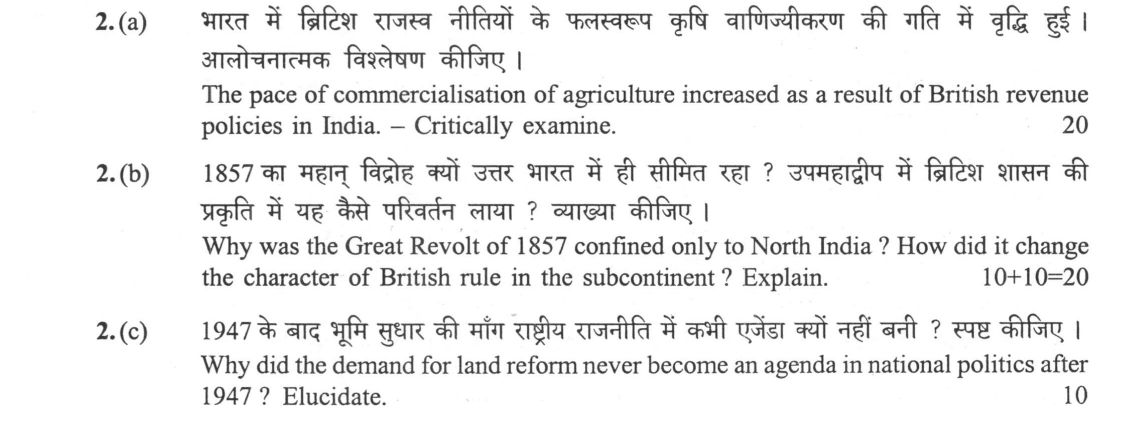
The pace of commercialisation of agriculture increased as a result of British revenue policies in India. – Critically examine. 20 marks
Why was the Great Revolt of 1857 confined only to North India ? How did it change the character of British rule in the subcontinent ? Explain. (10+10=20 marks)
Why did the demand for land reform never become an agenda in national politics after 1947 ? Elucidate. 10 marks
हिंदी में प्रश्न पढ़ें
भारत में ब्रिटिश राजस्व नीतियों के फलस्वरूप कृषि वाणिज्यीकरण की गति में वृद्धि हुई । आलोचनात्मक विश्लेषण कीजिए । 20 marks
1857 का महान विद्रोह क्यों उत्तर भारत में ही सीमित रहा ? उपमहाद्वीप में ब्रिटिश शासन की प्रकृति में यह कैसे परिवर्तन लाया ? व्याख्या कीजिए । (10+10=20)
1947 के बाद भूमि सुधार की मांग राष्ट्रीय राजनीति में कभी एजेंडा क्यों नहीं बनी ? स्पष्ट कीजिए । 10 marks
Model answer
Written by UPSC Answer Check against this question's marking rubric, to the expected length. UPSC does not publish answers for Mains — this is one way to score well, not an official key.
British land revenue systems—the Permanent Settlement (1793), Ryotwari (1820s), and Mahalwari—fundamentally altered agrarian dynamics by mandating unyielding cash payments on fixed calendar dates. This forced monetization coerced cultivators into market dependence, driving the expansion of export-oriented cash crops: indigo and opium across Bengal and Bihar, raw cotton in the Deccan, and jute in eastern India.
Agrarian Commercialisation: Forced Extraction versus Modern Growth
However, critically examining this expansion reveals that British-induced commercialisation was primarily a "forced commercialisation" driven by peasant distress rather than an organic, capital-accumulating market transition. Although commercial crops and monetized exchange pre-dated colonial rule under Mughal revenue systems and coastal trading networks, colonial policy severed commercialisation from peasant prosperity. Rigid revenue assessments forced cultivators into the clutches of rural moneylenders (mahajans), binding them to debt-trap production. Consequently, acreage under food grains declined in favor of commercial monopolies, rendering rural society acutely vulnerable to catastrophic famines, such as the 1770 Bengal famine and the 1876–78 Deccan famine. Colonial commercialisation accelerated not as a developmental modernization of agriculture, but as an extractive mechanism transferring agricultural surplus to metropolitan Britain.
The 1857 Revolt: Regional Confinement and Imperial Reconstruction
The Great Revolt of 1857 was largely confined to North and Central India due to specific socio-military conditions. Its nucleus lay in the Bengal Army, whose sepoys were drawn overwhelmingly from the high-caste (Brahmin and Rajput) landholding peasantry of Awadh and the North-Western Provinces, who were aggrieved by the 1856 annexation and the greased cartridge issue. The rebellion organized around displaced traditional elites—such as Nana Sahib, Rani Lakshmibai, and Begum Hazrat Mahal. Conversely, the Bombay and Madras Presidencies remained largely quiescent due to different military compositions, Punjab actively supplied Sikh and Punjabi irregulars to suppress the uprising, and major princely states (such as Gwalior and Hyderabad) acted as loyal "breakwaters to the storm." British control of the nascent electric telegraph and riverine-rail routes further enabled swift troop concentration across the Gangetic plains.
The aftermath fundamentally transformed the character of British rule:
- Sovereign and Administrative Reorganisation: The Government of India Act 1858 abolished Company rule, transferring authority to the British Crown. Queen Victoria’s Proclamation (1858) abandoned aggressive annexations, guaranteed princely status, and proclaimed religious non-interference. The Indian Councils Acts of 1861 and 1892 introduced limited, nominated legislative representation.
- Military Restructuring: The Peel Commission overhauled the armed forces by increasing the ratio of British to Indian troops and institutionalising the "martial and non-martial races" framework, favoring loyalist Gurkhas and Sikhs to prevent pan-Indian military solidarity.
- Ideological Shift: The reformist zeal gave way to racial conservatism, institutionalised "divide and rule", the ideological pretext of the "White Man's Burden", and the entrenchment of the Indian Civil Service as an unyielding bureaucratic "steel frame".
Land Reform and Post-1947 National Politics
Comprehensive land redistribution never emerged as an operative agenda in post-1947 national politics. The Indian National Congress operated as a broad "coalition of interests" heavily reliant on intermediate castes and rural landed elites for grassroots electoral mobilisation. Consequently, agrarian reform followed a path of constitutional gradualism rather than radical structural change.
Under the Seventh Schedule of the 1950 Constitution, land was made a State subject, preventing a unified central policy. Fundamental rights to property under original Article 31 subjected state-level Zamindari Abolition Acts (such as in Uttar Pradesh and Bihar during the 1950s) to protracted litigation. Radical peasant movements led by the All India Kisan Sabha were either co-opted or suppressed. While Nehruvian policy articulated a "socialist pattern of society," the state prioritized cooperative farming, technological inputs, and community projects over land ceiling enforcement. India eschewed the radical, state-directed land confiscation and redistribution seen in revolutionary China and Vietnam.
Conclusion
Colonial revenue systems accelerated commercialisation through coercion, leaving a legacy of peasant indebtedness and famine vulnerability while prompting the crisis of 1857. Post-independence India transitioned from an extractive colonial regime into a developmental state, yet maintained institutional continuities that accommodated landed elites, leaving fundamental agrarian property relations largely unredressed.
What "Critically examine" is asking you to do
Test the proposition the question puts to you and return a finding on how far it holds. Examine stems carry a claim, or ask whether something has happened, and expect evidence weighed both ways before the extent is stated — often with remedial measures attached. “Critically” is not a section added at the end: name the yardstick you are judging by — the evidence, the stated objective, a constitutional principle, a rival explanation — and let a verdict close each part of the body. Where the question quotes a claim, that verdict must land on the claim itself, accepted, qualified or rejected, and not on the theme in general.
Structure that answers it
Restate the claim as the question frames it → evidence that supports it → evidence that undercuts it → the conditions under which it holds → verdict on how far it stands
Where marks are lost
Merits in one paragraph, demerits in the next, and a conclusion calling for a balanced and holistic approach. That is a survey with the judgement left out and it holds the answer in the middle band. The opposite error is reading “critically” as permission to attack — and with the odd pairings, critically describe or critically explain, the exposition still carries most of the marks, the judgement being a layer on it rather than a substitute for it.
How this answer will be evaluated
Approach
Framework: Context > Thesis > Evidence > Historiography. (a) critically evaluate: positives > negatives/limits > conditions/safeguards > conclusion | (b) explain: definition/context > points in order > small example > short close | (c) account for: state the phenomenon > the causes in order of weight > conclusion Full marks: Analytical, cites specific acts/historians, addresses all sub-parts with nuance.
Key points expected
- Link Permanent Settlement/Zamindari to cash-crop production
- Analyze impact of railway expansion on export markets
- Discuss the 'drain of wealth' and de-industrialization
- Critique the 'benefit' argument of colonial modernization
- Identify reasons for absence in South/West (e.g., no sepoys)
- Explain the 'End of Company Rule' (1858 Act)
- Detail the shift to Crown rule (Viceroy)
- Analyze the 'divide and rule' policy post-1857
Evaluation rubric
Each sub-part is marked on its own, against the marks and word limit printed on the paper.
- (a) Assess the causal link between British revenue systems and the commercialization of Indian agriculture. 20 marks
critically evaluate— positives → negatives/limits → conditions/safeguards → conclusion
Must cover
- Link Permanent Settlement/Zamindari to cash-crop production
- Analyze impact of railway expansion on export markets
- Discuss the 'drain of wealth' and de-industrialization
- Critique the 'benefit' argument of colonial modernization
Loses marks
- Narrative history without economic analysis
- Ignoring the 'critical' aspect of the prompt
- Confusing commercialization with industrialization
Earns more
- Reference to specific cash crops (indigo, jute, cotton)
- Mention of specific revenue acts (e.g., 1793)
- Comparison of Zamindari vs. Ryotwari effects
- Reference to specific historians (e.g., R.I. Moore)
Extra mark
- Citation of specific trade statistics
- Reference to specific peasant uprisings (e.g., Indigo)
- (b) Explain the geographical limitations of the 1857 revolt and its impact on the nature of British rule. 20 marks
explain— definition/context → points in order → small example → short close
Must cover
- Identify reasons for absence in South/West (e.g., no sepoys)
- Explain the 'End of Company Rule' (1858 Act)
- Detail the shift to Crown rule (Viceroy)
- Analyze the 'divide and rule' policy post-1857
Loses marks
- Treating the two sub-questions as one
- Failing to explain 'why' it was confined to North
- Vague statements about 'change in character'
Earns more
- Mention of specific regions that did not revolt
- Reference to the 'Doctrine of Lapse' reversal
- Discussion of the 'New Imperialism' mindset
- Mention of the Indian Councils Act 1861
Extra mark
- Reference to specific British officials (e.g., Canning)
- Mention of specific military reorganization
- (c) Explain the political and social reasons for the failure of land reform as a national agenda post-1947. 10 marks
account for— state the phenomenon → the causes in order of weight → conclusion
Must cover
- Identify the political dominance of the landed class
- Explain the 'compromise' nature of the 1947 Constitution
- Discuss the role of the Congress party's elite base
- Analyze the lack of a strong peasant movement
Loses marks
- Focusing on economic reasons only
- Ignoring the political structure of the Congress party
- Vague generalizations about 'political will'
Earns more
- Reference to specific state-level reforms (e.g., West Bengal)
- Mention of the 'Zamindari Abolition' acts
- Discussion of the 'Green Revolution' as a substitute
- Reference to specific political leaders (e.g., Nehru)
Extra mark
- Citation of specific constitutional articles
- Reference to specific peasant organizations
Practice this exact question
Write your answer and it is marked point by point against the model answer above — what you covered, what you missed, what you got wrong.
Evaluate my answer →More from History 2024 Paper II
- Q1 Critically examine the following statements in about 150 words each: (a) After the battle…
- Q2 (a) The pace of commercialisation of agriculture increased as a result of British revenue…
- Q3 (a) Political extremism in colonial India often converged with cultural nationalism, but…
- Q4 (a) The Swadeshi movement of 1905 anticipated many of the tactics that were later develop…
- Q5 Critically examine the following statements in about 150 words each: (a) The ideas raised…