Paper II — Q8
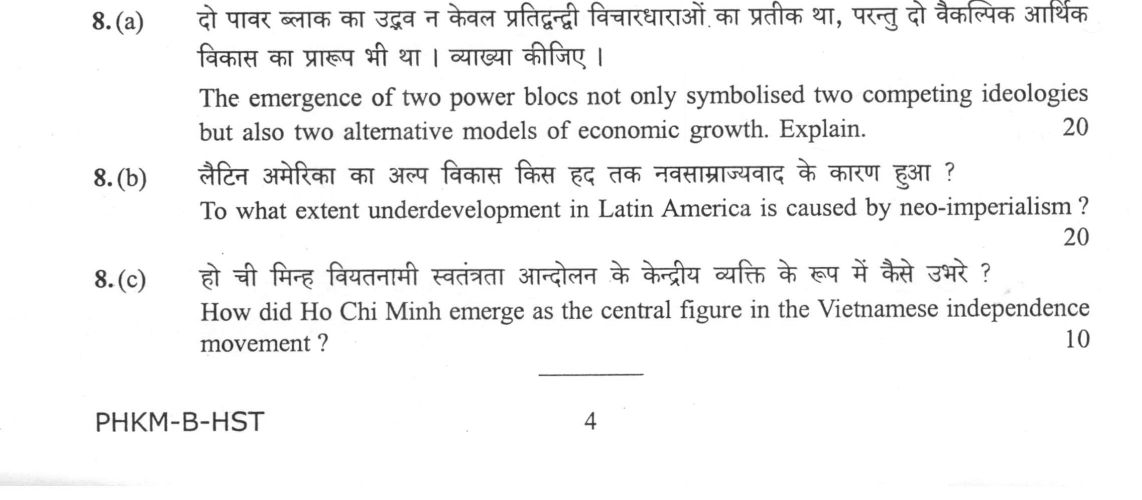
(a) The emergence of two power blocs not only symbolised two competing ideologies but also two alternative models of economic…
The emergence of two power blocs not only symbolised two competing ideologies but also two alternative models of economic growth. Explain. 20 marks
To what extent underdevelopment in Latin America is caused by neo-imperialism? 20 marks
How did Ho Chi Minh emerge as the central figure in the Vietnamese independence movement? 10 marks
हिंदी में प्रश्न पढ़ें
दो पावर ब्लॉक का उद्भव न केवल प्रतिद्वंद्वी विचारधाराओं का प्रतीक था, परंतु दो वैकल्पिक आर्थिक विकास का प्रारूप भी था। व्याख्या कीजिए। 20 marks
लैटिन अमेरिका का अल्प विकास किस हद तक नवसाम्राज्यवाद के कारण हुआ? 20 marks
हो ची मिन्ह वियतनामी स्वतंत्रता आंदोलन के केंद्रीय व्यक्ति के रूप में कैसे उभरे? 10 marks
Model answer
Written by UPSC Answer Check against this question's marking rubric, to the expected length. UPSC does not publish answers for Mains — this is one way to score well, not an official key.
The post-1945 emergence of the American and Soviet power blocs bifurcated international politics into two rival ideological frameworks that functioned simultaneously as competing blueprints for modernization and economic growth.
Competing Models of Economic Growth
The capitalist model, anchored in neoclassical economics, prioritized private enterprise, price mechanisms, and consumer capitalism. It was institutionalised globally through the Bretton Woods framework—the International Monetary Fund (IMF), the World Bank, and the GATT—alongside bilateral initiatives like the Marshall Plan (1948). This framework argued that integration into open multilateral trading systems, capital mobility, and comparative advantage would drive global prosperity.
Conversely, the socialist model was rooted in Marxist-Leninist state planning, prioritizing public ownership of the means of production, centralised allocation via Gosplan, and rapid heavy industrialisation over consumer goods. Internationally, this model was organised through the Council for Mutual Economic Assistance (COMECON, 1949) and bilateral state-to-state barter and aid agreements. For post-colonial nations like India, which adopted Five-Year Plans within a mixed economy, these blocs offered distinct paradigms for overcoming colonial backwardness, triggering an institutional rivalry between Western market-led development and Soviet-style state-led accumulation.
Neo-Imperialism and Latin American Underdevelopment
Underdevelopment in Latin America was significantly shaped by external structural factors, as articulated by Raúl Prebisch and Celso Furtado through Dependency Theory. They demonstrated how the international division of labour confined the periphery to exporting primary commodities while importing manufactured goods, producing secularly declining terms of trade and unequal exchange. Neo-imperial mechanisms reinforced this dependency through multinational corporations (MNCs) that extracted super-profits, enforced technological reliance, and influenced domestic policy. Later, external debt crises in the 1980s enabled international financial institutions to impose Washington Consensus structural adjustment conditionalities—austerity, deregulation, and rapid trade liberalisation—which curtailed autonomous state-led development.
However, neo-imperialism alone does not explain the region's underdevelopment. Internal structural bottlenecks played an equally decisive role. The historic concentration of land in semi-feudal latifundia depressed rural purchasing power and perpetuated extreme inequality. Entrenched oligarchic elites engaged in political capture and massive capital flight rather than domestic capital formation. Furthermore, domestic policy choices under Import Substitution Industrialisation (ISI) created inefficient, highly protected domestic monopolies, chronic fiscal deficits, and severe hyperinflation. Latin American underdevelopment was thus the combined product of external structural subordination and domestic institutional failure.
Ho Chi Minh and the Vietnamese Independence Movement
Ho Chi Minh emerged as the central figure of Vietnamese liberation by successfully fusing Marxist-Leninist revolutionary methods with broad, patriotic anti-colonial nationalism.
Initially operating as a Comintern agent (Nguyen Ai Quoc), he adapted rigid international communism to indigenous realities by founding the Indochinese Communist Party (1930) and later the cross-class nationalist front, the Viet Minh (1941). His leadership of the August Revolution (1945) and the subsequent declaration of the Democratic Republic of Vietnam established his unassailable domestic legitimacy.
During the First Indochina War, Ho provided the political vision that complemented General Giap's military strategy, culminating in the decisive defeat of the French at Dien Bien Phu (1954). When confronting American military intervention, Ho preserved his mass appeal through his ascetic personal reputation (Uncle Ho) and unwavering commitment to national reunification. Crucially, as the Sino-Soviet split divided the communist world, Ho maintained an astute diplomatic equilibrium, securing indispensable military and economic aid from both Moscow and Beijing while refusing ideological subordination to either, ensuring that the movement remained fundamentally Vietnamese.
Cold War bipolarity deeply conditioned the post-colonial world: while the superpowers structured global development along capitalist and socialist fault lines, anti-colonial leaders and developing states actively navigated, combined, and resisted these competing paradigms to secure their own political sovereignty and economic autonomy.
What "Explain" is asking you to do
Make the working of something clear — what sets it off, what follows from what, and what it produces. Explain is the Commission's mechanism word: it dominates the technical papers and the “explain why” stems, where the marks sit in the causal chain and not in the label.
Structure that answers it
State what it is → the initiating condition → the chain of cause, step by step → an instance where it plays out → what the chain produces
Where marks are lost
Describing what something looks like instead of why it works that way. Naming the stages without linking them reads as description too.
How this answer will be evaluated
Approach
Framework: Context > Thesis > Evidence > Historiography. (a) explain: definition/context > points in order > small example > short close | (b) comment: context > arguments both sides > judgment > close | (c) trace: start point > the stages in sequence > end point > what changed Full marks: Analytical depth with specific evidence and historiographical awareness.
Key points expected
- Identify the two competing ideologies (Capitalism vs Socialism)
- Detail the Western market-led growth model
- Detail the Soviet planned economy model
- Link the ideological split to the Cold War context
- Define neo-imperialism in the Latin American context
- Explain the dependency theory perspective
- Provide evidence of economic exploitation or debt
- Offer a balanced judgment on the extent of causality
Evaluation rubric
Each sub-part is marked on its own, against the marks and word limit printed on the paper.
- (a) Define the two blocs and contrast their specific economic growth models. 20 marks
explain— definition/context → points in order → small example → short close
Must cover
- Identify the two competing ideologies (Capitalism vs Socialism)
- Detail the Western market-led growth model
- Detail the Soviet planned economy model
- Link the ideological split to the Cold War context
Loses marks
- Narrating history without economic analysis
- Confusing political ideology with economic model
- Failing to distinguish the two specific models
Earns more
- Mention specific economic policies of both blocs
- Reference the Marshall Plan or COMECON
- Discuss the impact on non-aligned nations
- Use specific historical examples of economic divergence
Extra mark
- Cite a specific GDP growth statistic
- Name a key economic theorist of the era
- (b) Assess the role of neo-imperialism in Latin American underdevelopment. 20 marks
comment— context → arguments both sides → judgment → close
Must cover
- Define neo-imperialism in the Latin American context
- Explain the dependency theory perspective
- Provide evidence of economic exploitation or debt
- Offer a balanced judgment on the extent of causality
Loses marks
- Generalizing without specific regional examples
- Ignoring internal political or social factors
- Failing to define neo-imperialism clearly
Earns more
- Mention specific countries like Brazil or Argentina
- Reference the role of international financial institutions
- Discuss the 'resource curse' or commodity dependence
- Contrast with internal political factors
Extra mark
- Cite a specific dependency theory scholar
- Reference a specific trade agreement or debt crisis
- (c) Trace Ho Chi Minh's rise to central leadership in Vietnam. 10 marks
trace— start point → the stages in sequence → end point → what changed
Must cover
- Identify his early revolutionary activities
- Explain the founding of the Viet Minh
- Detail his role in the 1945 revolution
- Show his consolidation of power post-independence
Loses marks
- Focusing only on the war, not the rise
- Chronology without analysis of his influence
- Ignoring the political context of the 1930s-40s
Earns more
- Mention his time in the Soviet Union or China
- Reference the August Revolution specifically
- Discuss his unification of communist factions
- Mention the Declaration of Independence
Extra mark
- Quote a specific line from his declaration
- Name a specific rival he outmaneuvered
Practice this exact question
Write your answer and it is marked point by point against the model answer above — what you covered, what you missed, what you got wrong.
Evaluate my answer →More from History 2024 Paper II
- Q5 Critically examine the following statements in about 150 words each: (a) The ideas raised…
- Q6 (a) The course of the English industrialization was too long drawn to be considered a rev…
- Q7 (a) The second world war was a truly global conflict. Discuss. (20 marks) (b) Trace the d…
- Q8 (a) The emergence of two power blocs not only symbolised two competing ideologies but als…