Paper II — Q4
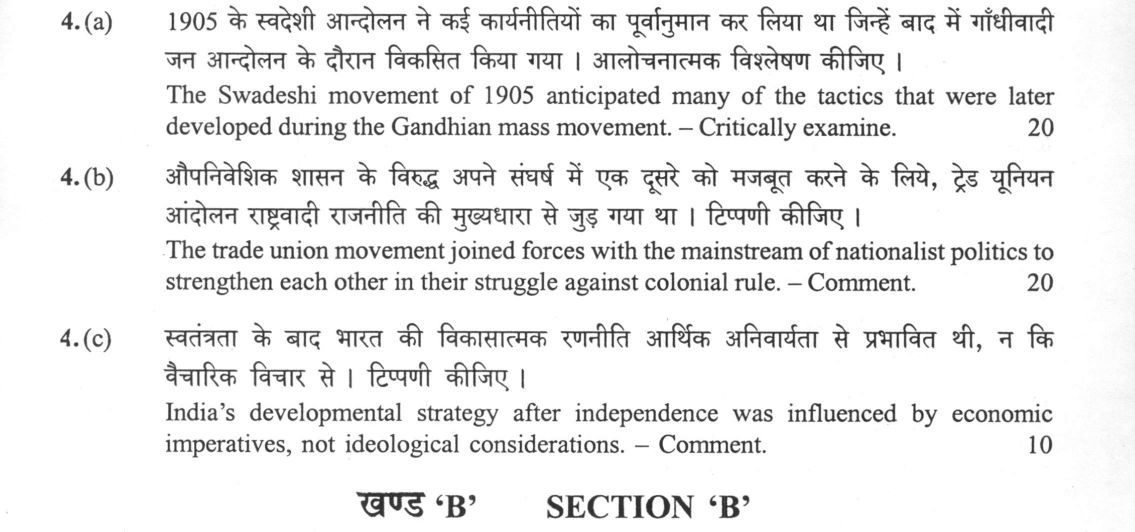
(a) The Swadeshi movement of 1905 anticipated many of the tactics that were later developed during the Gandhian mass movement. –…
The Swadeshi movement of 1905 anticipated many of the tactics that were later developed during the Gandhian mass movement. – Critically examine. 20 marks
The trade union movement joined forces with the mainstream of nationalist politics to strengthen each other in their struggle against colonial rule. – Comment. 20 marks
India's developmental strategy after independence was influenced by economic imperatives, not ideological considerations. – Comment. 10 marks
हिंदी में प्रश्न पढ़ें
1905 के स्वदेशी आंदोलन ने कई कार्यनीतियों का पूर्वानुमान कर लिया था जिन्हें बाद में गांधीवादी जन आंदोलन के दौरान विकसित किया गया । आलोचनात्मक विश्लेषण कीजिए । 20 marks
औपनिवेशिक शासन के विरुद्ध अपने संघर्ष में एक दूसरे को मजबूत करने के लिए, ट्रेड यूनियन आंदोलन राष्ट्रवादी राजनीति की मुख्यधारा से जुड़ गया था । टिप्पणी कीजिए । 20 marks
स्वतंत्रता के बाद भारत की विकासात्मक रणनीति आर्थिक अनिवार्यता से प्रभावित थी, न कि वैचारिक विचार से । टिप्पणी कीजिए । 10 marks
Model answer
Written by UPSC Answer Check against this question's marking rubric, to the expected length. UPSC does not publish answers for Mains — this is one way to score well, not an official key.
The 1905 Swadeshi campaign was a rehearsal for later mass nationalism, but only in method, not in strategy.
Swadeshi and Gandhian tactics Swadeshi anticipated several Gandhian tactics. It used picketing of foreign goods, boycott of British cloth and institutions, national education through institutions like the Calcutta National University, and swadeshi enterprises such as the Bengal Chemicals and Pharmaceutical Works. Cultural mobilization through songs, theatre and symbols, including Raksha Bandhan as a gesture of Hindu-Muslim unity, made the movement visible and gave it emotional force. Yet the claim must be qualified. Swadeshi was elite-led, divided between Moderates and Extremists, and its mass base was uneven. Although Bengal was the main centre, it spread to Maharashtra, Punjab and other regions; still, it did not become a disciplined, all-India mass movement. Some symbolic appeals drew on Hindu cultural idioms, which limited their universal reach. Gandhian mass movements differed strategically: they were built on structured satyagraha, non-cooperation, constructive programmes and a deliberately broad social base, including peasants, workers and women, with clearer moral and political objectives. It also showed that economic nationalism could become a political language, but it lacked the moral discipline and organizational depth of later Gandhian campaigns.
Trade unions and nationalist politics The trade union movement began as isolated economic unionism. Gandhi’s Ahmedabad experiment in 1918 and the founding of the Ahmedabad Textile Labour Association in 1920 linked labour discipline with nationalist ethics. The All India Trade Union Congress, founded in 1920, gave unions a national platform. By the 1920s, leaders such as N.M. Joshi and S.A. Dange connected strikes to anti-colonial politics. The 1928 strike wave, the 1931 Karachi Resolution on workers’ rights, the 1946 INA trials and the 1947 integration of labour into the nationalist state show how unions and Congress politics reinforced each other. However, the alliance was tense. Class interests often clashed with nationalist unity: unions were divided along communal and craft lines, the Meerut Conspiracy Case of 1929 exposed repression of left labour leaders, and the Congress socialist wing remained limited in its ability to transform industrial relations. After 1947, labour was often subordinated to planning priorities, with strikes controlled in the name of development. The relationship was mutual: nationalism gave labour legitimacy and a wider political frame, while strikes and worker mobilization expanded the social base of the Congress movement. This mutual reinforcement did not erase labour’s separate interests; it often made them more visible within nationalist politics.
Development strategy: imperatives or ideology? India’s post-independence strategy was shaped by economic imperatives, but not free of ideology. Nehru’s socialist rhetoric coexisted with pragmatism: the mixed economy accepted capital scarcity, weak industrial base and the need to retain private enterprise alongside public investment. The Mahalanobis model was grounded in technical planning, not doctrinaire socialism. Land reform was driven by political compulsions—peasant mobilization, state legitimacy and the need to break feudal power—rather than pure class ideology. Non-alignment had an economic logic, seeking aid and trade from both blocs. Yet ideology clearly influenced choices. The Directive Principles of State Policy, the abolition of zamindari, public-sector dominance in heavy industry, and the Planning Commission’s socialist orientation show that values shaped policy. In practice, implementation was uneven, and colonial economic structures—landlordism, urban bias and bureaucratic control—persisted. Thus the strategy was neither a pure market model nor a socialist blueprint; it was a negotiated compromise between developmental needs and the moral language of social justice.
Thus, Swadeshi anticipated Gandhian tactics but not their mass strategy; trade unions strengthened nationalism while remaining constrained by class and state limits; and post-independence planning was a blend of economic necessity and ideological aspiration.
What "Critically examine" is asking you to do
Test the proposition the question puts to you and return a finding on how far it holds. Examine stems carry a claim, or ask whether something has happened, and expect evidence weighed both ways before the extent is stated — often with remedial measures attached. “Critically” is not a section added at the end: name the yardstick you are judging by — the evidence, the stated objective, a constitutional principle, a rival explanation — and let a verdict close each part of the body. Where the question quotes a claim, that verdict must land on the claim itself, accepted, qualified or rejected, and not on the theme in general.
Structure that answers it
Restate the claim as the question frames it → evidence that supports it → evidence that undercuts it → the conditions under which it holds → verdict on how far it stands
Where marks are lost
Merits in one paragraph, demerits in the next, and a conclusion calling for a balanced and holistic approach. That is a survey with the judgement left out and it holds the answer in the middle band. The opposite error is reading “critically” as permission to attack — and with the odd pairings, critically describe or critically explain, the exposition still carries most of the marks, the judgement being a layer on it rather than a substitute for it.
How this answer will be evaluated
Approach
Framework: UPSC History Paper 2 (Modern India). (a) critique: the claim > its strengths > its weaknesses > your judgment | (b) comment: context > arguments both sides > judgment > close | (c) comment: context > arguments both sides > judgment > close Full marks: Nuanced analysis with specific historical evidence and historiographical awareness.
Key points expected
- Identify specific 1905 tactics (boycott, swadeshi, passive resistance).
- Map these to specific Gandhian tactics (Satyagraha, constructive programme).
- Analyze the continuity of 'mass' mobilization vs elite leadership.
- Critically evaluate the limits of the 'anticipation' argument.
- Explain the 'joining of forces' (e.g., 1929 Congress resolution).
- Analyze how unions strengthened the nationalist struggle.
- Analyze how nationalism strengthened the trade union movement.
- Provide specific examples of joint action (e.g., 1929 strikes).
Evaluation rubric
Each sub-part is marked on its own, against the marks and word limit printed on the paper.
- (a) Assess the validity of the claim that 1905 tactics prefigured Gandhian mass politics. 20 marks
critique— the claim → its strengths → its weaknesses → your judgment
Must cover
- Identify specific 1905 tactics (boycott, swadeshi, passive resistance).
- Map these to specific Gandhian tactics (Satyagraha, constructive programme).
- Analyze the continuity of 'mass' mobilization vs elite leadership.
- Critically evaluate the limits of the 'anticipation' argument.
Loses marks
- Narrating 1905 events without linking to Gandhi.
- Treating Swadeshi and Gandhian movements as identical.
Earns more
- Mention specific leaders (Aurobindo, Tilak, Gandhi).
- Reference specific events (Bengal Partition, Champaran).
Extra mark
- Cite a specific primary source or speech.
- Name a specific historian (e.g., R. P. Dutt).
- (b) Evaluate the mutual reinforcement between trade unions and nationalist politics. 20 marks
comment— context → arguments both sides → judgment → close
Must cover
- Explain the 'joining of forces' (e.g., 1929 Congress resolution).
- Analyze how unions strengthened the nationalist struggle.
- Analyze how nationalism strengthened the trade union movement.
- Provide specific examples of joint action (e.g., 1929 strikes).
Loses marks
- Discussing trade unions in isolation from politics.
- Ignoring the 'mutual' aspect of the relationship.
Earns more
- Mention key figures (Lala Lajpat Rai, C. P. Ramaswami Iyer).
- Reference the Trade Disputes Act or similar legislation.
Extra mark
- Cite a specific trade union resolution.
- Name a specific historian of labor history.
- (c) Assess the claim that economic needs, not ideology, drove post-independence strategy. 10 marks
comment— context → arguments both sides → judgment → close
Must cover
- Identify the 'economic imperatives' (poverty, food security, industrialization).
- Identify the 'ideological considerations' (Socialism, Five Year Plans).
- Argue for the interplay between the two.
- Provide a specific example (e.g., Green Revolution, Public Sector).
Loses marks
- Treating economics and ideology as mutually exclusive.
- Vague generalizations without specific policy examples.
Earns more
- Mention the Nehruvian model or mixed economy.
- Reference specific Five Year Plans.
Extra mark
- Cite a specific economic statistic from the 1950s.
- Name a specific economist (e.g., P.C. Mahalanobis).
Practice this exact question
Write your answer and it is marked point by point against the model answer above — what you covered, what you missed, what you got wrong.
Evaluate my answer →More from History 2024 Paper II
- Q1 Critically examine the following statements in about 150 words each: (a) After the battle…
- Q2 (a) The pace of commercialisation of agriculture increased as a result of British revenue…
- Q3 (a) Political extremism in colonial India often converged with cultural nationalism, but…
- Q4 (a) The Swadeshi movement of 1905 anticipated many of the tactics that were later develop…
- Q5 Critically examine the following statements in about 150 words each: (a) The ideas raised…
- Q6 (a) The course of the English industrialization was too long drawn to be considered a rev…
- Q7 (a) The second world war was a truly global conflict. Discuss. (20 marks) (b) Trace the d…