Paper II — Q5
Critically examine the following statements in about 150 words each: (a) The ideas raised by Enlightenment thinkers were…
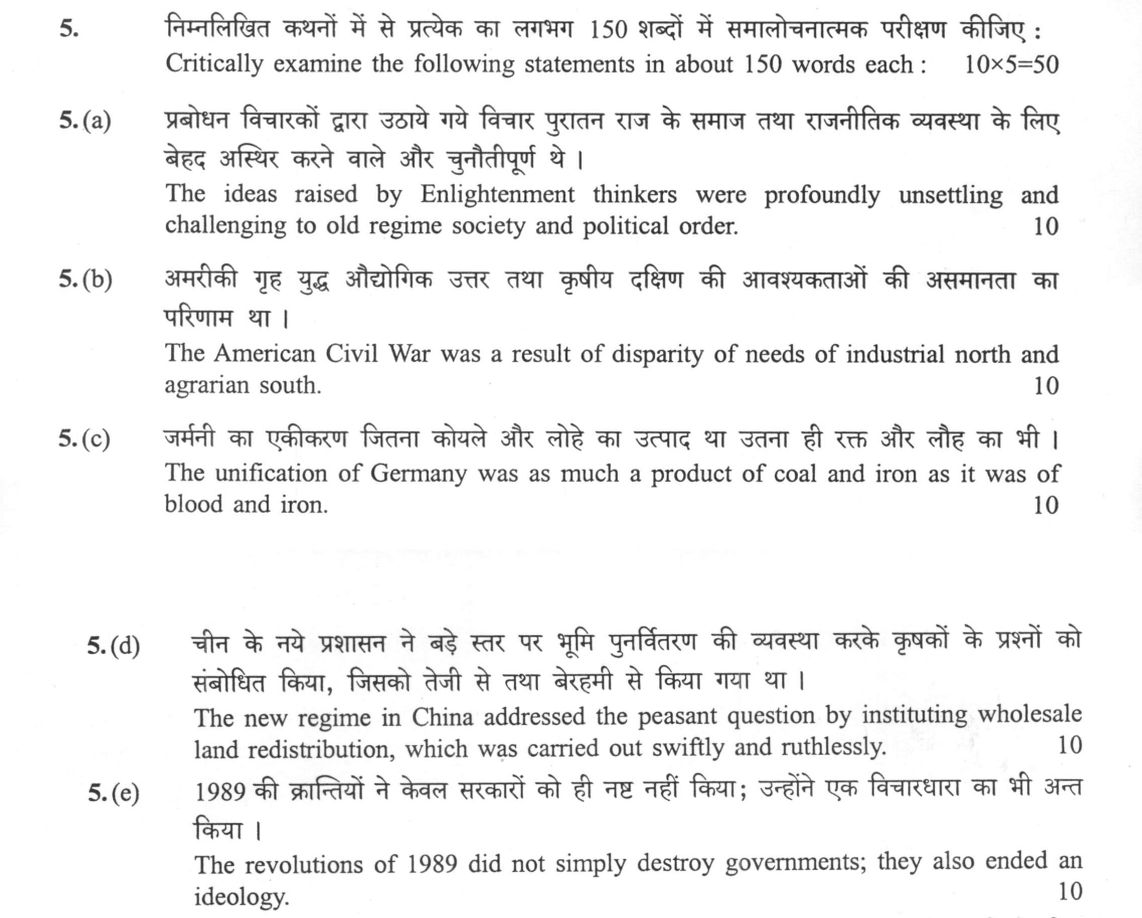
Critically examine the following statements in about 150 words each: The ideas raised by Enlightenment thinkers were profoundly unsettling and challenging to old regime society and political order. 10 marks
The American Civil War was a result of disparity of needs of industrial north and agrarian south. 10 marks
The unification of Germany was as much a product of coal and iron as it was of blood and iron. 10 marks
The new regime in China addressed the peasant question by instituting wholesale land redistribution, which was carried out swiftly and ruthlessly. 10 marks
The revolutions of 1989 did not simply destroy governments; they also ended an ideology. 10 marks
हिंदी में प्रश्न पढ़ें
निम्नलिखित कथनों में से प्रत्येक का लगभग 150 शब्दों में समालोचनात्मक परीक्षण कीजिए : प्रबोधन विचारकों द्वारा उठाये गये विचार पुरतन राज के समाज तथा राजनीतिक व्यवस्था के लिए बेहद अस्थिर करने वाले और चुनौतीपूर्ण थे । 10 marks
अमरीकी गृह युद्ध औद्योगिक उत्तर तथा कृषीय दक्षिण की आवश्यकताओं की असमानता का परिणाम था । 10 marks
जर्मनी का एकीकरण जितना कोयले और लोहे का उत्पाद था उतना ही रक्त और लोह का भी । 10 marks
चीन के नये प्रशासन ने बड़े स्तर पर भूमि पुनर्वितरण की व्यवस्था करके कृषकों के प्रश्नों को संबोधित किया, जिसको तेजी से तथा बेरहमी से किया गया था। 10 marks
1989 की क्रांतियों ने केवल सरकारों को ही नष्ट नहीं किया; उन्होंने एक विचारधारा का भी अंत किया। 10 marks
Model answer
Written by UPSC Answer Check against this question's marking rubric, to the 150-word length. UPSC does not publish answers for Mains — this is one way to score well, not an official key.
(a) Enlightenment Ideas and the Old Regime
Enlightenment thought directly subverted the ideological foundations of the European Ancien Régime. John Locke’s doctrine of natural rights (life, liberty, and property) challenged divine right absolutism; Montesquieu’s The Spirit of the Laws demanded the separation of powers to dismantle arbitrary monarchical authority; and Voltaire launched scathing critiques against ecclesiastical hegemony and religious intolerance. Rousseau’s assertion of popular sovereignty fundamentally re-anchored political legitimacy in the general will rather than dynastic lineage.
However, Enlightenment thinkers were reformist rather than insurrectionary. Many favored enlightened despots—such as Frederick the Great, Catherine II, and Joseph II—who co-opted rationalist administrative principles to modernize state machinery while consolidating autocracy and preserving feudal social stratification. Furthermore, these philosophical discourses remained confined to urban salons and bourgeois circles, lacking an inherent call for violent revolution.
Nevertheless, by stripping the feudal-monarchical order of its divine sanction and intellectual legitimacy, the Enlightenment rendered the Old Regime defenseless when structural fiscal and social crises erupted in 1789.
(b) Economic Disparity and the American Civil War
The economic divergence between the industrializing North and the agrarian South was a major axis of antebellum sectionalism. The Northern economy relied on free wage labor, domestic industrial protectionism, and extensive infrastructural networks, whereas the Southern economy was bound to King Cotton, global free trade, and chattel slavery. Economic historians like Charles Beard characterized the war as an inevitable clash between northern industrial capitalism and southern agrarian feudalism over federal economic policy.
However, reducing the Civil War solely to economic disparity overlooks the fact that the institution of slavery was the overarching political, constitutional, and moral fault line. Key legislative crises—including the Missouri Compromise of 1820, the Compromise of 1850, and the Kansas-Nebraska Act of 1854—centered not on industrial tariffs, but on the territorial expansion of slavery and the political balance of power in the Senate. The secession of Southern states following Lincoln’s 1860 election and the Confederate assault on Fort Sumter (1861) were triggered by the perceived existential threat to the slave system.
Economic differences accentuated regional hostility, but slavery and its irreconcilable constitutional contradictions were the proximate and decisive cause of the war.
(c) German Unification: Coal and Iron vs. Blood and Iron
Otto von Bismarck’s assertion that the great questions of the day would be decided by "blood and iron" reflects the militaristic dimension of German unification. Political consolidation was achieved through three orchestrated wars: against Denmark (1864), Austria (1866), and France (1870–71), supported by Prussian military reforms and Helmuth von Moltke’s strategic operational genius.
Yet, as J.M. Keynes famously argued, Germany was unified as much by "coal and iron." The Prussian-led Zollverein (Customs Union of 1834) economically integrated the German states, isolated Austria, and tied the northern and southern principalities to Berlin. Simultaneously, the rapid expansion of heavy industry in the Ruhr and Silesia, epitomized by Krupp’s armaments and vast railway grids, provided the technological and logistic foundation for Prussian military supremacy.
Militarism alone was insufficient; economic integration created the material base and political incentives for national cohesion. Thus, unification was a synthesis of industrial modernization (coal and iron) and calculated military statecraft (blood and iron).
(d) China's Agrarian Reform and the Peasant Question
Upon establishing the People's Republic of China in 1949, the Chinese Communist Party resolved the peasant question primarily through the Agrarian Reform Law of 1950. The regime confiscated roughly 43 million hectares of cultivable land from the gentry and redistributed it among more than 300 million landless and poor peasants, fulfilling its core revolutionary commitment.
This redistribution was executed with deliberate speed and violence. Peasant associations were mobilized through "speak bitterness" campaigns and public struggle sessions, designed to physically eradicate the traditional rural gentry as a social class. Between 1 and 2 million landlords were executed during these purges.
However, private peasant proprietorship was a transitory phase rather than a permanent settlement. By the mid-1950s, the state reversed individual ownership, subordinating peasant autonomy to state-directed collectivization through Agricultural Producers' Cooperatives and, ultimately, the People's Communes of the Great Leap Forward. The land reform was ruthlessly effective in destroying the old socio-political hierarchy, but served primarily as a vehicle for state control rather than enduring peasant land sovereignty.
(e) The Revolutions of 1989 and the End of Ideology
The revolutions of 1989 across Central and Eastern Europe—ignited by Poland's Solidarity movement, the peaceful street demonstrations of the Velvet Revolution in Czechoslovakia, and the breaching of the Berlin Wall—rapidly toppled entrenched communist regimes.
Crucially, the collapse extended beyond a routine turnover of political power; it represented the structural and moral exhaustion of Marxism-Leninism as an organizing ideology. The Soviet model of central economic planning, vanguard-party dictatorship, and state-enforced socialist realism had lost its legitimacy in the face of persistent economic stagnation, consumer shortages, and widespread civil dissent. Mikhail Gorbachev’s Glasnost and Perestroika inadvertently exposed this ideological bankruptcy, leaving the system unable to justify its own survival once the threat of Red Army intervention was removed.
While post-communist transitions faced profound socio-economic turbulence and resurgent local nationalisms, 1989 firmly discredited the totalitarian command-state paradigm in Europe, securing the undisputed, if complex, triumph of constitutional pluralism and market-oriented democracy.
What "Critically examine" is asking you to do
Test the proposition the question puts to you and return a finding on how far it holds. Examine stems carry a claim, or ask whether something has happened, and expect evidence weighed both ways before the extent is stated — often with remedial measures attached. “Critically” is not a section added at the end: name the yardstick you are judging by — the evidence, the stated objective, a constitutional principle, a rival explanation — and let a verdict close each part of the body. Where the question quotes a claim, that verdict must land on the claim itself, accepted, qualified or rejected, and not on the theme in general.
Structure that answers it
Restate the claim as the question frames it → evidence that supports it → evidence that undercuts it → the conditions under which it holds → verdict on how far it stands
Where marks are lost
Merits in one paragraph, demerits in the next, and a conclusion calling for a balanced and holistic approach. That is a survey with the judgement left out and it holds the answer in the middle band. The opposite error is reading “critically” as permission to attack — and with the odd pairings, critically describe or critically explain, the exposition still carries most of the marks, the judgement being a layer on it rather than a substitute for it.
How this answer will be evaluated
Approach
Framework: Context > Thesis > Evidence > Historiography. (a) critique: the claim > its strengths > its weaknesses > your judgment | (b) critique: the claim > its strengths > its weaknesses > your judgment | (c) critique: the claim > its strengths > its weaknesses > your judgment | (d) critique: the claim > its strengths > its weaknesses > your judgment | (e) critique: the claim > its strengths > its weaknesses > your judgment Full marks: Argues a clear thesis, cites specific evidence, and engages with historiography.
Key points expected
- Identify specific Enlightenment critiques of divine right/monarchy
- Link specific ideas to specific political outcomes
- Acknowledge the 'Old Regime' as a specific historical structure
- Provide a balanced judgment on the 'unsettling' nature
- Contrast the specific economic needs of North vs South
- Address the 'disparity of needs' as a causal factor
- Acknowledge the role of slavery as a central conflict
- Provide a judgment on the sufficiency of the economic argument
Evaluation rubric
Each sub-part is marked on its own, against the marks and word limit printed on the paper.
- (a) Assess the extent to which Enlightenment ideas destabilized the Old Regime. 10 marks · 150 words
critique— the claim → its strengths → its weaknesses → your judgment
Must cover
- Identify specific Enlightenment critiques of divine right/monarchy
- Link specific ideas to specific political outcomes
- Acknowledge the 'Old Regime' as a specific historical structure
- Provide a balanced judgment on the 'unsettling' nature
Loses marks
- Generalizing 'ideas' without naming specific concepts
- Narrating the French Revolution without analyzing the ideas
- Ignoring the 'political order' aspect of the prompt
Earns more
- Mention specific thinkers (Voltaire, Rousseau, Montesquieu)
- Reference the 'Declaration of the Rights of Man'
- Discuss the role of the salons or public sphere
Extra mark
- Cite a specific primary source or quote
- Name a specific historiographical debate (e.g., revisionist vs traditional)
- (b) Evaluate the economic disparity thesis for the American Civil War. 10 marks · 150 words
critique— the claim → its strengths → its weaknesses → your judgment
Must cover
- Contrast the specific economic needs of North vs South
- Address the 'disparity of needs' as a causal factor
- Acknowledge the role of slavery as a central conflict
- Provide a judgment on the sufficiency of the economic argument
Loses marks
- Focusing only on the military aspects of the war
- Ignoring the 'agrarian' nature of the South
- Treating the North and South as monolithic entities
Earns more
- Mention the 'Free Labor' ideology of the North
- Reference the 'Cotton Kingdom' of the South
- Discuss the tariff issue or internal improvements
Extra mark
- Cite a specific economic statistic or report
- Name a specific historian (e.g., Foote, McPherson)
- (c) Analyze the dual role of industrialization and militarism in German unification. 10 marks · 150 words
critique— the claim → its strengths → its weaknesses → your judgment
Must cover
- Explain the 'coal and iron' (industrial) dimension
- Explain the 'blood and iron' (military) dimension
- Show the interplay between economic and military power
- Provide a balanced assessment of both factors
Loses marks
- Focusing only on the military campaigns
- Ignoring the economic integration (Zollverein)
- Treating 'blood and iron' as a mere slogan without analysis
Earns more
- Mention the role of the Zollverein
- Reference the wars of unification (Danish, Austrian, French)
- Discuss the role of Bismarck in linking the two
Extra mark
- Cite a specific industrial statistic (e.g., steel production)
- Name a specific historian (e.g., Hobsbawm, A.J.P. Taylor)
- (d) Evaluate the CCP's land redistribution policy and its implementation. 10 marks · 150 words
critique— the claim → its strengths → its weaknesses → your judgment
Must cover
- Define the 'peasant question' in the Chinese context
- Describe the 'wholesale land redistribution' mechanism
- Assess the 'swiftly and ruthlessly' characterization
- Provide a judgment on the policy's effectiveness
Loses marks
- Ignoring the 'ruthless' aspect of the implementation
- Treating the policy as a simple administrative act
- Failing to link the policy to the 'peasant question'
Earns more
- Mention the 'Agrarian Reform Law' of 1950
- Reference the 'class struggle' or 'struggle sessions'
- Discuss the impact on the rural social structure
Extra mark
- Cite a specific statistic on land distribution
- Name a specific historian (e.g., Frank Dikötter, Rana Mitter)
- (e) Assess the ideological impact of the 1989 revolutions. 10 marks · 150 words
critique— the claim → its strengths → its weaknesses → your judgment
Must cover
- Identify the specific 'ideology' (Marxism-Leninism/Communism)
- Explain how the revolutions 'ended' this ideology
- Distinguish between the fall of governments and the fall of ideology
- Provide a balanced judgment on the 'ending' of the ideology
Loses marks
- Focusing only on the political changes (governments)
- Ignoring the ideological dimension of the revolutions
- Treating the 'ending' of ideology as a simple, linear process
Earns more
- Mention the 'End of History' thesis (Fukuyama)
- Reference the specific events of 1989 (Berlin Wall, etc.)
- Discuss the transition to market economies
Extra mark
- Cite a specific quote from a key figure (e.g., Gorbachev)
- Name a specific historian (e.g., Timothy Garton Ash)
Practice this exact question
Write your answer and it is marked point by point against the model answer above — what you covered, what you missed, what you got wrong.
Evaluate my answer →More from History 2024 Paper II
- Q2 (a) The pace of commercialisation of agriculture increased as a result of British revenue…
- Q3 (a) Political extremism in colonial India often converged with cultural nationalism, but…
- Q4 (a) The Swadeshi movement of 1905 anticipated many of the tactics that were later develop…
- Q5 Critically examine the following statements in about 150 words each: (a) The ideas raised…
- Q6 (a) The course of the English industrialization was too long drawn to be considered a rev…
- Q7 (a) The second world war was a truly global conflict. Discuss. (20 marks) (b) Trace the d…
- Q8 (a) The emergence of two power blocs not only symbolised two competing ideologies but als…