Paper II — Q6
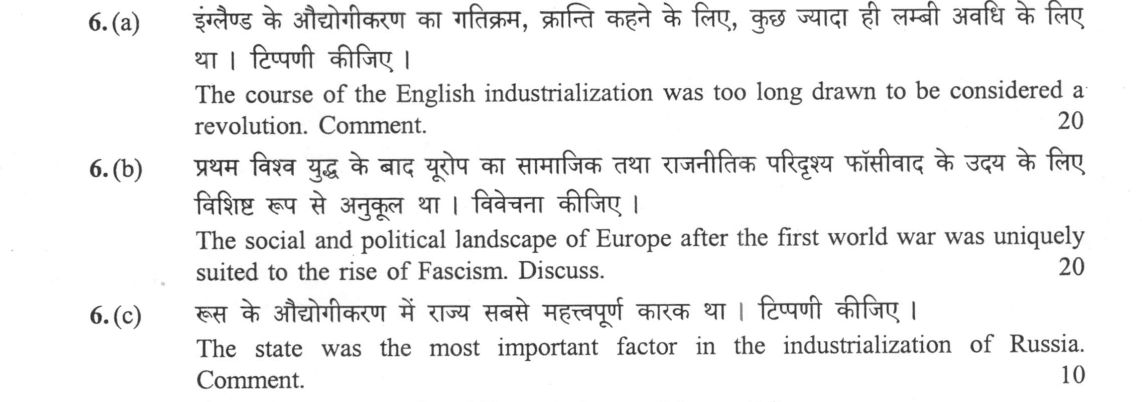
(a) The course of the English industrialization was too long drawn to be considered a revolution. Comment. (20 marks) (b) The…
The course of the English industrialization was too long drawn to be considered a revolution. Comment. 20 marks
The social and political landscape of Europe after the first world war was uniquely suited to the rise of Fascism. Discuss. 20 marks
The state was the most important factor in the industrialization of Russia. Comment. 10 marks
हिंदी में प्रश्न पढ़ें
इंग्लैंड के औद्योगीकरण का गतिक्रम, क्रांति कहने के लिए, कुछ ज्यादा ही लंबी अवधि के लिए था। टिप्पणी कीजिए। 20 marks
प्रथम विश्व युद्ध के बाद यूरोप का सामाजिक तथा राजनीतिक परिदृश्य फासीवाद के उदय के लिए विशिष्ट रूप से अनुकूल था। विवेचना कीजिए। 20 marks
रूस के औद्योगीकरण में राज्य सबसे महत्वपूर्ण कारक था। टिप्पणी कीजिए। 10 marks
Model answer
Written by UPSC Answer Check against this question's marking rubric, to the expected length. UPSC does not publish answers for Mains — this is one way to score well, not an official key.
The Pace and Nature of English Industrialization
The characterization of English industrialization as a protracted evolution rather than a sudden revolution reflects a central historiographical debate. Quantitative historians such as N.F.R. Crafts and T.S. Ashton argue that aggregate macroeconomic growth between 1760 and 1830 was modest, with GDP expanding at under 1.5% annually. They view industrialization as the culmination of long-term developments dating back to 1688, reinforced by Jan de Vries' concept of an early modern "industrious revolution" and preceding agrarian transformations that released labor and capital. Furthermore, industrial growth was geographically uneven, creating a dynamic, coal-fueled North alongside a predominantly agrarian and commercial South.
However, W.W. Rostow’s "take-off" paradigm and the analyses of Phyllis Deane and W.A. Cole correctly identify structural transformations that justify the term "revolution." Qualitative ruptures occurred in distinct waves: textile mechanization via Arkwright and Crompton in the 1760s–1780s, the application of steam power, and the railway boom of the 1830s–1850s. The Napoleonic Wars accelerated state-linked metallurgical, mining, and shipping capacities. Demographically, Britain underwent unprecedented rapid urbanization, becoming the first society where over half the population lived in towns by 1851. As E.J. Hobsbawm emphasized in his "dual revolution" thesis, the transformation was irreversible, radically restructuring class relations, labor organization, and the global economy. While quantitative output grew gradually over a century, its institutional, technological, and social consequences were distinctly revolutionary.
Post-WWI Europe and the Rise of Fascism
The social, political, and economic dislocations of post-First World War Europe created a unique opportunity structure for fascism, conceptualized by Roger Griffin as palingenetic ultranationalism emerging from societal trauma. The Paris Peace Treaties institutionalized deep grievances: Germany’s right-wing fostered the Dolchstoßlegende (stab-in-the-back myth) against the Weimar Republic, while Italy lamented a "mutilated victory" despite being on the winning side. The Weimar Republic suffered from constitutional instability, ultimately disintegrating into authoritarian governance via the routine abuse of Article 48 emergency decrees.
Socio-economic crises catalyzed mass radicalization. The post-war demobilization crisis, hyperinflation, and the Great Depression wiped out middle-class savings and caused widespread youth unemployment. Crucially, the 1917 Bolshevik Revolution instilled profound dread of communism among the landed elites, industrialists, and petty bourgeoisie. Fascist leaders exploited this fear; Stanley Payne notes that fascist parties drew their initial mass shock troops from radicalized war veterans (Arditi in Italy, Freikorps in Germany) and alienated youth.
In Italy (1919–1922), Mussolini exploited the social unrest of the Biennio Rosso to pose as the defender of property. In Germany (1930–1933), Hitler converted economic collapse into electoral dominance. However, this trajectory was not universal: regimes in Hungary under Horthy and Austria under Dollfuss established traditionalist or clerical-authoritarian rule rather than dynamic fascist regimes. Fascism was thus not an inevitable outcome, but a specific product of structural crises in interwar European capitalism and liberal democracy.
The State in Russian Industrialization
Alexander Gerschenkron’s thesis of "relative backwardness" confirms that the state was the primary driver, rather than merely an enabling condition, of Russian industrialization. Lacking the accumulated private capital and autonomous bourgeoisie of Britain’s market model, or the mixed corporate-banking framework of Prussia, the Russian state substituted itself for absent market mechanisms.
In the 1890s, Count Sergei Witte deployed state capital, protective tariffs, foreign loans, and direct procurement to drive heavy industry and the Trans-Siberian railway. While Stolypin sought to foster an individualist peasant market, the disruptions of WWI and the 1917 Revolution paved the way for total state control. Under Stalin, the state became absolute: Gosplan directed resource allocation, while forced agrarian collectivization extracted rural surpluses to fund rapid heavy industrialization across the Five-Year Plans.
Conclusion
The historical trajectory of European modernization reveals that industrialization and political stability were determined by the nature of state-society relations. While Britain’s protracted market-driven industrialization altered social structures gradually, late-developing economies like Russia relied on state coercion to compress decades of growth into years, just as the systemic shocks of industrial warfare and capitalist crises in interwar Europe generated the conditions for totalitarian fascist reactions.
What "Comment" is asking you to do
Take a position on the statement and support it. Comment usually attaches to a quoted line in the short slots, so the reasoning must be compressed — an opening view, a few load-bearing reasons, and the limit of the claim.
Structure that answers it
Unpack what the statement asserts → your stance → two or three supporting reasons → the qualification that limits it
Where marks are lost
Neutral summary; a comment without a stance has not answered. Equally costly is accepting the quoted line wholesale and never testing where it fails.
How this answer will be evaluated
Approach
Framework: Context > Thesis > Evidence > Historiography. (a) comment: context > arguments both sides > judgment > close | (b) discuss: intro > 3-4 dimensions > example > balanced close | (c) comment: context > arguments both sides > judgment > close Full marks: Argues a clear thesis, uses specific historical evidence, and engages with historiographical debates.
Key points expected
- Define the 'long-drawn' period (1760s-1840s) vs. rapid change
- Contrast with 'sudden' revolutions (French/American)
- Analyze gradual social/economic shifts (e.g., enclosure, wage labor)
- Provide a final judgment on the 'revolution' label
- Identify the 'unique' post-WWI landscape (treaty, debt, instability)
- Discuss social factors (fear of communism, middle-class anxiety)
- Discuss political factors (weak democracies, party fragmentation)
- Link these factors specifically to the rise of Fascist movements
Evaluation rubric
Each sub-part is marked on its own, against the marks and word limit printed on the paper.
- (a) Contextualize the 'long-drawn' nature of English industrialization and judge its revolutionary status. 20 marks
comment— context → arguments both sides → judgment → close
Must cover
- Define the 'long-drawn' period (1760s-1840s) vs. rapid change
- Contrast with 'sudden' revolutions (French/American)
- Analyze gradual social/economic shifts (e.g., enclosure, wage labor)
- Provide a final judgment on the 'revolution' label
Loses marks
- Narrating events without evaluating the 'revolution' claim
- Ignoring the 'long-drawn' aspect of the prompt
Earns more
- Reference to 'gradualism' vs. 'discontinuity' historiography
- Mention of specific sectors (textiles/iron) as slow adopters
- Comparison with later rapid industrializations (Germany/US)
Extra mark
- Citation of R. S. Sayers or T. S. Ashton
- Specific statistic on output growth rates
- (b) Analyze the specific post-WWI social and political conditions that enabled the rise of Fascism in Europe. 20 marks
discuss— intro → 3-4 dimensions → example → balanced close
Must cover
- Identify the 'unique' post-WWI landscape (treaty, debt, instability)
- Discuss social factors (fear of communism, middle-class anxiety)
- Discuss political factors (weak democracies, party fragmentation)
- Link these factors specifically to the rise of Fascist movements
Loses marks
- Generalizing about 'war' without specific post-WWI context
- Focusing only on one country (e.g., only Germany)
Earns more
- Reference to the 'Crisis of Liberalism'
- Mention of specific countries (Italy, Germany, Austria)
- Analysis of the 'totalitarian' appeal to the masses
Extra mark
- Citation of Eric Hobsbawm or George Mosse
- Specific reference to the Treaty of Versailles clauses
- (c) Evaluate the role of the state as the primary driver of Russian industrialization. 10 marks
comment— context → arguments both sides → judgment → close
Must cover
- Identify the state's role (Witte's plan, subsidies, tariffs)
- Contrast with private sector or foreign capital roles
- Provide a judgment on whether the state was the 'most important' factor
Loses marks
- Ignoring the 'state' focus and discussing general industrialization
- Failing to provide a judgment on the 'most important' claim
Earns more
- Mention of Sergei Witte's 'Railway Theory'
- Reference to the 'Great Spurt' (1890s) as state-led
- Discussion of forced labor/serfdom legacy
Extra mark
- Citation of a specific historian on Russian industrialization
- Specific statistic on state investment vs. private
Practice this exact question
Write your answer and it is marked point by point against the model answer above — what you covered, what you missed, what you got wrong.
Evaluate my answer →More from History 2024 Paper II
- Q3 (a) Political extremism in colonial India often converged with cultural nationalism, but…
- Q4 (a) The Swadeshi movement of 1905 anticipated many of the tactics that were later develop…
- Q5 Critically examine the following statements in about 150 words each: (a) The ideas raised…
- Q6 (a) The course of the English industrialization was too long drawn to be considered a rev…
- Q7 (a) The second world war was a truly global conflict. Discuss. (20 marks) (b) Trace the d…
- Q8 (a) The emergence of two power blocs not only symbolised two competing ideologies but als…