Paper II — Q3
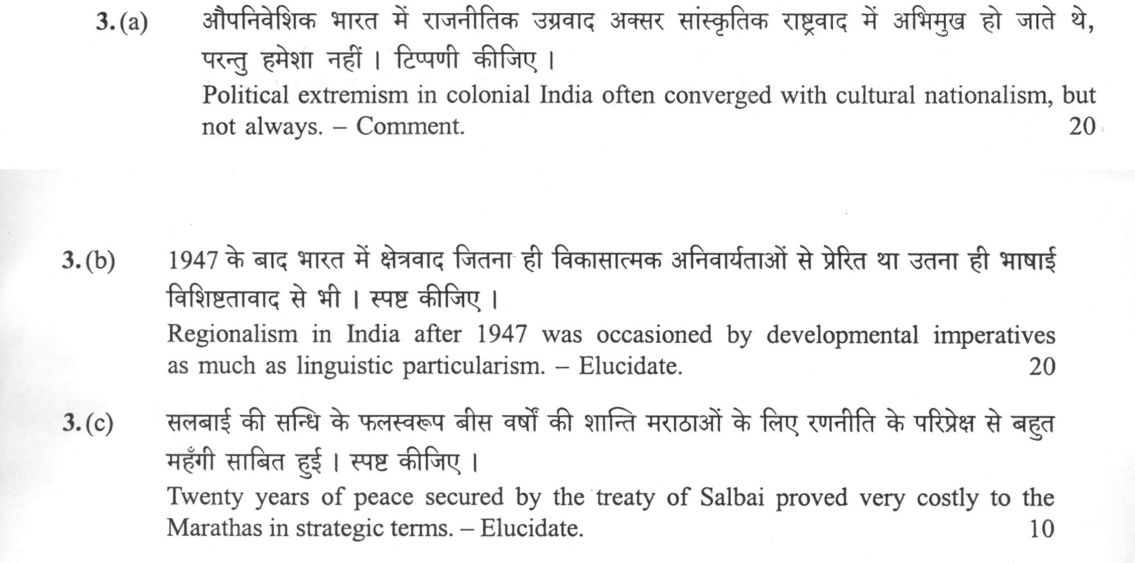
(a) Political extremism in colonial India often converged with cultural nationalism, but not always. – Comment. (20 marks) (b)…
Political extremism in colonial India often converged with cultural nationalism, but not always. – Comment. 20 marks
Regionalism in India after 1947 was occasioned by developmental imperatives as much as linguistic particularism. – Elucidate. 20 marks
Twenty years of peace secured by the treaty of Salbai proved very costly to the Marathas in strategic terms. – Elucidate. 10 marks
हिंदी में प्रश्न पढ़ें
औपनिवेशिक भारत में राजनीतिक उग्रवाद अक्सर सांस्कृतिक राष्ट्रवाद में अभिमुख हो जाते थे, परन्तु हमेशा नहीं । टिप्पणी कीजिए । 20 marks
1947 के बाद भारत में क्षेत्रवाद जितना ही विकासात्मक अनिवार्यताओं से प्रेरित था उतना ही भाषाई विशिष्टतावाद से भी । स्पष्ट कीजिए । 20 marks
सलबाई की संधि के फलस्वरूप बीस वर्षों की शांति मराठाओं के लिए रणनीति के परिप्रेक्ष्य से बहुत महँगी साबित हुई । स्पष्ट कीजिए । 10 marks
Model answer
Written by UPSC Answer Check against this question's marking rubric, to the expected length. UPSC does not publish answers for Mains — this is one way to score well, not an official key.
The evolution of Indian national consciousness and state-building reflects a complex interplay between cultural assertion, strategic calculation, and socio-economic imperatives across colonial and post-colonial epochs.
Extremism and Cultural Nationalism
Late nineteenth and early twentieth-century political extremism frequently utilized cultural revivalism to breach elite confines and mobilize the masses. Bal Gangadhar Tilak transformed traditional Ganeshotsav and Shivaji festivals into potent instruments of public assembly and anti-colonial agitation. Similarly, Aurobindo Ghosh conceptualized the nation as the divine Motherland through Bande Mataram, infusing political struggle with Vedantic spiritualism to generate moral urgency and sacrificial commitment.
However, extremism did not consistently converge with cultural nationalism. The revolutionary phase of the 1920s and 1930s prioritized political action and universalist ideologies over religious framing. The Hindustan Socialist Republican Association (HSRA), influenced by Marxism, subordinated cultural symbolism to an egalitarian socio-political program. The Chittagong armoury raid (1930), organized by Surya Sen’s Indian Republican Army, was driven by revolutionary republicanism rather than cultural revival. Furthermore, figures like Ashfaqulla Khan embodied militant anti-colonialism while remaining entirely outside the Hindu cultural idiom. Extremism, therefore, operated as a broad tactical and ideological spectrum where political radicalism often functioned autonomously from cultural nationalism.
Developmental Imperatives and Linguistic Particularism in Post-1947 Regionalism
Post-independence regionalism was initially propelled by linguistic particularism. Potti Sreeramulu’s fast-unto-death in 1952 precipitated the creation of Andhra State, prompting the States Reorganisation Act (1956) which systematically aligned administrative boundaries with linguistic lines. This dynamic continued with the bifurcation of Bombay State into Maharashtra and Gujarat in 1960 and the anti-Hindi agitations in Tamil Nadu in 1965, which established language as a core vehicle for regional identity and federal bargaining.
Concurrently, developmental imperatives played an equally decisive role in generating regional discontent. Uneven capital allocation and public investment exacerbated inter-state inequalities. The Green Revolution widened disparities by concentrating agricultural prosperity in the north-western states, leaving eastern regions economically neglected. Chronic water-sharing disputes over the Krishna and Cauvery river basins transformed natural resource management into persistent regional conflicts. Additionally, historical industrial backwardness generated enduring regional demands for Special Category Status from states such as Bihar and Odisha, demonstrating that material deprivation and economic competition shaped regional assertions as deeply as linguistic affinities.
Strategic Costs of the Treaty of Salbai (1782)
The Treaty of Salbai (1782) ended the First Anglo-Maratha War by restoring the status quo ante, returning occupied territories, and pensioning off Raghunath Rao. While it was hailed as a diplomatic success for Nana Phadnavis, the resulting twenty years of peace proved catastrophic for the Marathas in strategic terms.
The two-decade respite provided the British East India Company the time required to consolidate its administrative and revenue apparatus in Bengal without facing a pan-Indian confederacy. Crucially, it neutralized Maratha intervention, allowing the Company to isolate and defeat Tipu Sultan across the Third (1790–92) and Fourth (1799) Anglo-Mysore Wars, eliminating Britain's most formidable southern adversary. When Lord Wellesley assumed office in 1798 and advanced the Subsidiary Alliance system, the Maratha polity had disintegrated into internecine warfare among the Scindias, Holkars, and the Peshwa. Consequently, during the Second Anglo-Maratha War (1803–05), the British dismantled the fragmented Maratha Confederacy from an unassailable position of financial and military superiority.
While cultural symbols catalyzed anti-colonial mobilization and linguistic affinities shaped post-independence federal borders, material realities—whether strategic pauses in colonial warfare or regional developmental disparities—consistently dictated the ultimate political trajectory of modern India.
What "Comment" is asking you to do
Take a position on the statement and support it. Comment usually attaches to a quoted line in the short slots, so the reasoning must be compressed — an opening view, a few load-bearing reasons, and the limit of the claim.
Structure that answers it
Unpack what the statement asserts → your stance → two or three supporting reasons → the qualification that limits it
Where marks are lost
Neutral summary; a comment without a stance has not answered. Equally costly is accepting the quoted line wholesale and never testing where it fails.
How this answer will be evaluated
Approach
Framework: Context > Thesis > Evidence > Historiography. (a) comment: context > arguments both sides > judgment > close | (b) explain: definition/context > points in order > small example > short close | (c) explain: definition/context > points in order > small example > short close Full marks: Demonstrates deep understanding of the historical context, provides specific examples, and offers a nuanced analysis.
Key points expected
- Define the specific nature of political extremism (e.g., revolutionary or communal).
- Identify the 'cultural nationalism' elements (e.g., Vedic revival, Swadeshi, language).
- Provide evidence of convergence (e.g., Ghadar movement, early Congress).
- Provide evidence of divergence (e.g., secular vs. religious political goals).
- Define 'developmental imperatives' in the context of resource allocation.
- Explain the role of linguistic reorganization (1956) in shaping regions.
- Provide examples of regions driven by development (e.g., Punjab, Haryana).
- Provide examples of regions driven by language (e.g., Telangana, Assam).
Evaluation rubric
Each sub-part is marked on its own, against the marks and word limit printed on the paper.
- (a) Contextualize the convergence of political and cultural nationalism, then judge the extent of their divergence. 20 marks
comment— context → arguments both sides → judgment → close
Must cover
- Define the specific nature of political extremism (e.g., revolutionary or communal).
- Identify the 'cultural nationalism' elements (e.g., Vedic revival, Swadeshi, language).
- Provide evidence of convergence (e.g., Ghadar movement, early Congress).
- Provide evidence of divergence (e.g., secular vs. religious political goals).
Loses marks
- Treating 'cultural nationalism' as a monolith without nuance.
- Failing to address the 'not always' aspect of the prompt.
- Generalizing without specific historical examples.
Earns more
- Mention specific movements like the Swadeshi or Ghadar.
- Reference the role of the press in shaping cultural identity.
- Discuss the tension between Hindu and Muslim cultural identities.
- Cite specific leaders (e.g., Tilak, Bhasin).
Extra mark
- Quote a specific primary source or manifesto.
- Name a specific historiographical debate on this topic.
- (b) Explain how economic development needs and linguistic identity both drove regionalism post-1947. 20 marks
explain— definition/context → points in order → small example → short close
Must cover
- Define 'developmental imperatives' in the context of resource allocation.
- Explain the role of linguistic reorganization (1956) in shaping regions.
- Provide examples of regions driven by development (e.g., Punjab, Haryana).
- Provide examples of regions driven by language (e.g., Telangana, Assam).
Loses marks
- Focusing only on linguistic issues and ignoring economic factors.
- Failing to distinguish between different types of regionalism.
- Using vague terms like 'development' without specific examples.
Earns more
- Discuss the role of the States Reorganisation Commission.
- Mention specific economic grievances (e.g., water sharing, industrialization).
- Reference the impact of central planning on regional disparities.
- Discuss the role of political parties in mobilizing regional sentiment.
Extra mark
- Cite a specific economic report or policy document.
- Name a specific political leader or party associated with a region.
- (c) Explain the strategic costs to the Marathas resulting from the Treaty of Salbai. 10 marks
explain— definition/context → points in order → small example → short close
Must cover
- Identify the key terms of the Treaty of Salbai (1782).
- Explain the loss of naval power or coastal control.
- Discuss the impact on Maratha expansion in the Deccan.
- Mention the rise of rival powers (e.g., Nizam, Hyder Ali).
Loses marks
- Failing to explain the 'strategic' nature of the costs.
- Focusing only on the immediate military defeat.
- Ignoring the long-term implications of the treaty.
Earns more
- Discuss the impact on Maratha trade and revenue.
- Mention the role of the British in the treaty.
- Reference the specific military defeats that led to the treaty.
- Discuss the long-term consequences for the Maratha Empire.
Extra mark
- Cite a specific clause of the treaty.
- Name a specific Maratha leader involved in the negotiations.
Practice this exact question
Write your answer and it is marked point by point against the model answer above — what you covered, what you missed, what you got wrong.
Evaluate my answer →More from History 2024 Paper II
- Q1 Critically examine the following statements in about 150 words each: (a) After the battle…
- Q2 (a) The pace of commercialisation of agriculture increased as a result of British revenue…
- Q3 (a) Political extremism in colonial India often converged with cultural nationalism, but…
- Q4 (a) The Swadeshi movement of 1905 anticipated many of the tactics that were later develop…
- Q5 Critically examine the following statements in about 150 words each: (a) The ideas raised…
- Q6 (a) The course of the English industrialization was too long drawn to be considered a rev…