Paper II — Q7
(a) The second world war was a truly global conflict. Discuss. (20 marks) (b) Trace the different stages of European economic…
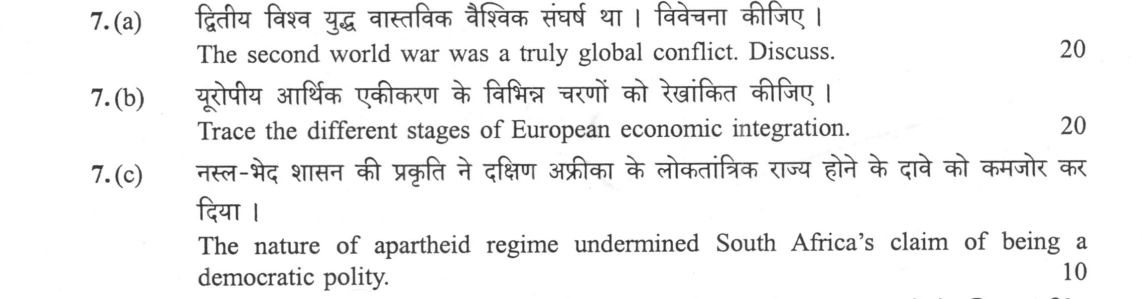
The second world war was a truly global conflict. Discuss. 20 marks
Trace the different stages of European economic integration. 20 marks
The nature of apartheid regime undermined South Africa's claim of being a democratic polity. 10 marks
हिंदी में प्रश्न पढ़ें
द्वितीय विश्व युद्ध वास्तविक वैश्विक संघर्ष था। विवेचना कीजिए। 20 marks
यूरोपीय आर्थिक एकीकरण के विभिन्न चरणों को रेखांकित कीजिए। 20 marks
नस्ल-भेद शासन की प्रकृति ने दक्षिण अफ्रीका के लोकतांत्रिक राज्य होने के दावे को कमजोर कर दिया। 10 marks
Model answer
Written by UPSC Answer Check against this question's marking rubric, to the expected length. UPSC does not publish answers for Mains — this is one way to score well, not an official key.
The Second World War was a truly global conflict because it combined European, Pacific, African and Indian Ocean theatres with colonial economies, manpower and supply chains. Unlike the First World War, whose centre of gravity remained largely European, the Second World War opened with Japan’s attack on Pearl Harbor in 1941 and the Burma campaign, while in Africa the battles of El Alamein and the liberation of Ethiopia showed that the war was not confined to the continent’s borders. Indian Ocean naval operations protected supply lines to India, the Middle East and the Pacific, and troops from India, Africa and Southeast Asia served in large numbers, making the conflict a colonial and imperial war as well as a metropolitan one. Its economic dimension was equally worldwide: strategic materials from colonies, Lend-Lease supply chains, and the mobilisation of Asian and African labour transformed societies, accelerated nationalist movements and exposed the contradictions of imperial rule. India’s ports, raw materials and manpower were drawn into Allied logistics, while African and Southeast Asian colonies became sources of food, minerals and soldiers. Thus, while Europe remained the decisive battlefield, the war’s causes, resources, battles and consequences were truly global. The war’s global character is also visible in its aftermath: decolonisation and new state systems in Asia and Africa showed that its consequences were worldwide.
Stages of European economic integration European integration began as a sectoral bargain after 1945. The 1951 ECSC pooled coal and steel among France, West Germany, Italy, Belgium, the Netherlands and Luxembourg, using shared markets to make war materially difficult. The 1957 Treaties of Rome created the EEC and Euratom, extending integration to a common market in goods, services, capital and labour, and to nuclear energy cooperation. The Single European Act of 1986 removed remaining internal barriers and prepared a single market by 1992. Maastricht in 1992 created the European Union and introduced the three-pillar structure, monetary union and closer political cooperation. The eurozone began in 1999 with electronic settlement and in 2002 with cash notes, deepening integration into currency. The ECSC’s High Authority and Court of Justice gave the process an early supranational character, while later treaties strengthened the Commission, Parliament and Council, showing a shift from narrow sectoral management to broader governance. Institutionally, the process moved from sectoral cooperation to comprehensive economic and political union. Theorists explain this through Haas’s functionalist spillover, where integration in one area creates pressure for more, and Moravcsik’s intergovernmental bargaining, where states trade sovereignty to protect national interests. The tension between supranational institutions and national sovereignty has remained central.
Apartheid and democratic deficit Apartheid undermined South Africa’s claim to democracy because it legally divided citizens by race and denied equal political rights. The Black majority had no effective vote, while white minority rule controlled parliament, local government and the courts, making the franchise racial rather than universal. The Population Registration Act classified people by race, the Group Areas Act allocated separate residential and economic spaces, and the Bantu Education Act provided inferior education to Black South Africans, institutionalising inequality. These laws contradicted democratic norms in the 1955 Freedom Charter, which demanded a united, non-racial South Africa, and international human rights frameworks based on equality and self-determination. Resistance exposed the regime’s illegitimacy: the ANC and PAC organised mass protest, Black Consciousness challenged internalised inferiority, and armed struggle intensified after 1960. External pressure also mattered; South Africa withdrew from the Commonwealth in 1961 amid opposition to apartheid, later faced Commonwealth sanctions, and experienced US divestment and sanctions. Together, legal exclusion, mass resistance and international isolation showed that apartheid was not a democratic polity but a racially stratified authoritarian system.
What "Discuss" is asking you to do
Lay the issue out from more than one side — how it arose, what is claimed for it, what is held against it, and where it now stands. UPSC attaches discuss to broad topics with several live dimensions, so coverage of the dimensions earns more than the strength of your opinion.
Structure that answers it
Set the issue up → the case as it is made → the case against → the dimension both sides leave out → where the balance now lies
Where marks are lost
Listing facts with no thread between them, or arguing one side throughout and calling it a discussion.
How this answer will be evaluated
Approach
Framework: Context > Thesis > Evidence > Historiography. (a) discuss: intro > 3-4 dimensions > example > balanced close | (b) trace: start point > the stages in sequence > end point > what changed | (c) comment: context > arguments both sides > judgment > close Full marks: Thesis-driven, specific evidence, clear sequence, historiographical awareness.
Key points expected
- Geographical spread: Europe, Pacific, North Africa, Asia
- Economic dimension: total war mobilization and industrial capacity
- Diplomatic dimension: formation of Allied and Axis blocs
- Thesis: conflict was truly global, not just European
- Start point: 1951 ECSC (Coal and Steel Community)
- Stage: 1957 Treaty of Rome (EEC) and 1968 Customs Union
- Stage: 1992 Single European Market (Maastricht Treaty)
- End point: 1999 Euro currency and 2004 Eastern expansion
Evaluation rubric
Each sub-part is marked on its own, against the marks and word limit printed on the paper.
- (a) Argue the global nature of WWII across multiple dimensions (geography, economy, diplomacy). 20 marks
discuss— intro → 3-4 dimensions → example → balanced close
Must cover
- Geographical spread: Europe, Pacific, North Africa, Asia
- Economic dimension: total war mobilization and industrial capacity
- Diplomatic dimension: formation of Allied and Axis blocs
- Thesis: conflict was truly global, not just European
Loses marks
- Narrating battles without analyzing their global impact
- Ignoring the Pacific or Asian theaters
- Treating it as a purely European conflict
Earns more
- Mention of specific theaters (e.g., Battle of Midway, Stalingrad)
- Reference to UNO formation as a global outcome
- Comparison with WWI's more limited scope
- Mention of colonial involvement in the war effort
Extra mark
- Citation of a specific historian (e.g., A.J.P. Taylor, John Keegan)
- Reference to a specific primary source or treaty (e.g., Atlantic Charter)
- (b) Sequence the stages of European economic integration from post-war to present. 20 marks
trace— start point → the stages in sequence → end point → what changed
Must cover
- Start point: 1951 ECSC (Coal and Steel Community)
- Stage: 1957 Treaty of Rome (EEC) and 1968 Customs Union
- Stage: 1992 Single European Market (Maastricht Treaty)
- End point: 1999 Euro currency and 2004 Eastern expansion
Loses marks
- Skipping the ECSC and starting with the EEC
- Confusing political integration (EU) with economic integration (EEC)
- Listing dates without explaining the economic logic of each step
Earns more
- Mention of the 'Schuman Declaration' as the intellectual origin
- Reference to the 'Six' founding members
- Explanation of the 'Spillover' effect (economic to political)
- Mention of the Lisbon Treaty (2009) as a recent stage
Extra mark
- Citation of a specific treaty article or date (e.g., 1 Jan 1958)
- Reference to a key figure (e.g., Jean Monnet, Robert Schuman)
- (c) Analyze how apartheid's nature contradicted the claim of democracy. 10 marks
comment— context → arguments both sides → judgment → close
Must cover
- Definition of Apartheid: institutionalized racial segregation
- Contradiction: 'One person, one vote' vs. 'Separate development'
- Evidence: Bantustans and the denial of citizenship to non-whites
- Judgment: The regime was a racial oligarchy, not a democracy
Loses marks
- Describing apartheid without linking it to the definition of democracy
- Ignoring the legal framework of the regime
- Treating it as a simple 'bad policy' rather than a structural contradiction
Earns more
- Mention of the 'Group Areas Act' or 'Pass Laws'
- Reference to the 'Tricameral Parliament' (1983) as a sham
- Mention of the 'Freedom Charter' as the counter-claim
- Reference to the 'Truth and Reconciliation Commission' (TRC)
Extra mark
- Citation of a specific act (e.g., Population Registration Act 1950)
- Reference to a specific leader (e.g., P.W. Botha, Nelson Mandela)
Practice this exact question
Write your answer and it is marked point by point against the model answer above — what you covered, what you missed, what you got wrong.
Evaluate my answer →More from History 2024 Paper II
- Q4 (a) The Swadeshi movement of 1905 anticipated many of the tactics that were later develop…
- Q5 Critically examine the following statements in about 150 words each: (a) The ideas raised…
- Q6 (a) The course of the English industrialization was too long drawn to be considered a rev…
- Q7 (a) The second world war was a truly global conflict. Discuss. (20 marks) (b) Trace the d…
- Q8 (a) The emergence of two power blocs not only symbolised two competing ideologies but als…