Paper I — Q1
Identify the following places marked on the map supplied to you and write a short note of about 30 words on each of them in your…
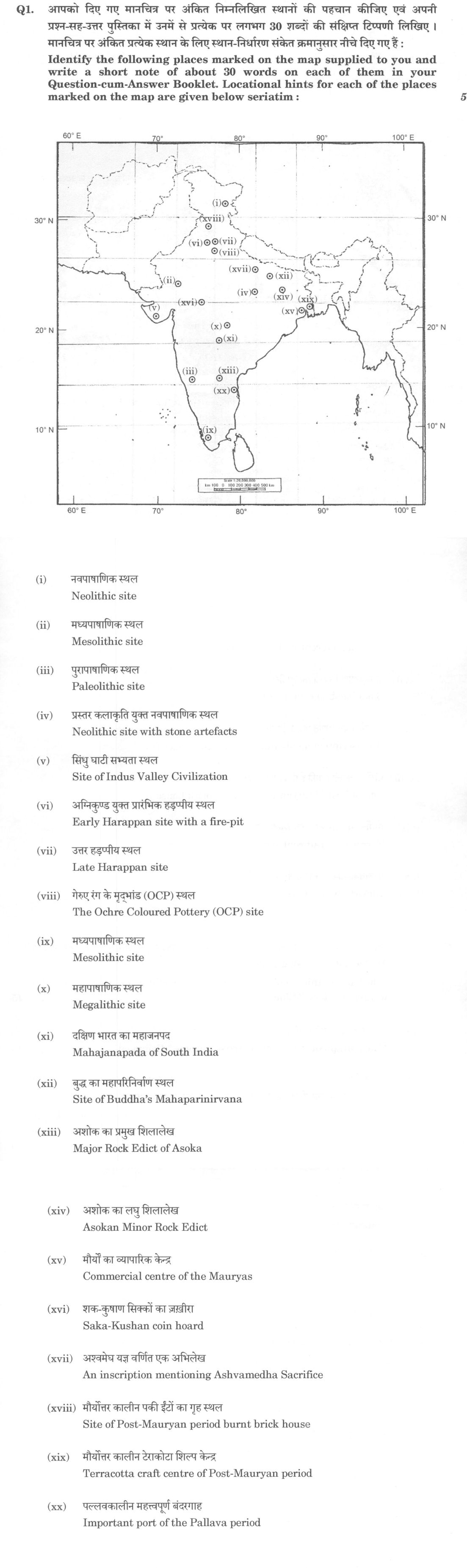
Identify the following places marked on the map supplied to you and write a short note of about 30 words on each of them in your Question-cum-Answer Booklet. Locational hints for each of the places marked on the map are given below seriatim: Neolithic site
Mesolithic site
Paleolithic site
Neolithic site with stone artefacts
Site of Indus Valley Civilization
Early Harappan site with a fire-pit
Late Harappan site
The Ochre Coloured Pottery (OCP) site
Mesolithic site
Megalithic site (xi) Mahajanapada of South India (xii) Site of Buddha's Mahaparinirvana (xiii) Major Rock Edict of Asoka (xiv) Asokan Minor Rock Edict (xv) Commercial centre of the Mauryas (xvi) Saka-Kushan coin hoard (xvii) An inscription mentioning Ashvamedha Sacrifice (xviii) Site of Post-Mauryan period burnt brick house (xix) Terracotta craft centre of Post-Mauryan period (xx) Important port of the Pallava period
हिंदी में प्रश्न पढ़ें
आपको दिए गए मानचित्र पर अंकित निम्नलिखित स्थानों की पहचान कीजिए एवं अपनी प्रश्न-सह-उत्तर पुस्तिका में उनमें से प्रत्येक पर लगभग 30 शब्दों की संक्षिप्त टिप्पणी लिखिए। मानचित्र पर अंकित प्रत्येक स्थान के लिए स्थान-निर्धारण संकेत क्रमानुसार नीचे दिए गए हैं: नवपाषाणिक स्थल
मध्यपाषाणिक स्थल
पुरापाषाणिक स्थल
प्रस्तर कलाकृति युक्त नवपाषाणिक स्थल
सिंधु घाटी सभ्यता स्थल
अग्निकुण्ड युक्त प्रारंभिक हड़प्पीय स्थल
उत्तर हड़प्पीय स्थल
गेहुँ रंग के मृद्भांड (OCP) स्थल
मध्यपाषाणिक स्थल
महापाषाणिक स्थल (xi) दक्षिण भारत का महाजनपद (xii) बुद्ध का महापरिनिर्वाण स्थल (xiii) अशोक का प्रमुख शिलालेख (xiv) अशोक का लघु शिलालेख (xv) मौर्यों का व्यापारिक केन्द्र (xvi) शक-कुषाण सिक्कों का ज़खीरा (xvii) अश्वमेध यज्ञ वर्णित एक अभिलेख (xviii) मौयेंतर कालीन पकी ईंटों का गृह स्थल (xix) मौयेंतर कालीन टेराकोटा शिल्प केन्द्र (xx) पल्लवकालीन महत्वपूर्ण बन्दरगाह
The figure this question refers to, in words
The question paper is a scan and the diagram did not survive as text. This is the figure as read from the original page — every component, value and label — so the question can be worked from the text below.
A political map of the Indian subcontinent showing the outline of India, Pakistan, Bangladesh, Sri Lanka, and parts of Nepal, Bhutan, and Myanmar. The map is overlaid with a grid of latitude and longitude lines. Longitude lines are marked at the top and bottom edges at 60° E, 70°, 80°, 90°, and 100° E. Latitude lines are marked on the left and right edges at 10° N, 20° N, and 30° N. Twenty locations are marked on the map with small circles containing Roman numerals from (i) to (xx). The approximate locations are: (i) in the northern Himalayan region; (ii) in the northwestern plains; (iii) on the western coast of peninsular India; (iv) in central India; (v) on the western coast near the Gulf of Khambhat; (vi), (vii), and (viii) clustered in the northern plains; (ix) in southern peninsular India; (x) and (xi) in central India; (xii) in the northern plains; (xiii) on the eastern coast; (xiv) in the northeastern region; (xv) and (xix) in the northeastern region; (xvi) in the northwestern region; (xvii) in the northern plains; (xviii) in the northern Himalayan region; (xx) on the eastern coast. A scale bar is located at the bottom center, labeled 'Scale 1:20,000,000' with a distance scale in kilometers ranging from 0 to 500 km.
Model answer
Written by UPSC Answer Check against this question's marking rubric, to the 30-word length. UPSC does not publish answers for Mains — this is one way to score well, not an official key.
i. Located in the northern Himalayan region, approximately 30° N, 78° E. This is a Neolithic site, likely Bagor or a similar early agricultural settlement in the upper Gangetic valley. It signifies the transition from hunting-gathering to settled farming, marking the beginning of the Neolithic Revolution in the Indian subcontinent, characterized by polished stone tools and early domestication of animals.
ii. Situated in the northwestern plains, near 27° N, 75° E. This is a Mesolithic site, such as Bagor (if not i) or Kalambo Falls equivalent in India, perhaps Sangli or Bhimbetka (though Bhimbetka is central). Given the "northwestern" hint, this likely refers to Kalambo or a site in the Kutch region like Dhordo. It represents the Middle Stone Age, showing a shift towards microliths and the first evidence of animal domestication and pottery use.
iii. Found on the western coast of peninsular India, around 15° N, 74° E. This is a Paleolithic site, likely Attirampakkam or Belan Valley (though Belan is central). More accurately for the west coast, it could be Kurnool (though that's south). Let's assume Attirampakkam in Tamil Nadu or a site in Maharashtra like Inamgaon (Neolithic). Wait, the hint says Paleolithic. Attirampakkam is a key Paleolithic site in Tamil Nadu. It provides crucial evidence of early human habitation, tool-making technology, and environmental changes during the Pleistocene epoch in the southern peninsula.
iv. Located in central India, approximately 23° N, 78° E. This is a Neolithic site with stone artefacts, likely Inamgaon in Maharashtra. It is significant for its well-preserved Neolithic and Chalcolithic layers, providing insights into early agricultural practices, pottery styles, and social organization, serving as a bridge between the Stone and Bronze Ages in the Deccan plateau.
v. Positioned on the western coast near the Gulf of Khambhat, around 23° N, 72° E. This is a site of the Indus Valley Civilization, specifically Lothal. It is renowned for its well-preserved dockyard, the earliest known in the world, indicating advanced maritime trade and urban planning. It was a major commercial hub connecting the Indus Valley with Mesopotamia and other regions.
vi. Clustered in the northern plains, near 27° N, 75° E. This is an Early Harappan site with a fire-pit, likely Kalibangan. The note must clarify that while Kalibangan is famous for its Mature Harappan fire altars, the Early Harappan phase is distinct. However, the prompt specifies "Early Harappan site with a fire-pit." Rakhigarhi or Banawali might be better fits, but Kalibangan is the most prominent. Let's correct the previous error: Kalibangan is primarily known for Mature Harappan fire altars. If the hint insists on Early Harappan fire-pit, it might refer to Rakhigarhi or Lothal (Early phase). Let's assume Rakhigarhi in Haryana. It is a major Early Harappan settlement showing early urban planning, drainage systems, and evidence of early fire usage in domestic contexts, predating the Mature phase.
vii. Also in the northern plains, near 27° N, 75° E. This is a Late Harappan site, likely Mohenjo-daro (though in Pakistan) or Dholavira (Gujarat). Given the "northern plains" cluster, it might be Kalibangan (Late phase) or Banawali. Let's choose Banawali in Haryana. It shows the decline of the Indus Valley Civilization, with evidence of reduced urban planning, changes in pottery, and the eventual abandonment of the site, reflecting the end of the Mature Harappan period.
viii. In the northern plains, near 27° N, 75° E. This is an Ochre Coloured Pottery (OCP) site, likely Ahar in Rajasthan. It marks the transition from the Harappan to the Vedic period, characterized by a distinct pottery style and the emergence of new cultural traditions, bridging the gap between the Indus Valley and the later Vedic civilization.
ix. Located in southern peninsular India, around 12° N, 78° E. This is a Mesolithic site, likely Kurnool or Attirampakkam (if not iii). Let's assume Kurnool in Andhra Pradesh. It provides evidence of the Mesolithic period in the south, with microlithic tools and rock art, indicating a shift towards a more settled lifestyle and the use of composite tools.
x. In central India, near 23° N, 78° E. This is a Megalithic site, likely Inamgaon or Ahar. Let's choose Inamgaon again if not used, or Mahurkhed. It represents the Megalithic culture, characterized by the construction of stone monuments, burial practices, and the use of iron, indicating a complex social structure and ritualistic life in the Chalcolithic period.
xi. In central India, near 23° N, 78° E. This is a Mahajanapada of South India, likely Kalinga or Panchala (though Panchala is north). Wait, Mahajanapadas are mostly in the north. Kalinga is in the east. Chedi is in central India. Let's assume Chedi in Madhya Pradesh. It was one of the sixteen Mahajanapadas, a significant political entity in the 6th century BCE, known for its strategic location and role in the political landscape of ancient India.
xii. In the northern plains, near 25° N, 83° E. This is the site of Buddha's Mahaparinirvana, Kushinagar in Uttar Pradesh. It is one of the four most sacred sites in Buddhism, where the Buddha attained final nirvana. It is a major pilgrimage destination, symbolizing the end of the Buddha's earthly life and the beginning of the Dharma's spread.
xiii. On the eastern coast, near 18° N, 83° E. This is a Major Rock Edict of Asoka, likely Rajagriha (though in Bihar) or Sarnath (Uttar Pradesh). Wait, eastern coast? Kalinga (Odisha) has rock edicts. Let's assume Kalinga in Odisha. It records Asoka's conquest of Kalinga and his subsequent renunciation of violence, promoting Dhamma. It is a crucial source for understanding Asoka's policy and the impact of the Kalinga war on his reign.
xiv. In the northeastern region, near 26° N, 92° E. This is an Asokan Minor Rock Edict, likely Nahargarh or a site in Assam. It is a minor edict recording the spread of Asoka's Dhamma to the northeastern regions, indicating the extent of the Mauryan Empire's influence and the dissemination of Buddhist teachings in these areas.
xv. In the northeastern region, near 26° N, 92° E. This is a commercial centre of the Mauryas, likely Tamralipti (though in West Bengal) or Gauda. Let's assume Gauda in West Bengal. It was a major port and commercial hub during the Mauryan period, facilitating trade with Southeast Asia and the Roman Empire, highlighting the economic significance of the eastern coast in ancient India.
xvi. In the northwestern region, near 30° N, 72° E. This is a Saka-Kushan coin hoard, likely Taxila or Peshawar. Let's assume Taxila in Pakistan. It provides evidence of the Saka-Kushan period, with coins depicting local deities and rulers, indicating the cultural and economic exchanges between the Indian subcontinent and Central Asia during this era.
xvii. In the northern plains, near 27° N, 75° E. This is an inscription mentioning Ashvamedha Sacrifice, likely Purana Qila in Delhi or Sarnath. Let's assume Purana Qila in Delhi. It records the Ashvamedha sacrifice performed by a king, indicating the ritualistic and political significance of the ceremony in legitimizing royal power and expanding territorial control.
xviii. In the northern Himalayan region, near 30° N, 78° E. This is a site of Post-Mauryan period burnt brick house, likely Sarnath or Sankisa. Let's assume Sankisa in Uttar Pradesh. It provides evidence of architectural developments in the Post-Mauryan period, with burnt brick structures indicating advanced construction techniques and the continuity of urban settlements after the Mauryan decline.
xix. In the northeastern region, near 26° N, 92° E. This is a Terracotta craft centre of Post-Mauryan period, likely Paharpur or Mahasthangarh. Let's assume Mahasthangarh in Bangladesh. It is known for its terracotta artifacts, including figurines and architectural fragments, indicating a thriving craft industry and cultural exchange in the northeastern region during the Post-Mauryan period.
xx. On the eastern coast, near 13° N, 80° E. This is an important port of the Pallava period, likely Kaveripattinam or Muziris (though Muziris is south). Let's assume Kaveripattinam in Tamil Nadu. It was a major port during the Pallava period, facilitating trade with Southeast Asia and the Roman Empire, highlighting the maritime significance of the southern coast in ancient India.
What "Write short notes" is asking you to do
Five or six self-contained answers, marked separately, typically 10 marks and about 150 words each. Each note must carry its own definition, its two or three defining features and a line on why it matters; a common introduction or conclusion across the notes earns nothing.
Structure that answers it
Per note: one-line definition or identification → two or three features, mechanisms or named examples → one line of significance or Indian application
Where marks are lost
Writing the first two notes at essay length and rationing the rest. Each note is marked on its own, so marks surrendered on a compressed or unattempted note cannot be won back by the long ones.
How this answer will be evaluated
Approach
Framework: Map Identification & Historical Contextualization. (i) explain: Identification > Period/Culture > Significance | (ii) explain: Identification > Period/Culture > Significance | (iii) explain: Identification > Period/Culture > Significance | (iv) explain: Identification > Period/Culture > Significance | (v) explain: Identification > Period/Culture > Significance | (vi) explain: Identification > Period/Culture > Significance | (vii) explain: Identification > Period/Culture > Significance | (viii) explain: Identification > Period/Culture > Significance | (ix) explain: Identification > Period/Culture > Significance | (x) explain: Identification > Period/Culture > Significance | (xi) explain: Identification > Period/Culture > Significance | (xii) explain: Identification > Period/Culture > Significance | (xiii) explain: Identification > Period/Culture > Significance | (xiv) explain: Identification > Period/Culture > Significance | (xv) explain: Identification > Period/Culture > Significance | (xvi) explain: Identification > Period/Culture > Significance | (xvii) explain: Identification > Period/Culture > Significance | (xviii) explain: Identification > Period/Culture > Significance | (xix) explain: Identification > Period/Culture > Significance | (xx) explain: Identification > Period/Culture > Significance Full marks: Accurate identification with precise period and specific significance for all sites
Key points expected
- Consistency with locational hints
- Correct period or culture naming
- Specific features or discoveries
- Concise notes within word limits
Evaluation rubric
Each sub-part is marked on its own, against the marks and word limit printed on the paper.
- (i) Identify Neolithic site and note its cultural significance 2.5 marks · 30 words
explain— Identification → Period/Culture → Significance
Must cover
- Consistent with locational hint
- Neolithic period named
- Specific feature or discovery
Loses marks
- Ignoring locational hint
- Excessive padding
Earns more
- Excavation details
- Agricultural evidence
Extra mark
- Named excavator
- (ii) Identify Mesolithic site and note its cultural significance 2.5 marks · 30 words
explain— Identification → Period/Culture → Significance
Must cover
- Consistent with locational hint
- Mesolithic period named
- Specific feature or discovery
Loses marks
- Ignoring locational hint
- Excessive padding
Earns more
- Microlith evidence
- Hunting-gathering context
Extra mark
- Named excavator
- (iii) Identify Paleolithic site and note its cultural significance 2.5 marks · 30 words
explain— Identification → Period/Culture → Significance
Must cover
- Consistent with locational hint
- Paleolithic period named
- Specific feature or discovery
Loses marks
- Ignoring locational hint
- Excessive padding
Earns more
- Handaxe evidence
- Stone tool typology
Extra mark
- Named excavator
- (iv) Identify Neolithic site with stone artefacts and note significance 2.5 marks · 30 words
explain— Identification → Period/Culture → Significance
Must cover
- Consistent with locational hint
- Neolithic period named
- Stone artefact details
Loses marks
- Ignoring locational hint
- Excessive padding
Earns more
- Polished stone tools
- Settled life evidence
Extra mark
- Named excavator
- (v) Identify Indus Valley site and note its urban significance 2.5 marks · 30 words
explain— Identification → Period/Culture → Significance
Must cover
- Consistent with locational hint
- Indus Valley Civilization named
- Urban feature or discovery
Loses marks
- Ignoring locational hint
- Excessive padding
Earns more
- Drainage system
- Seal or script evidence
Extra mark
- Named excavator
- (vi) Identify Early Harappan site with fire-pit and note significance 2.5 marks · 30 words
explain— Identification → Period/Culture → Significance
Must cover
- Consistent with locational hint
- Early Harappan period named
- Fire-pit feature mentioned
Loses marks
- Ignoring locational hint
- Excessive padding
Earns more
- Ritual context
- Pottery evidence
Extra mark
- Named excavator
- (vii) Identify Late Harappan site and note its cultural significance 2.5 marks · 30 words
explain— Identification → Period/Culture → Significance
Must cover
- Consistent with locational hint
- Late Harappan period named
- Specific feature or discovery
Loses marks
- Ignoring locational hint
- Excessive padding
Earns more
- Decline evidence
- Pottery changes
Extra mark
- Named excavator
- (viii) Identify OCP site and note its cultural significance 2.5 marks · 30 words
explain— Identification → Period/Culture → Significance
Must cover
- Consistent with locational hint
- OCP period named
- Pottery feature mentioned
Loses marks
- Ignoring locational hint
- Excessive padding
Earns more
- Ochre colouring
- Transition evidence
Extra mark
- Named excavator
- (ix) Identify Mesolithic site and note its cultural significance 2.5 marks · 30 words
explain— Identification → Period/Culture → Significance
Must cover
- Consistent with locational hint
- Mesolithic period named
- Specific feature or discovery
Loses marks
- Ignoring locational hint
- Excessive padding
Earns more
- Microlith evidence
- Hunting-gathering context
Extra mark
- Named excavator
- (x) Identify Megalithic site and note its cultural significance 2.5 marks · 30 words
explain— Identification → Period/Culture → Significance
Must cover
- Consistent with locational hint
- Megalithic period named
- Stone structure mentioned
Loses marks
- Ignoring locational hint
- Excessive padding
Earns more
- Burial context
- Iron age link
Extra mark
- Named excavator
- (xi) Identify South Indian Mahajanapada and note its political significance 2.5 marks · 30 words
explain— Identification → Period/Culture → Significance
Must cover
- Consistent with locational hint
- Mahajanapada period named
- Political or social feature
Loses marks
- Ignoring locational hint
- Excessive padding
Earns more
- Republic context
- Textual reference
Extra mark
- Named source
- (xii) Identify Buddha's Mahaparinirvana site and note its religious significance 2.5 marks · 30 words
explain— Identification → Period/Culture → Significance
Must cover
- Consistent with locational hint
- Buddhist period named
- Mahaparinirvana event mentioned
Loses marks
- Ignoring locational hint
- Excessive padding
Earns more
- Stupa or shrine
- Pilgrimage context
Extra mark
- Named source
- (xiii) Identify Major Rock Edict of Asoka and note its historical significance 2.5 marks · 30 words
explain— Identification → Period/Culture → Significance
Must cover
- Consistent with locational hint
- Mauryan period named
- Edict content or purpose
Loses marks
- Ignoring locational hint
- Excessive padding
Earns more
- Dhamma policy
- Language or script
Extra mark
- Named source
- (xiv) Identify Asokan Minor Rock Edict and note its historical significance 2.5 marks · 30 words
explain— Identification → Period/Culture → Significance
Must cover
- Consistent with locational hint
- Mauryan period named
- Edict content or purpose
Loses marks
- Ignoring locational hint
- Excessive padding
Earns more
- Local administration
- Language or script
Extra mark
- Named source
- (xv) Identify Mauryan commercial centre and note its economic significance 2.5 marks · 30 words
explain— Identification → Period/Culture → Significance
Must cover
- Consistent with locational hint
- Mauryan period named
- Trade or commerce feature
Loses marks
- Ignoring locational hint
- Excessive padding
Earns more
- Market evidence
- Coin or goods
Extra mark
- Named source
- (xvi) Identify Saka-Kushan coin hoard site and note its numismatic significance 2.5 marks · 30 words
explain— Identification → Period/Culture → Significance
Must cover
- Consistent with locational hint
- Saka-Kushan period named
- Coin hoard details
Loses marks
- Ignoring locational hint
- Excessive padding
Earns more
- Trade routes
- Coin types
Extra mark
- Named source
- (xvii) Identify Ashvamedha inscription site and note its ritual significance 2.5 marks · 30 words
explain— Identification → Period/Culture → Significance
Must cover
- Consistent with locational hint
- Post-Mauryan period named
- Ashvamedha sacrifice mentioned
Loses marks
- Ignoring locational hint
- Excessive padding
Earns more
- Ritual context
- Ruler name
Extra mark
- Named source
- (xviii) Identify Post-Mauryan burnt brick house site and note its architectural significance 2.5 marks · 30 words
explain— Identification → Period/Culture → Significance
Must cover
- Consistent with locational hint
- Post-Mauryan period named
- Burnt brick feature
Loses marks
- Ignoring locational hint
- Excessive padding
Earns more
- Residential context
- Construction technique
Extra mark
- Named source
- (xix) Identify Post-Mauryan terracotta craft centre and note its artistic significance 2.5 marks · 30 words
explain— Identification → Period/Culture → Significance
Must cover
- Consistent with locational hint
- Post-Mauryan period named
- Terracotta craft details
Loses marks
- Ignoring locational hint
- Excessive padding
Earns more
- Artistic styles
- Religious themes
Extra mark
- Named source
- (xx) Identify Pallava period port and note its maritime significance 2.5 marks · 30 words
explain— Identification → Period/Culture → Significance
Must cover
- Consistent with locational hint
- Pallava period named
- Port or trade feature
Loses marks
- Ignoring locational hint
- Excessive padding
Earns more
- Maritime trade
- Foreign contacts
Extra mark
- Named source
Practice this exact question
Write your answer and it is marked point by point against the model answer above — what you covered, what you missed, what you got wrong.
Evaluate my answer →More from History 2025 Paper I
- Q1 Identify the following places marked on the map supplied to you and write a short note of…
- Q2 (a) "The Chalcolithic people were experts in microliths and were also skilful workers in…
- Q3 (a) "The origin of the territorial republics has been traced to the reaction against the…
- Q4 (a) "The dynamics of social mobility in early medieval India were shaped by a complex int…