Paper I — Q6
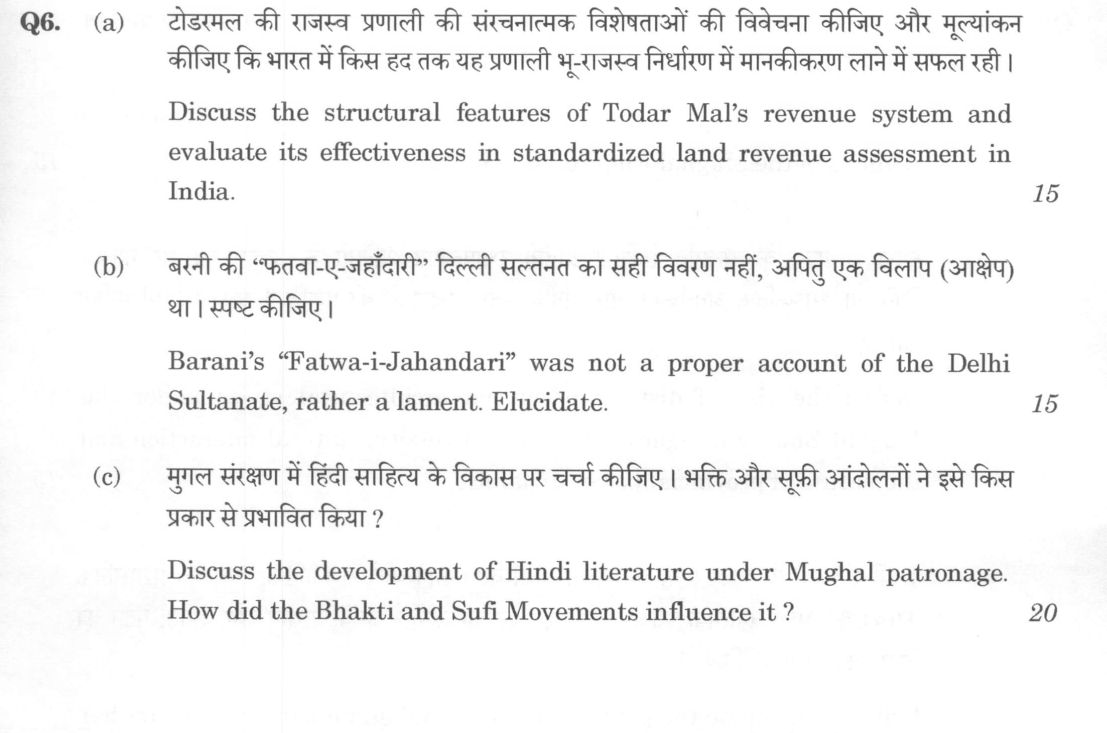
(a) Discuss the structural features of Todar Mal's revenue system and evaluate its effectiveness in standardized land revenue…
Discuss the structural features of Todar Mal's revenue system and evaluate its effectiveness in standardized land revenue assessment in India. 15 marks
Barani's "Fatwa-i-Jahandari" was not a proper account of the Delhi Sultanate, rather a lament. Elucidate. 15 marks
Discuss the development of Hindi literature under Mughal patronage. How did the Bhakti and Sufi Movements influence it ? 20 marks
हिंदी में प्रश्न पढ़ें
टोडरमल की राजस्व प्रणाली की संरचनात्मक विशेषताओं की विवेचना कीजिए और मूल्यांकन कीजिए कि भारत में किस हद तक यह प्रणाली भू-राजस्व निर्धारण में मानकीकरण लाने में सफल रही। (15 अंक)
बरनी की "फतवा-ए-जहांदारी" दिल्ली सल्तनत का सही विवरण नहीं, अपितु एक विलाप (आक्षेप) था। स्पष्ट कीजिए। (15 अंक)
मुगल संरक्षण में हिंदी साहित्य के विकास पर चर्चा कीजिए। भक्ति और सूफी आंदोलनों ने इसे किस प्रकार से प्रभावित किया ? (20 अंक)
Model answer
Written by UPSC Answer Check against this question's marking rubric, to the expected length. UPSC does not publish answers for Mains — this is one way to score well, not an official key.
The medieval Indian state underwent significant transformations in agrarian administration, political thought, and vernacular culture, reflecting both institutional rationalization and ideological contestation.
Todar Mal’s Revenue System and Standardization
Raja Todar Mal institutionalized the Ain-i-Dahsala (1580–82) under Akbar, building upon the measurement traditions of Alauddin Khalji and Sher Shah’s rai schedules. The core of this zabt system was the replacement of arbitrary crop-sharing (batai) with direct assessment based on actual measurement using a standardized jarib (bamboo rods joined with iron rings) and the gaz-i-Ilahi. Lands were classified into four categories based on cultivation frequency: polaj (annually cultivated), parati (fallow), chachar (fallow for 3–4 years), and banjar (uncultivated for 5+ years). State demand was fixed at one-third of average produce, calculated over a ten-year average price and yield index, converted into cash. Officials like the amil (revenue collector) and quanungo (keeper of land records) ensured institutional oversight.
The system achieved unprecedented revenue stability and administrative predictability, insulating the treasury from annual crop fluctuations. However, its operation was structurally uneven: it operated successfully in core provinces like Agra, Delhi, Allahabad, and Malwa, but proved unfeasible in frontier regions like Bengal, Gujarat, and Sindh, where older nasaq or ghalla-bakhshi prevailed. Furthermore, fixing cash rates created rigidities during unforeseen crop failures or price slumps, exacerbating agrarian distress despite theoretical provisions for relief.
**Barani’s Fatwa-i-Jahandari: Historiography and Lament**
Ziauddin Barani’s Fatwa-i-Jahandari functions not as an empirical chronicle of the Delhi Sultanate, but as an idealistic treatise on statecraft (nasihat) and a bitter lament. Writing as an alienated former courtier after Muhammad bin Tughlaq’s death, Barani observed the erosion of the pure Turkish nobility (shurafa) and the dilution of the hereditary iqta system. For Barani, the elevation of the low-born (ajlaf)—such as Ladha, Pira, and Aziz Khummar under Tughlaq—and the pragmatic compromises of statecraft (zawabit) constituted a catastrophic departure from ideal Islamic governance.
Barani's work reflects deep-seated aristocratic biases, displaying contempt for non-Turks and viewing political stability through an inflexible social hierarchy akin to Brahmanical varna order. Unlike his Tarikh-i-Firuz Shahi, the Fatwa-i-Jahandari projects anachronistic, utopian mandates onto past rulers like Mahmud of Ghazni. When contrasted with Ibn Battuta’s empirical travelogue or Amir Khusrau’s celebration of India’s composite culture, Barani's political philosophy emerges primarily as the ideological frustration of a displaced aristocratic class resisting socio-political integration.
Mughal Patronage, Bhakti, and Sufi Influences on Hindi Literature
Mughal patronage provided structural impetus for the flourishing of Hindi literature. Akbar’s policy of sulh-i-kul led to institutional patronization through the imperial Maktab Khana, which translated texts like the Mahabharata (Razmnama) and Ramayana. Court nobles like Abdur Rahim Khan-i-Khanan, Ras Khan, and Birbal composed sophisticated Braj poetry, while later emperors like Jahangir and Shah Jahan patronized poets such as Sundar Das and Kavindracharya Saraswati. Literary hubs flourished in Mathura, Varanasi, and Orchha alongside the imperial court.
Simultaneously, the Bhakti movement provided thematic vigor, democratizing literature via vernacularization. The Sagun tradition enriched Braj Bhasha through Surdas’s Sursagar and Mirabai's padas, centering on Krishna devotion, while Awadhi reached its zenith with Tulsidas’s Ramcharitmanas. Concurrently, Nirgun poets like Kabir and Dadu Dayal employed simple dialects to critique orthodoxies.
The Sufi movement introduced the Persian masnavi tradition into Awadhi through allegorical romances (premakhyans). Malik Muhammad Jayasi’s Padmavat synthesized Sufi mystic symbolism (ishq-e-haqiqi) with indigenous folk motifs and Vedantic concepts.
The synthesis of Todar Mal’s standardized institutions, the historical evolution away from Barani’s exclusionary statecraft, and the syncretic vernacular literature under Mughal rule together demonstrate the development of an integrated, composite socio-political fabric in early modern India.
What "Discuss" is asking you to do
Lay the issue out from more than one side — how it arose, what is claimed for it, what is held against it, and where it now stands. UPSC attaches discuss to broad topics with several live dimensions, so coverage of the dimensions earns more than the strength of your opinion.
Structure that answers it
Set the issue up → the case as it is made → the case against → the dimension both sides leave out → where the balance now lies
Where marks are lost
Listing facts with no thread between them, or arguing one side throughout and calling it a discussion.
How this answer will be evaluated
Approach
Framework: UPSC History Paper 1. (a) discuss: intro > 3-4 dimensions > example > balanced close | (b) comment: context > arguments both sides > judgment > close | (c) discuss: intro > 3-4 dimensions > example > balanced close Full marks: Thesis-driven, cites specific sources (Ain-i-Akbari, Fatwa-i-Jahandari), names historians, balanced evaluation.
Key points expected
- Zabti system and measurement of land
- Classification of soil (Chahi, Par, Khara)
- Fixed assessment and cash payment
- Evaluation of standardization vs. local variations
- Barani's bias against non-Turks (Hindus)
- Focus on 'Turkic' ideal vs. reality
- Critique of Alauddin Khalji's policies
- Nature of 'Fatwa-i-Jahandari' as political commentary
Evaluation rubric
Each sub-part is marked on its own, against the marks and word limit printed on the paper.
- (a) Analyze structural features of Todar Mal's system and evaluate its effectiveness in standardization. 15 marks
discuss— intro → 3-4 dimensions → example → balanced close
Must cover
- Zabti system and measurement of land
- Classification of soil (Chahi, Par, Khara)
- Fixed assessment and cash payment
- Evaluation of standardization vs. local variations
Loses marks
- Narrative of Akbar's life instead of system
- Ignoring the 'evaluation' aspect of the question
- Confusing Todar Mal's system with later reforms
Earns more
- Mansabdari system linkage
- Role of Amiri and Qanungos
- Comparison with Sher Shah's system
- Critique of 'standardization' claim
Extra mark
- Specific reference to Ain-i-Akbari
- Mention of 'Dastur-e-Am' (customary practice)
- (b) Elucidate why Barani's work is a lament rather than a proper account of the Delhi Sultanate. 15 marks
comment— context → arguments both sides → judgment → close
Must cover
- Barani's bias against non-Turks (Hindus)
- Focus on 'Turkic' ideal vs. reality
- Critique of Alauddin Khalji's policies
- Nature of 'Fatwa-i-Jahandari' as political commentary
Loses marks
- Treating it as a neutral historical record
- Ignoring the 'lament' aspect of the prompt
- Generalizing about all Sultanate historians
Earns more
- Comparison with Amir Khusrau's works
- Context of Barani's exile
- Specific examples of his 'lament' (e.g., on administration)
- Historiographical value vs. factual accuracy
Extra mark
- Quotation from Fatwa-i-Jahandari
- Reference to specific 'Turkic' virtues he praises
- (c) Discuss development of Hindi literature under Mughal patronage and the influence of Bhakti/Sufi movements. 20 marks
discuss— intro → 3-4 dimensions → example → balanced close
Must cover
- Mughal patronage of Hindi (e.g., Akbar, Jahangir)
- Influence of Bhakti movement (Tulsidas, Surdas)
- Influence of Sufi movement (syncretism)
- Evolution of language and themes
Loses marks
- Ignoring the 'Mughal patronage' aspect
- Treating Bhakti/Sufi as separate from Mughal context
- Chronology without analysis of influence
Earns more
- Specific works (Ramcharitmanas, Sur Sagar)
- Role of 'Adab-i-Atish' (fire of poetry)
- Impact of Persian on Hindi vocabulary
- Regional variations in Mughal Hindi
Extra mark
- Reference to specific Mughal court poets
- Mention of 'Braj Bhasha' development
Practice this exact question
Write your answer and it is marked point by point against the model answer above — what you covered, what you missed, what you got wrong.
Evaluate my answer →More from History 2025 Paper I
- Q3 (a) "The origin of the territorial republics has been traced to the reaction against the…
- Q4 (a) "The dynamics of social mobility in early medieval India were shaped by a complex int…
- Q5 Answer the following questions in about 150 words each: (a) "Religious themes inspired a…
- Q6 (a) Discuss the structural features of Todar Mal's revenue system and evaluate its effect…
- Q7 (a) Portuguese maritime power disrupted the character of trade in the Indian Ocean in the…
- Q8 (a) "Aurangzeb's religious policy was a reflection of the changed political realities of…