Paper I — Q8
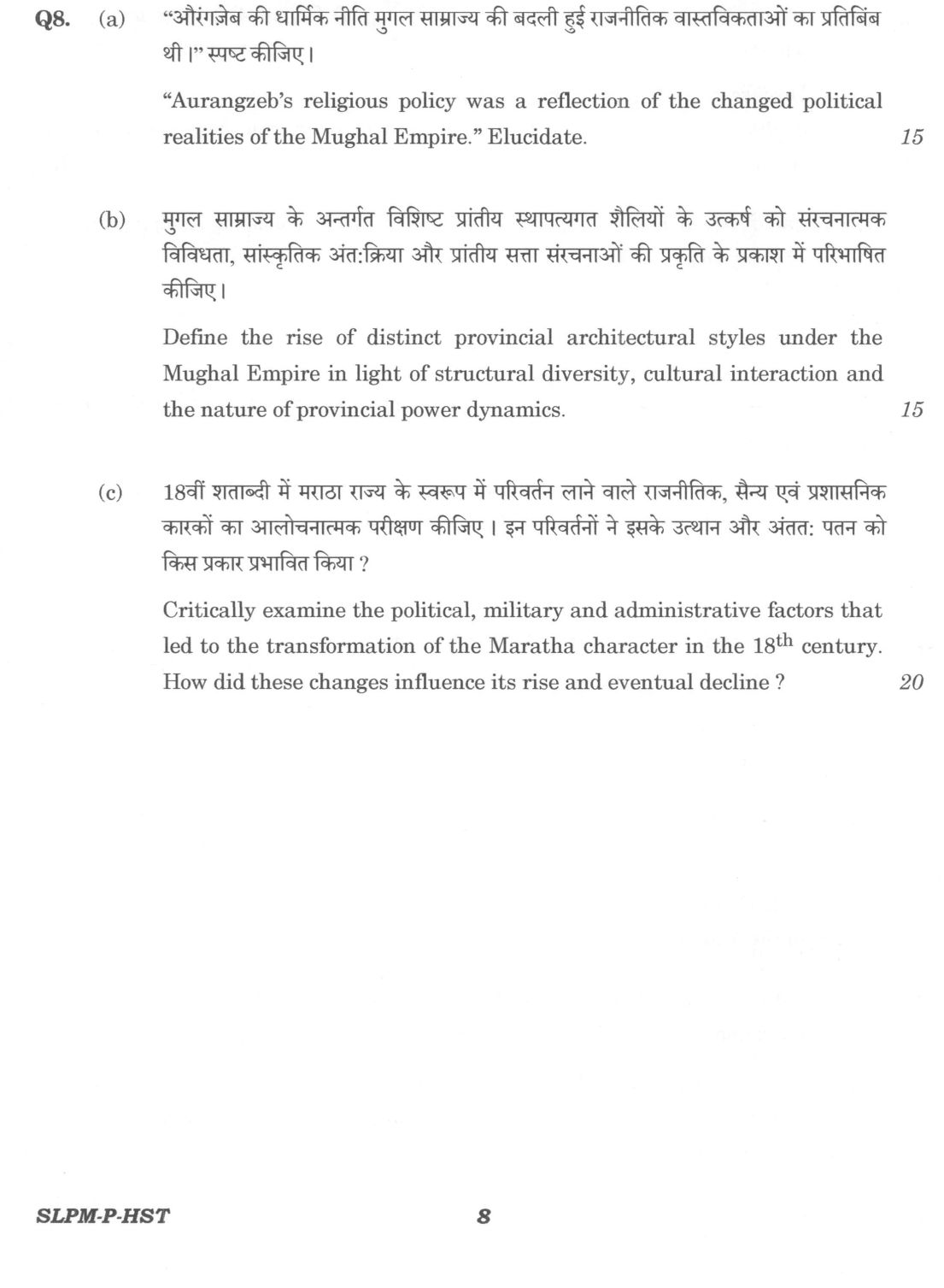
(a) "Aurangzeb's religious policy was a reflection of the changed political realities of the Mughal Empire." Elucidate. (15…
"Aurangzeb's religious policy was a reflection of the changed political realities of the Mughal Empire." Elucidate. 15 marks
Define the rise of distinct provincial architectural styles under the Mughal Empire in light of structural diversity, cultural interaction and the nature of provincial power dynamics. 15 marks
Critically examine the political, military and administrative factors that led to the transformation of the Maratha character in the 18th century. How did these changes influence its rise and eventual decline ? 20 marks
हिंदी में प्रश्न पढ़ें
"औरंगजेब की धार्मिक नीति मुगल साम्राज्य की बदली हुई राजनीतिक वास्तविकताओं का प्रतिबिंब थी।" स्पष्ट कीजिए। (15 अंक)
मुगल साम्राज्य के अंतर्गत विशिष्ट प्रांतीय स्थापत्यगत शैलियों के उत्कर्ष को संरचनात्मक विविधता, सांस्कृतिक अंतःक्रिया और प्रांतीय सत्ता संरचनाओं की प्रकृति के प्रकाश में परिभाषित कीजिए। (15 अंक)
18वीं शताब्दी में मराठा राज्य के स्वरूप में परिवर्तन लाने वाले राजनीतिक, सैन्य एवं प्रशासनिक कारकों का आलोचनात्मक परीक्षण कीजिए। इन परिवर्तनों ने इसके उत्थान और अंततः पतन को किस प्रकार प्रभावित किया ? (20 अंक)
Model answer
Written by UPSC Answer Check against this question's marking rubric, to the expected length. UPSC does not publish answers for Mains — this is one way to score well, not an official key.
Aurangzeb’s policy as statecraft Aurangzeb’s religious policy was less a personal crusade than a political instrument responding to changed realities. After Shah Jahan’s death, the Mughal state faced declining jagirdari efficiency, zamindari resistance and the cost of maintaining a large army. The re-imposition of jizya in 1679, and its later use as a source of revenue, reflected fiscal strain and the need to assert authority over non-Muslim subjects; the Deccan wars from the 1680s then intensified military expenditure. The suspension and re-imposition of jizya show that policy was contingent, shaped by court politics and revenue needs, not by a fixed theological programme. Temple destructions in Kuch Behar and Mathura were concentrated in areas of Rajput and regional resistance, not a uniform programme of persecution. Earlier Mughal practice had employed Maratha sardars and tolerated local practices; Aurangzeb’s orthodoxy became a tool to secure Muslim noble loyalty after Rajput defections, including Jaswant Singh’s rebellion and the later rebellion of Prince Akbar. Thus his policy reflected political calculation: piety was mobilised to legitimise central authority, but statecraft, not mere zealotry, shaped its application.
Provincial architecture The rise of distinct provincial styles shows structural diversity. In Bengal, Mughal-era buildings adopted do-chala and chauchala roofs, curved eaves and brick construction suited to the monsoon climate and local masons, unlike Delhi’s sandstone congregational mosques. Bengal’s brick and timber forms contrasted with Delhi’s cut sandstone and marble inlays, showing how material availability conditioned imperial aesthetics. In Awadh, Shi’a nawabs patronised imambaras and tombs, creating a public ceremonial architecture that avoided the imperial mosque typology and expressed regional identity. In the Deccan, Mughal-influenced mosques and tombs often simplified or omitted tall minarets, absorbing Adil Shahi and Qutb Shahi traditions while signalling subahdari autonomy. These styles emerged from cultural interaction: local craftsmen, materials and religious communities shaped imperial forms, while subahdars, with limited resources and fading imperial oversight, used architecture to compete for legitimacy. Provincial power dynamics mattered: where nawabs and sardars could command revenue and patronage, they built distinctive monuments; where imperial control weakened, regional elites used architecture to assert sovereignty.
Maratha transformation The Maratha character changed from Shivaji’s swarajya, based on a king-in-council ideal and the ashtapradhan, to a Peshwa-dominated confederacy. From Balaji Vishwanath to Baji Rao I, the Peshwa became a hereditary prime minister, centralising decision-making and eroding the earlier council model. Militarily, the Marathas did not abandon light cavalry; the bargir horsemen remained the core of their mobility and raiding power. But they supplemented them with European-style infantry and artillery, especially under Ibrahim Gardi, enabling sieges and pitched battles. Administratively, revenue farming gave way to chauth and sardeshmukhi, which extracted tribute from conquered territories rather than integrating them into a stable territorial state. A Brahminical bureaucracy strengthened Peshwa control but alienated many Maratha chiefs, who expected shared authority. Brahminical centralisation under the Peshwas concentrated authority but narrowed the base of support, contributing to overextension at Panipat.
These changes explain both rise and decline. The Mughal vacuum, fiscal-military innovation and flexible cavalry allowed rapid expansion. Yet extractive revenue, overextension and internal rivalry weakened the confederacy. The defeat at Panipat in 1761 exposed the limits of a plunder-based expansion that could not be converted into durable administration. Subsequent fragmentation among Peshwas and sardars made the Marathas vulnerable to British exploitation of their disunity.
Verdict Critically, Aurangzeb’s policy and provincial architectural regionalism were responses to the same decentralising pressures, while the Maratha transformation was both an opportunity and a structural trap. The Peshwa state’s centralisation and extractive finance enabled its rise, but its inability to become a consolidated territorial state, combined with Mughal fragmentation and British intervention, led to decline.
What "Critically examine" is asking you to do
Test the proposition the question puts to you and return a finding on how far it holds. Examine stems carry a claim, or ask whether something has happened, and expect evidence weighed both ways before the extent is stated — often with remedial measures attached. “Critically” is not a section added at the end: name the yardstick you are judging by — the evidence, the stated objective, a constitutional principle, a rival explanation — and let a verdict close each part of the body. Where the question quotes a claim, that verdict must land on the claim itself, accepted, qualified or rejected, and not on the theme in general.
Structure that answers it
Restate the claim as the question frames it → evidence that supports it → evidence that undercuts it → the conditions under which it holds → verdict on how far it stands
Where marks are lost
Merits in one paragraph, demerits in the next, and a conclusion calling for a balanced and holistic approach. That is a survey with the judgement left out and it holds the answer in the middle band. The opposite error is reading “critically” as permission to attack — and with the odd pairings, critically describe or critically explain, the exposition still carries most of the marks, the judgement being a layer on it rather than a substitute for it.
How this answer will be evaluated
Approach
Framework: Context > Thesis > Evidence > Historiography. (a) explain: definition/context > points in order > small example > short close | (b) define: precise definition > the distinguishing feature > one example | (c) critique: the claim > its strengths > its weaknesses > your judgment Full marks: Argues a clear thesis, cites specific sources/historians, and links all factors to the core argument.
Key points expected
- Identify specific political realities (e.g., Deccan expansion, Maratha conflict).
- Link policy shifts (Jizya, temple destruction) to these political needs.
- Contrast with earlier Mughal syncretic policies (Akbar/Jahangir).
- Argue that policy was a tool for political consolidation.
- Define 'provincial style' in the Mughal context.
- Explain structural diversity (local materials, techniques).
- Analyze cultural interaction (Indo-Islamic, regional synthesis).
- Connect style to provincial power dynamics (Nawabs).
Evaluation rubric
Each sub-part is marked on its own, against the marks and word limit printed on the paper.
- (a) Explain how Aurangzeb's religious policy reflected the empire's changed political realities. 15 marks
explain— definition/context → points in order → small example → short close
Must cover
- Identify specific political realities (e.g., Deccan expansion, Maratha conflict).
- Link policy shifts (Jizya, temple destruction) to these political needs.
- Contrast with earlier Mughal syncretic policies (Akbar/Jahangir).
- Argue that policy was a tool for political consolidation.
Loses marks
- Narrating events without linking to political causes.
- Treating policy as purely theological rather than political.
- Ignoring the 'changed' aspect (no comparison to past).
Earns more
- Mention the role of the Ulema in policy formation.
- Reference the impact on the Rajput alliance.
- Cite specific chronicles (e.g., Badauni, Manucci).
- Discuss the economic implications of the Jizya.
Extra mark
- Quote a specific line from Aurangzeb's letters.
- Name a specific historian (e.g., Satish Chandra).
- (b) Define the rise of distinct provincial architectural styles under the Mughal Empire. 15 marks
define— precise definition → the distinguishing feature → one example
Must cover
- Define 'provincial style' in the Mughal context.
- Explain structural diversity (local materials, techniques).
- Analyze cultural interaction (Indo-Islamic, regional synthesis).
- Connect style to provincial power dynamics (Nawabs).
Loses marks
- Describing only Delhi/Agra architecture.
- Ignoring the 'power dynamics' aspect of the prompt.
- Failing to define the term clearly.
Earns more
- Cite specific examples (e.g., Lucknow, Hyderabad, Bengal).
- Mention the role of local artisans and patrons.
- Discuss the shift from imperial to regional aesthetics.
- Reference specific architectural features (e.g., Chhatri, Jharokha).
Extra mark
- Reference a specific architectural feature (e.g., Chhatri).
- Name a specific historian (e.g., Ebba Koch).
- (c) Critically examine political, military, and administrative factors transforming Maratha character in the 18th century. 20 marks
critique— the claim → its strengths → its weaknesses → your judgment
Must cover
- Analyze political factors (Peshwa dominance, Ashtapradhan decline).
- Examine military factors (shift to heavy cavalry, Pindaris).
- Assess administrative factors (Chauth/Sardeshmukhi, revenue systems).
- Link these changes to the rise and eventual decline.
Loses marks
- Narrating history without critical analysis.
- Ignoring the 'transformation' aspect (static view).
- Failing to link factors to rise/decline.
Earns more
- Mention the role of the Gaikwads and Holkars.
- Discuss the impact of the Third Battle of Panipat.
- Reference the Anglo-Maratha Wars as a turning point.
- Cite specific administrative reforms (e.g., by Peshwas).
Extra mark
- Quote a specific source on Maratha administration.
- Name a specific historian (e.g., R.S. Sharma).
Practice this exact question
Write your answer and it is marked point by point against the model answer above — what you covered, what you missed, what you got wrong.
Evaluate my answer →More from History 2025 Paper I
- Q5 Answer the following questions in about 150 words each: (a) "Religious themes inspired a…
- Q6 (a) Discuss the structural features of Todar Mal's revenue system and evaluate its effect…
- Q7 (a) Portuguese maritime power disrupted the character of trade in the Indian Ocean in the…
- Q8 (a) "Aurangzeb's religious policy was a reflection of the changed political realities of…