Paper I — Q4
(a) "The dynamics of social mobility in early medieval India were shaped by a complex interplay of caste hierarchies, religious…
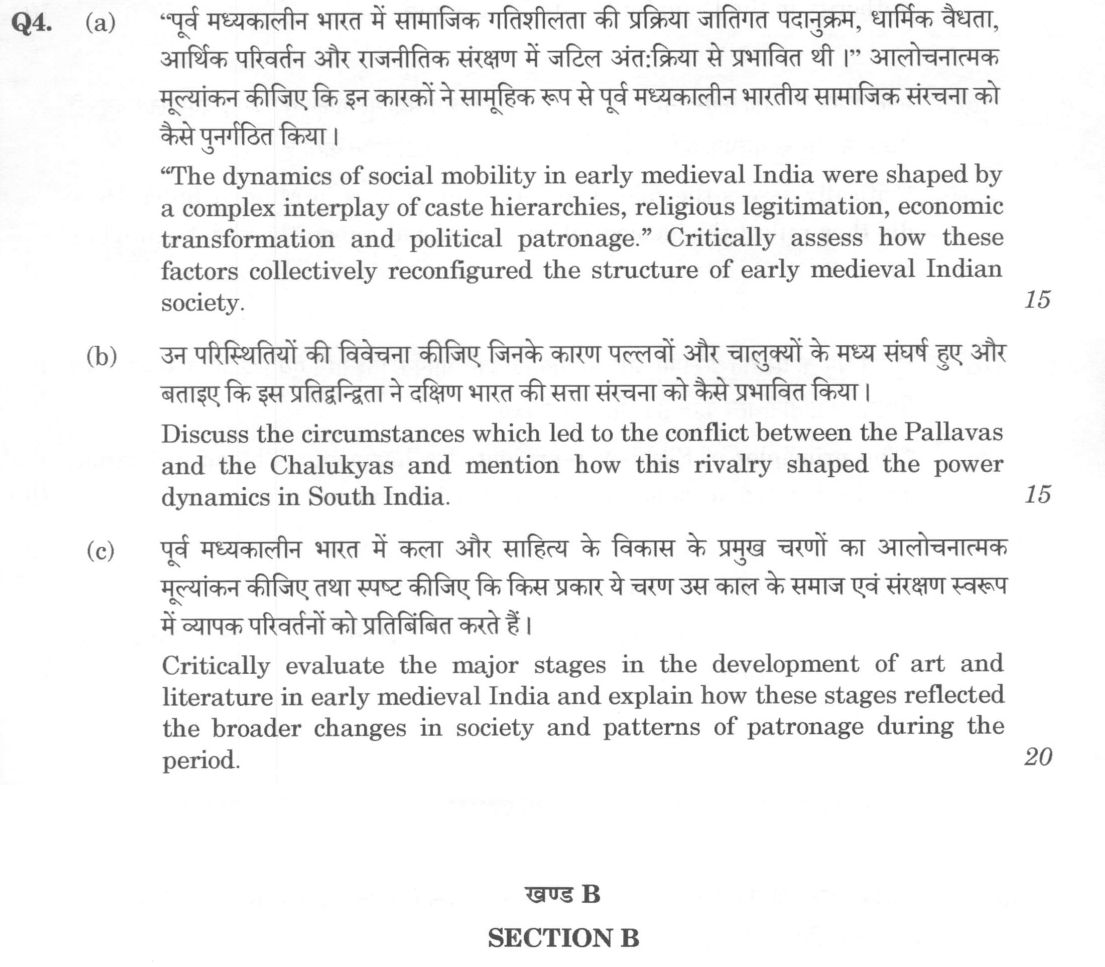
"The dynamics of social mobility in early medieval India were shaped by a complex interplay of caste hierarchies, religious legitimation, economic transformation and political patronage." Critically assess how these factors collectively reconfigured the structure of early medieval Indian society. 15 marks
Discuss the circumstances which led to the conflict between the Pallavas and the Chalukyas and mention how this rivalry shaped the power dynamics in South India. 15 marks
Critically evaluate the major stages in the development of art and literature in early medieval India and explain how these stages reflected the broader changes in society and patterns of patronage during the period. 20 marks
हिंदी में प्रश्न पढ़ें
"पूर्व मध्यकालीन भारत में सामाजिक गतिशीलता की प्रक्रिया जातिगत पदानुक्रम, धार्मिक वैधता, आर्थिक परिवर्तन और राजनीतिक संरक्षण में जटिल अंतःक्रिया से प्रभावित थी।" आलोचनात्मक मूल्यांकन कीजिए कि इन कारकों ने सामूहिक रूप से पूर्व मध्यकालीन भारतीय सामाजिक संरचना को कैसे पुनर्गठित किया। (15 अंक)
उन परिस्थितियों की विवेचना कीजिए जिनके कारण पल्लवों और चालुक्यों के मध्य संघर्ष हुए और बताइए कि इस प्रतिद्वंद्विता ने दक्षिण भारत की सत्ता संरचना को कैसे प्रभावित किया। (15 अंक)
पूर्व मध्यकालीन भारत में कला और साहित्य के विकास के प्रमुख चरणों का आलोचनात्मक मूल्यांकन कीजिए तथा स्पष्ट कीजिए कि किस प्रकार ये चरण उस काल के समाज एवं संरक्षण स्वरूप में व्यापक परिवर्तनों को प्रतिबिंबित करते हैं। (20 अंक)
Model answer
Written by UPSC Answer Check against this question's marking rubric, to the expected length. UPSC does not publish answers for Mains — this is one way to score well, not an official key.
Early medieval India (c. 600–1200) was not a static caste society but a field in which mobility, conflict and culture reconfigured each other.
Social Mobility and State Formation Caste remained a framework, but jati proliferation allowed new groups to claim status through ritual, land and office. Brahmanical legitimation was central: local chieftains and low-status warriors pursued Rajputization by adopting Vedic ritual, genealogies and temple patronage, while Bhakti movements, especially the Alvars and Nayanars, offered alternative religious authority that could include non-Brahmanical voices. Economically, the shift from coastal trade to agrarian expansion, tank irrigation and village production made land the key resource. Land grants to Brahmanas, temples and officials created brahmadeyas, devadanas and new village hierarchies, converting revenue into social rank. This was not simple upward mobility; many groups were reclassified, and new jatis were incorporated into varna frameworks, so mobility often reinforced hierarchy. Here Burton Stein’s segmentary state model explains local autonomy and mobility through repeated bargaining among lineages, but B.D. Chattopadhyaya’s process of state formation better captures how land grants, Brahmanical ideology and royal patronage integrated villages into larger polities. The verdict is that mobility was real but conditional: it often meant absorption into Brahmanical hierarchies rather than their overthrow.
Pallava-Chalukya Rivalry The Pallava-Chalukya conflict arose from competition for Vengi in the Krishna-Godavari delta and Tondaimandalam, the Pallava heartland. Pulakeshin II’s defeat of Mahendravarman I c. 642 CE and capture of Kanchi showed Chalukyan reach, while his brother Kubja Vishnuvardhana established the Eastern Chalukyas in Vengi after conquering the Vishnukundins, not by direct Pallava defeat. Narasimhavarman I’s revenge at Vatapi reversed the balance, securing Pallava dominance in the south. The rivalry was not merely dynastic; it forced sub-regional consolidation. Eastern Chalukyas, Rashtrakutas and later Cholas emerged from this fractured landscape, with Rashtrakutas first as Chalukya vassals and later as independent kings, while the Cholas consolidated in the Cauza delta. The rivalry also stimulated temple building, copper-plate grants and military organization, making kingship more territorial. Thus the conflict transformed South Indian polity from chiefdoms and port-based chiefdoms into territorial states with standing armies, temple economies and defined frontiers.
Art, Literature and Patronage Art and literature mark the same transformation. Mahendravarman’s rock-cut caves and rathas at Mamallapuram mark the transition from rock-cut experimentation toward structural temple building, later matured in the Dravidian style under later Pallavas. Early Chalukyan temples at Aihole, Badami and Pattadakal are experimental, blending Nagara and Dravidian elements; the distinct Vesara style is associated with later Kalyani Chalukyas and Hoysalas. Literary production moved across Sanskrit, Prakrit and regional languages: Sanskrit court poetry, Prakrit narrative and Tamil Bhakti hymns coexisted. Patronage shifted from mercantile and port-based elites to agrarian elites whose power rested on land grants, village assemblies and temple endowments. The stages thus mirror society: rock-cut and early structural temples reflect royal experimentation; classical styles reflect settled agrarian patronage; multilingual literature reflects both courtly Sanskrit and local devotional participation. Romila Thapar’s cultural transaction model usefully shows exchange between Sanskritic and regional cultures, while Sheldon Pollock’s Sanskrit cosmopolis highlights the pan-Indian prestige of Sanskrit and imperial ideology. Yet Pollock risks overemphasizing Sanskrit hegemony, whereas Thapar better explains local agency. The verdict is that early medieval culture was neither purely Sanskritic nor purely regional; it was a negotiated field in which agrarian patronage, political rivalry and religious reform produced new forms.
In sum, political conflict restructured social hierarchies, and those hierarchies found expression in art and literature. Early medieval India’s transformation was therefore a single process: mobility through land and ritual, territorial state-making through rivalry, and cultural production through patronage.
What "Critically evaluate" is asking you to do
Judge how well something has performed against the standard it set for itself — its stated aim, mandate or promise — and commit to a verdict. Name the yardstick before you judge; an unanchored judgement reads as opinion. “Critically” is not a section added at the end: name the yardstick you are judging by — the evidence, the stated objective, a constitutional principle, a rival explanation — and let a verdict close each part of the body. Where the question quotes a claim, that verdict must land on the claim itself, accepted, qualified or rejected, and not on the theme in general.
Structure that answers it
Name the yardstick — stated aim, mandate or benchmark → performance against it → shortfall against it → why the gap exists → verdict
Where marks are lost
Merits in one paragraph, demerits in the next, and a conclusion calling for a balanced and holistic approach. That is a survey with the judgement left out and it holds the answer in the middle band. The opposite error is reading “critically” as permission to attack — and with the odd pairings, critically describe or critically explain, the exposition still carries most of the marks, the judgement being a layer on it rather than a substitute for it.
How this answer will be evaluated
Approach
Framework: Context > Thesis > Evidence > Historiography. (a) critically evaluate: positives > negatives/limits > conditions/safeguards > conclusion | (b) discuss: intro > 3-4 dimensions > example > balanced close | (c) critically evaluate: positives > negatives/limits > conditions/safeguards > conclusion Full marks: Thesis-driven with specific evidence, historiographical awareness, and critical analysis
Key points expected
- Caste hierarchy and religious legitimation
- Economic transformation and political patronage
- Collective reconfiguration of social structure
- Critical assessment of interplay
- Circumstances leading to conflict
- Rivalry's impact on power dynamics
- South India context
- Balanced discussion of both sides
Evaluation rubric
Each sub-part is marked on its own, against the marks and word limit printed on the paper.
- (a) Assess how caste, religion, economy, and politics reconfigured social structure. 15 marks
critically evaluate— positives → negatives/limits → conditions/safeguards → conclusion
Must cover
- Caste hierarchy and religious legitimation
- Economic transformation and political patronage
- Collective reconfiguration of social structure
- Critical assessment of interplay
Loses marks
- Chronology without analysis
- Textbook retelling
- Missing critical assessment
Earns more
- Specific examples of social mobility
- Inscriptions or chronicles as evidence
- Historiographical school named
- Balanced judgment on factors
Extra mark
- Named historian
- Source quotation
- (b) Explain causes of Pallava-Chalukya conflict and its impact on power dynamics. 15 marks
discuss— intro → 3-4 dimensions → example → balanced close
Must cover
- Circumstances leading to conflict
- Rivalry's impact on power dynamics
- South India context
- Balanced discussion of both sides
Loses marks
- Chronology without analysis
- Textbook retelling
- Missing power dynamics analysis
Earns more
- Specific battles or treaties
- Map or timeline of conflict
- Inscriptions as evidence
- Historiographical perspective
Extra mark
- Named historian
- Source quotation
- (c) Evaluate art/literature development stages and their reflection of societal changes. 20 marks
critically evaluate— positives → negatives/limits → conditions/safeguards → conclusion
Must cover
- Major stages in art/literature development
- Reflection of broader societal changes
- Patterns of patronage during period
- Critical evaluation of stages
Loses marks
- Chronology without analysis
- Textbook retelling
- Missing critical evaluation
Earns more
- Specific art/literature examples
- Patronage patterns explained
- Societal changes linked to art
- Historiographical perspective
Extra mark
- Named historian
- Source quotation
Practice this exact question
Write your answer and it is marked point by point against the model answer above — what you covered, what you missed, what you got wrong.
Evaluate my answer →More from History 2025 Paper I
- Q1 Identify the following places marked on the map supplied to you and write a short note of…
- Q2 (a) "The Chalcolithic people were experts in microliths and were also skilful workers in…
- Q3 (a) "The origin of the territorial republics has been traced to the reaction against the…
- Q4 (a) "The dynamics of social mobility in early medieval India were shaped by a complex int…
- Q5 Answer the following questions in about 150 words each: (a) "Religious themes inspired a…
- Q6 (a) Discuss the structural features of Todar Mal's revenue system and evaluate its effect…
- Q7 (a) Portuguese maritime power disrupted the character of trade in the Indian Ocean in the…