Paper I — Q2
(a) "The Chalcolithic people were experts in microliths and were also skilful workers in stone." Elucidate. (15 marks) (b) "The…
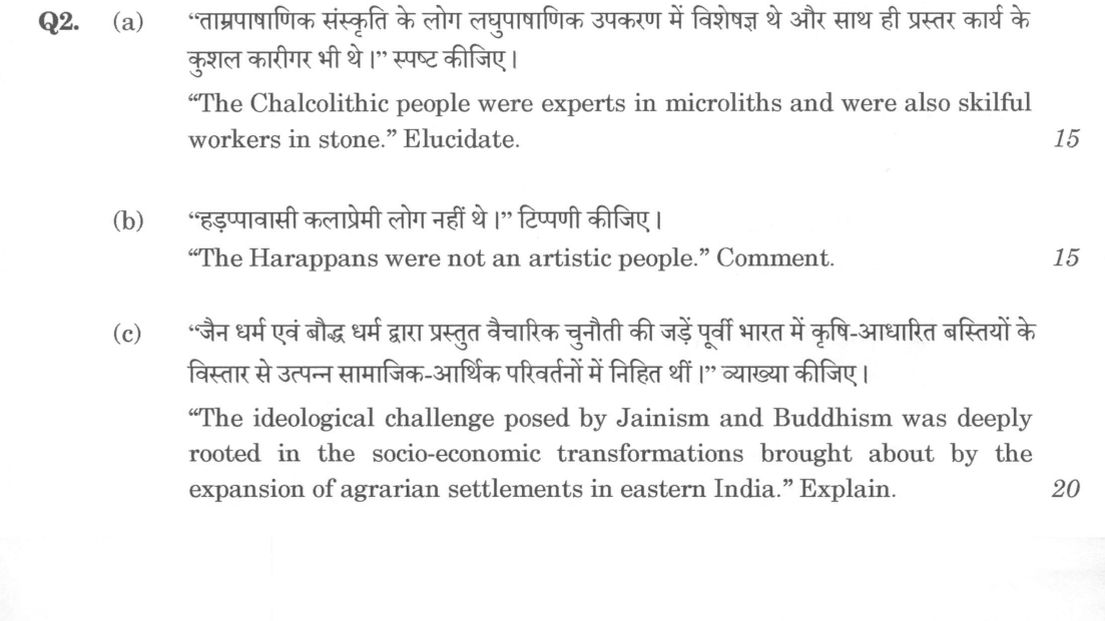
"The Chalcolithic people were experts in microliths and were also skilful workers in stone." Elucidate. 15 marks
"The Harappans were not an artistic people." Comment. 15 marks
"The ideological challenge posed by Jainism and Buddhism was deeply rooted in the socio-economic transformations brought about by the expansion of agrarian settlements in eastern India." Explain. 20 marks
हिंदी में प्रश्न पढ़ें
"ताम्रपाषाणिक संस्कृति के लोग लघुपाषाणिक उपकरण में विशेषज्ञ थे और साथ ही प्रस्तर कार्य के कुशल कारीगर भी थे।" स्पष्ट कीजिए। (15 अंक)
"हड़प्पावासी कलाप्रेमी लोग नहीं थे।" टिप्पणी कीजिए। (15 अंक)
"जैन धर्म एवं बौद्ध धर्म द्वारा प्रस्तुत वैचारिक चुनौती की जड़ें पूर्वी भारत में कृषि-आधारित बस्तियों के विस्तार से उत्पन्न सामाजिक-आर्थिक परिवर्तनों में निहित थीं।" व्याख्या कीजिए। (20 अंक)
Model answer
Written by UPSC Answer Check against this question's marking rubric, to the expected length. UPSC does not publish answers for Mains — this is one way to score well, not an official key.
Chalcolithic Lithic Traditions and Stone Craftsmanship
The Chalcolithic period (c. 2000–700 BCE) marked a dual technological framework where the limited availability of copper necessitated the sophisticated continuation and perfection of stone-working traditions. The description of Chalcolithic people as "experts in microliths" refers to their mastery of the crested-guided-ridge technique, producing mass-standardized parallel-sided micro-blades and geometric tools from siliceous stones like chalcedony, chert, and jasper. These microliths were hafted into bone or wooden handles to serve as composite tools, particularly sickles and harvesting knives for agrarian activities.
Simultaneously, they were "skilful workers in stone" across macrolithic and lapidary spheres. Ground and polished stone celts, axes, and adzes were systematically manufactured alongside massive saddle querns and mullers essential for grain processing. Lapidary craft reached notable sophistication; sites like Kayatha revealed rich caches of carnelian, agate, and crystal beads. At Malwa culture sites like Navdatoli and Jorwe culture settlements such as Inamgaon and Chandoli, excavations have uncovered specialized bead-making workshops, micro-drills, and fine stone-grinding equipment. The coexistence of ground stone tools, delicate microlithic industries, and copper tools reflects a technologically adept adaptation to regional ecologies.
Reassessing Harappan Artistic Traditions
The characterization of Harappans as "non-artistic" stems from a conventional nineteenth-century Eurocentric bias that equated art exclusively with monumental public architecture, temple reliefs, and monumental royal statuary, which are largely absent in the Indus Valley. However, modern archaeological assessments, beginning with Sir John Marshall, recognize that Harappan artistic expression was defined by a utilitarian aesthetic, technical mastery, and intimate, small-scale representation rather than grandiosity.
Harappan artistic sophistication is evident across several media. In metallurgy, the lost-wax (cire-perdue) bronze casting of the Mohenjodaro Dancing Girl exhibits remarkable anatomical rhythm, posture, and naturalism, matched later by the Daimabad bronze sculptures. The glyptic art on steatite seals—such as the Pashupati seal and the majestic humped bull—displays unmatched miniature relief carving and spatial balance. In stone sculpture, the bearded Priest-King from Mohenjodaro reflects advanced mastery over soft stone portraiture. Minor arts further counter the non-artistic view: expressive terracotta figurines of the Mother Goddess, animated animal-drawn toy carts, complex faience ornaments, micro-bead jewellery, and standardized black-on-red painted ceramics adorned with intricate geometric and faunal motifs. Harappan art was deeply integrated into civic and daily life.
Socio-Economic Roots of Jainism and Buddhism
The ideological challenge mounted by Buddhism and Jainism in the 6th century BCE was directly anchored in the material transformations of the middle Gangetic basin. As demonstrated by D.D. Kosambi and R.S. Sharma, the introduction of iron technology (axes and iron-tipped ploughshares) enabled the clearing of the dense, moist monsoonal forests of eastern Uttar Pradesh and Bihar, ushering in intensive wet-rice cultivation (ropana). This generated substantial agrarian surpluses, sustaining demographic expansion and the rise of cities—the 'Second Urbanization'.
This transformation restructured society, producing affluent rural landholders (gahapatis or grihapatis) and wealthy urban mercantile groups (setthis) organized into trade guilds (shrenis). However, orthodox Brahmanical ideology, anchored in the pastoral-agrarian ethos of the Vedic period, had become obsolete and restrictive. The Vedic ritual system demanded indiscriminate cattle slaughter in yajnas, directly destroying the draught animal base indispensable for iron-plough agriculture. Furthermore, the varna hierarchy relegated wealthy merchants to third-tier Vaishya status, while Brahmanical texts condemned urban life, sea voyages, and moneylending (usury) as sinful.
Jainism and Buddhism provided an ideological framework suited to this new economy. The doctrine of ahimsa (non-injury) protected cattle wealth, directly securing the agricultural production base. Their universalist, anti-caste ethos accommodated urban cosmopolitanism and validated the social dignity of the mercantile and landowning classes. Furthermore, the Kshatriya leadership of Gautama Buddha and Vardhamana Mahavira challenged Brahmanical ritual supremacy. As U.N. Ghoshal noted, heterodox philosophies legitimized state centralization, commercial wealth accumulation, and individual agency, providing the necessary moral sanction for the emerging urbanized agrarian society.
Ultimately, early Indian history demonstrates that changes in the techno-economic base consistently necessitated corresponding evolutions in craftsmanship, aesthetic expression, and religious ideologies.
What "Elucidate" is asking you to do
Make a stated proposition plain and then prove it with instances. Elucidate stems almost always carry a claim or a named concept, and very often the words “with examples” or “with suitable diagrams” — the illustration is part of the directive, not decoration.
Structure that answers it
Plain-language statement of what the proposition means → the part that is obscure, resolved → first illustration → second illustration → why the proposition holds
Where marks are lost
Adding terminology; elucidate rewards removing it. The commoner loss is a clean explanation with no example, when the stem asked for examples.
How this answer will be evaluated
Approach
Framework: Context > Thesis > Evidence > Historiography. (a) explain: definition/context > points in order > small example > short close | (b) comment: context > arguments both sides > judgment > close | (c) explain: definition/context > points in order > small example > short close Full marks: Argues a clear thesis, cites specific sites/artifacts, and engages with historiographical debates.
Key points expected
- Define Chalcolithic period (c. 2000-800 BCE)
- Explain microlithic continuity (geometric shapes, hafting)
- Describe stone-working (quarrying, grinding, polishing)
- Link technology to subsistence (agriculture, pastoralism)
- Define 'artistic' in archaeological context (aesthetics vs. utility)
- Cite evidence of craftsmanship (seals, jewelry, pottery)
- Discuss the 'standardization' argument (uniformity vs. lack of art)
- Provide a balanced judgment on the statement
Evaluation rubric
Each sub-part is marked on its own, against the marks and word limit printed on the paper.
- (a) Clarify the dual nature of Chalcolithic technology: microlithic continuity and stone-working skill. 15 marks
explain— definition/context → points in order → small example → short close
Must cover
- Define Chalcolithic period (c. 2000-800 BCE)
- Explain microlithic continuity (geometric shapes, hafting)
- Describe stone-working (quarrying, grinding, polishing)
- Link technology to subsistence (agriculture, pastoralism)
Loses marks
- Confusing microliths with megaliths
- Ignoring the 'copper' aspect of the period
- Treating stone-working as primitive rather than specialized
Earns more
- Mention specific sites (Ahar, Kayatha, Inamgaon)
- Reference specific tools (celts, axes, adzes)
- Note the transition from Neolithic to Chalcolithic
- Mention the role of stone in ritual contexts
Extra mark
- Cite specific excavation reports (e.g., Rao, Kenoyer)
- Reference specific typological classifications of microliths
- (b) Critically assess the claim that Harappans lacked artistic sensibility. 15 marks
comment— context → arguments both sides → judgment → close
Must cover
- Define 'artistic' in archaeological context (aesthetics vs. utility)
- Cite evidence of craftsmanship (seals, jewelry, pottery)
- Discuss the 'standardization' argument (uniformity vs. lack of art)
- Provide a balanced judgment on the statement
Loses marks
- Accepting the statement as fact without critique
- Ignoring the 'standardization' argument
- Confusing 'art' with 'fine art' (Western bias)
Earns more
- Mention specific artifacts (Dancing Girl, Priest-King)
- Reference the 'standardization' of weights and measures
- Discuss the 'iconography' of seals (unicorn, bull)
- Mention the 'craft specialization' evident in workshops
Extra mark
- Cite specific scholars (e.g., Marshall, Wheeler, Kenoyer)
- Reference specific site finds (e.g., Lothal beads, Mohenjo-daro jewelry)
- (c) Explain the link between agrarian expansion in eastern India and the rise of Jainism/Buddhism. 20 marks
explain— definition/context → points in order → small example → short close
Must cover
- Define the 'ideological challenge' (anti-Vedic, anti-Brahmanical)
- Describe the 'socio-economic transformations' (iron, plough, surplus)
- Link 'agrarian expansion' to 'eastern India' (Gangetic plain)
- Explain how new social groups (shudras, vaishyas) supported new religions
Loses marks
- Ignoring the 'economic' basis of the religious change
- Treating Jainism and Buddhism as identical
- Failing to link the 'eastern' geography to the 'agrarian' expansion
Earns more
- Mention the 'Iron Age' and 'plough agriculture'
- Reference the 'Varna' system and its challenges
- Discuss the role of 'urbanization' and 'trade'
- Mention the 'Sramana' movement
Extra mark
- Cite specific texts (e.g., Jataka, Jaina Agamas)
- Reference specific sites (e.g., Rajgir, Vaishali, Pataliputra)
Practice this exact question
Write your answer and it is marked point by point against the model answer above — what you covered, what you missed, what you got wrong.
Evaluate my answer →More from History 2025 Paper I
- Q1 Identify the following places marked on the map supplied to you and write a short note of…
- Q2 (a) "The Chalcolithic people were experts in microliths and were also skilful workers in…
- Q3 (a) "The origin of the territorial republics has been traced to the reaction against the…
- Q4 (a) "The dynamics of social mobility in early medieval India were shaped by a complex int…
- Q5 Answer the following questions in about 150 words each: (a) "Religious themes inspired a…