Paper I — Q5
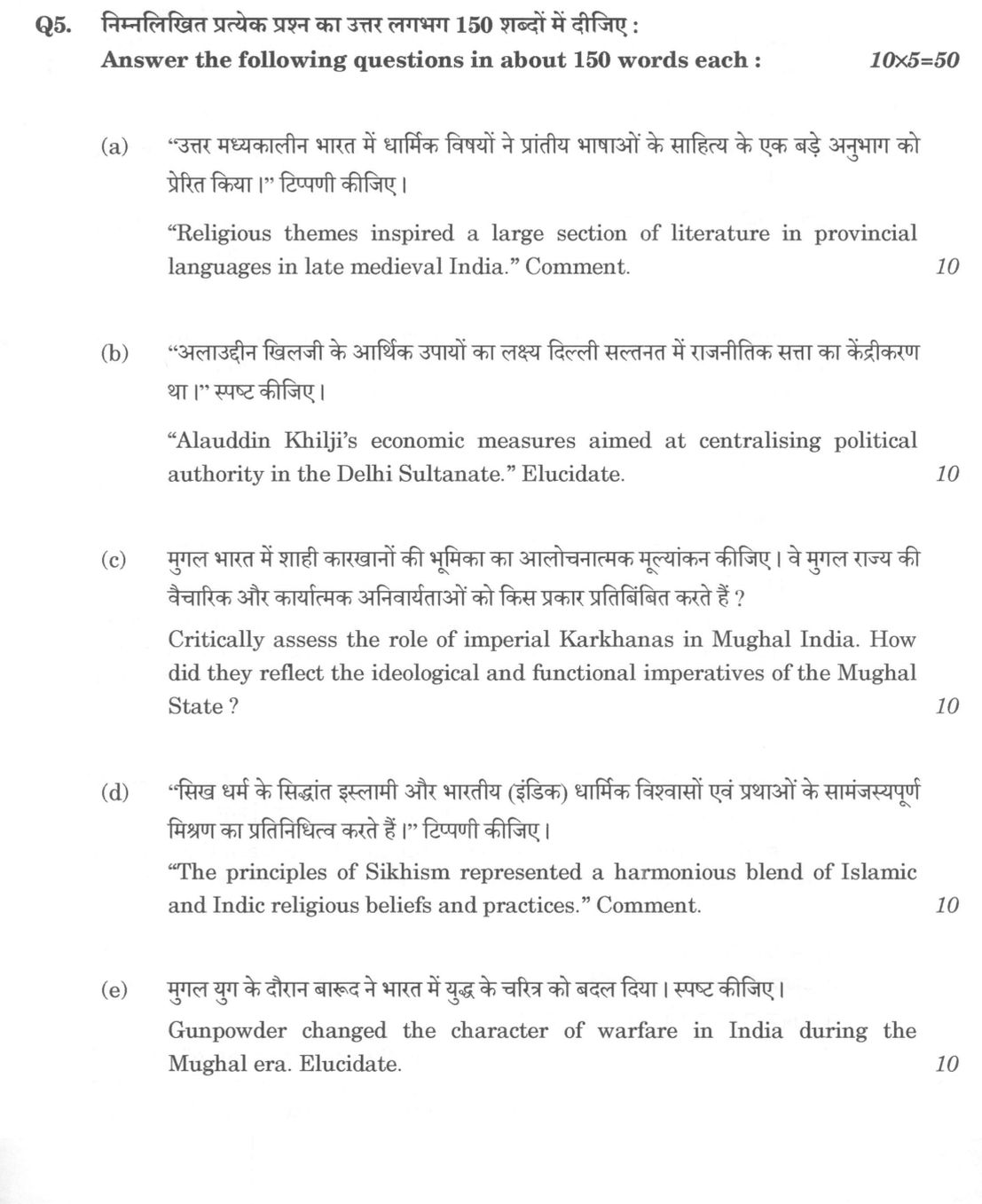
Answer the following questions in about 150 words each: (a) "Religious themes inspired a large section of literature in…
Answer the following questions in about 150 words each: "Religious themes inspired a large section of literature in provincial languages in late medieval India." Comment. 10 marks
"Alauddin Khilji's economic measures aimed at centralising political authority in the Delhi Sultanate." Elucidate. 10 marks
Critically assess the role of imperial Karkhanas in Mughal India. How did they reflect the ideological and functional imperatives of the Mughal State ? 10 marks
"The principles of Sikhism represented a harmonious blend of Islamic and Indic religious beliefs and practices." Comment. 10 marks
Gunpowder changed the character of warfare in India during the Mughal era. Elucidate. 10 marks
हिंदी में प्रश्न पढ़ें
निम्नलिखित प्रत्येक प्रश्न का उत्तर लगभग 150 शब्दों में दीजिए: "उत्तर मध्यकालीन भारत में धार्मिक विषयों ने प्रांतीय भाषाओं के साहित्य के एक बड़े अनुभाग को प्रेरित किया।" टिप्पणी कीजिए। (10 अंक)
"अलाउद्दीन खिलजी के आर्थिक उपायों का लक्ष्य दिल्ली सल्तनत में राजनीतिक सत्ता का केंद्रीकरण था।" स्पष्ट कीजिए। (10 अंक)
मुगल भारत में शाही कारखानों की भूमिका का आलोचनात्मक मूल्यांकन कीजिए। वे मुगल राज्य की वैचारिक और कार्यात्मक अनिवार्यताओं को किस प्रकार प्रतिबिंबित करते हैं ? (10 अंक)
"सिख धर्म के सिद्धांत इस्लामी और भारतीय (हिंदिक) धार्मिक विश्वासों एवं प्रथाओं के सामंजस्यपूर्ण मिश्रण का प्रतिनिधित्व करते हैं।" टिप्पणी कीजिए। (10 अंक)
मुगल युग के दौरान बारूद ने भारत में युद्ध के चरित्र को बदल दिया। स्पष्ट कीजिए। (10 अंक)
Model answer
Written by UPSC Answer Check against this question's marking rubric, to the 150-word length. UPSC does not publish answers for Mains — this is one way to score well, not an official key.
(a) Religious Themes in Provincial Literature
Late medieval India witnessed a remarkable efflorescence of regional vernacular literature, largely driven by the Bhakti and Sufi movements. This marked a conscious transition from courtly Persian and classical Sanskrit to accessible regional dialects, democratizing devotional expression.
In North India, Tulsidas composed the Ramcharitmanas in Awadhi, making the Rama narrative accessible to ordinary people, while Kabir used rustic Sadhukkadi for his iconoclastic dohas. In the eastern region, the Gaudiya Vaishnava movement catalyzed Bengali literary production, producing hagiographies like the Chaitanya Charitamrita alongside rich padavali poetry. In Punjab, Guru Nanak’s devotional verses laid the foundations of Punjabi literature, while the Abhangas of Tukaram and Eknath enriched Marathi. Simultaneously, Sufi poets composed premakhyans such as Malik Muhammad Jayasi’s Padmavat, using local Awadhi idioms and Indic allegories to convey mystical Islamic thought.
Thus, provincial literature did not merely borrow religious themes; it fundamentally reshaped them to foster localized cultural identities and inclusive spiritual participation.
(b) Alauddin Khilji's Economic Centralisation
Alauddin Khilji’s economic reforms were strategic measures designed to centralize royal authority, eliminate fiscal decentralization, and sustain a large standing army directly under the crown.
To curb the influence of landed aristocrats, Alauddin restructured agrarian relations. He introduced land measurement (paimash), fixed the state revenue demand (kharaj) at 50% of gross produce, and abolished the traditional perquisites of village headmen (khuts, muqaddams, and chaudharis). Revenue was collected directly from the peasantry, frequently in grain, thereby neutralizing intermediate power structures.
In urban centres, he instituted stringent market controls under officials like the Shahna-i-Mandi and Diwan-i-Riyasat. By strictly fixing the prices of food grains, cloth, and horses, he ensured that soldiers could be maintained on modest cash salaries. Furthermore, the resumption of tax-free in'am and waqf lands and the curtailment of hereditary iqta grants dismantled the economic foundation of noble rebellions, consolidating unchallenged autocracy in the Delhi Sultanate.
(c) Role of Imperial Karkhanas in Mughal India
The imperial karkhanas (state manufacturing units) were central to the administrative and courtly economy of the Mughal Empire, embodying both pragmatic statecraft and royal ideology. As recorded by Abul Fazl in the Ain-i-Akbari, these workshops were managed under the Mir Saman.
Functionally, the karkhanas catered directly to the logistical and military needs of the empire, producing heavy ordnance, siege weaponry, and armor, alongside processing mint operations and provisions for the imperial household. By retaining the finest artisans and controlling raw materials, the state maintained a monopoly over advanced technology and luxury production.
Ideologically, they served as instruments of imperial magnificence (shukoh). The production of textiles, carpets, and ceremonial robes of honor (khilat) reinforced courtly hierarchies and legitimized the Padshah's role as the supreme distributor of prestige and patronage. Under the later Mughals, however, mounting fiscal stress and political fragmentation led to the farming out of these operations, precipitating the decline of direct state-managed manufacturing.
(d) Principles of Sikhism: Syncretism and Distinct Identity
While Sikhism developed in the context of the Nirguna Bhakti and Sufi traditions, characterizing it as a simple "harmonious blend" overlooks its distinct theological and institutional originality.
Guru Nanak utilized existing Indic concepts (karma, maya, mukti) and Islamic monotheistic terminology (Hukam, Nirankar), but he firmly rejected the core orthodoxies of both. He repudiated Brahminical caste divisions, scriptural authority, polytheism, and ascetic renunciation, while simultaneously rejecting Islamic clerical formalism and ritual exclusivity.
Rather than constructing an eclectic compromise, Nanak established an autonomous path centered on the unity of God, unmediated devotion (Nam Simran), and ethical worldly engagement. This distinctiveness was institutionalized through Sangat (egalitarian congregation) and Pangat (communal dining), followed by the compilation of the Adi Granth and the creation of the Khalsa in 1699 by Guru Gobind Singh. Thus, Sikhism represents an independent revelation and sovereign religious tradition rather than a derivative synthesis.
(e) Gunpowder and Warfare in the Mughal Era
Gunpowder transformed Indian military architecture, battle tactics, and state centralization during the early modern era.
Babur first demonstrated the decisive potential of combined-arms gunpowder tactics at Panipat (1526) and Khanwa (1527), integrating field artillery (topkhana) and matchlock men (tufangchis) behind carts (araba) in the Ottoman Rumi formation. This tactical integration broke the historic battlefield supremacy of massed, shock-cavalry charges.
Sher Shah Suri and Akbar institutionalized the use of heavy siege artillery, which altered defensive architecture. Traditional high, vertical fortress walls gave way to thicker masonry, ditch systems, and curved bastions capable of absorbing artillery fire and deploying defensive cannon. Additionally, gunpowder weaponry expanded into riverine flotillas in eastern campaigns like Bengal and Assam.
Because founding, casting, and supplying gunpowder armies required vast financial outlays and centralized logistics, this military revolution accelerated fiscal extraction, enabling the Mughal state to subordinate regional warlords and establish an unprecedentedly centralized imperial structure.
What "Elucidate" is asking you to do
Make a stated proposition plain and then prove it with instances. Elucidate stems almost always carry a claim or a named concept, and very often the words “with examples” or “with suitable diagrams” — the illustration is part of the directive, not decoration.
Structure that answers it
Plain-language statement of what the proposition means → the part that is obscure, resolved → first illustration → second illustration → why the proposition holds
Where marks are lost
Adding terminology; elucidate rewards removing it. The commoner loss is a clean explanation with no example, when the stem asked for examples.
How this answer will be evaluated
Approach
Framework: Context > Thesis > Evidence > Historiography. (a) comment: context > arguments both sides > judgment > close | (b) explain: definition/context > points in order > small example > short close | (c) critique: the claim > its strengths > its weaknesses > your judgment | (d) comment: context > arguments both sides > judgment > close | (e) explain: definition/context > points in order > small example > short close Full marks: Thesis-driven, specific evidence, historiographical awareness, balanced judgment.
Key points expected
- Identify specific movements (Bhakti/Sufi) and languages (Braj, Marathi, etc.)
- Link religious themes to the rise of provincial literary traditions
- Provide specific textual or poetical examples
- Offer a balanced judgment on the extent of this inspiration
- Detail the market control (Dagiri) and price fixing measures
- Explain the ban on private trade in grain and horses
- Connect economic control to the reduction of noble power
- Mention the impact on the army and state revenue
Evaluation rubric
Each sub-part is marked on its own, against the marks and word limit printed on the paper.
- (a) Contextualize and judge the role of religion in late medieval vernacular literature. 10 marks · 150 words
comment— context → arguments both sides → judgment → close
Must cover
- Identify specific movements (Bhakti/Sufi) and languages (Braj, Marathi, etc.)
- Link religious themes to the rise of provincial literary traditions
- Provide specific textual or poetical examples
- Offer a balanced judgment on the extent of this inspiration
Loses marks
- Generalizing without naming specific languages or texts
- Treating Bhakti and Sufi movements as identical
Earns more
- Mention specific poets (e.g., Kabir, Tulsidas, Nannaya)
- Reference specific works (e.g., Ramcharitmanas, Bhagavata Purana)
Extra mark
- Cite a specific historian's view on vernacularization
- Quote a specific verse or source
- (b) Explain how Alauddin Khilji's economic policies served to centralize political power. 10 marks · 150 words
explain— definition/context → points in order → small example → short close
Must cover
- Detail the market control (Dagiri) and price fixing measures
- Explain the ban on private trade in grain and horses
- Connect economic control to the reduction of noble power
- Mention the impact on the army and state revenue
Loses marks
- Listing measures without linking them to political centralization
- Confusing Alauddin's measures with later Sultans
Earns more
- Reference the 'Dagiri' system specifically
- Mention the role of the 'Shahna' (market inspector)
Extra mark
- Cite a specific source like Amir Khusrau's chronicle
- Mention the specific price of a horse
- (c) Critically assess the role of imperial Karkhanas in Mughal India and their reflection of state imperatives. 10 marks · 150 words
critique— the claim → its strengths → its weaknesses → your judgment
Must cover
- Define the scope of imperial Karkhanas (textiles, arms, etc.)
- Analyze their role in state revenue and military supply
- Discuss their ideological function (display of imperial power)
- Evaluate their impact on the private sector and artisans
Loses marks
- Focusing only on production without state analysis
- Ignoring the ideological dimension of the Karkhanas
Earns more
- Mention specific Karkhanas (e.g., Surat, Agra)
- Reference the 'Mansabdari' system's link to Karkhanas
Extra mark
- Cite a specific historian like John F. Richards
- Mention a specific product (e.g., chintz, muslin)
- (d) Comment on the blend of Islamic and Indic elements in Sikh principles. 10 marks · 150 words
comment— context → arguments both sides → judgment → close
Must cover
- Identify specific Islamic influences (e.g., monotheism, equality)
- Identify specific Indic influences (e.g., bhakti, karma)
- Explain how these were synthesized in Sikh theology
- Provide a balanced judgment on the nature of this blend
Loses marks
- Listing elements without explaining their synthesis
- Overstating the Islamic or Indic influence
Earns more
- Mention specific Gurus (e.g., Guru Nanak, Guru Gobind Singh)
- Reference specific concepts (e.g., 'Ik Onkar', 'Seva')
Extra mark
- Cite a specific line from the Guru Granth Sahib
- Mention a specific historian's view on Sikh syncretism
- (e) Explain how gunpowder changed the character of warfare in Mughal India. 10 marks · 150 words
explain— definition/context → points in order → small example → short close
Must cover
- Describe the introduction and adoption of gunpowder weapons
- Explain the shift from cavalry-centric to infantry-centric warfare
- Discuss the impact on fortification and siege warfare
- Mention the role of artillery in Mughal military organization
Loses marks
- Focusing only on the weapons without tactical analysis
- Ignoring the impact on fortifications and sieges
Earns more
- Mention specific weapons (e.g., matchlocks, cannons)
- Reference specific battles (e.g., Panipat, Haldighati)
Extra mark
- Cite a specific source on Mughal artillery
- Mention a specific Mughal general known for artillery use
Practice this exact question
Write your answer and it is marked point by point against the model answer above — what you covered, what you missed, what you got wrong.
Evaluate my answer →More from History 2025 Paper I
- Q2 (a) "The Chalcolithic people were experts in microliths and were also skilful workers in…
- Q3 (a) "The origin of the territorial republics has been traced to the reaction against the…
- Q4 (a) "The dynamics of social mobility in early medieval India were shaped by a complex int…
- Q5 Answer the following questions in about 150 words each: (a) "Religious themes inspired a…
- Q6 (a) Discuss the structural features of Todar Mal's revenue system and evaluate its effect…
- Q7 (a) Portuguese maritime power disrupted the character of trade in the Indian Ocean in the…
- Q8 (a) "Aurangzeb's religious policy was a reflection of the changed political realities of…