Paper I — Q3
(a) "The origin of the territorial republics has been traced to the reaction against the pattern of life that evolved in the…
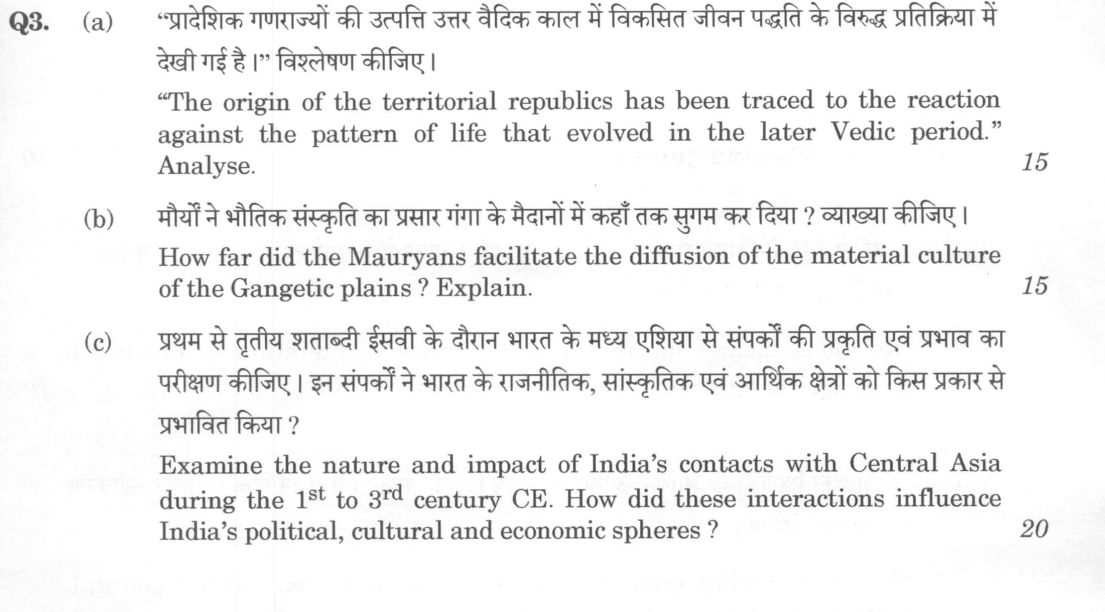
"The origin of the territorial republics has been traced to the reaction against the pattern of life that evolved in the later Vedic period." Analyse. 15 marks
How far did the Mauryans facilitate the diffusion of the material culture of the Gangetic plains ? Explain. 15 marks
Examine the nature and impact of India's contacts with Central Asia during the 1st to 3rd century CE. How did these interactions influence India's political, cultural and economic spheres ? 20 marks
हिंदी में प्रश्न पढ़ें
"प्रादेशिक गणराज्यों की उत्पत्ति उत्तर वैदिक काल में विकसित जीवन पद्धति के विरुद्ध प्रतिक्रिया में देखी गई है।" विस्लेषण कीजिए। (15 अंक)
मौर्यों ने भौतिक संस्कृति का प्रसार गंगा के मैदानों में कहाँ तक सुगम कर दिया ? व्याख्या कीजिए। (15 अंक)
प्रथम से तृतीय शताब्दी ईस्वी के दौरान भारत के मध्य एशिया से संपर्कों की प्रकृति एवं प्रभाव का परीक्षण कीजिए। इन संपर्कों ने भारत के राजनीतिक, सांस्कृतिक एवं आर्थिक क्षेत्रों को किस प्रकार से प्रभावित किया ? (20 अंक)
Model answer
Written by UPSC Answer Check against this question's marking rubric, to the expected length. UPSC does not publish answers for Mains — this is one way to score well, not an official key.
The trajectory from the sixth century BCE to the third century CE shows early historic India moving from lineage-based polities to imperial and transregional networks. Republican reaction. The later Vedic order, with its varna hierarchy, patriarchal household, and ritualism centred on brahmanical sacrifice, created social and political tensions. This stratification made older tribal arrangements seem restrictive. In the outer Gangetic zone and Himalayan foothills, gana-sanghas such as the Vajji, Malla and Shakya emerged as territorial republics. Their institutions were oligarchic rather than fully egalitarian: the Vajji had a santhagara, the assembly hall, where clan assemblies met; the Malla and Shakya were governed by leading lineages. Yet they limited hereditary kingship and ritual monopoly, making them a reaction against later Vedic orthodoxy. The reaction was not a simple rejection of all Vedic culture; it reconfigured political authority around lineage councils and territorial control, enabling the rise of mahajanapadas. Their geographical concentration in the foothills and outer Gangetic zone, away from mature Vedic ritual centres, gave these republics space to develop distinct institutions. K.P. Jayaswal read them as ‘Aryan democracy’, while Romila Thapar saw them as lineage-based oligarchies; both agree that they broke from the ritualised, stratified Vedic pattern.
Mauryan diffusion. The Mauryan state accelerated the spread of Gangetic material culture through administrative and economic mechanisms. The Arthashastra prescribes regulation of weights, measures, markets, roads and ports, while Mauryan coinage, especially punch-marked coins, helped circulate value, though it was not a single uniformly standardised issue. State control over roads, granaries and urban centres encouraged movement of goods and artisans. The Arthashastra’s administrative prescriptions thus made the Gangetic plain a model for state-managed circulation. The diffusion was not merely military; it was carried by merchants, artisans, migrants and officials, making it partly organic. Archaeologically, Northern Black Polished Ware, ring wells, burnt-brick construction and urban layouts appear beyond the core Gangetic plain, indicating state-supported and organic diffusion. Yet the process was uneven: in the Deccan and South, local pottery, settlement forms and social structures persisted, showing that Mauryan influence was often selective rather than imposed.
Central Asian contacts. Between the first and third centuries CE, India’s contacts with Central Asia intensified through the Silk Route, Kushan political bridging, and movement of peoples such as the Sakas, Kushans and Yuezhi. Key channels were Bactria, Gandhara, Taxila and Mathura. The first century saw Saka incursions and early Kushan expansion under Kujula Kadphises and Vima Kadphises; the second and third centuries saw Kushan consolidation and suzerainty. The Kushan bridge turned Central Asian movement into a structured political economy, with Gandhara and Mathura serving as nodes between Bactria and the Ganges. The movement of peoples and goods made Gandhara and Mathura nodes of exchange. Politically, Kushan rule introduced administrative innovations, provincial administration, coinage and bilingual/multilingual inscriptions, creating a court culture that linked Bactrian, Greek, Sanskrit and Kharoshthi traditions. Culturally, Gandhara art fused Hellenistic, Persian and Indian conventions, while the Mathura school remained primarily indigenous; together they supported Mahayana Buddhism and the spread of Kharoshthi and Brahmi scripts. This period also saw the circulation of Buddhist texts and monastic communities, linking Central Asian patrons with Indian centres. Economically, long-distance trade brought bullion inflows, new crafts, urban proliferation and demand for textiles, spices and precious stones. Historiographically, these contacts should not be reduced to simple ‘Indianization’; they were interactive hybridity, with Central Asian elements transforming Indian art, religion and commerce while Indian ideas also travelled westward.
Conclusion. The republican reaction, Mauryan material diffusion and Central Asian interactions collectively transformed early historic India: they weakened old ritual hierarchies, created a more integrated Gangetic economy, and opened India to transregional exchange, laying foundations for later classical state and culture.
What "Analyse" is asking you to do
Break the subject into its working parts and show how they act on each other. The marks are in the interconnections — which factor drives which, and what the resulting structure explains — not in the inventory of factors.
Structure that answers it
Define the whole → separate it into its parts → show which part drives which → what that interaction produces → what the structure implies
Where marks are lost
A flat list of causes with no account of which drives which. An answer of neatly separated headings, each self-contained, scores as description.
How this answer will be evaluated
Approach
Framework: Context > Thesis > Evidence > Historiography. (a) analyse: intro > causes > effects > stakeholders/linkages > way forward | (b) explain: definition/context > points in order > small example > short close | (c) examine: intro > how/why with reasoning > evidence > conclusion Full marks: Thesis-driven, cites specific sources, names historians, covers all dimensions.
Key points expected
- Identify later Vedic features (Brahmanical dominance, Varna rigidity).
- Link reaction to rise of Janapadas/Mahajanapadas.
- Cite specific evidence (e.g., Vajjiani, Kashi, Anga).
- Mention the role of Sramana movements.
- Define 'material culture' (coinage, weights, pottery, architecture).
- Explain the role of the Arthashastra in standardization.
- Discuss the impact of the Mauryan road network.
- Mention specific examples (e.g., punch-marked coins, Nalanda).
Evaluation rubric
Each sub-part is marked on its own, against the marks and word limit printed on the paper.
- (a) Analyse the reaction against later Vedic life that led to territorial republics. 15 marks
analyse— intro → causes → effects → stakeholders/linkages → way forward
Must cover
- Identify later Vedic features (Brahmanical dominance, Varna rigidity).
- Link reaction to rise of Janapadas/Mahajanapadas.
- Cite specific evidence (e.g., Vajjiani, Kashi, Anga).
- Mention the role of Sramana movements.
Loses marks
- Narrating Vedic history without linking to republics.
- Ignoring the 'reaction' aspect of the prompt.
Earns more
- Reference to specific Vedic texts (e.g., Atharvaveda).
- Mention of specific historians (e.g., R.C. Majumdar).
- Comparison with tribal (Gana) vs territorial (Janapada) forms.
Extra mark
- Quotation from a specific inscription or text.
- Reference to a specific archaeological site.
- (b) Explain how Mauryans facilitated the diffusion of Gangetic material culture. 15 marks
explain— definition/context → points in order → small example → short close
Must cover
- Define 'material culture' (coinage, weights, pottery, architecture).
- Explain the role of the Arthashastra in standardization.
- Discuss the impact of the Mauryan road network.
- Mention specific examples (e.g., punch-marked coins, Nalanda).
Loses marks
- Focusing only on political expansion, not material culture.
- Ignoring the 'diffusion' aspect (spreading to other regions).
Earns more
- Reference to specific inscriptions (e.g., Ashoka's edicts).
- Mention of specific trade routes (e.g., Ujjain to Taxila).
- Comparison with pre-Mauryan material culture.
Extra mark
- Quotation from the Arthashastra.
- Reference to a specific archaeological find.
- (c) Examine nature/impact of India-Central Asia contacts (1st-3rd c. CE) on politics, culture, economy. 20 marks
examine— intro → how/why with reasoning → evidence → conclusion
Must cover
- Identify key contacts (Kushans, Huns, Silk Road).
- Analyse political impact (Kushan rule, Gupta resistance).
- Analyse cultural impact (Gandhara art, Buddhism spread).
- Analyse economic impact (Silk Road trade, coinage).
Loses marks
- Ignoring the specific time period (1st-3rd c. CE).
- Focusing only on one sphere (e.g., only culture).
Earns more
- Reference to specific inscriptions (e.g., Rabatak).
- Mention of specific historians (e.g., A. H. Dani).
- Comparison with earlier (Mauryan) or later (Gupta) contacts.
Extra mark
- Quotation from a specific chronicle (e.g., Faxian).
- Reference to a specific archaeological site (e.g., Taxila).
Practice this exact question
Write your answer and it is marked point by point against the model answer above — what you covered, what you missed, what you got wrong.
Evaluate my answer →More from History 2025 Paper I
- Q1 Identify the following places marked on the map supplied to you and write a short note of…
- Q2 (a) "The Chalcolithic people were experts in microliths and were also skilful workers in…
- Q3 (a) "The origin of the territorial republics has been traced to the reaction against the…
- Q4 (a) "The dynamics of social mobility in early medieval India were shaped by a complex int…
- Q5 Answer the following questions in about 150 words each: (a) "Religious themes inspired a…
- Q6 (a) Discuss the structural features of Todar Mal's revenue system and evaluate its effect…