Paper I — Q7
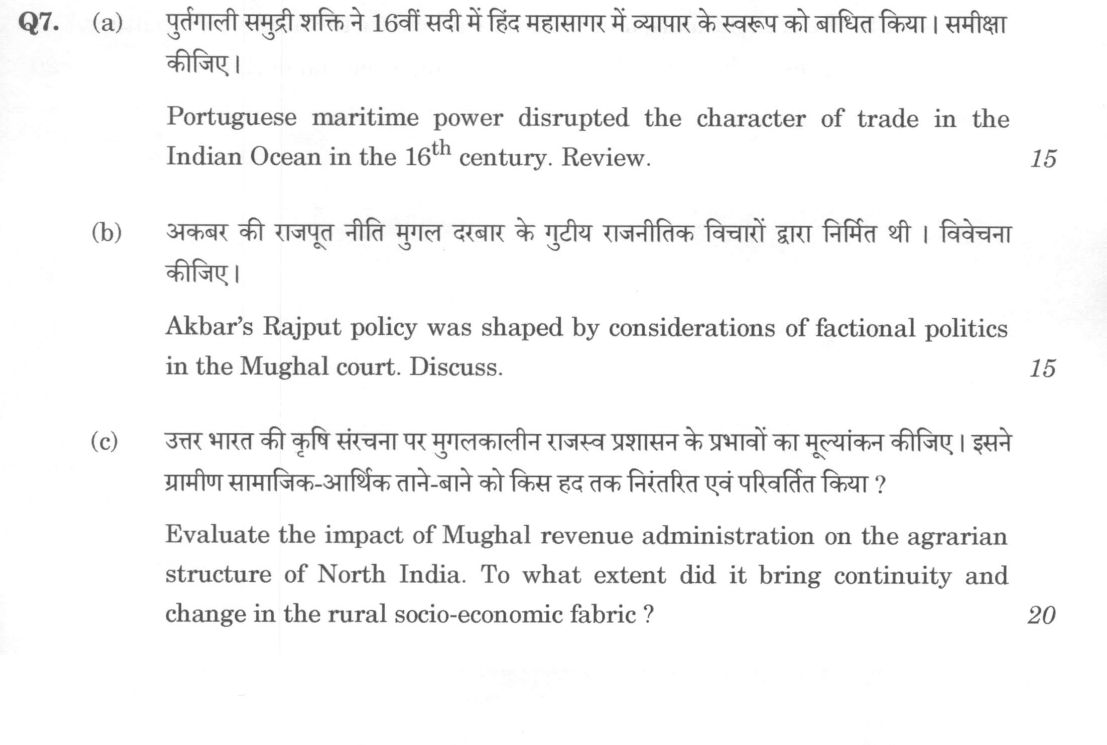
(a) Portuguese maritime power disrupted the character of trade in the Indian Ocean in the 16th century. Review. (15 marks) (b)…
Portuguese maritime power disrupted the character of trade in the Indian Ocean in the 16th century. Review. 15 marks
Akbar's Rajput policy was shaped by considerations of factional politics in the Mughal court. Discuss. 15 marks
Evaluate the impact of Mughal revenue administration on the agrarian structure of North India. To what extent did it bring continuity and change in the rural socio-economic fabric ? 20 marks
हिंदी में प्रश्न पढ़ें
पुर्तगाली समुद्री शक्ति ने 16वीं सदी में हिंद महासागर में व्यापार के स्वरूप को बाधित किया। समीक्षा कीजिए। (15 अंक)
अकबर की राजपूत नीति मुगल दरबार के गुटीय राजनीतिक विचारों द्वारा निर्मित थी। विवेचना कीजिए। (15 अंक)
उत्तर भारत की कृषि संरचना पर मुगलकालीन राजस्व प्रशासन के प्रभावों का मूल्यांकन कीजिए। इसने ग्रामीण सामाजिक-आर्थिक ताने-बाने को किस हद तक निरंतरित एवं परिवर्तित किया ? (20 अंक)
Model answer
Written by UPSC Answer Check against this question's marking rubric, to the expected length. UPSC does not publish answers for Mains — this is one way to score well, not an official key.
The sixteenth and seventeenth centuries witnessed a fundamental restructuring of South Asian political economy, driven by European oceanic mercantilism, Mughal administrative centralization, and the deepening of an agrarian cash nexus.
Portuguese Maritime Disruption in the Indian Ocean
The arrival of the Portuguese transformed the Indian Ocean from a zone of unarmed, customary trade into an arena of state-regulated armed commerce. Operating through the Estado da Índia, the Portuguese utilized advanced naval technology, notably cannon-mounted carracks, to establish fortified maritime choke points across the littoral. By enforcing the cartaz (pass) system, they monopolized high-value commodities such as spices and arms, compulsorily rerouting Asian shipping through their customs houses. This institutional violence severely fractured the long-established operational autonomy of Arab, Persian, and Gujarati merchant networks. However, this disruption was maritime rather than absolute. Lacking substantial inland territorial control, the Portuguese could not dismantle indigenous overland caravan networks or subjugate continental agrarian empires, rendering their dominance an oceanic overlay rather than a complete economic conquest.
Akbar’s Rajput Policy and Court Factions
Akbar’s Rajput policy was fundamentally an instrument of statecraft engineered to neutralize factional instability within the Mughal ruling elite. The early Mughal nobility was dominated by assertive Turani and Irani factions whose recurring rebellions, such as those of the Uzbegs and Mirza Hakim, threatened imperial authority. Akbar counterbalanced these elements by incorporating indigenous elites into the imperial fold.
Beginning with matrimonial alliances with the Kachhwahas of Amber and later extending to the Hadas of Ranthambore, Akbar transformed traditional adversaries into imperial pillars. While the siege of Chittor (1568) demonstrated the ruthless cost of resistance to Sisodias, Akbar quickly pivoted from outright subjugation to institutional co-optation. By embedding Rajput chieftains into the mansabdari framework as high-ranking military commanders and assigning them watan jagirs, he secured unshakeable loyalty. The elevation of indigenous non-princely figures like Raja Todar Mal in finance and Raja Birbal in administrative councils further eroded the monopoly of foreign nobility, establishing a composite, multi-ethnic ruling class.
Agrarian Structure: Continuity and Change
Mughal revenue administration, articulated through the mansabdari-jagirdari framework and Todar Mal’s Ain-i-Dahsala, profoundly reorganized the rural political economy of North India, representing a complex dynamic between structural continuity and commercialized disruption.
In terms of continuity, the Mughal revenue apparatus built directly upon the Delhi Sultanate’s iqta tradition by claiming the surplus product without altering traditional landownership. The imperial state remained heavily dependent on hereditary zamindars and village headmen (muqaddams) as indispensable fiscal intermediaries. The village community retained its internal social hierarchy, and traditional modes of assessment like batai (crop-sharing) and nasaq (estimation) persisted extensively alongside empirical measurements.
The element of change lay in the aggressive imposition of the zabt system across the fertile Gangetic plains, which measured land with standard units (tanab) and demanded revenue settlements strictly in cash. This demand catalyzed a deep cash nexus, compelling peasants to produce high-value cash crops like cotton, indigo, and sugarcane for urban and overseas markets. This commercialization deepened socio-economic stratification, widening the divide between privileged, landholding khud-kasht peasants and impoverished, dependent pahi-kasht tenants and landless kamins. Furthermore, regional variations were pronounced: while the Gangetic core saw intense zabt standardization, Punjab maintained flexible appraisal methods, and the Deccan resisted uniform fiscal penetration due to rugged topography and localized elite autonomy.
A profound structural tension emerged from the short tenure of transferable jagirs. Insecure jagirdars, anxious over imminent transfers, frequently extracted excessive surpluses from the peasantry, compromising long-term agrarian investment and precipitating localized peasant flight.
Verdict
On evaluation, while the Mughal revenue system maintained institutional continuities with the Sultanate’s fiscal architecture and left traditional village hierarchies intact, its aggressive cash monetization, rigid measurement, and market integration irreversibly commodified North Indian agrarian relations. Together with oceanic militarization and ethnic political co-optation, it exemplified the Mughal state's sophisticated adaptation to early modern globalization, though its predatory fiscal pressures ultimately sowed the seeds of structural agrarian crises.
What "Evaluate" is asking you to do
Judge how well something has performed against the standard it set for itself — its stated aim, mandate or promise — and commit to a verdict. Name the yardstick before you judge; an unanchored judgement reads as opinion.
Structure that answers it
Name the yardstick — stated aim, mandate or benchmark → performance against it → shortfall against it → why the gap exists → verdict
Where marks are lost
Presenting both sides and then declining to decide, or delivering a verdict against a standard you never stated, which makes it look arbitrary.
How this answer will be evaluated
Approach
Framework: Context > Thesis > Evidence > Historiography. (a) comment: context > arguments both sides > judgment > close | (b) discuss: intro > 3-4 dimensions > example > balanced close | (c) evaluate: criteria > evidence > balanced judgment Full marks: Argues a clear thesis, cites specific sources/historians, and provides a nuanced, balanced judgment.
Key points expected
- Contextualize pre-Portuguese trade networks (Arab, Gujarati, Chinese)
- Identify specific disruptions: monopoly, violence, route shifts
- Assess the 'character' of trade (commodities, scale, actors)
- Provide a balanced judgment on the extent of disruption
- Identify key factions (Ulema, Turani, Irani, Rajputs)
- Explain the political logic of Rajput integration (military/administrative)
- Link specific policy shifts to court dynamics (e.g., marriage alliances)
- Discuss the tension between religious orthodoxy and political pragmatism
Evaluation rubric
Each sub-part is marked on its own, against the marks and word limit printed on the paper.
- (a) Contextualize Portuguese entry and judge the extent of trade disruption in the Indian Ocean. 15 marks
comment— context → arguments both sides → judgment → close
Must cover
- Contextualize pre-Portuguese trade networks (Arab, Gujarati, Chinese)
- Identify specific disruptions: monopoly, violence, route shifts
- Assess the 'character' of trade (commodities, scale, actors)
- Provide a balanced judgment on the extent of disruption
Loses marks
- Narrative retelling of Vasco da Gama's voyage without analysis
- Ignoring the continuity of existing trade networks
- Failing to address the 'character' of trade specifically
Earns more
- Mention specific ports (Goa, Diu, Malacca)
- Reference specific commodities (spices, textiles, horses)
- Cite a specific chronicle or source (e.g., Duarte Pacheco Pereira)
Extra mark
- Name a specific historian (e.g., K.N. Chaudhuri, Sanjay Subrahmanyam)
- Quote a specific source or treaty
- (b) Analyze how internal Mughal court factions influenced the formulation of Akbar's Rajput policy. 15 marks
discuss— intro → 3-4 dimensions → example → balanced close
Must cover
- Identify key factions (Ulema, Turani, Irani, Rajputs)
- Explain the political logic of Rajput integration (military/administrative)
- Link specific policy shifts to court dynamics (e.g., marriage alliances)
- Discuss the tension between religious orthodoxy and political pragmatism
Loses marks
- Treating Rajput policy as purely military strategy
- Ignoring the role of the Ulema or religious factions
- Chronological listing of events without political analysis
Earns more
- Mention specific Rajput dynasties (Mewar, Marwar, Bundi)
- Reference the role of key advisors (Bairam Khan, Todar Mal)
- Cite a specific event (e.g., Battle of Haldighati, marriage to Jodha Bai)
Extra mark
- Name a specific historian (e.g., Irfan Habib, John F. Richards)
- Quote a specific source (e.g., Ain-i-Akbari, Akbarnama)
- (c) Assess the impact of Mughal revenue administration on North Indian agrarian structure, focusing on continuity and change. 20 marks
evaluate— criteria → evidence → balanced judgment
Must cover
- Define the Mughal revenue system (Zabt, Ijara, Mansabdari)
- Analyze changes in land tenure and peasant status
- Identify continuities in rural socio-economic fabric
- Provide a balanced judgment on the extent of change
Loses marks
- Describing the revenue system without analyzing its impact
- Ignoring the 'continuity' aspect of the question
- Failing to address the 'rural socio-economic fabric' specifically
Earns more
- Mention specific revenue officers (Todar Mal, Todar Mal's reforms)
- Reference specific land categories (Polaj, Parauti, Chahar Gah)
- Cite a specific source (e.g., Ain-i-Akbari, Iqta records)
Extra mark
- Name a specific historian (e.g., Irfan Habib, R.I. Frykenberg)
- Quote a specific source or inscription
Practice this exact question
Write your answer and it is marked point by point against the model answer above — what you covered, what you missed, what you got wrong.
Evaluate my answer →More from History 2025 Paper I
- Q4 (a) "The dynamics of social mobility in early medieval India were shaped by a complex int…
- Q5 Answer the following questions in about 150 words each: (a) "Religious themes inspired a…
- Q6 (a) Discuss the structural features of Todar Mal's revenue system and evaluate its effect…
- Q7 (a) Portuguese maritime power disrupted the character of trade in the Indian Ocean in the…
- Q8 (a) "Aurangzeb's religious policy was a reflection of the changed political realities of…