Paper II — Q1
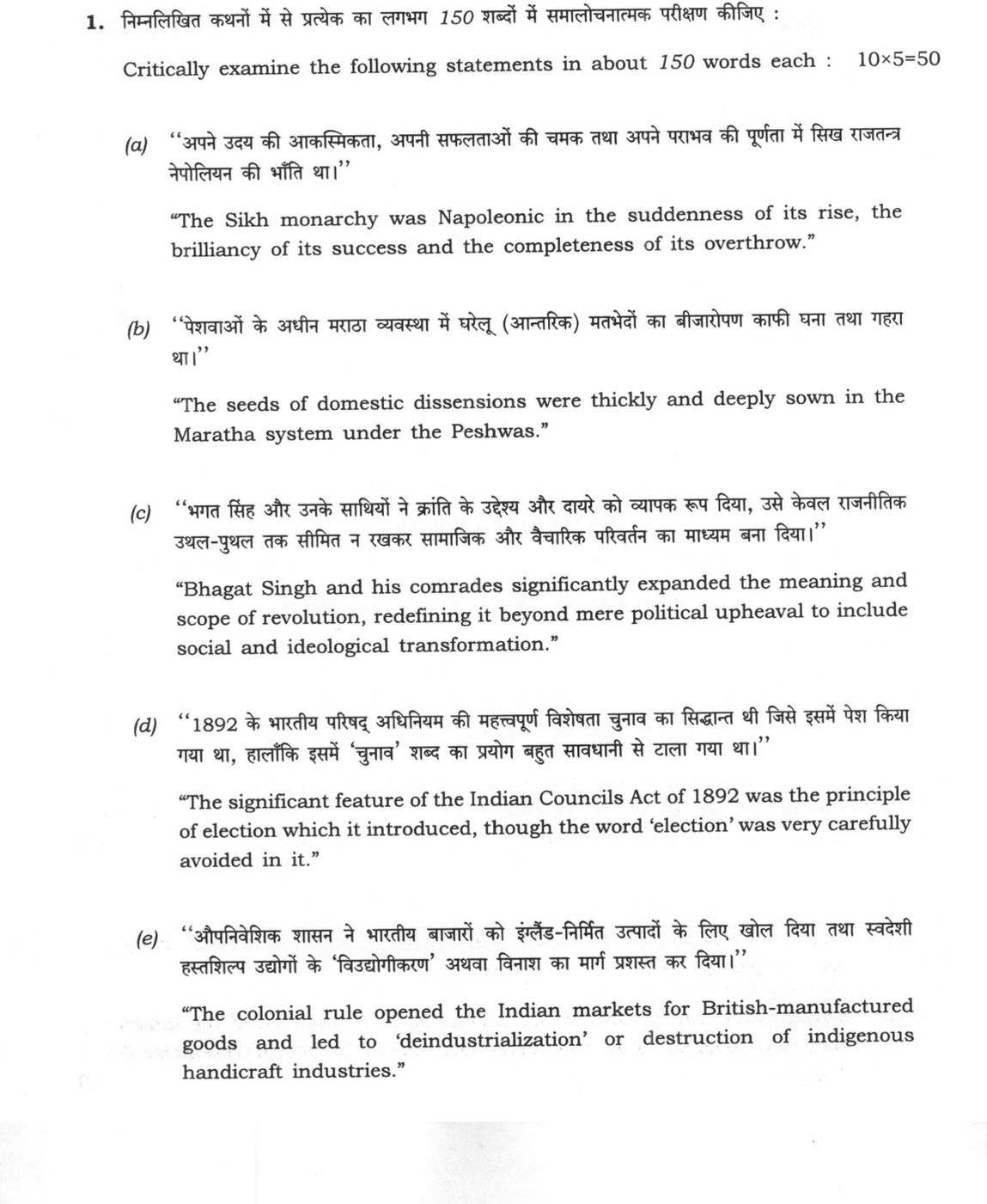
Critically examine the following statements in about 150 words each: (a) "The Sikh monarchy was Napoleonic in the suddenness of…
Critically examine the following statements in about 150 words each:
"The Sikh monarchy was Napoleonic in the suddenness of its rise, the brilliancy of its success and the completeness of its overthrow." 10 marks
"The seeds of domestic dissensions were thickly and deeply sown in the Maratha system under the Peshwas." 10 marks
"Bhagat Singh and his comrades significantly expanded the meaning and scope of revolution, redefining it beyond mere political upheaval to include social and ideological transformation." 10 marks
"The significant feature of the Indian Councils Act of 1892 was the principle of election which it introduced, though the word 'election' was very carefully avoided in it." 10 marks
"The colonial rule opened the Indian markets for British-manufactured goods and led to 'deindustrialization' or destruction of indigenous handicraft industries." 10 marks
हिंदी में प्रश्न पढ़ें
निम्नलिखित कथनों में से प्रत्येक का लगभग 150 शब्दों में समालोचनात्मक परीक्षण कीजिए :
"अपने उदय की आकस्मिकता, अपनी सफलताओं की चमक तथा अपने पतन की पूर्णता में सिख राजतंत्र नेपोलियन की भांति था।" (10 अंक)
"पेशवाओं के अधीन मराठा व्यवस्था में घरेलू (आंतरिक) मतभेदों का बीजारोपण काफी घना तथा गहरा था।" (10 अंक)
"भगत सिंह और उनके साथियों ने क्रांति के उद्देश्य और दायरे को व्यापक रूप दिया, उसे केवल राजनीतिक उथल-पुथल तक सीमित न रखकर सामाजिक और वैचारिक परिवर्तन का माध्यम बना दिया।" (10 अंक)
"1892 के भारतीय परिषद् अधिनियम की महत्त्वपूर्ण विशेषता चुनाव का सिद्धांत थी जिसे इसमें पेश किया गया था, हालांकि इसमें 'चुनाव' शब्द का प्रयोग बहुत सावधानी से टाला गया था।" (10 अंक)
"औपनिवेशिक शासन ने भारतीय बाजारों को इंग्लैंड-निर्मित उत्पादों के लिए खोल दिया तथा स्वदेशी हस्तशिल्प उद्योगों के 'विद्योगीकरण' अथवा विनाश का मार्ग प्रशस्त कर दिया।" (10 अंक)
Model answer
Written by UPSC Answer Check against this question's marking rubric, to the 150-word length. UPSC does not publish answers for Mains — this is one way to score well, not an official key.
Sikh monarchy. The Sikh monarchy was indeed Napoleonic in tempo: after the fall of Mughal authority, Ranjit Singh consolidated the misals, captured Lahore in 1799, and by the 1830s had built a disciplined, multi-ethnic state with a modern army and centralized revenue. Yet the parallel is limited. Napoleon’s empire rested on legal and administrative codification, whereas Ranjit Singh’s power depended on personal charisma, patronage and the uneasy cooperation of Sikh misals, Punjabi Muslim officers and Hindu ministers. The structural weakness was succession: after his death in 1839, the monarchy lacked a clear constitutional principle, and court factions, regency struggles and military disunity weakened it. The “completeness of overthrow” is also overstated: the British annexed the kingdom in 1849, but Sikh political identity, institutions and resistance did not vanish. Thus the statement captures dramatic rise and fall, but understates institutional fragility and continuity.
Maratha Peshwas. The Maratha system under the Peshwas did contain deep fissures, but the statement risks reducing a complex polity to internal decay. The Peshwai became increasingly Brahminical and court-centred, alienating many Maratha warriors and other communities, while revenue farming (ijara) and the burdens of chauth and sardeshmukhi encouraged local resentment and fiscal instability. Succession and regency disputes, such as the Tarabai–Shahu conflict, fragmented authority and allowed sardars to assert autonomy. The Battle of Poona (1802), fought between Yashwantrao Holkar and the combined forces of Peshwa Baji Rao II and Scindia, exposed Holkar–Scindia rivalries and how sardars could challenge the Peshwa. Yet the Marathas were not merely self-destructive: they had flexible institutions, regional administration, a strong tradition of military leadership and a capacity for recovery. The “seeds” were real, but they sprouted because of British pressure, military technology, administrative reform and the failure to create a unified constitutional centre.
Bhagat Singh. Bhagat Singh and the HSRA did broaden revolution beyond the older pattern of armed resistance. The Ghadar movement and Anushilan Samiti had already challenged British rule, but Ghadar was largely secular, egalitarian and anti-colonial, while Anushilan often relied on individual heroism and a narrower nationalist vocabulary. The HSRA consciously linked anti-colonial struggle to socialism, a communist critique of capitalism, anti-imperialism, workers’ rights, peasant distress, anti-communalism, class consciousness and popular education, making “Inquilab Zindabad” a slogan for social as well as political change. Their hunger strikes in prison turned the body into a moral weapon, forcing the state to confront the ethics of detention. Yet the claim must be qualified: their audience remained small, their methods violent, and their ideology often more aspirational than organisational. Still, they shifted the language of freedom from mere overthrow of the Crown to transformation of class, caste and communal relations.
Indian Councils Act of 1892. The Indian Councils Act of 1892 did introduce a limited principle of election, but the statement is accurate only in a qualified sense. The Act allowed some members of legislative councils to be chosen indirectly through municipal bodies, district boards and chambers of commerce, while the word “election” was avoided because the government preferred “nomination” or “selection” to prevent a claim to representative government. This was a concession to Indian National Congress pressure and to the growing demand for public participation in administration. Yet the franchise was extremely narrow, the electorates were elite and non-representative, and official majorities were retained in the councils. Thus the Act opened a door to political association and public debate, but it did not create a genuine electoral system. Its significance lies less in the reality of voting than in the symbolic recognition that Indians could be associated with legislation, even under strict imperial control.
Deindustrialisation. The claim that colonial rule opened Indian markets to British goods and caused deindustrialisation is broadly valid, but it needs qualification. Tariffs, customs duties, railway rates and the free-trade policy after 1854 made Indian textiles vulnerable to Manchester cloth, while the decline of weavers, spinners and artisans is well documented in Bengal, the Deccan and the Coromandel. The nationalist “deindustrialisation” narrative correctly identifies the destruction of indigenous handicraft industries and the transformation of India into a supplier of raw materials. Yet revisionist historians such as Morris D. Morris, Clive Dewey and Tirthankar Roy argue that the process was uneven, with regional variations; some regions and sectors adapted and commercial networks persisted, while Tirthankar Roy’s “reallocation” thesis stresses a shift from handicraft to proto-industrial and commercial activity rather than total collapse. The verdict is that colonial policy accelerated decline in key textiles, but the scale and uniformity of deindustrialisation remain contested.
Overall, each statement is partly true but requires qualification: the processes were significant, yet none was absolute.
What "Critically examine" is asking you to do
Test the proposition the question puts to you and return a finding on how far it holds. Examine stems carry a claim, or ask whether something has happened, and expect evidence weighed both ways before the extent is stated — often with remedial measures attached. “Critically” is not a section added at the end: name the yardstick you are judging by — the evidence, the stated objective, a constitutional principle, a rival explanation — and let a verdict close each part of the body. Where the question quotes a claim, that verdict must land on the claim itself, accepted, qualified or rejected, and not on the theme in general.
Structure that answers it
Restate the claim as the question frames it → evidence that supports it → evidence that undercuts it → the conditions under which it holds → verdict on how far it stands
Where marks are lost
Merits in one paragraph, demerits in the next, and a conclusion calling for a balanced and holistic approach. That is a survey with the judgement left out and it holds the answer in the middle band. The opposite error is reading “critically” as permission to attack — and with the odd pairings, critically describe or critically explain, the exposition still carries most of the marks, the judgement being a layer on it rather than a substitute for it.
How this answer will be evaluated
Approach
Framework: Context > Thesis > Evidence > Historiography. (a) critique: the claim > its strengths > its weaknesses > your judgment | (b) critique: the claim > its strengths > its weaknesses > your judgment | (c) critique: the claim > its strengths > its weaknesses > your judgment | (d) critique: the claim > its strengths > its weaknesses > your judgment | (e) critique: the claim > its strengths > its weaknesses > your judgment Full marks: Thesis-driven, cites specific sources/historians, directly addresses the 'critique' command word, and provides a balanced judgment.
Key points expected
- Contextualize the rise of Ranjit Singh's state
- Analyze the 'suddenness' of the rise (1799-1839)
- Examine the 'brilliancy' of military/administrative success
- Critique the 'completeness' of the British overthrow
- Identify the 'seeds' of dissent (e.g., Peshwa vs. Sardars)
- Analyze the 'domestic' nature of the conflicts
- Assess the 'depth' of these dissensions in the system
- Link internal weakness to the eventual decline
Evaluation rubric
Each sub-part is marked on its own, against the marks and word limit printed on the paper.
- (a) Assess the validity of the 'Napoleonic' analogy for the Sikh state's rise and fall. 10 marks · 150 words
critique— the claim → its strengths → its weaknesses → your judgment
Must cover
- Contextualize the rise of Ranjit Singh's state
- Analyze the 'suddenness' of the rise (1799-1839)
- Examine the 'brilliancy' of military/administrative success
- Critique the 'completeness' of the British overthrow
Loses marks
- Narrating events without analytical comparison
- Ignoring the 'Napoleonic' analogy entirely
- Focusing only on the British conquest
Earns more
- Mention the role of the Dal Khalsa
- Reference the Treaty of Amritsar (1809)
- Cite the First Anglo-Sikh War (1845)
- Name a historian like K.S. Duggal
Extra mark
- Quote from a specific chronicle
- Mention the Treaty of Lahore (1846)
- (b) Evaluate the extent of internal political instability within the Peshwa administration. 10 marks · 150 words
critique— the claim → its strengths → its weaknesses → your judgment
Must cover
- Identify the 'seeds' of dissent (e.g., Peshwa vs. Sardars)
- Analyze the 'domestic' nature of the conflicts
- Assess the 'depth' of these dissensions in the system
- Link internal weakness to the eventual decline
Loses marks
- Focusing only on external British threats
- Listing events without analyzing internal causes
- Ignoring the specific role of the Peshwas
Earns more
- Mention the conflict between Peshwa and Nana Phadnavis
- Reference the role of the Gaikwads or Holkars
- Cite the Third Anglo-Maratha War (1817-18)
- Name a historian like R.C. Majumdar
Extra mark
- Quote from a Peshwa-era document
- Mention the Treaty of Bassein (1802)
- (c) Assess Bhagat Singh's contribution to redefining revolution as social/ideological change. 10 marks · 150 words
critique— the claim → its strengths → its weaknesses → your judgment
Must cover
- Define the 'expanded meaning' of revolution
- Analyze the shift from 'political upheaval' to 'social transformation'
- Examine the 'ideological' dimension (e.g., socialism)
- Evaluate the impact of his comrades (e.g., Rajguru, Sukhdev)
Loses marks
- Focusing only on the assassination of General Dyer
- Ignoring the 'social' and 'ideological' aspects
- Treating Bhagat Singh as a lone actor
Earns more
- Mention the Hindustan Socialist Republican Association (HSRA)
- Reference the 'Inquilab' slogan
- Cite the trial speeches as ideological documents
- Name a historian like Sumit Sarkar
Extra mark
- Quote from 'Why I am an Atheist'
- Mention the influence of Karl Marx
- (d) Evaluate the introduction of the 'principle of election' in the 1892 Act. 10 marks · 150 words
critique— the claim → its strengths → its weaknesses → your judgment
Must cover
- Identify the 'principle of election' introduced
- Analyze why the word 'election' was 'carefully avoided'
- Examine the 'significant feature' of the Act
- Assess the impact on Indian political participation
Loses marks
- Focusing only on the 'avoidance' of the word
- Ignoring the 'principle' of election
- Treating the Act as a major democratic reform
Earns more
- Mention the 'nomination' process
- Reference the role of the Governor
- Cite the limited franchise (property/education)
- Name a historian like Bipan Chandra
Extra mark
- Quote from the Act's text
- Mention the role of the Indian National Congress
- (e) Assess the impact of colonial rule on Indian markets and indigenous industries. 10 marks · 150 words
critique— the claim → its strengths → its weaknesses → your judgment
Must cover
- Analyze how colonial rule 'opened' Indian markets
- Examine the 'deindustrialization' of handicrafts
- Evaluate the 'destruction' of indigenous industries
- Link market opening to industrial destruction
Loses marks
- Focusing only on 'market opening'
- Ignoring the 'deindustrialization' aspect
- Treating the impact as purely economic
Earns more
- Mention the 'drain of wealth' theory
- Reference the decline of the textile industry
- Cite the role of British tariffs
- Name a historian like R.C. Dutt
Extra mark
- Quote from 'Economic History of India'
- Mention the 'deindustrialization' statistic
Practice this exact question
Write your answer and it is marked point by point against the model answer above — what you covered, what you missed, what you got wrong.
Evaluate my answer →More from History 2025 Paper II
- Q1 Critically examine the following statements in about 150 words each: (a) "The Sikh monarc…
- Q2 (a) Do you agree that the idea of permanent fixation of land revenue of 1793 in Bengal wa…
- Q3 (a) "During the Carnatic Wars, the French position, which at one time dazzled the Indian…
- Q4 (a) "The tensions between cultural revivalism and modernization shaped the trajectory of…