Paper II — Q4
(a) "The tensions between cultural revivalism and modernization shaped the trajectory of the socio-religious reform movements in…
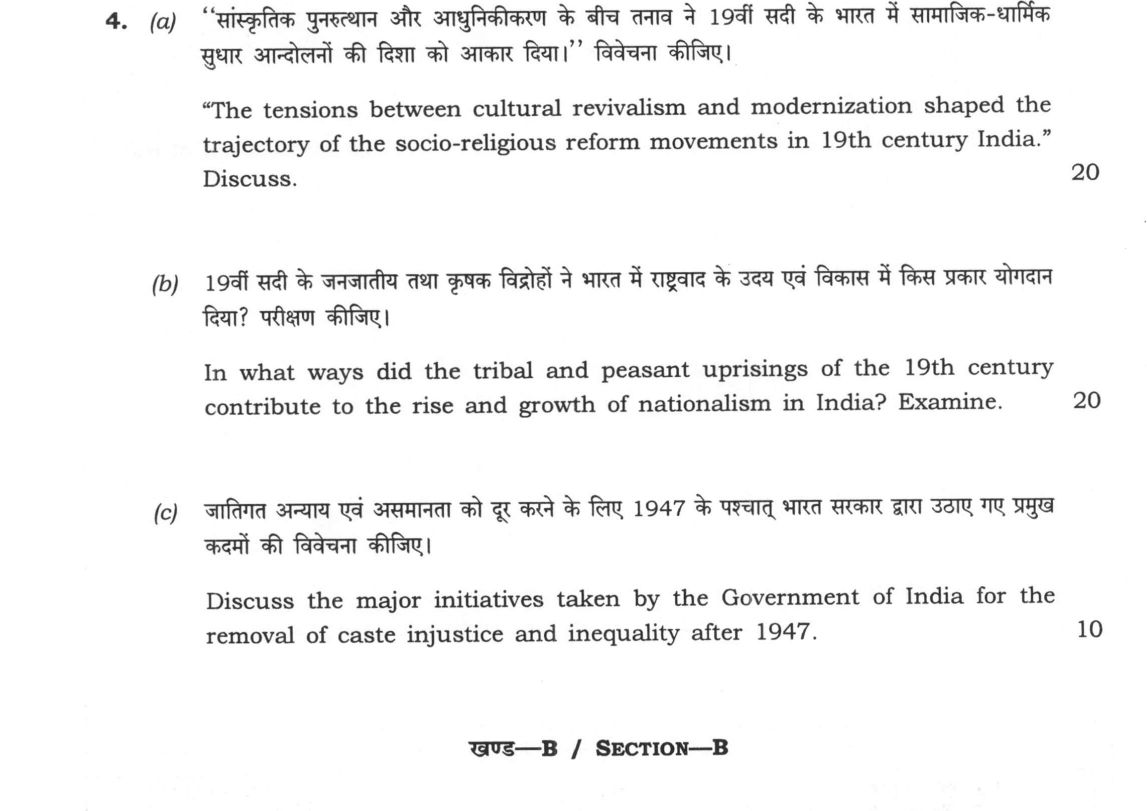
"The tensions between cultural revivalism and modernization shaped the trajectory of the socio-religious reform movements in 19th century India." Discuss. 20 marks
In what ways did the tribal and peasant uprisings of the 19th century contribute to the rise and growth of nationalism in India? Examine. 20 marks
Discuss the major initiatives taken by the Government of India for the removal of caste injustice and inequality after 1947. 10 marks
हिंदी में प्रश्न पढ़ें
"सांस्कृतिक पुनरुत्थान और आधुनिकीकरण के बीच तनाव ने 19वीं सदी के भारत में सामाजिक-धार्मिक सुधार आंदोलनों की दिशा को आकार दिया।" विवेचना कीजिए। (20 अंक)
19वीं सदी के जनजातीय तथा कृषक विद्रोहों ने भारत में राष्ट्रवाद के उदय एवं विकास में किस प्रकार योगदान दिया? परीक्षण कीजिए। (20 अंक)
जातिगत अन्याय एवं असमानता को दूर करने के लिए 1947 के पश्चात् भारत सरकार द्वारा उठाए गए प्रमुख कदमों की विवेचना कीजिए। (10 अंक)
Model answer
Written by UPSC Answer Check against this question's marking rubric, to the expected length. UPSC does not publish answers for Mains — this is one way to score well, not an official key.
The 19th-century reform, peasant and tribal responses, and post-1947 state action can be read as linked stages in India’s democratic transformation: reformers renegotiated tradition, popular uprisings politicised rural and tribal grievances, and the Republic converted anti-caste ideals into constitutional rights.
Part (a): Reform, revivalism and modernization The tension between cultural revivalism and modernization did not simply oppose tradition to the West; it made reformers use the past to attack present injustices while borrowing modern institutions. In Bengal, Raja Rammohan Roy’s Brahmo Samaj combined monotheism, widow remarriage, women’s education and a scientific temper, helping produce the Widow Remarriage Act of 1856. The Young Bengal movement’s radicalism provoked conservative backlash, showing how modernizing ideas could destabilise orthodox social order. Ishwar Chandra Vidyasagar’s secular-modernizing approach—widow remarriage, female education and vernacular reform—stood against revivalist historicism. In contrast, Dayanand Saraswati’s Arya Samaj rejected idolatry and caste privilege but invoked a Vedic “golden age”; its suddhi ritual sought to restore converts to the fold and reassert Vedic Hindu identity. Similar dialectics appeared in Bombay’s Prarthana Samaj and Madras Presidency’s Theosophical and neo-Vedantic currents, where revival of dharma coexisted with modern schooling and social reform. These tensions shaped trajectories: modernization expanded rights and public life, while revivalism supplied cultural confidence and later ideological resonances, including precursors to integral humanism associated with Deendayal Upadhyaya.
Part (b): Tribal and peasant uprisings and nationalism Tribal uprisings began as local resistance to colonial exploitation but became symbols of anti-colonial struggle. The Santhal Hool of 1855-56 attacked moneylenders, zamindars and colonial forest and revenue regimes in Santhal Parganas; Birsa Munda’s Ulgulan of 1899-1900 in Chotanagpur challenged moneylenders, missionaries and colonial land alienation. Nationalist leaders later appropriated such uprisings as evidence of popular anti-British feeling and as moral resources for swaraj. The 19th-century tribal idiom of self-rule also fed later movements, such as the 20th-century Tana Bhagat movement, showing the long reach of these upsurges. Peasant rebellions performed a similar function. The Indigo Revolt of 1859-60 against forced indigo cultivation and the Deccan Riots of 1875-76 against high rents, evictions and moneylenders exposed the exploitative colonial agrarian economy. They created a reservoir of grievance that later nationalism could organise. In the 20th century, Champaran (1917) and Kheda (1918) converted such grievances into Congress-kisan linkages; Gandhi’s strategic incorporation of peasant suffering through satyagraha made rural distress a central issue of national politics, broadening nationalism beyond elite and urban concerns.
Part (c): Post-1947 removal of caste injustice After independence, the state addressed caste injustice through constitutional, legislative and institutional measures. Article 14 guarantees equality before law, while Article 15 prohibits discrimination on grounds such as caste and permits special provisions for Scheduled Castes and Scheduled Tribes. Article 17 abolishes untouchability, and Article 46 directs the state to promote the welfare of weaker sections and prevent social injustice. The Fifth and Sixth Schedules provide special administrative arrangements for tribal areas. The Constitution (Scheduled Castes) and Scheduled Tribes Orders identify beneficiaries, while reservation policies in education and employment, supported by Articles 15(5), 16(4), 16(4A), 16(4B) and 335, seek substantive equality. The Untouchability Offences Act, 1955 criminalised caste-based discrimination, later replaced and strengthened by the Scheduled Castes and Scheduled Tribes (Prevention of Atrocities) Act, 1989. Institutional oversight was provided by the National Commission for Scheduled Castes and the National Commission for Scheduled Tribes; the National Commission for Backward Classes, created by statute in 1993 and later given constitutional status in 2018, extended the framework to other disadvantaged groups.
The way forward is to keep constitutional guarantees, anti-exploitation politics and social reform mutually reinforcing, so that equality, dignity and anti-caste justice remain operative in Indian society.
What "Discuss" is asking you to do
Lay the issue out from more than one side — how it arose, what is claimed for it, what is held against it, and where it now stands. UPSC attaches discuss to broad topics with several live dimensions, so coverage of the dimensions earns more than the strength of your opinion.
Structure that answers it
Set the issue up → the case as it is made → the case against → the dimension both sides leave out → where the balance now lies
Where marks are lost
Listing facts with no thread between them, or arguing one side throughout and calling it a discussion.
How this answer will be evaluated
Approach
Framework: Context > Thesis > Evidence > Historiography. (a) discuss: intro > 3-4 dimensions > example > balanced close | (b) examine: intro > how/why with reasoning > evidence > conclusion | (c) discuss: intro > 3-4 dimensions > example > balanced close Full marks: Demonstrates deep understanding, uses specific examples, and provides a clear analytical argument.
Key points expected
- Define the tension between revivalism and modernization
- Analyze Brahmo Samaj's synthesis of modernity and tradition
- Examine Arya Samaj's revivalist response to colonialism
- Discuss the impact on the trajectory of reform movements
- Identify specific tribal uprisings (e.g., Santhal, Munda)
- Identify specific peasant uprisings (e.g., Indigo, Deccan)
- Analyze the reasons for these uprisings (economic, social)
- Explain how these uprisings contributed to the rise of nationalism
Evaluation rubric
Each sub-part is marked on its own, against the marks and word limit printed on the paper.
- (a) Analyze the dialectic between cultural revivalism and modernization in 19th-century socio-religious reform. 20 marks
discuss— intro → 3-4 dimensions → example → balanced close
Must cover
- Define the tension between revivalism and modernization
- Analyze Brahmo Samaj's synthesis of modernity and tradition
- Examine Arya Samaj's revivalist response to colonialism
- Discuss the impact on the trajectory of reform movements
Loses marks
- Narrative retelling without analytical argument
- Failure to address the 'tension' or 'trajectory' aspect
- Generalities without specific examples
Earns more
- Reference to specific reformers (e.g., Rammohan Roy, Dayanand)
- Mention of specific texts or institutions
- Historiographical perspective on the nature of reform
- Comparison of different reform movements
Extra mark
- Citation of a specific primary source or text
- Reference to a specific historian's interpretation
- (b) Examine the contribution of 19th-century tribal and peasant uprisings to Indian nationalism. 20 marks
examine— intro → how/why with reasoning → evidence → conclusion
Must cover
- Identify specific tribal uprisings (e.g., Santhal, Munda)
- Identify specific peasant uprisings (e.g., Indigo, Deccan)
- Analyze the reasons for these uprisings (economic, social)
- Explain how these uprisings contributed to the rise of nationalism
Loses marks
- Listing uprisings without analyzing their contribution
- Failure to distinguish between tribal and peasant uprisings
- Generalities without specific examples
Earns more
- Reference to specific leaders or figures
- Mention of specific grievances (e.g., rent, labor)
- Discussion of the role of the press in spreading awareness
- Linkage to the broader nationalist movement
Extra mark
- Citation of a specific primary source or document
- Reference to a specific historian's interpretation
- (c) Discuss major post-1947 government initiatives to remove caste injustice and inequality. 10 marks
discuss— intro → 3-4 dimensions → example → balanced close
Must cover
- Mention constitutional provisions (e.g., Articles 15, 17)
- Discuss legislative measures (e.g., SC/ST Acts)
- Explain affirmative action policies (e.g., reservations)
- Mention social welfare schemes for marginalized communities
Loses marks
- Listing initiatives without explaining their purpose or impact
- Failure to address both 'injustice' and 'inequality'
- Generalities without specific examples
Earns more
- Reference to specific committees or commissions
- Mention of specific schemes or programs
- Discussion of the impact of these initiatives
- Reference to specific challenges in implementation
Extra mark
- Citation of a specific statistic or data point
- Reference to a specific court judgment
Practice this exact question
Write your answer and it is marked point by point against the model answer above — what you covered, what you missed, what you got wrong.
Evaluate my answer →More from History 2025 Paper II
- Q1 Critically examine the following statements in about 150 words each: (a) "The Sikh monarc…
- Q2 (a) Do you agree that the idea of permanent fixation of land revenue of 1793 in Bengal wa…
- Q3 (a) "During the Carnatic Wars, the French position, which at one time dazzled the Indian…
- Q4 (a) "The tensions between cultural revivalism and modernization shaped the trajectory of…
- Q5 Critically examine the following statements in about 150 words each: (a) "The French Revo…
- Q6 (a) "Nationalism in the 19th century was a driving force for both integration and disinte…
- Q7 (a) "By the time of 1932 elections, Germany's ruling classes began to feel that the only…