Paper II — Q8
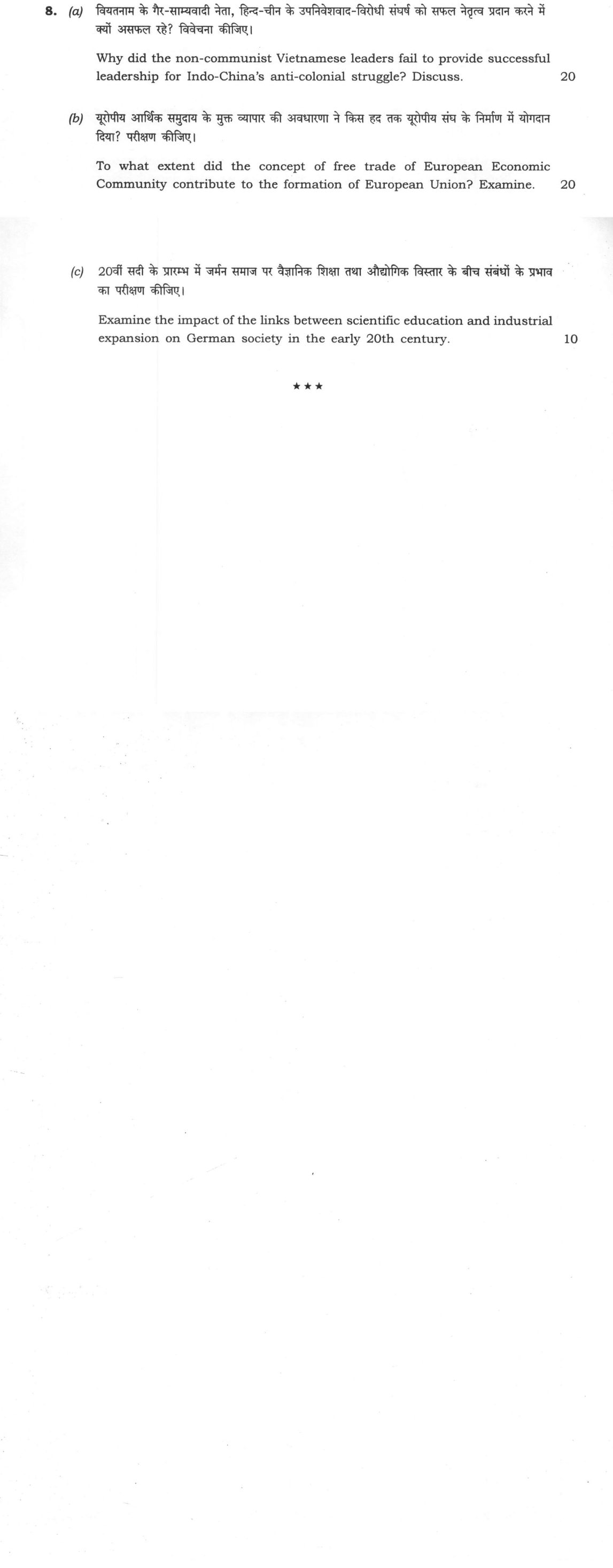
(a) Why did the non-communist Vietnamese leaders fail to provide successful leadership for Indo-China's anti-colonial struggle?…
Why did the non-communist Vietnamese leaders fail to provide successful leadership for Indo-China's anti-colonial struggle? Discuss. 20 marks
To what extent did the concept of free trade of European Economic Community contribute to the formation of European Union? Examine. 20 marks
हिंदी में प्रश्न पढ़ें
वियतनाम के गैर-साम्यवादी नेता, हिंद-चीन के उपनिवेशवाद-विरोधी संघर्ष को सफल नेतृत्व प्रदान करने में क्यों असफल रहे? विवेचना कीजिए। (20 अंक)
यूरोपीय आर्थिक समुदाय के मुक्त व्यापार की अवधारणा ने किस हद तक यूरोपीय संघ के निर्माण में योगदान दिया? परीक्षण कीजिए। (20 अंक)
Model answer
Written by UPSC Answer Check against this question's marking rubric, to the expected length. UPSC does not publish answers for Mains — this is one way to score well, not an official key.
The twentieth century witnessed contrasting trajectories in collective action and institution-building, evident in Indo-China's anti-colonial struggle and Western Europe's post-war integration.
Failure of Non-Communist Leadership in Vietnam
The inability of non-communist Vietnamese leadership to steer the national movement stemmed from ideological narrowness, structural weaknesses, and colonial repression. Nationalist groups, most notably the Viet Nam Quoc Dan Dang (VNQDD), suffered from an urban, bourgeois-intellectual bias. They failed to construct a grassroots rural apparatus or formulate an agrarian agenda, alienating the peasantry who constituted the vast majority of the population.
Furthermore, non-communist factions were fragmented and lacked clandestine organizational resilience. When the VNQDD launched the premature Yen Bai mutiny in 1930, brutal French retaliation virtually wiped out its domestic leadership. In contrast, the Viet Minh under Ho Chi Minh succeeded by deploying broad-based 'united front' tactics that integrated anti-colonial nationalism with immediate peasant concerns, notably rent reduction and land reform. This programmatic depth and organizational discipline enabled the communists to capture the mantle of national liberation.
EEC's Free Trade and the Path to the European Union
In Europe, the mechanics of free trade acted as a primary catalyst for political integration through neo-functionalist "spillover." The European Economic Community (EEC), founded in 1958, instituted a customs union and the Common Agricultural Policy (CAP). Eliminating internal tariffs generated structural imperatives for deeper regulatory alignment, monetary stability, and free movement of capital and labour. This momentum culminated in the Single European Act (1986), steered by the Delors Commission, which dismantled non-tariff barriers and expanded qualified majority voting, laying the institutional blueprint for the Maastricht Treaty (1992) and the European Union.
However, free trade alone was not entirely deterministic. The transition from economic market to political union required decisive geopolitical catalysts and political entrepreneurship. The collapse of the Soviet bloc and the impending reunification of Germany created an urgent strategic need to anchor a unified German state within a supranational framework. This was actualized through the political leadership of the Franco-German axis, particularly Helmut Kohl and François Mitterrand, who consciously transformed commercial interdependence into a political project.
Conclusion
The contrasting outcomes demonstrate the interplay between structural capacity and leadership. While functional economic integration and sustained diplomatic consensus enabled Western Europe to transcend sovereignty into a supranational union, class limitations, factionalism, and tactical fragility doomed non-communist alternatives in Vietnam, leaving the mass-mobilizing Viet Minh as the sole viable vanguard against colonial rule.
What "Discuss" is asking you to do
Lay the issue out from more than one side — how it arose, what is claimed for it, what is held against it, and where it now stands. UPSC attaches discuss to broad topics with several live dimensions, so coverage of the dimensions earns more than the strength of your opinion.
Structure that answers it
Set the issue up → the case as it is made → the case against → the dimension both sides leave out → where the balance now lies
Where marks are lost
Listing facts with no thread between them, or arguing one side throughout and calling it a discussion.
How this answer will be evaluated
Approach
Framework: Context > Thesis > Evidence > Historiography. (a) discuss: intro > 3-4 dimensions > example > balanced close | (b) examine: intro > how/why with reasoning > evidence > conclusion Full marks: Argues a clear thesis, uses specific evidence, and engages with historiography.
Key points expected
- Contrast Viet Minh's mass mobilization with non-communist elitism
- Analyze the failure of the Viet Quoc Dang (VNQD)
- Discuss the weakness of the State of Vietnam (Bao Dai)
- Explain the lack of a coherent anti-colonial ideology
- Explain the Treaty of Rome (1957) and the EEC
- Trace the evolution from EEC to the European Union
- Analyze the Single European Act (1986) and Maastricht Treaty
- Assess the link between economic integration and political union
Evaluation rubric
Each sub-part is marked on its own, against the marks and word limit printed on the paper.
- (a) Analyze the structural and strategic reasons for the failure of non-communist Vietnamese leadership. 20 marks
discuss— intro → 3-4 dimensions → example → balanced close
Must cover
- Contrast Viet Minh's mass mobilization with non-communist elitism
- Analyze the failure of the Viet Quoc Dang (VNQD)
- Discuss the weakness of the State of Vietnam (Bao Dai)
- Explain the lack of a coherent anti-colonial ideology
Loses marks
- Narrating events without analyzing the causes of failure
- Ignoring the role of the Viet Minh in the early struggle
- Treating all non-communist groups as a monolithic entity
Earns more
- Reference to the 1945 August Revolution as a turning point
- Mention of the 1946 elections and their legitimacy
- Analysis of the 1954 Geneva Accords' impact on the South
- Comparison of Ho Chi Minh's appeal vs. Bao Dai's
Extra mark
- Citation of a specific primary source or memoir
- Reference to a specific historian's interpretation (e.g., Kees Koolhof)
- (b) Evaluate the role of the EEC's free trade concept in the formation of the EU. 20 marks
examine— intro → how/why with reasoning → evidence → conclusion
Must cover
- Explain the Treaty of Rome (1957) and the EEC
- Trace the evolution from EEC to the European Union
- Analyze the Single European Act (1986) and Maastricht Treaty
- Assess the link between economic integration and political union
Loses marks
- Focusing only on political aspects, ignoring the economic core
- Treating the EEC and EU as identical entities
- Chronological listing of treaties without analytical connection
Earns more
- Mention of the Common Market and the four freedoms
- Reference to the Schengen Agreement as a parallel development
- Discussion of the role of the European Commission
- Analysis of the 'spillover' effect (functionalism)
Extra mark
- Citation of a specific article from the Treaty of Rome
- Reference to a specific historian (e.g., John Monar)
Practice this exact question
Write your answer and it is marked point by point against the model answer above — what you covered, what you missed, what you got wrong.
Evaluate my answer →More from History 2025 Paper II
- Q5 Critically examine the following statements in about 150 words each: (a) "The French Revo…
- Q6 (a) "Nationalism in the 19th century was a driving force for both integration and disinte…
- Q7 (a) "By the time of 1932 elections, Germany's ruling classes began to feel that the only…
- Q8 (a) Why did the non-communist Vietnamese leaders fail to provide successful leadership fo…