Paper II — Q3
(a) "During the Carnatic Wars, the French position, which at one time dazzled the Indian world by its political successes, was…
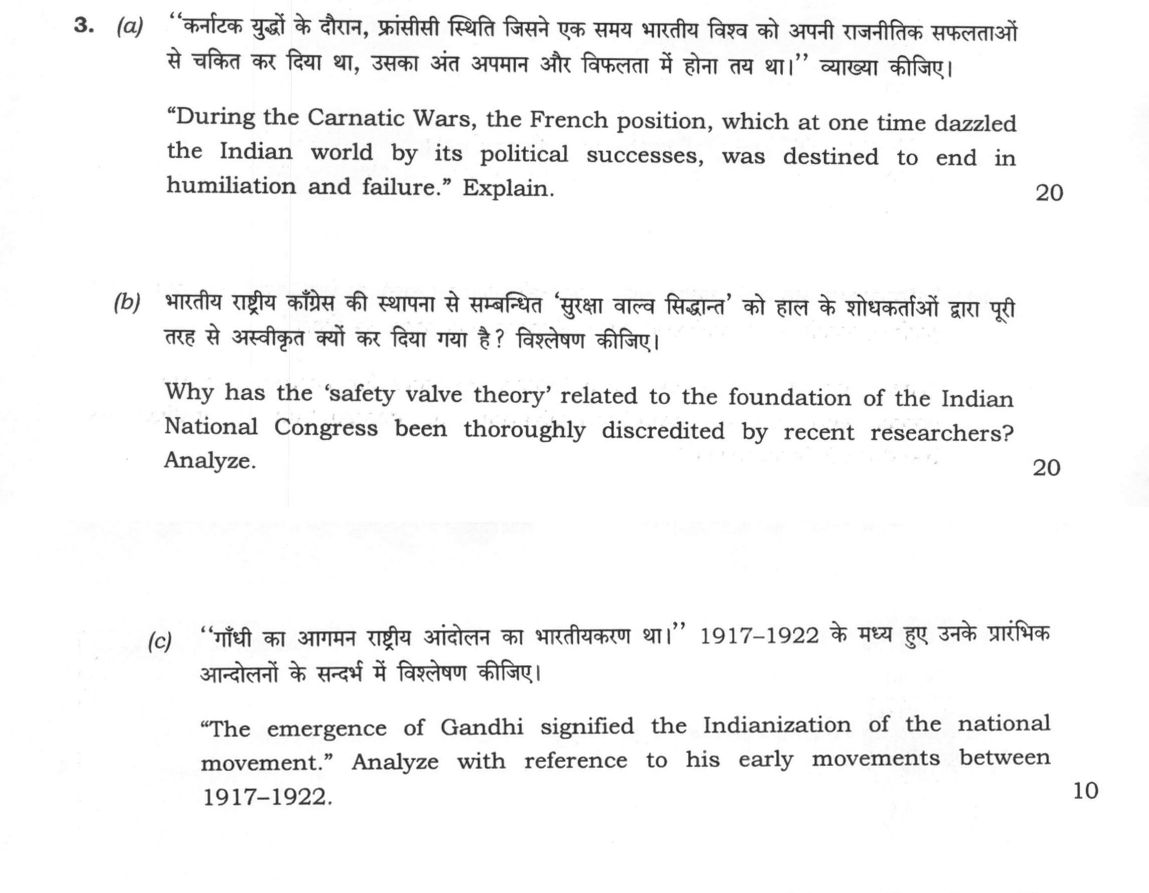
"During the Carnatic Wars, the French position, which at one time dazzled the Indian world by its political successes, was destined to end in humiliation and failure." Explain. 20 marks
Why has the 'safety valve theory' related to the foundation of the Indian National Congress been thoroughly discredited by recent researchers? Analyze. 20 marks
"The emergence of Gandhi signified the Indianization of the national movement." Analyze with reference to his early movements between 1917-1922. 10 marks
हिंदी में प्रश्न पढ़ें
"कर्नाटक युद्धों के दौरान, फ्रांसीसी स्थिति जिसने एक समय भारतीय विश्व को अपनी राजनीतिक सफलताओं से चकित कर दिया था, उसका अंत अपमान और विफलता में होना तय था।" व्याख्या कीजिए। (20 अंक)
भारतीय राष्ट्रीय कांग्रेस की स्थापना से संबंधित 'सुरक्षा वाल्व सिद्धांत' को हाल के शोधकर्ताओं द्वारा पूरी तरह से अस्वीकृत क्यों कर दिया गया है? विश्लेषण कीजिए। (20 अंक)
"गांधी का आगमन राष्ट्रीय आंदोलन का भारतीयरण था।" 1917-1922 के मध्य हुए उनके प्रारंभिक आंदोलनों के संदर्भ में विश्लेषण कीजिए। (10 अंक)
Model answer
Written by UPSC Answer Check against this question's marking rubric, to the expected length. UPSC does not publish answers for Mains — this is one way to score well, not an official key.
Part (a) Between 1746 and 1754, Dupleix converted Pondicherry from a trading post into a political instrument. Through the Treaty of Buziac (1748) and patronage of Chanda Sahib, he backed claimants in the Carnatic and extended influence into Hyderabad and Mysore, making French policy a mix of commerce, diplomacy and military support to Indian rulers. This made the French seem a rival to British dominance. Yet the model was structurally weak: it depended on distant naval supply, limited French troops and unstable Indian allies, while the Company had a larger revenue base in Bengal and a more flexible alliance system. The British advantage was decisive at sea: Admiral Pocock’s naval superiority isolated French garrisons, while the decisive land victory at Wandiwash (1760) in the Third Carnatic War destroyed the French field army and ended the hope of a French-backed Indian power. Plassey (1757) had already shown how British political-military success in Bengal could outflank French ambitions in the Carnatic, because the Company could fund armies and exploit rivalries among Indian rulers. After Wandiwash, French support to Chanda Sahib and other allies collapsed, and the Treaty of Paris (1763) forced France to surrender its Indian possessions except small trading posts. Thus the French position ended in humiliation because its commercial-military model could not sustain a continental political contest against a better-supplied, better-financed British Company.
Part (b) The safety-valve theory held that the British created the Indian National Congress in 1885 to provide a controlled outlet for Indian discontent, preventing more dangerous agitation. It was popularised in nationalist writings such as Lajpat Rai’s and later systematised by R. Palme Dutt in India Today (1940), which portrayed the Congress as a British invention to drain revolutionary energy. Recent research has discredited this because the Congress emerged from organic elite mobilisation, not official design. Pre-1885 associations such as the Bombay Association, Calcutta Native Association and Indian Association, along with newspapers and legal networks, created a ready-made public for a national body. Bipan Chandra and S.R. Mehrotra showed that the founders were Indian professionals, lawyers and intellectuals seeking a platform for political expression, not a committee appointed by the Raj. Archival work, including Carey Anthony Watt’s study of official reactions, indicates that British administrators were often suspicious of the Congress, fearing it would articulate collective Indian demands, rather than welcoming it as a safety valve. The theory also fails because the Congress quickly moved beyond the limited constitutional demands of its founders, becoming a vehicle for mass politics. Hence the “conspiracy” explanation cannot account for the Congress’s origins, leadership or trajectory.
Part (c) Gandhi’s early movements between 1917 and 1922 Indianized the national movement because they transformed it from elite petitioning into mass participation grounded in Indian social and moral categories. In Champaran (1917) he entered a peasant struggle against indigo planters; in Kheda (1918) he supported peasants resisting revenue assessment; in the Ahmedabad mill strike (1918) he mediated between workers and mill owners. These campaigns brought the Congress into villages and towns, using local grievances and Indian languages. The Rowlatt Satyagraha (1919) and the Non-Cooperation Movement (1920-22) then converted constitutional agitation into satyagraha and mass civil disobedience, boycotts, hartals, khadi, and the use of symbols such as the flag and swadeshi. Gandhi emphasised Hindu-Muslim unity, presenting the movement as a moral struggle for self-rule rather than a narrow elite demand. By linking politics to daily life, religion, and village economy, he made nationalism accessible to peasants, workers and women. Thus Gandhi did not merely join the national movement; he restructured its methods, language and base, making it genuinely Indian in character.
What "Explain" is asking you to do
Make the working of something clear — what sets it off, what follows from what, and what it produces. Explain is the Commission's mechanism word: it dominates the technical papers and the “explain why” stems, where the marks sit in the causal chain and not in the label.
Structure that answers it
State what it is → the initiating condition → the chain of cause, step by step → an instance where it plays out → what the chain produces
Where marks are lost
Describing what something looks like instead of why it works that way. Naming the stages without linking them reads as description too.
How this answer will be evaluated
Approach
Framework: UPSC History Paper 2 (Modern India). (a) explain: definition/context > points in order > small example > short close | (b) analyse: intro > causes > effects > stakeholders/linkages > way forward | (c) analyse: intro > causes > effects > stakeholders/linkages > way forward Full marks: Comprehensive, analytical, and well-supported with specific historical evidence and historiographical references.
Key points expected
- Context of French entry and initial political successes
- Key factors leading to French humiliation and failure
- Role of British-French rivalry in the Carnatic region
- Outcome of the Carnatic Wars and its impact
- Definition and context of the 'safety valve theory'
- Arguments presented by recent researchers against the theory
- Evidence supporting the discrediting of the theory
- Alternative explanations for the founding of the INC
Evaluation rubric
Each sub-part is marked on its own, against the marks and word limit printed on the paper.
- (a) Explain the trajectory of French political success and subsequent failure during the Carnatic Wars. 20 marks
explain— definition/context → points in order → small example → short close
Must cover
- Context of French entry and initial political successes
- Key factors leading to French humiliation and failure
- Role of British-French rivalry in the Carnatic region
- Outcome of the Carnatic Wars and its impact
Loses marks
- Chronological narrative without analytical depth
- Failure to connect French success to subsequent failure
- Generic statements without specific historical evidence
Earns more
- Mention of specific battles (e.g., Plassey, Buxar)
- Reference to French and British military strategies
- Discussion of the role of local Indian rulers
- Analysis of the long-term consequences for French influence
Extra mark
- Citation of a specific historical source or chronicle
- Reference to a named historian's interpretation
- (b) Analyze why the 'safety valve theory' regarding the founding of the INC has been discredited. 20 marks
analyse— intro → causes → effects → stakeholders/linkages → way forward
Must cover
- Definition and context of the 'safety valve theory'
- Arguments presented by recent researchers against the theory
- Evidence supporting the discrediting of the theory
- Alternative explanations for the founding of the INC
Loses marks
- Restating the 'safety valve theory' without critical analysis
- Failure to engage with recent historiographical debates
- Lack of specific evidence to support the discrediting
Earns more
- Mention of specific historians who challenged the theory
- Reference to primary sources or archival evidence
- Discussion of the political and social context of the INC's founding
- Comparison of the 'safety valve' view with other interpretations
Extra mark
- Citation of a specific research paper or book
- Reference to a specific event or document that contradicts the theory
- (c) Analyze how Gandhi's emergence signified the Indianization of the national movement (1917-1922). 10 marks
analyse— intro → causes → effects → stakeholders/linkages → way forward
Must cover
- Definition of 'Indianization of the national movement'
- Gandhi's early movements between 1917-1922
- How these movements represented a shift in the national movement
- Impact of Gandhi's approach on the broader nationalist struggle
Loses marks
- Generic description of Gandhi's life without specific focus on 1917-1922
- Failure to connect Gandhi's actions to the concept of 'Indianization'
- Lack of specific examples from the specified period
Earns more
- Mention of specific movements (e.g., Champaran, Kheda, Ahmedabad)
- Reference to Gandhi's methods (e.g., Satyagraha, non-cooperation)
- Discussion of the role of mass mobilization
- Comparison with pre-Gandhian nationalist strategies
Extra mark
- Citation of a specific Gandhi quote or speech
- Reference to a specific historical event or document
Practice this exact question
Write your answer and it is marked point by point against the model answer above — what you covered, what you missed, what you got wrong.
Evaluate my answer →More from History 2025 Paper II
- Q1 Critically examine the following statements in about 150 words each: (a) "The Sikh monarc…
- Q2 (a) Do you agree that the idea of permanent fixation of land revenue of 1793 in Bengal wa…
- Q3 (a) "During the Carnatic Wars, the French position, which at one time dazzled the Indian…
- Q4 (a) "The tensions between cultural revivalism and modernization shaped the trajectory of…
- Q5 Critically examine the following statements in about 150 words each: (a) "The French Revo…
- Q6 (a) "Nationalism in the 19th century was a driving force for both integration and disinte…