Paper II — Q5
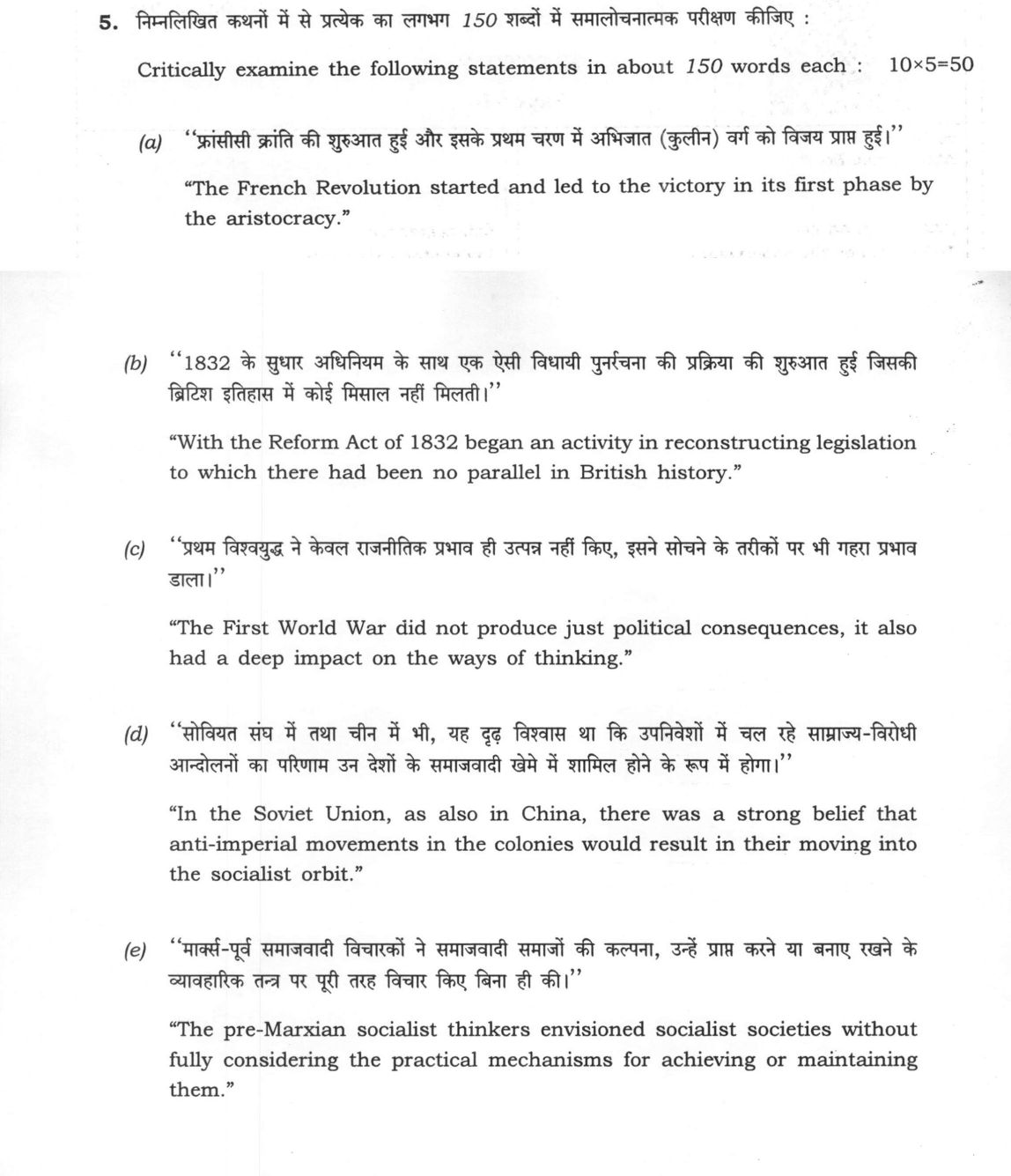
Critically examine the following statements in about 150 words each: (a) "The French Revolution started and led to the victory…
Critically examine the following statements in about 150 words each:
"The French Revolution started and led to the victory in its first phase by the aristocracy." 10 marks
"With the Reform Act of 1832 began an activity in reconstructing legislation to which there had been no parallel in British history." 10 marks
"The First World War did not produce just political consequences, it also had a deep impact on the ways of thinking." 10 marks
"In the Soviet Union, as also in China, there was a strong belief that anti-imperial movements in the colonies would result in their moving into the socialist orbit." 10 marks
"The pre-Marxian socialist thinkers envisioned socialist societies without fully considering the practical mechanisms for achieving or maintaining them." 10 marks
हिंदी में प्रश्न पढ़ें
निम्नलिखित कथनों में से प्रत्येक का लगभग 150 शब्दों में समालोचनात्मक परीक्षण कीजिए :
"फ्रांसीसी क्रांति की शुरुआत हुई और इसके प्रथम चरण में अभिजात (कुलीन) वर्ग को विजय प्राप्त हुई।" (10 अंक)
"1832 के सुधार अधिनियम के साथ एक ऐसी विधायी पुनर्चना की प्रक्रिया की शुरुआत हुई जिसकी ब्रिटिश इतिहास में कोई मिसाल नहीं मिलती।" (10 अंक)
"प्रथम विश्वयुद्ध ने केवल राजनीतिक प्रभाव ही उत्पन्न नहीं किए, इसने सोचने के तरीकों पर भी गहरा प्रभाव डाला।" (10 अंक)
"सोवियत संघ में तथा चीन में भी, यह दृढ़ विश्वास था कि उपनिवेशों में चल रहे साम्राज्य-विरोधी आंदोलनों का परिणाम उन देशों के समाजवादी क्षेत्र में शामिल होने के रूप में होगा।" (10 अंक)
"मार्क्स-पूर्व समाजवादी विचारकों ने समाजवादी समाजों की कल्पना, उन्हें प्राप्त करने या बनाए रखने के व्यावहारिक तंत्र पर पूरी तरह विचार किए बिना ही की।" (10 अंक)
Model answer
Written by UPSC Answer Check against this question's marking rubric, to the 150-word length. UPSC does not publish answers for Mains — this is one way to score well, not an official key.
(a) Aristocratic Initiation versus Bourgeois Triumph in the French Revolution
The French Revolution began with an aristocratic revolt between 1787 and 1789. Facing fiscal bankruptcy, the monarchy attempted fiscal reforms through Calonne and Brienne. The Assembly of Notables (1787) and the aristocratic Parlements resisted universal land taxes and demanded the convocation of the Estates-General, thereby directly paralyzing royal absolutism and initiating the revolutionary crisis.
However, the nobility did not lead this phase to victory. Once the Estates-General convened in May 1789, the Third Estate asserted itself by establishing the National Assembly and enacting the Tennis Court Oath. The true beneficiaries were the bourgeoisie and the peasantry. The August Decrees (1789) dismantled feudal dues, hunting rights, and seigneurial courts, while the Declaration of the Rights of Man and of the Citizen established juridical equality. Therefore, while the aristocracy undeniably started the revolutionary process to safeguard their privileges, the first phase ended in their own structural defeat and the ascendance of the bourgeoisie.
(b) The Reform Act of 1832 and the Era of Reconstructive Legislation
The Great Reform Act of 1832 was a landmark statute that disenfranchised rotten boroughs and enfranchised the industrial middle class, establishing that the British constitution could adapt through statutory reform. It inaugurated a prolific legislative period, yielding the Factory Act (1833), the abolition of colonial slavery (1833), the Poor Law Amendment Act (1834), the Municipal Corporations Act (1835), and the eventual repeal of the Corn Laws (1846).
Nevertheless, asserting that there was "no parallel" overlooks significant pre-1832 legislative reforms. The liberal Tory ministry of the 1820s had already begun modernising the legal and economic architecture, marked by the Repeal of the Combination Acts (1824–1825), the Repeal of the Test and Corporation Acts (1828), and the Catholic Emancipation Act (1829). Thus, the 1832 Act did not initiate legislative reconstruction in an absolute vacuum, but rather accelerated and broadened an existing reformist impulse by aligning parliamentary representation with the socioeconomic realities of industrialisation.
(c) First World War and the Transformation of Modern Thought
The First World War went beyond dismantling empires; it delivered a profound shock to nineteenth-century Enlightenment positivism, rationalism, and belief in linear progress.
The industrial-scale slaughter produced deep cultural disillusionment, spawning the existential alienation of the "Lost Generation" in literature (Ernest Hemingway, Erich Maria Remarque) and stimulating modern existentialist philosophy. In psychology, Sigmund Freud’s psychoanalysis gained wider resonance, turning toward the death drive (Thanatos) and the irrationality of human nature. Art forms like Dadaism and Surrealism openly repudiated traditional bourgeois aesthetics.
Crucially, the war shattered the myth of European moral superiority in the colonised world. In India, post-war economic distress and betrayal over constitutional promises (marked by the Rowlatt Act and Jallianwala Bagh) catalyzed a radical shift in nationalist thought. Mahatma Gandhi channelled this disillusionment into mass-based, non-violent Non-Cooperation, redefining anti-colonial ideology. WWI fundamentally transformed global intellectual discourse from confident positivism to critical introspection.
(d) Soviet and Chinese Perspectives on Colonial Anti-Imperial Movements
Both the Soviet Union and China operated on the theoretical assumption that anti-imperialist struggles in the colonies would weaken the global capitalist system and transition into the socialist orbit.
However, their underlying strategic doctrines diverged significantly. In the Soviet Union, Vladimir Lenin’s Theses on the National and Colonial Questions (1920) argued that colonial national liberation movements, even if led by the national bourgeoisie, were objectively anti-imperialist and warranted tactical support from the Comintern. Moscow envisioned a two-stage revolution, frequently backing secular nationalist regimes (such as the Kuomintang or post-colonial regimes in Asia and Africa).
In contrast, Mao Zedong formulated the doctrine of New Democracy (1940), contending that in semi-colonial, semi-feudal societies, anti-imperialist revolutions could not be trusted to the national bourgeoisie. Instead, they required the direct leadership of the proletariat allied with the peasantry through armed agrarian struggle. Thus, while both powers anticipated a socialist destination for decolonisation, they pursued contrasting ideological strategies over revolutionary leadership and methods.
(e) Pre-Marxian Socialism and the Limits of Utopian Thought
Pre-Marxian early socialists, notably Claude Henri de Saint-Simon, Charles Fourier, and Robert Owen, provided pioneering moral and economic critiques of industrial capitalism. They offered detailed blueprints for egalitarian societies, including Fourier’s cooperative phalansteries, Owen’s model industrial communities (New Lanark and New Harmony), and Saint-Simon’s technocratic, planned industrial order.
However, as Karl Marx and Friedrich Engels noted, these thinkers remained "utopian" because they failed to identify the objective historical and material mechanisms necessary to achieve and sustain their visions. They relied primarily on moral persuasion, philanthropic paternalism from the wealthy, and isolated community experiments. They lacked an analysis of historical materialism, dismissed the necessity of class struggle, and developed no strategy for capturing state power or confronting the resistance of capital. Consequently, while pre-Marxian socialists laid essential ethical and conceptual foundations for social justice, their disregard for political praxis rendered their systems incapable of transforming the capitalist state.
What "Critically examine" is asking you to do
Test the proposition the question puts to you and return a finding on how far it holds. Examine stems carry a claim, or ask whether something has happened, and expect evidence weighed both ways before the extent is stated — often with remedial measures attached. “Critically” is not a section added at the end: name the yardstick you are judging by — the evidence, the stated objective, a constitutional principle, a rival explanation — and let a verdict close each part of the body. Where the question quotes a claim, that verdict must land on the claim itself, accepted, qualified or rejected, and not on the theme in general.
Structure that answers it
Restate the claim as the question frames it → evidence that supports it → evidence that undercuts it → the conditions under which it holds → verdict on how far it stands
Where marks are lost
Merits in one paragraph, demerits in the next, and a conclusion calling for a balanced and holistic approach. That is a survey with the judgement left out and it holds the answer in the middle band. The opposite error is reading “critically” as permission to attack — and with the odd pairings, critically describe or critically explain, the exposition still carries most of the marks, the judgement being a layer on it rather than a substitute for it.
How this answer will be evaluated
Approach
Framework: Context > Thesis > Evidence > Historiography. (a) critique: the claim > its strengths > its weaknesses > your judgment | (b) critique: the claim > its strengths > its weaknesses > your judgment | (c) critique: the claim > its strengths > its weaknesses > your judgment | (d) critique: the claim > its strengths > its weaknesses > your judgment | (e) critique: the claim > its strengths > its weaknesses > your judgment Full marks: Thesis-driven, cites specific sources/historians, critiques the claim effectively.
Key points expected
- Identify the Third Estate's role in the Estates-General
- Analyze the 'Great Fear' and peasant uprisings
- Examine the role of the National Assembly
- Critique the 'aristocratic victory' thesis
- Explain the changes to the House of Commons
- Analyze the expansion of the franchise
- Assess the impact on the political system
- Critique the 'no parallel' claim
Evaluation rubric
Each sub-part is marked on its own, against the marks and word limit printed on the paper.
- (a) Assess the claim that the aristocracy led the French Revolution's first phase. 10 marks · 150 words
critique— the claim → its strengths → its weaknesses → your judgment
Must cover
- Identify the Third Estate's role in the Estates-General
- Analyze the 'Great Fear' and peasant uprisings
- Examine the role of the National Assembly
- Critique the 'aristocratic victory' thesis
Loses marks
- Narrating events without analysis
- Ignoring the role of the Third Estate
- Confusing the phases of the Revolution
Earns more
- Mention the Tennis Court Oath
- Reference the Declaration of the Rights of Man
- Cite the storming of the Bastille
- Discuss the role of the bourgeoisie
Extra mark
- Name a specific historian (e.g., Soboul)
- Quote a primary source from 1789
- (b) Evaluate the significance of the 1832 Reform Act in British legislative history. 10 marks · 150 words
critique— the claim → its strengths → its weaknesses → your judgment
Must cover
- Explain the changes to the House of Commons
- Analyze the expansion of the franchise
- Assess the impact on the political system
- Critique the 'no parallel' claim
Loses marks
- Narrating events without analysis
- Ignoring the impact on the working class
- Confusing the 1832 Act with later reforms
Earns more
- Mention the reduction of 'rotten boroughs'
- Reference the rise of industrial cities
- Discuss the role of the Whigs and Tories
- Cite the impact on the working class
Extra mark
- Name a specific historian (e.g., J.H. Plumb)
- Quote a primary source from 1832
- (c) Assess the impact of WWI on political and intellectual thought. 10 marks · 150 words
critique— the claim → its strengths → its weaknesses → your judgment
Must cover
- Analyze the collapse of empires
- Examine the rise of new ideologies
- Assess the impact on international relations
- Critique the 'deep impact' claim
Loses marks
- Narrating events without analysis
- Ignoring the impact on international relations
- Confusing WWI with WWII
Earns more
- Mention the Treaty of Versailles
- Reference the rise of communism
- Discuss the impact on women's rights
- Cite the impact on literature and art
Extra mark
- Name a specific historian (e.g., John Keegan)
- Quote a primary source from the 1920s
- (d) Evaluate the Soviet and Chinese belief in the socialist orbit of colonies. 10 marks · 150 words
critique— the claim → its strengths → its weaknesses → your judgment
Must cover
- Explain the Soviet support for anti-imperial movements
- Analyze the Chinese support for national liberation
- Assess the impact on the colonies
- Critique the 'socialist orbit' claim
Loses marks
- Narrating events without analysis
- Ignoring the impact on the Cold War
- Confusing the Soviet and Chinese approaches
Earns more
- Mention the Comintern
- Reference the Bandung Conference
- Discuss the impact on India and China
- Cite the impact on the Cold War
Extra mark
- Name a specific historian (e.g., Arun Shourie)
- Quote a primary source from the 1950s
- (e) Assess the practical mechanisms of pre-Marxian socialist thinkers. 10 marks · 150 words
critique— the claim → its strengths → its weaknesses → your judgment
Must cover
- Explain the ideas of early socialists
- Analyze their practical mechanisms
- Assess the impact on later socialism
- Critique the 'without fully considering' claim
Loses marks
- Narrating events without analysis
- Ignoring the impact on later socialism
- Confusing pre-Marxian with Marxist socialism
Earns more
- Mention Robert Owen
- Reference Charles Fourier
- Discuss the impact on the labor movement
- Cite the impact on Marx and Engels
Extra mark
- Name a specific historian (e.g., G.D.H. Cole)
- Quote a primary source from the 1830s
Practice this exact question
Write your answer and it is marked point by point against the model answer above — what you covered, what you missed, what you got wrong.
Evaluate my answer →More from History 2025 Paper II
- Q2 (a) Do you agree that the idea of permanent fixation of land revenue of 1793 in Bengal wa…
- Q3 (a) "During the Carnatic Wars, the French position, which at one time dazzled the Indian…
- Q4 (a) "The tensions between cultural revivalism and modernization shaped the trajectory of…
- Q5 Critically examine the following statements in about 150 words each: (a) "The French Revo…
- Q6 (a) "Nationalism in the 19th century was a driving force for both integration and disinte…
- Q7 (a) "By the time of 1932 elections, Germany's ruling classes began to feel that the only…
- Q8 (a) Why did the non-communist Vietnamese leaders fail to provide successful leadership fo…