Paper II — Q7
(a) "By the time of 1932 elections, Germany's ruling classes began to feel that the only way to escape from a deep economic…
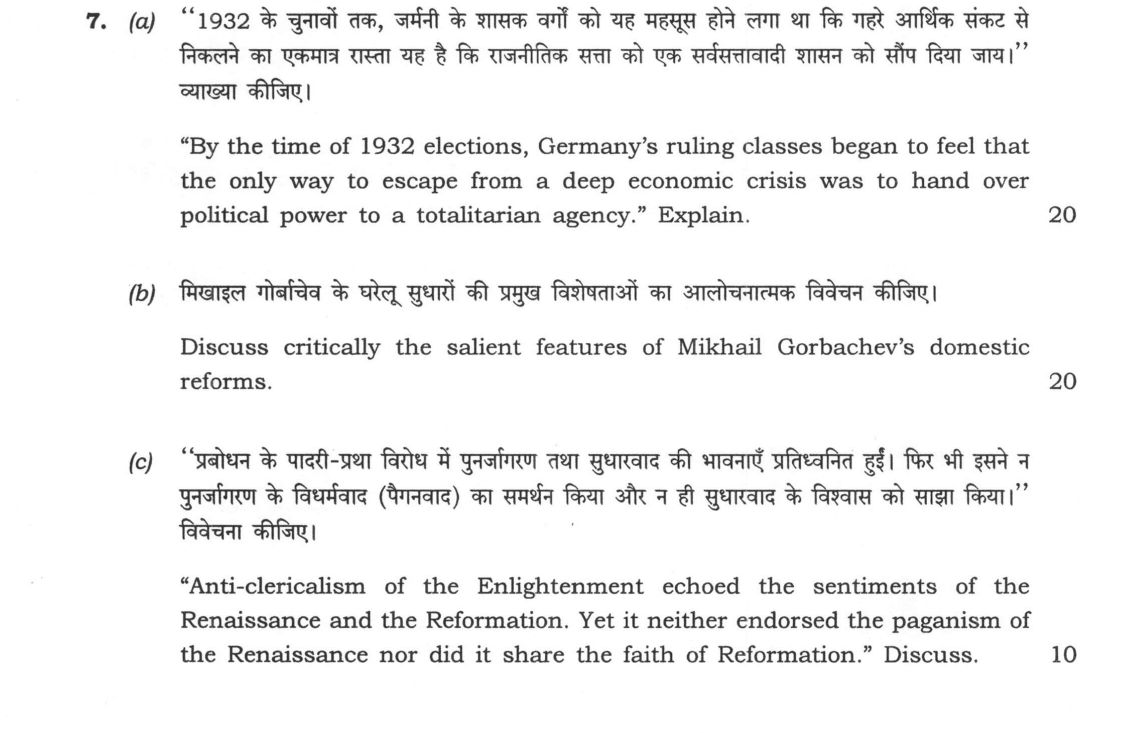
"By the time of 1932 elections, Germany's ruling classes began to feel that the only way to escape from a deep economic crisis was to hand over political power to a totalitarian agency." Explain. 20 marks
Discuss critically the salient features of Mikhail Gorbachev's domestic reforms. 20 marks
"Anti-clericalism of the Enlightenment echoed the sentiments of the Renaissance and the Reformation. Yet it neither endorsed the paganism of the Renaissance nor did it share the faith of Reformation." Discuss. 10 marks
हिंदी में प्रश्न पढ़ें
"1932 के चुनावों तक, जर्मनी के शासक वर्गों को यह महसूस होने लगा था कि गहरे आर्थिक संकट से निकलने का एकमात्र रास्ता यह है कि राजनीतिक सत्ता को एक सर्वसत्तावादी शासन को सौंप दिया जाय।" व्याख्या कीजिए। (20 अंक)
मिखाइल गोर्बाचेव के घरेलु सुधारों की प्रमुख विशेषताओं का आलोचनात्मक विवेचन कीजिए। (20 अंक)
"प्रबोधन के पादरी-प्रथा विरोध में पुनर्जागरण तथा सुधारवाद की भावनाएं प्रतिध्वनित हुईं। फिर भी इसने न पुनर्जागरण के विधर्मवाद (पैगनवाद) का समर्थन किया और न ही सुधारवाद के विश्वास को साझा किया।" विवेचना कीजिए। (10 अंक)
Model answer
Written by UPSC Answer Check against this question's marking rubric, to the expected length. UPSC does not publish answers for Mains — this is one way to score well, not an official key.
The interwar crisis in Germany, the terminal stagnation of the Soviet Union, and the intellectual ruptures of modern Europe illustrate how systemic structural crises compel ruling elites to seek radical political realignments.
Crisis of Weimar and the Authoritarian Turn (1929–1933)
The Great Depression shattered Germany’s fragile Weimar Republic, pushing unemployment above six million and precipitating severe social polarization. Chancellor Heinrich Brüning’s orthodox deflationary measures—slashing wages, reducing welfare expenditure, and governing via Article 48 emergency decrees—paralysed parliamentary democracy and intensified public misery. Consequently, the July 1932 elections saw extremist surges, with the Communist Party (KPD) expanding rapidly.
This polarization terrified Germany’s traditional ruling classes: the Junker agrarian elites, Ruhr industrialists, and Reichswehr generals. Fearing a socialist revolution and finding democratic governance unworkable for capital accumulation, they resolved to dismantle the republic. Although the Nazi vote actually declined in the November 1932 elections, the traditional right sought to harness Adolf Hitler’s mass mobilization. Franz von Papen, backed by President Paul von Hindenburg’s aristocratic camarilla, orchestrated a backroom deal. Believing they could "box Hitler in" while using his totalitarian paramilitary force to crush the left and abolish trade unions, Hindenburg appointed Hitler Chancellor in January 1933. The handover of power was thus not an outright electoral conquest, but a deliberate abdication by conservative elites seeking authoritarian stabilization.
Gorbachev’s Reforms: Modernisation and Collapse
Ascending to power in 1985, Mikhail Gorbachev sought to revitalize a stagnant Soviet economy through a multi-pronged reform agenda:
Uskoreniye (acceleration) initially targeted industrial modernization but failed due to fiscal deficits. Gorbachev then introduced Perestroika (economic restructuring), allowing enterprise autonomy, limited private cooperatives, and foreign joint ventures. To overcome bureaucratic inertia, he launched Glasnost (openness/transparency) and Demokratizatsiya (democratization), introducing multi-candidate elections for the new Congress of People’s Deputies in 1989.
Critically, these domestic reforms suffered from fatal internal contradictions. Perestroika dismantled central planning mechanisms without establishing functional market institutions, causing acute consumer goods shortages, hyperinflation, and economic chaos. Unlike Deng Xiaoping in China, who prioritized phased market reforms while maintaining strict political control, Gorbachev simultaneously democratized the political sphere. Glasnost liberated suppressed public discontent, exposing historical atrocities and enabling latent ethnic nationalisms in the Baltic states and the Caucasus to mobilize against the Union.
While Gorbachev viewed his programme as a humane socialist renewal, conservative hardliners like Yegor Ligachev condemned it as the liquidation of the socialist state, culminating in the abortive August 1991 coup. Conversely, radical reformers led by Boris Yeltsin exploited the institutional opening to dismantle the Soviet apparatus, transforming an attempt at systemic salvage into state disintegration.
Enlightenment Anti-Clericalism in Perspective
The anti-clericalism of the eighteenth-century Enlightenment drew upon earlier revolts against Roman Catholic hegemony, yet diverged fundamentally in its epistemology and objectives.
Renaissance humanism (Marsilio Ficino, Pico della Mirandola) revived classical antiquity, blending Neoplatonic pagan philosophy with Christian theology without directly attacking institutional dogma. The Protestant Reformation (Martin Luther, John Calvin) broke clerical authority, but it was an intensely spiritual, scripture-based rebellion rooted in sola fide (justification by faith alone), which replaced Catholic orthodoxy with strict biblical dogmatism.
In contrast, Enlightenment anti-clericalism was grounded in secular rationalism, empiricism, and natural science. Thinkers like Voltaire (écrasez l’infâme) attacked the Church not to purify faith, but to eradicate religious intolerance, superstition, and clerical political privilege. Denis Diderot and Baron d'Holbach extended this to philosophical materialism and explicit atheism. The Enlightenment thus rejected the pagan mystical cosmology of the Renaissance while repudiating the revealed theology of the Reformation, establishing secularism as an autonomous modern worldview.
Across these historical junctures, the interplay between structural economic collapse and ideological transformation underscores that when institutional paradigms fail, the resulting political realignments—whether reactionary totalitarianism, unmanaged state reform, or rationalist secularism—fundamentally reshape the modern world order.
What "Explain" is asking you to do
Make the working of something clear — what sets it off, what follows from what, and what it produces. Explain is the Commission's mechanism word: it dominates the technical papers and the “explain why” stems, where the marks sit in the causal chain and not in the label.
Structure that answers it
State what it is → the initiating condition → the chain of cause, step by step → an instance where it plays out → what the chain produces
Where marks are lost
Describing what something looks like instead of why it works that way. Naming the stages without linking them reads as description too.
How this answer will be evaluated
Approach
Framework: UPSC History Paper 2 (Modern World History). (a) explain: definition/context > points in order > small example > short close | (b) discuss: intro > 3-4 dimensions > example > balanced close | (c) discuss: intro > 3-4 dimensions > example > balanced close Full marks: Comprehensive, analytical, and well-structured with specific historical evidence and critical evaluation.
Key points expected
- Impact of Great Depression on German economy
- Failure of Weimar Republic and hyperinflation
- Role of ruling classes (industrialists, landowners)
- Appeal of totalitarianism as a solution
- Definition and scope of Perestroika (restructuring)
- Definition and scope of Glasnost (openness)
- Economic reforms (market mechanisms, cooperatives)
- Political reforms (multi-party system, elections)
Evaluation rubric
Each sub-part is marked on its own, against the marks and word limit printed on the paper.
- (a) Explain the political and economic factors leading to the rise of Nazism in Germany by 1932. 20 marks
explain— definition/context → points in order → small example → short close
Must cover
- Impact of Great Depression on German economy
- Failure of Weimar Republic and hyperinflation
- Role of ruling classes (industrialists, landowners)
- Appeal of totalitarianism as a solution
Loses marks
- Chronological narrative without analysis
- Ignoring the role of ruling classes
- Focusing only on Hitler's personality
Earns more
- Mention of specific dates (1929, 1930, 1932)
- Reference to specific political parties (NSDAP)
- Mention of specific figures (Hitler, Hindenburg)
- Reference to specific economic policies (New Deal contrast)
Extra mark
- Citation of specific economic data (unemployment rates)
- Reference to specific political events (Reichstag fire)
- (b) Critically discuss the salient features of Mikhail Gorbachev's domestic reforms. 20 marks
discuss— intro → 3-4 dimensions → example → balanced close
Must cover
- Definition and scope of Perestroika (restructuring)
- Definition and scope of Glasnost (openness)
- Economic reforms (market mechanisms, cooperatives)
- Political reforms (multi-party system, elections)
Loses marks
- Describing reforms without critical analysis
- Ignoring the economic context
- Focusing only on foreign policy
Earns more
- Mention of specific laws (Law on Cooperatives)
- Reference to specific events (1990 elections)
- Discussion of social impact (media freedom)
- Mention of specific figures (Gorbachev, Yeltsin)
Extra mark
- Citation of specific economic data (GDP growth)
- Reference to specific political events (1991 coup)
- (c) Discuss the relationship between Enlightenment anti-clericalism and Renaissance/Reformation sentiments. 10 marks
discuss— intro → 3-4 dimensions → example → balanced close
Must cover
- Definition of Enlightenment anti-clericalism
- Connection to Renaissance humanism
- Connection to Reformation critique of Church
- Distinction from Renaissance paganism
Loses marks
- Confusing Enlightenment with Reformation
- Ignoring the 'paganism' aspect of Renaissance
- Failing to distinguish between the three movements
Earns more
- Mention of specific thinkers (Voltaire, Rousseau)
- Reference to specific works (Encyclopedie)
- Discussion of specific Church practices (simony)
- Mention of specific Reformation figures (Luther, Calvin)
Extra mark
- Citation of specific quotes from Enlightenment thinkers
- Reference to specific historical events (French Revolution)
Practice this exact question
Write your answer and it is marked point by point against the model answer above — what you covered, what you missed, what you got wrong.
Evaluate my answer →More from History 2025 Paper II
- Q4 (a) "The tensions between cultural revivalism and modernization shaped the trajectory of…
- Q5 Critically examine the following statements in about 150 words each: (a) "The French Revo…
- Q6 (a) "Nationalism in the 19th century was a driving force for both integration and disinte…
- Q7 (a) "By the time of 1932 elections, Germany's ruling classes began to feel that the only…
- Q8 (a) Why did the non-communist Vietnamese leaders fail to provide successful leadership fo…