Paper II — Q6
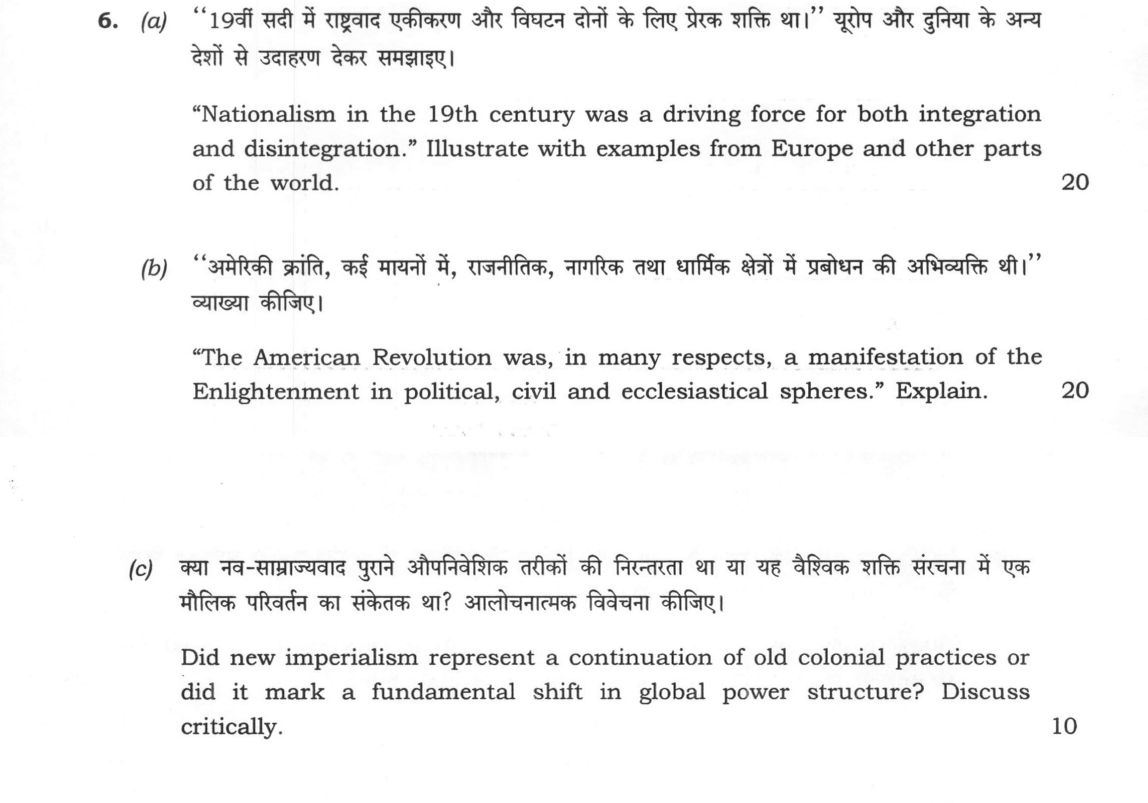
(a) "Nationalism in the 19th century was a driving force for both integration and disintegration." Illustrate with examples from…
"Nationalism in the 19th century was a driving force for both integration and disintegration." Illustrate with examples from Europe and other parts of the world. 20 marks
"The American Revolution was, in many respects, a manifestation of the Enlightenment in political, civil and ecclesiastical spheres." Explain. 20 marks
Did new imperialism represent a continuation of old colonial practices or did it mark a fundamental shift in global power structure? Discuss critically. 10 marks
हिंदी में प्रश्न पढ़ें
"19वीं सदी में राष्ट्रवाद एकीकरण और विघटन दोनों के लिए प्रेरक शक्ति था।" यूरोप और दुनिया के अन्य देशों से उदाहरण देकर समझाइए। (20 अंक)
"अमेरिकी क्रांति, कई मायनों में, राजनीतिक, नागरिक तथा धार्मिक क्षेत्रों में प्रबोधन की अभिव्यक्ति थी।" व्याख्या कीजिए। (20 अंक)
क्या नव-साम्राज्यवाद पुराने औपनिवेशिक तरीकों की निरंतरता था या यह वैश्विक शक्ति संरचना में एक मौलिक परिवर्तन का संकेतक था? आलोचनात्मक विवेचना कीजिए। (10 अंक)
Model answer
Written by UPSC Answer Check against this question's marking rubric, to the expected length. UPSC does not publish answers for Mains — this is one way to score well, not an official key.
Nineteenth-century transformations made nationalism, Enlightenment thought and imperialism mutually reinforcing, reorganising states and redrawing the global order.
Nationalism: integration and disintegration. In Europe, nationalism integrated fragmented territories into nation-states. German unification in 1871, driven by Prussian statecraft, liberal-nationalist agitation and the Franco-Prussian War, created a powerful central state. The Italian Risorgimento similarly fused liberal, Catholic and popular movements under Cavour, Garibaldi and the Sardinian state to make Italy. The same ideology disintegrated multi-ethnic empires. In the Balkans, Greek, Serbian, Bulgarian and later Albanian and Macedonian nationalisms weakened Ottoman rule, contributed to its later breakup, and helped produce the Congress of Berlin (1878) settlements. Austro-Hungarian fragmentation was accelerated by Magyar, Czech, Polish and South Slav nationalisms that strained the Dual Monarchy throughout the later nineteenth century. Outside Europe, Meiji Japan’s nation-building (1868) fused state, army and education to create a modern national state. The Indian National Congress (1885) gave institutional form to Indian nationalism; its early moderate phase sought association with British rule, while later it became a vehicle for anti-colonial nationalism. Ottoman reform currents later associated with the Young Turks sought a redefined national identity in the late nineteenth century, showing that nationalism could both modernise and destabilise empires. The contradiction is that nationalism consolidated states where the imagined nation matched the state, but dissolved empires where one state contained several nations; it made political legitimacy depend on national identity rather than dynastic or religious authority.
American Revolution and the Enlightenment. The Revolution translated Enlightenment ideas into political, civil and ecclesiastical practice. Politically, it drew on Lockean natural rights—property in Locke’s theory, and life, liberty and the pursuit of happiness in the Declaration of Independence—along with republicanism and Montesquieu’s separation of powers. State constitutions and the Federal Constitution of 1787 embodied constitutionalism, limited government, representative legislatures and checks on executive power, making sovereignty reside in the people rather than in hereditary rule. In civil society, Enlightenment rationalism challenged inherited privilege: several states abolished primogeniture, removed religious tests for public office, and expanded suffrage, though still limited by property, race and gender. In the ecclesiastical sphere, the Virginia Statute for Religious Freedom (1786) disestablished the Anglican Church and separated church from state. Jefferson’s later 1802 letter to the Danbury Baptists described this as a “wall of separation,” while Enlightenment thinkers promoted rational religion against revealed dogma. Together, these changes made rights, representation and religious liberty central to public life. Thus the Revolution was not merely a war of independence but a constitutional experiment in Enlightenment governance.
New imperialism: continuity and shift. New imperialism continued old colonial practices: extraction of surplus, racial hierarchy, and the “civilizing mission” justified domination. Yet it marked a fundamental shift. Industrial capitalism created demand for markets, raw materials and investment outlets; the Scramble for Africa, formalised at the Berlin Conference of 1884, produced formal empire and new financial mechanisms such as concessions, railways and chartered companies. It also integrated the world into a global system of trade, migration and capital. The shift was not merely territorial but financial and institutional, as metropolitan banks and legal regimes tied colonies to metropolitan markets. Hobson and Lenin emphasised over-accumulation and monopoly capital as causes, while Gallagher and Robinson’s “imperialism of free trade” stressed a spectrum from informal control to formal empire. Peripheral agency mattered: local elites, resistance and adaptation shaped how imperial rule operated. Hence new imperialism was both a continuation of colonial exploitation and a structural transformation of global power.
In conclusion, the century’s transformations reshaped the world: nationalism built states and broke empires, the American Revolution institutionalised rational governance, and imperialism reorganised global hierarchy. Its legacy was a modern state system in which ideas, institutions and capital produced integration, disintegration and unequal interdependence.
What "Illustrate" is asking you to do
Carry the point with concrete cases rather than assert it, so the examples do the work of proving it. In the technical papers illustrate is often literal — a labelled diagram, a map, a graph — and an answer without the figure has not complied with the instruction.
Structure that answers it
The point stated → example 1 with the feature it demonstrates → example 2 → example 3 or the required diagram → what the set of examples establishes
Where marks are lost
Examples named and then abandoned. A case listed without the sentence showing what it demonstrates is marked as recall of information, not as illustration.
How this answer will be evaluated
Approach
Framework: UPSC History Paper 2 Rubric. (a) explain: definition/context > points in order > small example > short close | (b) explain: definition/context > points in order > small example > short close | (c) critique: the claim > its strengths > its weaknesses > your judgment Full marks: Thesis-driven, specific examples, clear analytical links, balanced judgment.
Key points expected
- Integration examples: German or Italian unification
- Disintegration examples: Balkan or Ottoman collapse
- Non-European examples: Latin America or Asia
- Analytical link between ideology and political outcome
- Political sphere: Sovereignty and separation of powers
- Civil sphere: Rights, liberty, and equality
- Ecclesiastical sphere: Separation of church and state
- Linkage to specific Enlightenment thinkers (e.g., Locke, Montesquieu)
Evaluation rubric
Each sub-part is marked on its own, against the marks and word limit printed on the paper.
- (a) Demonstrate nationalism's dual role in integration and disintegration with specific examples. 20 marks
explain— definition/context → points in order → small example → short close
Must cover
- Integration examples: German or Italian unification
- Disintegration examples: Balkan or Ottoman collapse
- Non-European examples: Latin America or Asia
- Analytical link between ideology and political outcome
Loses marks
- Narrative retelling without analytical argument
- Ignoring the 'disintegration' aspect of the prompt
- Failing to provide examples from outside Europe
Earns more
- Reference to specific nationalist leaders (e.g., Bismarck)
- Mention of specific treaties or wars
- Comparison of different nationalist models
Extra mark
- Citation of a specific primary source or historian
- Reference to specific dates of unification events
- (b) Explain how the American Revolution manifested Enlightenment ideas in three specific spheres. 20 marks
explain— definition/context → points in order → small example → short close
Must cover
- Political sphere: Sovereignty and separation of powers
- Civil sphere: Rights, liberty, and equality
- Ecclesiastical sphere: Separation of church and state
- Linkage to specific Enlightenment thinkers (e.g., Locke, Montesquieu)
Loses marks
- Treating the three spheres as a single general point
- Failing to connect specific ideas to specific thinkers
- Ignoring the 'ecclesiastical' sphere entirely
Earns more
- Reference to the Declaration of Independence
- Mention of specific state constitutions
- Discussion of the Bill of Rights
Extra mark
- Quotation from the Declaration of Independence
- Reference to specific Enlightenment texts (e.g., Second Treatise)
- (c) Critically evaluate whether new imperialism was a continuation or a fundamental shift. 10 marks
critique— the claim → its strengths → its weaknesses → your judgment
Must cover
- Arguments for 'continuation' (e.g., economic exploitation)
- Arguments for 'shift' (e.g., industrial scale, global reach)
- Balanced judgment on the nature of the change
- Reference to specific global power structures
Loses marks
- Taking a one-sided view without critical evaluation
- Failing to define 'new' vs 'old' imperialism clearly
- Lack of specific examples to support the argument
Earns more
- Mention of the 'Scramble for Africa'
- Reference to specific imperial powers (e.g., Britain, France)
- Discussion of technological changes (e.g., steamships)
Extra mark
- Reference to a specific historian's view on imperialism
- Mention of specific treaties (e.g., Berlin Conference)
Practice this exact question
Write your answer and it is marked point by point against the model answer above — what you covered, what you missed, what you got wrong.
Evaluate my answer →More from History 2025 Paper II
- Q3 (a) "During the Carnatic Wars, the French position, which at one time dazzled the Indian…
- Q4 (a) "The tensions between cultural revivalism and modernization shaped the trajectory of…
- Q5 Critically examine the following statements in about 150 words each: (a) "The French Revo…
- Q6 (a) "Nationalism in the 19th century was a driving force for both integration and disinte…
- Q7 (a) "By the time of 1932 elections, Germany's ruling classes began to feel that the only…
- Q8 (a) Why did the non-communist Vietnamese leaders fail to provide successful leadership fo…