Paper II — Q2
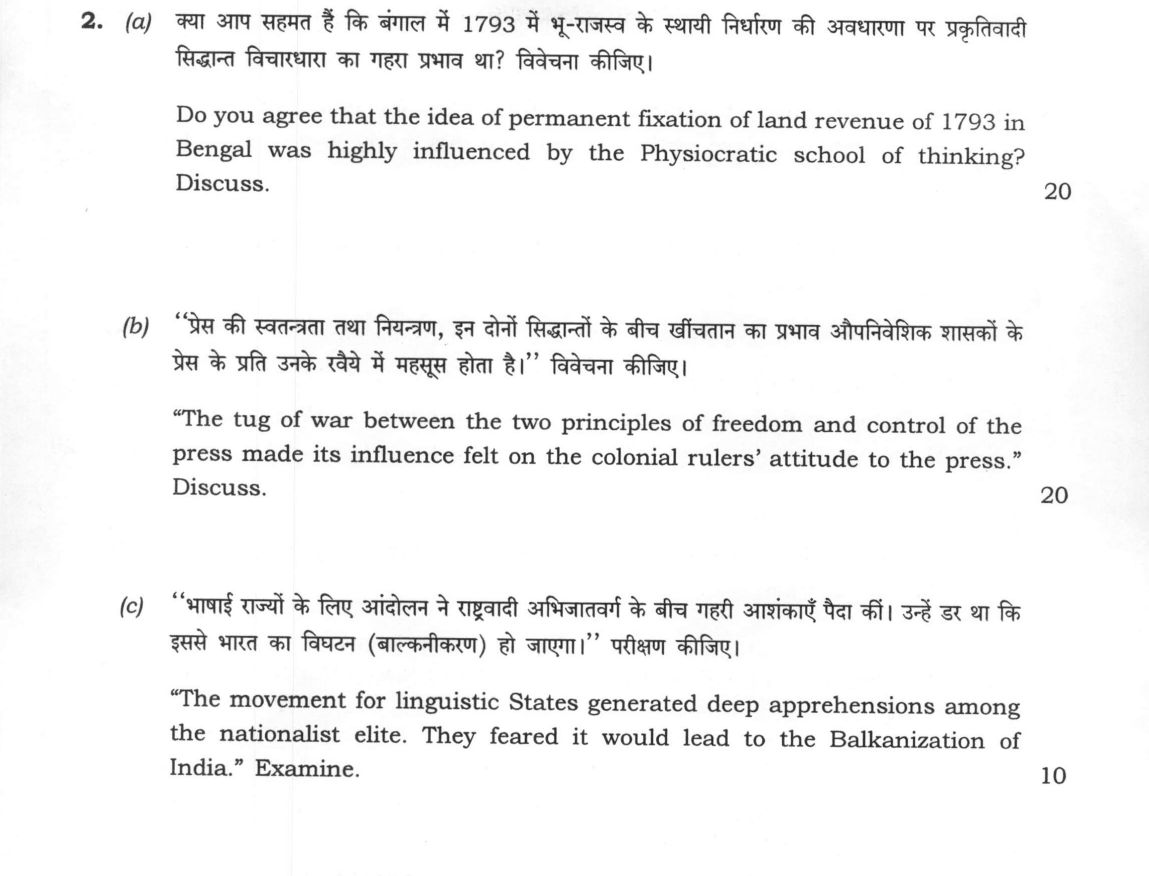
(a) Do you agree that the idea of permanent fixation of land revenue of 1793 in Bengal was highly influenced by the Physiocratic…
Do you agree that the idea of permanent fixation of land revenue of 1793 in Bengal was highly influenced by the Physiocratic school of thinking? Discuss. 20 marks
"The tug of war between the two principles of freedom and control of the press made its influence felt on the colonial rulers' attitude to the press." Discuss. 20 marks
"The movement for linguistic States generated deep apprehensions among the nationalist elite. They feared it would lead to the Balkanization of India." Examine. 10 marks
हिंदी में प्रश्न पढ़ें
क्या आप सहमत हैं कि बंगाल में 1793 में भू-राजस्व के स्थायी निर्धारण की अवधारणा पर प्रकृतिवादी सिद्धांत विचारधारा का गहरा प्रभाव था? विवेचना कीजिए। (20 अंक)
"प्रेस की स्वतंत्रता तथा नियंत्रण, इन दोनों सिद्धांतों के बीच खींचतान का प्रभाव औपनिवेशिक शासकों के प्रेस के प्रति उनके रवैये में महसूस होता है।" विवेचना कीजिए। (20 अंक)
"भाषाई राज्यों के लिए आंदोलन ने राष्ट्रवादी अभिजातवर्ग के बीच गहरी आशंकाएं पैदा की। उन्हें डर था कि इससे भारत का विखंडन (बाल्कनीकरण) हो जाएगा।" परीक्षण कीजिए। (10 अंक)
Model answer
Written by UPSC Answer Check against this question's marking rubric, to the expected length. UPSC does not publish answers for Mains — this is one way to score well, not an official key.
The three propositions trace a common colonial and post-colonial dilemma: how rulers manage revenue, information and territory while preserving unity. In Bengal, the Permanent Settlement of 1793 is often linked to Physiocracy, but the connection is partial. Quesnay’s impôt unique and the idea that land is the source of wealth encouraged the view that a fixed, single land tax could simplify revenue and encourage improvement. In the Cornwallis–Philip Francis debate, Francis’s European-style landlord model and Cornwallis’s desire for a stable class of zamindars resemble Physiocratic assumptions, with zamindars treated as proprietary landlords rather than mere collectors. Yet the settlement was not a pure Physiocratic experiment. It served the fiscal-military needs of the Company, secured predictable revenue for war and administration, and reflected mercantilist and utilitarian concerns about credit, property and control. The absence of any real concern for peasant welfare, and the later divergence between fixed revenue and agrarian distress, shows that the scheme was more a revenue instrument than a social theory. Burkean caution about property and order may be noted, but it was secondary to administrative and financial imperatives. Thus the Physiocratic influence is visible in the language of land, property and fixed rent, but not in the settlement’s actual operation.
Press policy shows a similar oscillation between freedom and control. Wellesley’s 1799 censorship and prior restraint reflected fear of sedition and imperial insecurity. John Adam’s Licensing Regulations of 1823 relaxed prior restraint but retained licensing, while Metcalfe’s 1835 policy and Macaulay’s Press Act of 1835 removed many restrictions, embodying Enlightenment confidence in public opinion and commercial print. The shift was not consistent: the English press was treated as a potential ally of liberal governance, while the vernacular press was seen as a threat. Lytton’s Vernacular Press Act of 1878, in the aftermath of 1857 and amid rising nationalist agitation, authorised penalties for seditious publications, revealing the colonial state’s priority of control when the press mobilised Indian opinion. Ripon’s repeal in 1882, partly under pressure from Indian public opinion and liberal opinion, restored a measure of freedom. The tug of war was therefore between imperial information control and the ideological need to present British rule as modern and lawful; the press became a site where nationalist mobilisation tested that balance.
Linguistic states raised a different but related anxiety. The nationalist elite, including Nehru and Patel, feared that language-based reorganisation might fragment India, weaken the national market, and encourage regional separatism; Nehru’s ‘Balkanisation’ concern captured this. Earlier Congress discussions in the 1920s had entertained linguistic provincial reorganisation, but leaders remained cautious because they saw the nation as a political unity above linguistic communities. Popular movements, however, increasingly identified with language as a marker of culture, education and political representation. Potti Sriramulu’s 58-day fast in 1952 for Andhra made the issue impossible to ignore. The States Reorganisation Commission (1953–56) examined the demand and recommended a linguistic principle tempered by practical safeguards. The States Reorganisation Act, 1956, implemented the reorganisation, while the Constitution (Seventh Amendment) Act, 1956 adjusted the constitutional framework. The eventual acceptance of linguistic states, with a strong central state and common institutions, showed that the elite fear of Balkanisation could be managed without denying linguistic identity.
Taken together, these episodes show that colonial and post-colonial governance repeatedly negotiated between ideological principles and administrative control. Physiocracy supplied a vocabulary for land revenue, but fiscal needs shaped the Permanent Settlement; press freedom was tolerated when it served imperial legitimacy and curtailed when it threatened order; linguistic reorganisation was resisted as divisive but accepted when popular identity demanded it. The way forward was a regulated compromise: fixed revenue with administrative control, press freedom with legal limits, and linguistic states within a unified constitutional framework.
What "Discuss" is asking you to do
Lay the issue out from more than one side — how it arose, what is claimed for it, what is held against it, and where it now stands. UPSC attaches discuss to broad topics with several live dimensions, so coverage of the dimensions earns more than the strength of your opinion.
Structure that answers it
Set the issue up → the case as it is made → the case against → the dimension both sides leave out → where the balance now lies
Where marks are lost
Listing facts with no thread between them, or arguing one side throughout and calling it a discussion.
How this answer will be evaluated
Approach
Framework: Context > Thesis > Evidence > Historiography. (a) discuss: intro > 3-4 dimensions > example > balanced close | (b) discuss: intro > 3-4 dimensions > example > balanced close | (c) examine: intro > how/why with reasoning > evidence > conclusion Full marks: Argues a clear thesis, cites specific laws/thinkers, and balances the 'tug of war' or 'fear' with evidence.
Key points expected
- Define Physiocratic 'net product' and 'impôt unique' concepts
- Link Cornwallis's policy to the 'landlord as intermediary' model
- Contrast with the 'Ryotwari' or 'Zamindari' pre-existing structures
- Assess the 'permanent' nature as a departure from Mughal practice
- Identify the 'tug of war' between liberal ideals and imperial security
- Trace the shift from 'licensing' to 'libel' laws (e.g., Press Act 1878)
- Explain how nationalist press (e.g., Kesari, Commonweal) forced policy changes
- Assess the 'attitude' of rulers as reactive rather than proactive
Evaluation rubric
Each sub-part is marked on its own, against the marks and word limit printed on the paper.
- (a) Evaluate the extent of Physiocratic influence on the 1793 Permanent Settlement in Bengal. 20 marks
discuss— intro → 3-4 dimensions → example → balanced close
Must cover
- Define Physiocratic 'net product' and 'impôt unique' concepts
- Link Cornwallis's policy to the 'landlord as intermediary' model
- Contrast with the 'Ryotwari' or 'Zamindari' pre-existing structures
- Assess the 'permanent' nature as a departure from Mughal practice
Loses marks
- Narrating the history of Bengal without linking to theory
- Confusing the Permanent Settlement with the Ryotwari system
- Failing to define the 'Physiocratic school' clearly
Earns more
- Mention specific Physiocratic thinkers (Quesnay, Turgot)
- Reference the 'Bengal Regulation' of 1793
- Discuss the 'revenue farming' vs 'fixed rent' distinction
- Note the 'sovereign' vs 'proprietor' status of the Zamindar
Extra mark
- Cite a specific quote from Cornwallis or a contemporary
- Reference a specific historiographical debate (e.g., Romila Thapar vs. others)
- (b) Analyze the tension between press freedom and colonial control in shaping British policy. 20 marks
discuss— intro → 3-4 dimensions → example → balanced close
Must cover
- Identify the 'tug of war' between liberal ideals and imperial security
- Trace the shift from 'licensing' to 'libel' laws (e.g., Press Act 1878)
- Explain how nationalist press (e.g., Kesari, Commonweal) forced policy changes
- Assess the 'attitude' of rulers as reactive rather than proactive
Loses marks
- Generalizing about 'freedom of speech' without specific colonial context
- Ignoring the 'control' aspect and focusing only on 'freedom'
- Failing to link specific laws to specific press movements
Earns more
- Mention specific acts (Vernacular Press Act 1878, Press Act 1910)
- Reference key figures (W.C. Bonnerjee, Bal Gangadhar Tilak)
- Discuss the role of the 'White Paper' or specific government reports
- Note the distinction between 'English' and 'Vernacular' press treatment
Extra mark
- Cite a specific editorial or government circular
- Reference a specific historian's view on 'imperial censorship'
- (c) Evaluate the nationalist elite's fear of 'Balkanization' regarding linguistic states. 10 marks
examine— intro → how/why with reasoning → evidence → conclusion
Must cover
- Define 'Balkanization' in the Indian context (fragmentation of unity)
- Identify the 'nationalist elite' (e.g., Nehru, Azad, Congress leadership)
- Explain the 'unity in diversity' argument against linguistic division
- Assess the 'deep apprehensions' as a political strategy vs. genuine fear
Loses marks
- Treating 'Balkanization' as a modern term without historical context
- Ignoring the 'nationalist elite' and focusing only on 'regional leaders'
- Failing to explain the 'fear' as a specific political concern
Earns more
- Mention the 'States Reorganisation Act' of 1956
- Reference the 'Dhar Commission' or 'JVP Committee'
- Discuss the 'Hindi vs. English' language politics
- Note the eventual compromise of 'linguistic states' with 'national integration'
Extra mark
- Cite a specific speech by Nehru or Azad
- Reference a specific state's formation (e.g., Andhra Pradesh, 1953)
Practice this exact question
Write your answer and it is marked point by point against the model answer above — what you covered, what you missed, what you got wrong.
Evaluate my answer →More from History 2025 Paper II
- Q1 Critically examine the following statements in about 150 words each: (a) "The Sikh monarc…
- Q2 (a) Do you agree that the idea of permanent fixation of land revenue of 1793 in Bengal wa…
- Q3 (a) "During the Carnatic Wars, the French position, which at one time dazzled the Indian…
- Q4 (a) "The tensions between cultural revivalism and modernization shaped the trajectory of…
- Q5 Critically examine the following statements in about 150 words each: (a) "The French Revo…