Paper I — Q1
Answer the following questions in about 150 words each : 10×5=50 (a) "The Fundamental Rights may be said to constitutionalise…
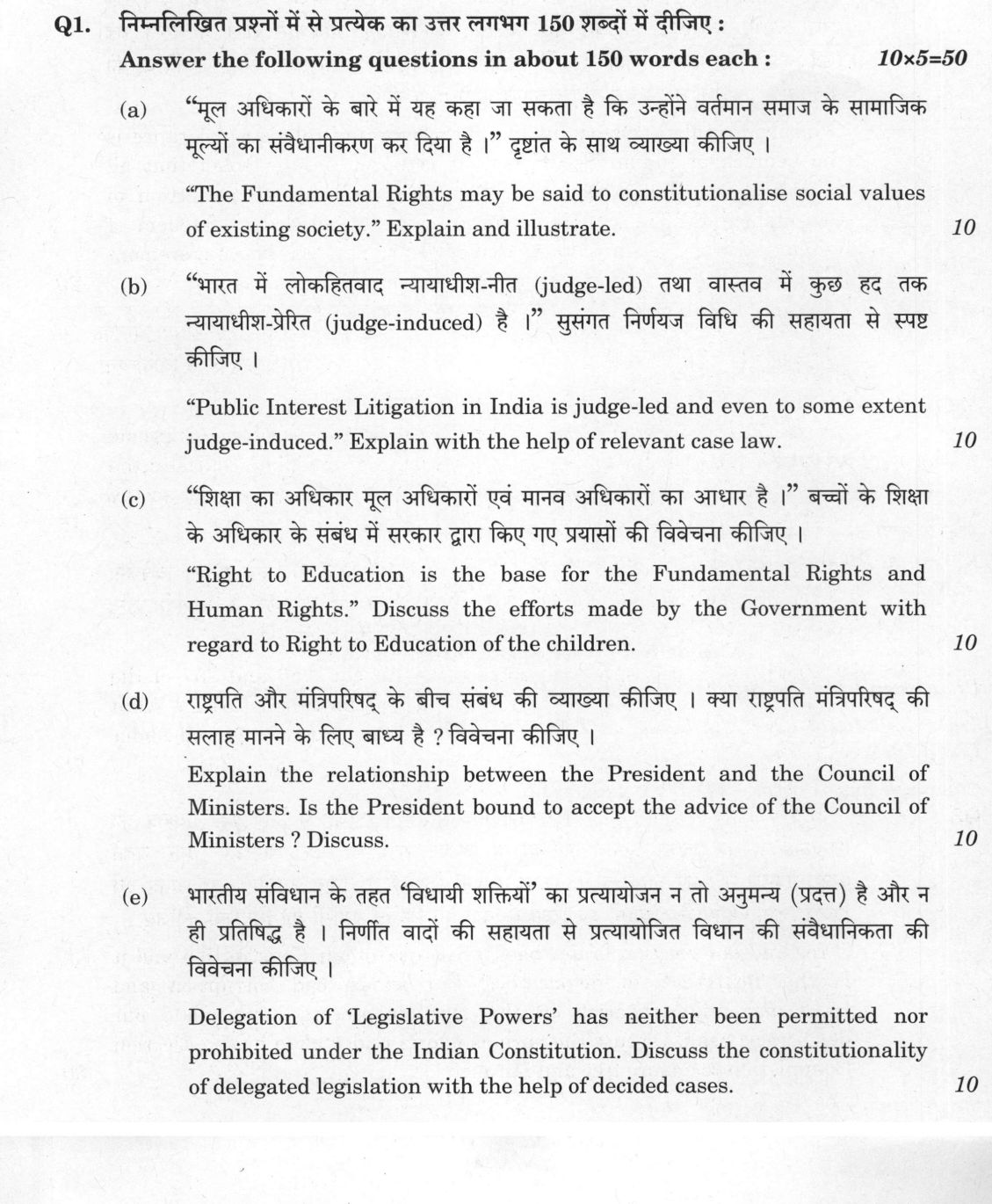
Answer the following questions in about 150 words each : 10×5=50
"The Fundamental Rights may be said to constitutionalise social values of existing society." Explain and illustrate. 10 marks
"Public Interest Litigation in India is judge-led and even to some extent judge-induced." Explain with the help of relevant case law. 10 marks
"Right to Education is the base for the Fundamental Rights and Human Rights." Discuss the efforts made by the Government with regard to Right to Education of the children. 10 marks
Explain the relationship between the President and the Council of Ministers. Is the President bound to accept the advice of the Council of Ministers ? Discuss. 10 marks
Delegation of 'Legislative Powers' has neither been permitted nor prohibited under the Indian Constitution. Discuss the constitutionality of delegated legislation with the help of decided cases. 10 marks
हिंदी में प्रश्न पढ़ें
निम्नलिखित प्रश्नों में से प्रत्येक का उत्तर लगभग 150 शब्दों में दीजिए :
"मूल अधिकारों के बारे में यह कहा जा सकता है कि उन्होंने वर्तमान समाज के सामाजिक मूल्यों का संवैधानिकरण कर दिया है।" दृष्टांत के साथ व्याख्या कीजिए। 10
"भारत में लोकहितवाद न्यायधीश-नीत (judge-led) तथा वास्तव में कुछ हद तक न्यायधीश-प्रेरित (judge-induced) है।" सुसंगत निर्णय विधि की सहायता से स्पष्ट कीजिए। 10
"शिक्षा का अधिकार मूल अधिकारों एवं मानव अधिकारों का आधार है।" बच्चों के शिक्षा के अधिकार के संबंध में सरकार द्वारा किए गए प्रयासों की विवेचना कीजिए। 10
राष्ट्रपति और मंत्रिपरिषद् के बीच संबंध की व्याख्या कीजिए। क्या राष्ट्रपति मंत्रिपरिषद् की सलाह मानने के लिए बाध्य है ? विवेचना कीजिए। 10
भारतीय संविधान के तहत 'विधायी शक्तियों' का प्रत्यायोजन न तो अनुमन्य (प्रदत) है और न ही प्रतिबद्ध है। निर्णीत वादों की सहायता से प्रत्यायोजित विधान की संवैधानिकता की विवेचना कीजिए। 10
Model answer
Written by UPSC Answer Check against this question's marking rubric, to the 150-word length. UPSC does not publish answers for Mains — this is one way to score well, not an official key.
(a) Fundamental Rights as Constitutionalisation of Social Values
Part III of the Indian Constitution translates the historical aspirations, anti-feudal struggles, and egalitarian values of Indian society into legally enforceable norms. Rather than creating rights in a vacuum, the Constitution elevated foundational social demands into fundamental guarantees to dismantle entrenched social hierarchies.
Articles 14 to 18 institutionalise the social demand for egalitarianism. Specifically, Article 17 abolishes untouchability, constitutionalising decades of social reform against caste oppression. Article 19 secures individual autonomy, speech, and democratic participation, which were suppressed under colonial rule. Article 21 expands the social understanding of human dignity, protecting bodily integrity and personal liberty against arbitrary state action. Furthermore, Articles 25 to 28 constitutionalise India’s composite culture and secular ethos by balancing individual freedom of conscience with social reform. These provisions demonstrate that Fundamental Rights operate as an instrument of social engineering, converting dynamic societal values into durable constitutional protections.
(b) Judge-Led and Judge-Induced Public Interest Litigation
Public Interest Litigation (PIL) in India emerged primarily through judicial innovation rather than statutory codification, specifically to address institutional inaction and expand access to justice for the marginalised. The Supreme Court dismantled traditional procedural barriers by relaxing the strict rule of locus standi, pioneering epistolary jurisdiction where letters and telegrams were treated as writ petitions.
In S.P. Gupta v. Union of India (1981), Justice P.N. Bhagwati formally institutionalised PIL by holding that any public-spirited individual could move the court on behalf of those unable to access justice due to poverty or disability. In the M.C. Mehta cases, the Court took proactive, suo motu cognizance of environmental degradation, evolving concepts like the Precautionary Principle and deploying continuing mandamus to supervise executive compliance. Similarly, in Vishaka v. State of Rajasthan (1997), the judiciary actively intervened to formulate guidelines against workplace sexual harassment in the absence of enacted legislation, underscoring that Indian PIL has been largely judge-led in inception and judge-induced in execution.
(c) Right to Education as the Base for Fundamental and Human Rights
Education serves as the foundational enabler for all other civil, political, and socio-economic rights; without literacy, the exercise of freedom of speech under Article 19 or dignified existence under Article 21 becomes illusory. Recognizing this nexus, the Supreme Court in Unnikrishnan v. State of Andhra Pradesh (1993) read the right to education directly into Article 21 up to the age of fourteen years.
To institutionalise this judicial mandate, Parliament enacted the Constitution (Eighty-Sixth Amendment) Act, 2002, inserting Article 21A, which made free and compulsory education for children aged 6 to 14 years a Fundamental Right. Consequently, the Right of Children to Free and Compulsory Education (RTE) Act, 2009 was passed, mandating a 25% reservation for economically weaker sections in private unaided schools and laying down infrastructural norms. Programmatic measures such as the Sarva Shiksha Abhiyan (now subsumed under Samagra Shiksha) and the PM POSHAN (Mid-Day Meal) Scheme further operationalised this right by enhancing enrollment, retention, and nutritional support for children across India.
(d) Relationship between President and Council of Ministers
The Indian Constitution establishes a parliamentary executive modeled on the Westminster system, where the President acts as the de jure constitutional head while real executive power resides with the de facto executive—the Council of Ministers headed by the Prime Minister. Under Article 53, executive power is vested in the President, but Article 74 mandates that there shall be a Council of Ministers to aid and advise the President in the exercise of these functions. Article 75 ensures democratic accountability by making the Council collectively responsible to the Lok Sabha.
The binding nature of this advice was historically affirmed in Ram Jawaya Kapur v. State of Punjab (1955) and Samsher Singh v. State of Punjab (1974), wherein the Supreme Court held that the President must act only on ministerial advice. The 42nd Constitutional Amendment Act, 1976 made this advice explicitly mandatory. The 44th Constitutional Amendment Act, 1978 introduced a limited check via a proviso to Article 74(1), empowering the President to return advice once for reconsideration. However, if the Council of Ministers reiterates its advice, the President is constitutionally bound to accept it.
(e) Constitutionality of Delegated Legislation
The Constitution of India contains no express provision either permitting or prohibiting the delegation of legislative powers. However, given the complexities of the modern welfare state and technical subject matters, delegation has become an administrative necessity, balanced against the doctrine of separation of powers.
The constitutional validity of delegated legislation was established by the Supreme Court in the landmark reference In re Delhi Laws Act (1951). The Court ruled that delegation is permissible provided the legislature does not abdicate its essential functions. Under the "Essential Legislative Functions Doctrine," the legislature must determine the legislative policy and formulate a clear standard; it cannot delegate the power to repeal, amend, or modify the core policy of an Act. In Harishankar Bagla v. State of M.P. (1954), the Court held that a statute delegating power must provide an intelligible principle and guidance for the delegate. Furthermore, in Gwalior Rayon Mills v. Assistant Commissioner of Sales Tax (1974), it was reiterated that delegated legislation remains constitutional only so long as the parent statute sets out the legislative objective, thereby preventing excessive delegation.
What "Explain" is asking you to do
Make the working of something clear — what sets it off, what follows from what, and what it produces. Explain is the Commission's mechanism word: it dominates the technical papers and the “explain why” stems, where the marks sit in the causal chain and not in the label.
Structure that answers it
State what it is → the initiating condition → the chain of cause, step by step → an instance where it plays out → what the chain produces
Where marks are lost
Describing what something looks like instead of why it works that way. Naming the stages without linking them reads as description too.
How this answer will be evaluated
Approach
Framework: Issue > Rule: statute or Article > Authority > Application and conclusion. (a) explain: definition/context > points in order > small example > short close | (b) explain: definition/context > points in order > small example > short close | (c) discuss: intro > 3-4 dimensions > example > balanced close | (d) explain: definition/context > points in order > small example > short close | (e) discuss: intro > 3-4 dimensions > example > balanced close Full marks: Precise legal analysis with relevant case law and constitutional provisions.
Key points expected
- Define constitutionalisation of social values
- Link specific Articles to social values
- Provide concrete illustrations of these values
- Conclude on the transformative role of FRs
- Define judge-led and judge-induced PIL
- Cite relevant case law for judge-led aspect
- Cite relevant case law for judge-induced aspect
- Explain the role of judicial activism
Evaluation rubric
Each sub-part is marked on its own, against the marks and word limit printed on the paper.
- (a) Explain how Fundamental Rights constitutionalise social values with illustrations. 10 marks · 150 words
explain— definition/context → points in order → small example → short close
Must cover
- Define constitutionalisation of social values
- Link specific Articles to social values
- Provide concrete illustrations of these values
- Conclude on the transformative role of FRs
Loses marks
- Listing Articles without explaining social value
- Ignoring the 'illustrate' command word
- General discussion without constitutional link
Earns more
- Mention Article 14 (Equality)
- Mention Article 15 (Non-discrimination)
- Mention Article 17 (Abolition of Untouchability)
- Mention Article 21 (Life and Liberty)
Extra mark
- Reference to Directive Principles of State Policy
- Reference to specific landmark case on social justice
- (b) Explain the judge-led and judge-induced nature of PIL with case law. 10 marks · 150 words
explain— definition/context → points in order → small example → short close
Must cover
- Define judge-led and judge-induced PIL
- Cite relevant case law for judge-led aspect
- Cite relevant case law for judge-induced aspect
- Explain the role of judicial activism
Loses marks
- Citing cases without explaining their relevance
- Confusing judge-led with judge-induced
- No specific case law cited
Earns more
- Mention M.C. Mehta v. Union of India
- Mention S.P. Gupta v. Union of India
- Mention Bandhua Mukti Morcha v. Union of India
- Mention Vishaka v. State of Rajasthan
Extra mark
- Reference to Article 32 or 226
- Reference to relaxation of locus standi
- (c) Discuss government efforts regarding Right to Education of children. 10 marks · 150 words
discuss— intro → 3-4 dimensions → example → balanced close
Must cover
- State the constitutional basis of Right to Education
- Mention key government schemes/acts
- Discuss specific efforts for children's education
- Evaluate the impact of these efforts
Loses marks
- General discussion without specific schemes
- Ignoring the 'children' focus
- No evaluation of government efforts
Earns more
- Mention Article 21A
- Mention Right to Education Act, 2009
- Mention Sarva Shiksha Abhiyan
- Mention Mid-Day Meal Scheme
Extra mark
- Reference to UNICEF data on literacy
- Reference to specific state-level initiatives
- (d) Explain the relationship between President and Council of Ministers. 10 marks · 150 words
explain— definition/context → points in order → small example → short close
Must cover
- Describe the constitutional relationship
- State the President's role in accepting advice
- Discuss the binding nature of advice
- Mention exceptions or discretionary powers
Loses marks
- Vague description of relationship
- Ignoring the 'bound to accept' question
- No mention of constitutional provisions
Earns more
- Mention Article 74
- Mention Article 52
- Mention Sarkaria Commission report
- Mention specific cases on presidential discretion
Extra mark
- Reference to Article 111 (Assent to Bills)
- Reference to Article 123 (Ordinance-making power)
- (e) Discuss constitutionality of delegated legislation with decided cases. 10 marks · 150 words
discuss— intro → 3-4 dimensions → example → balanced close
Must cover
- Define delegated legislation
- State the constitutional position on delegation
- Cite decided cases on constitutionality
- Discuss limits on delegated legislation
Loses marks
- No specific cases cited
- Confusing delegation with devolution
- No discussion on limits or constitutionality
Earns more
- Mention A.K. Kraipak v. Union of India
- Mention D.C. Wadia Ltd. v. Bank of England
- Mention State of Bombay v. Federal Board
- Mention Manohar Lal v. Union of India
Extra mark
- Reference to Article 123 (Ordinances)
- Reference to Article 248 (Residuary powers)
Practice this exact question
Write your answer and it is marked point by point against the model answer above — what you covered, what you missed, what you got wrong.
Evaluate my answer →More from Law 2021 Paper I
- Q1 Answer the following questions in about 150 words each : 10×5=50 (a) "The Fundamental Rig…
- Q2 (a) "Pluralism is the keystone of Indian culture and religious tolerance is the bedrock o…
- Q3 (a) "Free and fair election is the 'basic structure' of our Constitution and it is the 'h…
- Q4 (a) "The provisions of the Directive Principles of State Policy are not enforceable by an…