Paper I — Q8
(a) Is it a legal duty of States under international law to settle their disputes by peaceful means? Can failure of peaceful…
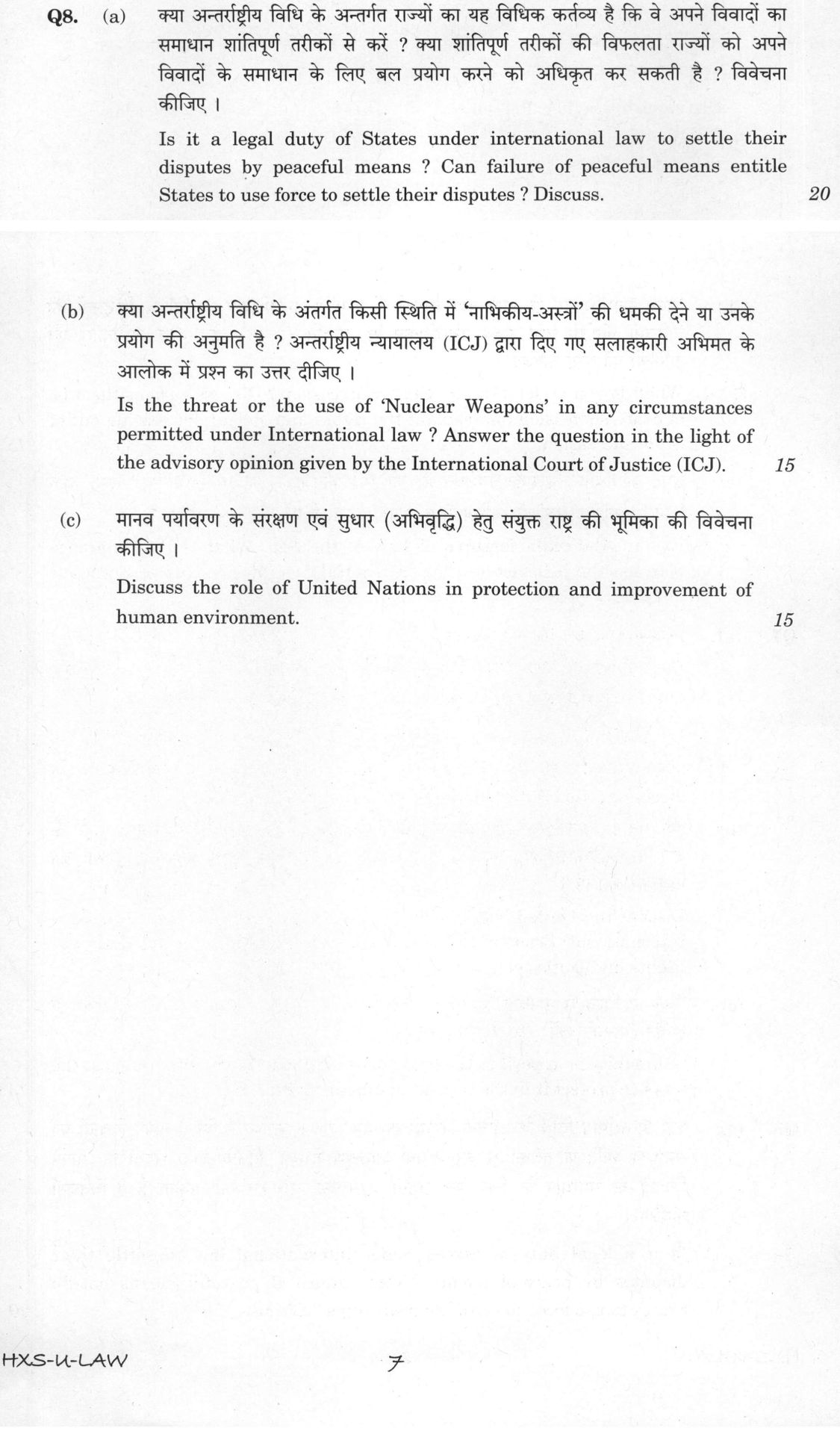
Is it a legal duty of States under international law to settle their disputes by peaceful means? Can failure of peaceful means entitle States to use force to settle their disputes? Discuss. 20 marks
Is the threat or the use of 'Nuclear Weapons' in any circumstances permitted under International law ? Answer the question in the light of the advisory opinion given by the International Court of Justice (ICJ). 15 marks
Discuss the role of United Nations in protection and improvement of human environment. 15 marks
हिंदी में प्रश्न पढ़ें
क्या अंतर्राष्ट्रीय विधि के अंतर्गत राज्यों का यह विधिक कर्तव्य है कि वे अपने विवादों का समाधान शांतिपूर्ण तरीकों से करें ? क्या शांतिपूर्ण तरीकों की विफलता राज्यों को अपने विवादों के समाधान के लिए बल प्रयोग करने को अधिकृत कर सकती है ? विवेचना कीजिए । 20
क्या अन्तर्राष्ट्रीय विधि के अन्तर्गत किसी स्थिति में 'नाभिकीय-अस्त्रों' की धमकी देने या उनके प्रयोग की अनुमति है ? अन्तर्राष्ट्रीय न्यायालय (ICJ) द्वारा दिए गए सलाहकारी अभिमत के आलोक में प्रश्न का उत्तर दीजिए । 15
मानव पर्यावरण के संरक्षण एवं सुधार (अभिवृद्धि) हेतु संयुक्त राष्ट्र की भूमिका की विवेचना कीजिए । 15
Model answer
Written by UPSC Answer Check against this question's marking rubric, to the expected length. UPSC does not publish answers for Mains — this is one way to score well, not an official key.
Peaceful Settlement of Disputes and the Use of Force
Under international law, States have a positive legal duty to settle disputes amicably. Article 2(3) of the UN Charter obliges all members to settle international disputes by peaceful means in such a manner that international peace, security, and justice are not endangered. Article 33(1) reinforces this by mandating that parties to any dispute likely to endanger peace shall first seek a solution through negotiation, enquiry, mediation, conciliation, arbitration, judicial settlement, or regional arrangements.
However, the duty to seek peaceful settlement under Article 33 is legally distinct from the absolute prohibition on the threat or use of force under Article 2(4), which constitutes a peremptory norm (jus cogens). Consequently, the mere failure, breakdown, or exhaustion of peaceful means does not automatically entitle a State to resort to armed force. Force is lawful only under two strictly defined Charter exceptions: individual or collective self-defence in response to an armed attack under Article 51, and collective security enforcement authorized by the Security Council under Chapter VII.
The International Court of Justice (ICJ) affirmed in the Nicaragua Case (1986) and the Oil Platforms Case (2003) that the use of force is governed strictly by the criteria of necessity and proportionality under customary international law, rather than the impasse of diplomatic negotiations. India has consistently upheld this normative framework, favoring bilateral, peaceful dispute resolution through direct dialogue—as reflected in the Simla Agreement (1972)—while maintaining force solely as a measure of lawful self-defence.
Legality of the Threat or Use of Nuclear Weapons
The legality of nuclear weapons under international law was addressed by the ICJ in its 1996 Advisory Opinion on the Legality of the Threat or Use of Nuclear Weapons. The Court unanimously held that the threat or use of force by nuclear weapons is subject to Article 2(4) and Article 51 of the UN Charter, and must comply with International Humanitarian Law (IHL)—including the principles of distinction, proportionality, and the prohibition of unnecessary suffering—as well as international environmental obligations. The Court affirmed that an unlawful use of force ipso facto makes the corresponding threat unlawful.
On the core issue of legality, the Court was divided (7–7, decided by President Bedjaoui’s casting vote). It concluded that the threat or use of nuclear weapons would be "generally contrary" to the rules of international law applicable in armed conflict. However, the Court could not reach a definitive conclusion on whether their use would be lawful or unlawful in an "extreme circumstance of self-defence, in which the very survival of a State would be at stake."
While the Non-Proliferation Treaty (NPT) mandates nuclear disarmament under Article VI, recent customary and conventional efforts have advanced through the Treaty on the Prohibition of Nuclear Weapons (TPNW, 2017). India, maintaining a policy of credible minimum deterrence, aligns with IHL constraints through its doctrine of "No First Use" (NFU) and non-use against non-nuclear-weapon States.
Role of the United Nations in Environmental Protection
The UN has spearheaded the normative and institutional architecture of global environmental governance:
The 1972 UN Conference on the Human Environment (Stockholm) laid the foundation of international environmental law and created the United Nations Environment Programme (UNEP). This evolved into the 1992 UN Conference on Environment and Development (Rio Earth Summit), which produced the Rio Declaration, Agenda 21, and the foundational Rio Conventions: the UNFCCC, the Convention on Biological Diversity (CBD), and the UNCCD. Subsequent milestones include the 2002 Johannesburg Summit and the 2030 Agenda featuring Sustainable Development Goals (SDGs 13, 14, and 15).
Institutionally, UNEP, the UNFCCC Secretariat, and the Intergovernmental Panel on Climate Change (IPCC) drive scientific consensus and treaty implementation. The UN General Assembly has recognized the human right to a clean, healthy, and sustainable environment, while the Security Council increasingly examines climate-induced security risks.
The UN framework crystallized core principles: Common But Differentiated Responsibilities (CBDR), the Precautionary Principle, and the Polluter Pays Principle. India actively participates in UN environmental regimes, enacting the Environment (Protection) Act, 1986 following Stockholm. Domestically, the Supreme Court of India integrated these UN principles into Article 21 jurisprudence in landmark rulings such as Vellore Citizens' Welfare Forum (1996) and the M.C. Mehta series of cases.
Way Forward
To strengthen international rule of law, the UN must bridge the compliance gap across all three domains: codifying absolute prohibitions on nuclear use through universal multilateral instruments, strengthening Chapter VII enforcement to deter unilateral resort to force, and operationalizing the principle of intergenerational equity to enforce state accountability for global environmental degradation.
What "Discuss" is asking you to do
Lay the issue out from more than one side — how it arose, what is claimed for it, what is held against it, and where it now stands. UPSC attaches discuss to broad topics with several live dimensions, so coverage of the dimensions earns more than the strength of your opinion.
Structure that answers it
Set the issue up → the case as it is made → the case against → the dimension both sides leave out → where the balance now lies
Where marks are lost
Listing facts with no thread between them, or arguing one side throughout and calling it a discussion.
How this answer will be evaluated
Approach
Framework: Issue > Rule > Authority > Application. (a) discuss: intro > 3-4 dimensions > example > balanced close | (b) discuss: intro > 3-4 dimensions > example > balanced close | (c) discuss: intro > 3-4 dimensions > example > balanced close Full marks: Precise legal citations, clear distinction of principles, and balanced analysis of exceptions.
Key points expected
- Cite UN Charter Article 2(3) and 2(4)
- Distinguish self-defence (Art 51) from aggression
- Mention ICJ Nicaragua v. USA case
- Explain failure of peaceful means does not justify force
- Cite 1996 ICJ Advisory Opinion on Nuclear Weapons
- State that threat/use is generally contrary to law
- Mention the 'indeterminate' exception in extreme self-defence
- Reference to Geneva Conventions and humanitarian law
Evaluation rubric
Each sub-part is marked on its own, against the marks and word limit printed on the paper.
- (a) Legal duty of peaceful settlement and limits on use of force. 20 marks
discuss— intro → 3-4 dimensions → example → balanced close
Must cover
- Cite UN Charter Article 2(3) and 2(4)
- Distinguish self-defence (Art 51) from aggression
- Mention ICJ Nicaragua v. USA case
- Explain failure of peaceful means does not justify force
Loses marks
- Claiming states can use force if diplomacy fails
- Ignoring the prohibition on use of force in Art 2(4)
Earns more
- Reference to ICJ Corfu Channel case
- Mention of 'jus ad bellum' principles
- Discussion of Security Council role in enforcement
Extra mark
- Reference to 2005 World Summit Outcome
- Mention of R2P (Responsibility to Protect) doctrine
- (b) Legality of nuclear weapons under ICJ Advisory Opinion. 15 marks
discuss— intro → 3-4 dimensions → example → balanced close
Must cover
- Cite 1996 ICJ Advisory Opinion on Nuclear Weapons
- State that threat/use is generally contrary to law
- Mention the 'indeterminate' exception in extreme self-defence
- Reference to Geneva Conventions and humanitarian law
Loses marks
- Claiming nuclear use is always illegal without exception
- Ignoring the specific ICJ Advisory Opinion requested
Earns more
- Mention of the 'opinio juris' regarding non-use
- Reference to the Nuclear Non-Proliferation Treaty (NPT)
- Discussion of the 'right to life' in human rights law
Extra mark
- Mention of the 2017 UN General Assembly resolution
- Reference to the 2017 Treaty on the Prohibition of Nuclear Weapons
- (c) Role of UN in environmental protection and improvement. 15 marks
discuss— intro → 3-4 dimensions → example → balanced close
Must cover
- Mention UNEP (United Nations Environment Programme)
- Cite the 1972 Stockholm Conference
- Reference to the 1992 Rio Declaration
- Mention the Paris Agreement on Climate Change
Loses marks
- Focusing only on climate change and ignoring other environmental issues
- Failing to mention specific UN bodies or treaties
Earns more
- Reference to the 2015 Sustainable Development Goals (SDGs)
- Mention of the UNFCCC (Climate Change Convention)
- Discussion of the 'polluter pays' principle
Extra mark
- Mention of the 2022 Kunming-Montreal Global Biodiversity Framework
- Reference to the UN Ocean Conference
Practice this exact question
Write your answer and it is marked point by point against the model answer above — what you covered, what you missed, what you got wrong.
Evaluate my answer →More from Law 2021 Paper I
- Q5 Answer the following questions in about 150 words each : 10×5=50 (a) Discuss the various…
- Q6 (a) Distinguish whether 'Recognition of States' is an act of policy or of law. Also disti…
- Q7 (a) Discuss the powers of the Security Council for the maintenance of world peace and sec…
- Q8 (a) Is it a legal duty of States under international law to settle their disputes by peac…