Paper I — Q4
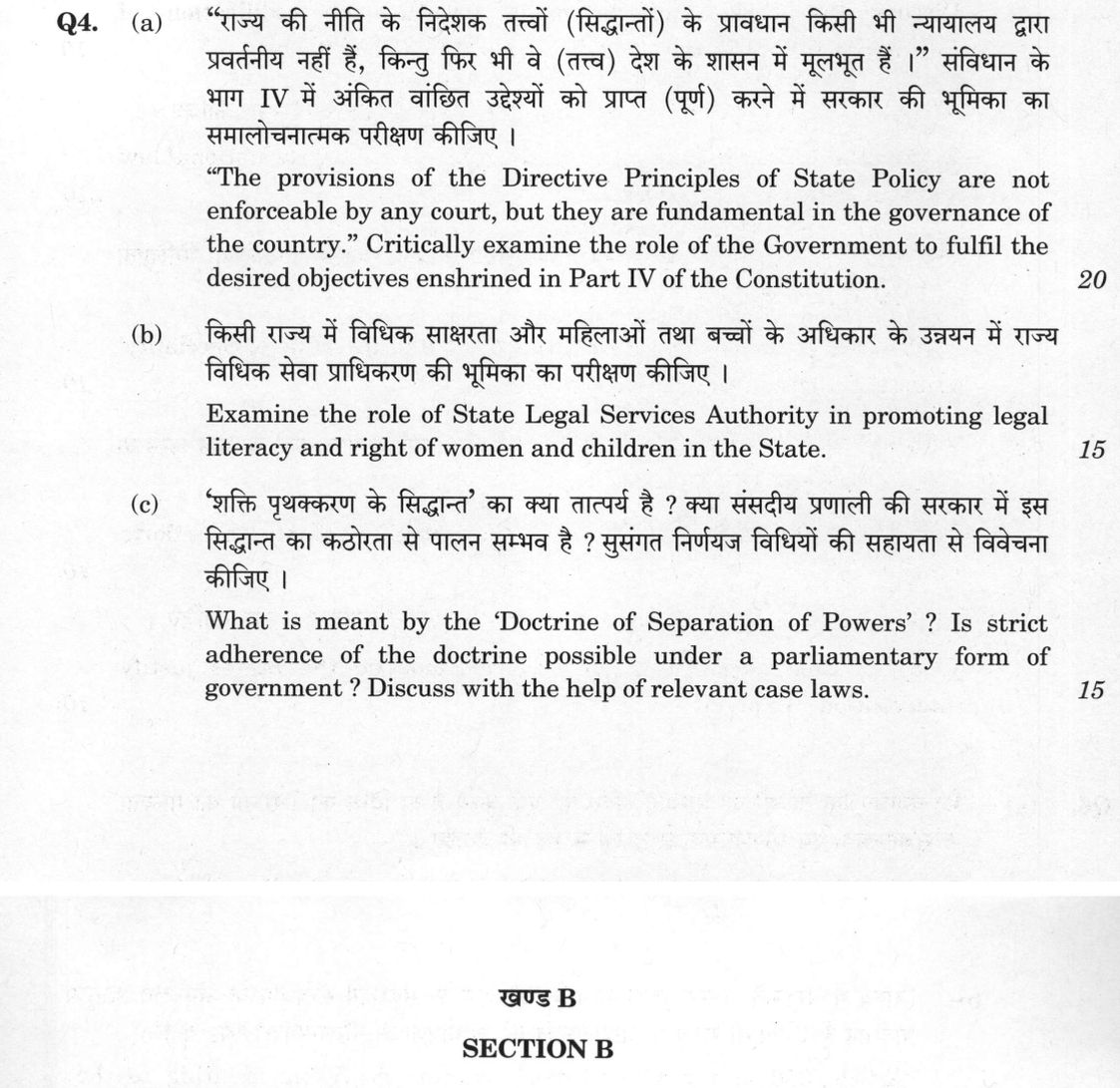
(a) "The provisions of the Directive Principles of State Policy are not enforceable by any court, but they are fundamental in the…
"The provisions of the Directive Principles of State Policy are not enforceable by any court, but they are fundamental in the governance of the country." Critically examine the role of the Government to fulfil the desired objectives enshrined in Part IV of the Constitution. 20 marks
Examine the role of State Legal Services Authority in promoting legal literacy and right of women and children in the State. 15 marks
What is meant by the 'Doctrine of Separation of Powers' ? Is strict adherence of the doctrine possible under a parliamentary form of government ? Discuss with the help of relevant case laws. 15 marks
हिंदी में प्रश्न पढ़ें
"राज्य की नीति के निदेशक तत्वों (सिद्धांतों) के प्रावधान किसी भी न्यायालय द्वारा प्रवर्तनीय नहीं हैं, किन्तु फिर भी वे (तत्व) देश के शासन में मूलभूत हैं ।" संविधान के भाग IV में अंकित वांछित उद्देश्यों को प्राप्त (पूर्ण) करने में सरकार की भूमिका का समालोचनात्मक परीक्षण कीजिए । 20
किसी राज्य में विधिक साक्षरता और महिलाओं तथा बच्चों के अधिकार के उत्थान में राज्य विधिक सेवा प्राधिकरण की भूमिका का परीक्षण कीजिए । 15
'शक्ति पृथक्करण के सिद्धांत' का क्या तात्पर्य है ? क्या संसदीय प्रणाली की सरकार में इस सिद्धांत का कठोरता से पालन संभव है ? सुसंगत निर्णयज विधियों की सहायता से विवेचना कीजिए । 15
Model answer
Written by UPSC Answer Check against this question's marking rubric, to the expected length. UPSC does not publish answers for Mains — this is one way to score well, not an official key.
(a) Directive Principles of State Policy: Non-Enforceability versus Governance Mandate
Article 37 explicitly declares that Directive Principles of State Policy (Part IV) shall not be enforceable by any court, yet characterizes them as fundamental in the governance of the country, imposing a constitutional duty on the State to apply them in law-making. Through welfare legislation and executive measures, the State has progressively realized several economic and social goals (Articles 38–51). Key statutory interventions include the Mahatma Gandhi National Rural Employment Guarantee Act (realizing the right to work under Article 41), the Right to Education Act (Article 45/21A), the National Food Security Act (Article 47), and statutory reforms in personal laws advancing religious and social equality under Article 25(2)(b).
However, historical friction arose regarding the primacy between Fundamental Rights (Part III) and DPSPs. In Golak Nath (1967), the Supreme Court prioritized Part III, leading to the 42nd Constitutional Amendment that attempted to subordinate Fundamental Rights to all DPSPs. In Minerva Mills v. Union of India (1980), the Court harmonized this tension, ruling that the balance between Part III and Part IV forms part of the basic structure—likened to the two wheels of a chariot.
A critical appraisal reveals systemic implementation deficits: socio-economic rights remain contingent on fiscal capacity, administrative efficiency, and political will, leaving provisions like the Uniform Civil Code (Article 44) contentious and unfulfilled. Nonetheless, through Public Interest Litigation (PIL) and expanded readings of Article 21, the judiciary has indirectly enforced DPSPs (such as health, clean environment, and livelihood), demonstrating that while judicially non-justiciable directly, Part IV effectively steers state action.
(b) State Legal Services Authority: Promoting Legal Literacy and Rights of Women and Children
Constituted under the Legal Services Authorities Act, 1987, the State Legal Services Authority (SLSA) operationalizes access to justice under Article 39A. SLSA promotes grassroots legal literacy through mobile legal aid clinics, legal awareness camps, and deployment of Nyaya Mitras to facilitate dispute disposal via National and Permanent Lok Adalats.
For women, SLSA implements targeted measures including free legal representation under Section 12(c) of the 1987 Act, legal assistance under the Protection of Women from Domestic Violence Act, family court counseling, and compensation disbursement through the Nirbhaya Fund-linked Victim Compensation Scheme.
For children, SLSA plays a pivotal statutory role in enforcing compliance with the Juvenile Justice (Care and Protection of Children) Act, providing mandatory legal aid to children in conflict with law and children in need of care. SLSA also ensures specialized legal and psychological support under the POCSO Act, extending to the operationalization of child-friendly court infrastructure and witness assistance rooms to prevent secondary victimization.
(c) Doctrine of Separation of Powers in a Parliamentary Government
Formulated by Montesquieu, the Doctrine of Separation of Powers posits a tripartite division—Legislature, Executive, and Judiciary—to prevent tyranny. The Indian Constitution incorporates functional differentiation rather than rigid separation, reflected in Article 50 (separation of judiciary from executive), legislative immunity (Articles 121 and 211), and presidential/gubernatorial immunity (Article 361).
Strict adherence is unfeasible in a parliamentary system due to structural integration: the executive is drawn directly from the legislature and remains collectively responsible to it. As held in Ram Jawaya Kapur v. State of Punjab (1955), the Indian Constitution recognizes a separation of functions rather than of powers in a strict sense. In Kesavananda Bharati (1973) and Indira Nehru Gandhi v. Raj Narain (1975), the Supreme Court recognized the separation of powers as a facet of the basic structure, prohibiting one organ from usurping the essential functions of another.
This manifests in permissible functional overlaps: the executive exercises delegated legislation and promulgates ordinances (Articles 123/213); the legislature exercises quasi-judicial powers over contempt (Keshav Singh's Case); and the judiciary engages in gap-filling legislative activism (e.g., Vishaka v. State of Rajasthan guidelines).
Conclusion
Constitutional governance in India relies on a dynamic equilibrium rather than rigid compartmentalization: DPSPs supply the substantive vision of a welfare state, SLSAs ensure egalitarian access to that vision, and a flexible separation of powers provides institutional checks and balances necessary for democratic stability.
What "Critically examine" is asking you to do
Test the proposition the question puts to you and return a finding on how far it holds. Examine stems carry a claim, or ask whether something has happened, and expect evidence weighed both ways before the extent is stated — often with remedial measures attached. “Critically” is not a section added at the end: name the yardstick you are judging by — the evidence, the stated objective, a constitutional principle, a rival explanation — and let a verdict close each part of the body. Where the question quotes a claim, that verdict must land on the claim itself, accepted, qualified or rejected, and not on the theme in general.
Structure that answers it
Restate the claim as the question frames it → evidence that supports it → evidence that undercuts it → the conditions under which it holds → verdict on how far it stands
Where marks are lost
Merits in one paragraph, demerits in the next, and a conclusion calling for a balanced and holistic approach. That is a survey with the judgement left out and it holds the answer in the middle band. The opposite error is reading “critically” as permission to attack — and with the odd pairings, critically describe or critically explain, the exposition still carries most of the marks, the judgement being a layer on it rather than a substitute for it.
How this answer will be evaluated
Approach
Framework: Issue > Rule: statute or Article > Authority > Application and conclusion. (a) critically evaluate: positives > negatives/limits > conditions/safeguards > conclusion | (b) examine: intro > how/why with reasoning > evidence > conclusion | (c) discuss: intro > 3-4 dimensions > example > balanced close Full marks: Precise legal citations, critical analysis, and clear application of law to the specific context of each part.
Key points expected
- Cite Article 37 regarding non-enforceability and fundamental nature.
- Identify specific DPSPs (e.g., Art 39, 41, 45) and corresponding Govt schemes.
- Discuss the 'Harmonious Construction' doctrine (Kesavananda Bharati case).
- Critically evaluate the gap between constitutional intent and implementation.
- Cite Article 39A and the Legal Services Authorities Act, 1987.
- Explain the specific mandate of State Legal Services Authority (SLSA).
- Detail mechanisms for legal literacy (e.g., Lok Adalats, legal aid camps).
- Discuss specific initiatives for women and children (e.g., protection of rights).
Evaluation rubric
Each sub-part is marked on its own, against the marks and word limit printed on the paper.
- (a) Assess the Government's role in implementing Part IV objectives despite non-justiciability. 20 marks
critically evaluate— positives → negatives/limits → conditions/safeguards → conclusion
Must cover
- Cite Article 37 regarding non-enforceability and fundamental nature.
- Identify specific DPSPs (e.g., Art 39, 41, 45) and corresponding Govt schemes.
- Discuss the 'Harmonious Construction' doctrine (Kesavananda Bharati case).
- Critically evaluate the gap between constitutional intent and implementation.
Loses marks
- Treating DPSPs as justiciable without qualification.
- Listing schemes without linking them to specific Articles.
- Ignoring the 'critical' aspect (only listing positives).
Earns more
- Mention Article 371A or 371J for specific state implementation.
- Reference the 14th Finance Commission's role in fiscal federalism.
- Cite the 103rd Amendment (Article 15(6)) as a legislative step.
- Mention the 'Basic Structure' doctrine's relevance to DPSPs.
Extra mark
- Cite the Law Commission of India report on DPSPs.
- Reference a recent Supreme Court judgment on DPSPs (e.g., 2023/2024).
- (b) Analyze the State Legal Services Authority's role in legal literacy and rights for women/children. 15 marks
examine— intro → how/why with reasoning → evidence → conclusion
Must cover
- Cite Article 39A and the Legal Services Authorities Act, 1987.
- Explain the specific mandate of State Legal Services Authority (SLSA).
- Detail mechanisms for legal literacy (e.g., Lok Adalats, legal aid camps).
- Discuss specific initiatives for women and children (e.g., protection of rights).
Loses marks
- Confusing SLSA with NALSA or DLSA roles.
- Failing to link legal literacy to the rights of women/children.
- Generic discussion of legal aid without specific SLSA focus.
Earns more
- Mention the role of District Legal Services Authorities (DLSA).
- Reference the 'Nyaya Mandir' scheme or similar state-specific programs.
- Discuss the impact on access to justice for marginalized groups.
- Cite the National Legal Services Authority (NALSA) guidelines.
Extra mark
- Cite a specific state's successful legal aid initiative.
- Reference a recent Supreme Court judgment on legal aid.
- (c) Define Separation of Powers and discuss its feasibility in a parliamentary system with case laws. 15 marks
discuss— intro → 3-4 dimensions → example → balanced close
Must cover
- Define the Doctrine of Separation of Powers (Montesquieu).
- Explain the 'functional' vs 'strict' separation in India.
- Cite Article 50 (Separation of Judiciary from Executive).
- Discuss the feasibility in a parliamentary form of government.
Loses marks
- Defining the doctrine without linking it to the Indian context.
- Failing to discuss the 'parliamentary form' aspect.
- Citing case laws without explaining their relevance to the doctrine.
Earns more
- Cite the Kesavananda Bharati case (1973) on separation of powers.
- Reference the S.R. Bommai case (1994) on judicial review.
- Discuss the 'Preamble' and 'Basic Structure' in this context.
- Mention the role of the Judiciary in checking the Legislature/Executive.
Extra mark
- Cite a recent Supreme Court judgment on separation of powers.
- Reference the Law Commission of India report on separation of powers.
Practice this exact question
Write your answer and it is marked point by point against the model answer above — what you covered, what you missed, what you got wrong.
Evaluate my answer →More from Law 2021 Paper I
- Q1 Answer the following questions in about 150 words each : 10×5=50 (a) "The Fundamental Rig…
- Q2 (a) "Pluralism is the keystone of Indian culture and religious tolerance is the bedrock o…
- Q3 (a) "Free and fair election is the 'basic structure' of our Constitution and it is the 'h…
- Q4 (a) "The provisions of the Directive Principles of State Policy are not enforceable by an…
- Q5 Answer the following questions in about 150 words each : 10×5=50 (a) Discuss the various…
- Q6 (a) Distinguish whether 'Recognition of States' is an act of policy or of law. Also disti…
- Q7 (a) Discuss the powers of the Security Council for the maintenance of world peace and sec…