Paper I — Q2
(a) "Pluralism is the keystone of Indian culture and religious tolerance is the bedrock of Indian Secularism. It is based on the…
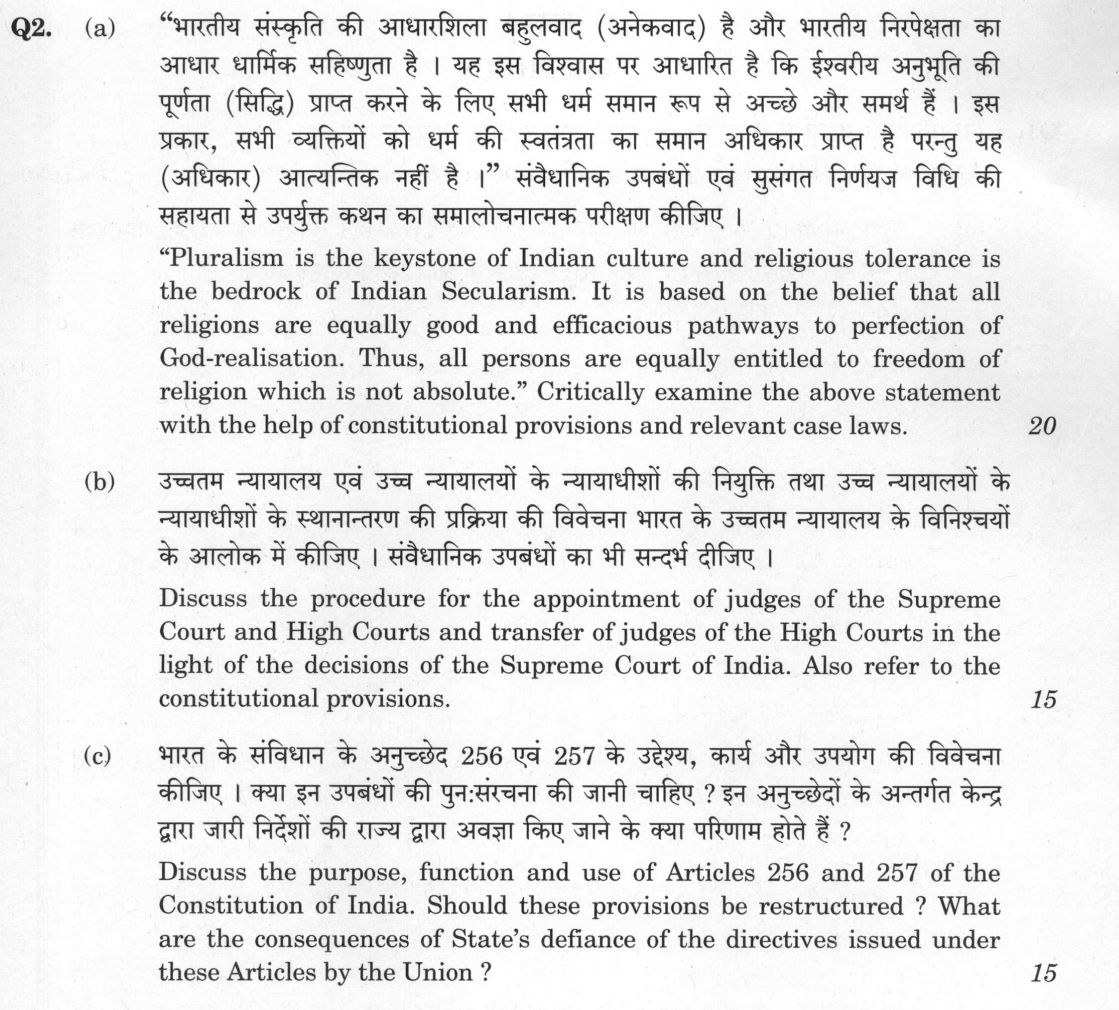
"Pluralism is the keystone of Indian culture and religious tolerance is the bedrock of Indian Secularism. It is based on the belief that all religions are equally good and efficacious pathways to perfection of God-realisation. Thus, all persons are equally entitled to freedom of religion which is not absolute." Critically examine the above statement with the help of constitutional provisions and relevant case laws. 20 marks
Discuss the procedure for the appointment of judges of the Supreme Court and High Courts and transfer of judges of the High Courts in the light of the decisions of the Supreme Court of India. Also refer to the constitutional provisions. 15 marks
Discuss the purpose, function and use of Articles 256 and 257 of the Constitution of India. Should these provisions be restructured ? What are the consequences of State's defiance of the directives issued under these Articles by the Union ? 15 marks
हिंदी में प्रश्न पढ़ें
"भारतीय संस्कृति की आधारशिला बहुलवाद (अनेकवाद) है और भारतीय निरपेक्षता का आधार धार्मिक सहिष्णुता है । यह इस विश्वास पर आधारित है कि ईश्वरीय अनुभूति की पूर्णता (सिद्धि) प्राप्त करने के लिए सभी धर्म समान रूप से अच्छे और समर्थ हैं । इस प्रकार, सभी व्यक्तियों को धर्म की स्वतंत्रता का समान अधिकार प्राप्त है परंतु यह (अधिकार) आत्यंतिक नहीं है ।" संवैधानिक उपबंधों एवं सुसंगत निर्णय विधि की सहायता से उपयुक्त कथन का समालोचनात्मक परीक्षण कीजिए । 20
उच्चतम न्यायालय एवं उच्च न्यायालयों के न्यायाधीशों की नियुक्ति तथा उच्च न्यायालयों के न्यायाधीशों के स्थानांतरण की प्रक्रिया की विवेचना भारत के उच्चतम न्यायालय के विनिर्णयों के आलोक में कीजिए । संवैधानिक उपबंधों का भी संदर्भ दीजिए । 15
भारत के संविधान के अनुच्छेद 256 एवं 257 के उद्देश्य, कार्य और उपयोग की विवेचना कीजिए । क्या इन उपबंधों की पुनःसंरचना की जानी चाहिए ? इन अनुच्छेदों के अंतर्गत केंद्र द्वारा जारी निर्देशों की राज्य द्वारा अवज्ञा किए जाने के क्या परिणाम होते हैं ? 15 marks
Model answer
Written by UPSC Answer Check against this question's marking rubric, to the expected length. UPSC does not publish answers for Mains — this is one way to score well, not an official key.
Secularism and religious freedom The statement is broadly correct but needs qualification. Indian secularism is *Sarva Dharma Sama Bhava*—equal respect, not indifference: the State does not favour one religion but may regulate religious practice for public order, morality, health and fundamental rights. Articles 25–28 guarantee freedom of conscience, profession, practice and propagation, management of religious institutions, and regulation of religious instruction in State-aided or wholly State-owned institutions. S.R. Bommai held secularism part of the basic structure; Ismail Faruqui allowed State regulation of a place of public worship; Shayara Bano examined triple talaq as an essential religious practice and struck it down under Article 14. Thus, religious freedom is not absolute. However, the claim that all religions are “equally good and efficacious” is theological, not constitutional. The Constitution does not judge religious efficacy; it secures equal citizenship. The “equal respect” model differs from the “wall of separation” because India permits reasonable regulation and affirmative protection of minorities under Articles 29–30. The UCC debate shows the tension: uniformity may promote equality, but coercive uniformity may flatten pluralism. A critical verdict is that Indian secularism is pluralist and tolerant, but its strength lies in limiting religious power where it harms individuals, not in declaring all religions equally efficacious.
Appointment and transfer of judges Article 124(2) provides for appointment of Supreme Court judges by the President after consultation with such judges as the CJI considers necessary; Articles 217 and 222 provide analogous provisions for High Court appointments and transfers. In S.P. Gupta, the Court gave executive primacy, reading “consultation” as advice that need not be followed. The First Judges Case restored judicial primacy, holding the CJI’s opinion prevails. The Second Judges Case made the CJI’s opinion that of a collegium of two senior-most SC judges for High Court appointments. The Third Judges Case expanded the collegium and clarified that consultation is not mere advice but a binding process, while preserving the President’s power to seek reasons. For Supreme Court appointments, the collegium is the CJI and four senior-most SC judges; for transfers, the CJI and four senior-most SC judges. The NJAC, including the CJI, two senior judges, the Law Minister and two eminent persons, was struck down in Supreme Court Advocates-on-Record Association v. Union of India (2016) as violating the basic structure by diluting judicial independence. The current position is collegium-based appointment and transfer, with executive power to seek reasons.
Federal executive coordination Articles 256 and 257 ensure that the Union executive can direct State executives to comply with laws made by Parliament and to carry out Union directions. Article 256 makes State executive power subject to Union direction where a law requires it; Article 257 empowers the President to require States to hold stocks of essential commodities and, on failure to comply with directions under Article 256 or 257(1), to issue further directions. Their purpose is to preserve cooperative federalism, national integrity, and parliamentary supremacy within competence. They coordinate implementation of central laws, national policies, and disaster response. Restructuring may be desirable to reduce executive overreach and clarify limits, especially after Sarkaria Commission’s caution against casual use of federal instruments. Yet complete removal would weaken the Union’s ability to ensure uniformity. State defiance may lead to judicial enforcement, or, in extreme cases, Article 356 if governance becomes impossible. State of Rajasthan v. Union of India emphasised that Article 356 is a constitutional remedy of last resort, not a political weapon. Thus, Articles 256–257 should be retained but restructured with clearer procedural safeguards, independent review, and a presumption against central direction except where national interest or legal compliance demands it.
What "Critically examine" is asking you to do
Test the proposition the question puts to you and return a finding on how far it holds. Examine stems carry a claim, or ask whether something has happened, and expect evidence weighed both ways before the extent is stated — often with remedial measures attached. “Critically” is not a section added at the end: name the yardstick you are judging by — the evidence, the stated objective, a constitutional principle, a rival explanation — and let a verdict close each part of the body. Where the question quotes a claim, that verdict must land on the claim itself, accepted, qualified or rejected, and not on the theme in general.
Structure that answers it
Restate the claim as the question frames it → evidence that supports it → evidence that undercuts it → the conditions under which it holds → verdict on how far it stands
Where marks are lost
Merits in one paragraph, demerits in the next, and a conclusion calling for a balanced and holistic approach. That is a survey with the judgement left out and it holds the answer in the middle band. The opposite error is reading “critically” as permission to attack — and with the odd pairings, critically describe or critically explain, the exposition still carries most of the marks, the judgement being a layer on it rather than a substitute for it.
How this answer will be evaluated
Approach
Framework: Issue > Rule > Authority > Application. (a) critically evaluate: positives > negatives/limits > conditions/safeguards > conclusion | (b) discuss: intro > 3-4 dimensions > example > balanced close | (c) discuss: intro > 3-4 dimensions > example > balanced close Full marks: Comprehensive coverage of all constitutional provisions and case laws, with clear reasoning and balanced judgment.
Key points expected
- Cite Article 25 (Freedom of Religion) and its limitations.
- Cite Article 26 (Right to manage religious affairs).
- Cite Article 29 (Protection of interests of minorities).
- Cite Article 44 (Directive Principle: Uniform Civil Code).
- Cite Article 124 (Appointment of Supreme Court judges).
- Cite Article 217 (Appointment of High Court judges).
- Cite Article 222 (Transfer of High Court judges).
- Reference the Collegium System (Second Judges Case).
Evaluation rubric
Each sub-part is marked on its own, against the marks and word limit printed on the paper.
- (a) Critically examine the statement on pluralism, secularism, and freedom of religion using constitutional provisions and case laws. 20 marks
critically evaluate— positives → negatives/limits → conditions/safeguards → conclusion
Must cover
- Cite Article 25 (Freedom of Religion) and its limitations.
- Cite Article 26 (Right to manage religious affairs).
- Cite Article 29 (Protection of interests of minorities).
- Cite Article 44 (Directive Principle: Uniform Civil Code).
Loses marks
- Failing to mention the 'not absolute' nature of freedom of religion.
- Ignoring the 'bedrock of secularism' aspect of the statement.
- Citing cases without explaining their ratio.
Earns more
- Reference Kesavananda Bharati case regarding secularism.
- Reference Sarla Mudgal case regarding Uniform Civil Code.
- Reference Shabana Begum case regarding religious freedom.
- Reference Ismail Faruqui case regarding secularism.
Extra mark
- Reference Article 28 (Freedom from religious instruction in state educational institutions).
- Reference Article 30 (Right of minorities to establish educational institutions).
- (b) Discuss the procedure for appointment and transfer of judges of the Supreme Court and High Courts in light of Supreme Court decisions and constitutional provisions. 15 marks
discuss— intro → 3-4 dimensions → example → balanced close
Must cover
- Cite Article 124 (Appointment of Supreme Court judges).
- Cite Article 217 (Appointment of High Court judges).
- Cite Article 222 (Transfer of High Court judges).
- Reference the Collegium System (Second Judges Case).
Loses marks
- Failing to distinguish between appointment and transfer procedures.
- Ignoring the role of the Collegium in the appointment process.
- Citing the NJAC Act without mentioning its invalidation.
Earns more
- Reference the Third Judges Case (1998).
- Reference the NJAC Act (2014) and its invalidation.
- Reference the National Judicial Appointments Commission (NJAC) case.
- Reference the 99th Constitutional Amendment Act.
Extra mark
- Reference the 99th Constitutional Amendment Act (2014).
- Reference the 99th Constitutional Amendment Act (2014).
- (c) Discuss the purpose, function, and use of Articles 256 and 257, and the consequences of State's defiance of Union directives. 15 marks
discuss— intro → 3-4 dimensions → example → balanced close
Must cover
- Cite Article 256 (Obedience to the President's orders).
- Cite Article 257 (Executive power of the Union).
- Explain the concept of 'subordination' of State executive to the Union.
- Discuss the consequences of State's defiance (e.g., President's Rule under Article 356).
Loses marks
- Failing to explain the 'subordination' of State executive to the Union.
- Ignoring the 'consequences' of State's defiance.
- Citing Articles without explaining their 'purpose' and 'function'.
Earns more
- Reference the S.R. Bommai case regarding President's Rule.
- Reference the Kesavananda Bharati case regarding federalism.
- Reference the State of Rajasthan v. Union of India case.
- Reference the State of Punjab v. Union of India case.
Extra mark
- Reference the 73rd and 74th Constitutional Amendment Acts.
- Reference the 73rd and 74th Constitutional Amendment Acts.
Practice this exact question
Write your answer and it is marked point by point against the model answer above — what you covered, what you missed, what you got wrong.
Evaluate my answer →More from Law 2021 Paper I
- Q1 Answer the following questions in about 150 words each : 10×5=50 (a) "The Fundamental Rig…
- Q2 (a) "Pluralism is the keystone of Indian culture and religious tolerance is the bedrock o…
- Q3 (a) "Free and fair election is the 'basic structure' of our Constitution and it is the 'h…
- Q4 (a) "The provisions of the Directive Principles of State Policy are not enforceable by an…
- Q5 Answer the following questions in about 150 words each : 10×5=50 (a) Discuss the various…