Paper I — Q7
(a) Discuss the powers of the Security Council for the maintenance of world peace and security. Has the 'Veto Power' proved a…
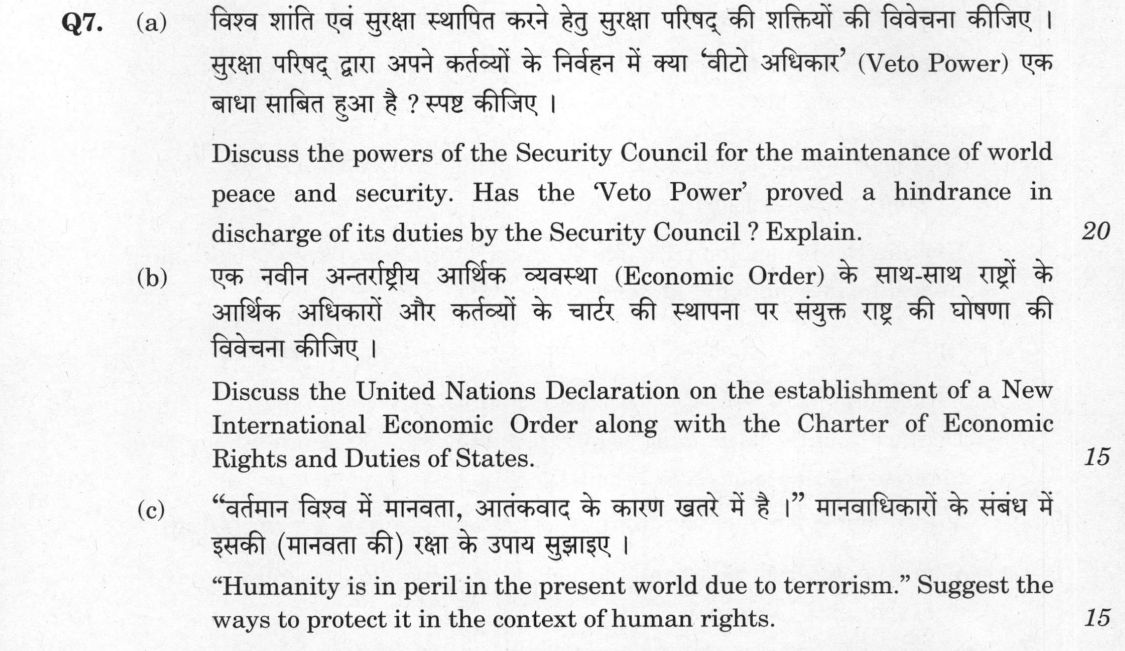
Discuss the powers of the Security Council for the maintenance of world peace and security. Has the 'Veto Power' proved a hindrance in discharge of its duties by the Security Council? Explain. 20 marks
Discuss the United Nations Declaration on the establishment of a New International Economic Order along with the Charter of Economic Rights and Duties of States. 15 marks
"Humanity is in peril in the present world due to terrorism." Suggest the ways to protect it in the context of human rights. 15 marks
हिंदी में प्रश्न पढ़ें
विश्व शांति एवं सुरक्षा स्थापित करने हेतु सुरक्षा परिषद की शक्तियों की विवेचना कीजिए । सुरक्षा परिषद द्वारा अपने कर्तव्यों के निर्वहन में क्या 'वीटो अधिकार' (Veto Power) एक बाधा साबित हुआ है ? स्पष्ट कीजिए । 20
एक नवीन अंतर्राष्ट्रीय आर्थिक व्यवस्था (Economic Order) के साथ-साथ राष्ट्रों के आर्थिक अधिकारों और कर्तव्यों के चार्टर की स्थापना पर संयुक्त राष्ट्र की घोषणा की विवेचना कीजिए । 15
"वर्तमान विश्व में मानवता, आतंकवाद के कारण खतरे में है ।" मानवाधिकारों के संबंध में इसकी (मानवता की) रक्षा के उपाय सुझाइए । 15
Model answer
Written by UPSC Answer Check against this question's marking rubric, to the expected length. UPSC does not publish answers for Mains — this is one way to score well, not an official key.
The UN's peace mandate is strongest in the Security Council, but its effectiveness is shaped by veto, economic order and counter-terrorism.
Powers and veto Under the Charter, the Council has primary responsibility for maintenance of international peace and security (Art. 24). It distinguishes pacific settlement (Ch. VI, Arts. 33-38) from enforcement (Ch. VII). Under Art. 39 it determines the existence of a threat, breach, or act of aggression. Art. 40 allows provisional measures; Art. 41 non-forced measures such as sanctions, blockades, asset freezes and interruption of communications; the Council may also impose arms embargoes and travel bans; Art. 42 armed force; Art. 43 arrangements for armed forces. These powers are central to collective security, allowing the UN to move from recommendations to binding obligations. But Art. 27(3) requires concurring votes of permanent members for substantive decisions, giving veto. Its original purpose was great-power unanimity, ensuring major-power participation and preventing the Council from acting against them. Yet veto has often paralysed action, sometimes preventing the Council from even defining a threat under Art. 39. In Syria 2011-2022, Russia and China vetoes blocked resolutions on chemical weapons, ceasefire, and accountability, enabling the conflict. In Ukraine 2022, Russia vetoed condemnations and prevented binding action. In Gaza 2023-24, vetoes delayed or blocked resolutions on ceasefire, humanitarian access, and accountability. The GA's Uniting for Peace Res. 377(V) can recommend collective measures when the Council fails, but cannot replace binding enforcement. Reforms include the G4 initiative (India, Japan, Germany, Brazil) seeking permanent seats, veto restraint, and expanded membership.
NIEO and CERDS The 1974 UN Declaration on NIEO (GA Res. 3201 S-VI) and CERDS (GA Res. 3281) sought to correct structural inequality in the international economy. They affirmed permanent sovereignty over natural resources, the right to nationalise or transfer ownership with appropriate compensation, equitable trade, technology transfer, and special treatment for developing states. The Declaration linked economic rights to development, arguing that peace required reducing North-South disparities through reform of trade, finance and commodity prices. CERDS gave states broad economic rights, including control over transnationals and the right to choose their economic system. Their legal status is limited: GA resolutions are not self-executing, and post-1990s liberalisation, WTO rules, investment treaties and IMF/World Bank conditionality weakened their force. Yet they remain normative benchmarks for sovereignty, development and a fair economic order.
Terrorism and human rights Terrorism threatens humanity by attacking civilians, destabilising states and violating rights to life, liberty and security. The UN framework includes sectoral conventions such as the 1963 Tokyo Convention, which criminalised unlawful seizure of aircraft, and Security Council Res. 1373 (2001), obliging states to criminalise financing, deny safe haven, and prevent terrorist acts; Res. 1566 (2004) states terrorist acts are under no circumstances justifiable by political, philosophical, ideological, racial, ethnic, religious or similar considerations. But counter-terrorism must respect due process, fair trial, prohibition of torture, and non-discrimination. India's experience shows tension: POTA was struck down in 2004 as excessive; UAPA remains, with Supreme Court in Kartar Singh v. State of Punjab (1994) allowing preventive detention for terrorism, while in Arup Bhuyan (2011) it required more than passive association; that 2011 view was later overruled in Arup Bhuyan (2023), upholding UAPA's criminalisation of membership of a banned organisation.
Way forward The three issues are linked: economic marginalisation and Council dysfunction can fuel terrorism, while security measures can erode rights. A way forward requires Council reform and responsible veto restraint, revival of NIEO principles through equitable trade and development, and counter-terrorism anchored in human rights, rule of law and proportionality. India's claim for permanent membership should be tied to greater accountability and inclusive human security.
What "Discuss" is asking you to do
Lay the issue out from more than one side — how it arose, what is claimed for it, what is held against it, and where it now stands. UPSC attaches discuss to broad topics with several live dimensions, so coverage of the dimensions earns more than the strength of your opinion.
Structure that answers it
Set the issue up → the case as it is made → the case against → the dimension both sides leave out → where the balance now lies
Where marks are lost
Listing facts with no thread between them, or arguing one side throughout and calling it a discussion.
How this answer will be evaluated
Approach
Framework: UN Charter & International Law. (a) discuss: intro > 3-4 dimensions > example > balanced close | (b) discuss: intro > 3-4 dimensions > example > balanced close | (c) suggest: the problem in one line > implementable measures > who acts > conclusion Full marks: Precise legal references, balanced analysis, and clear application to the specific context.
Key points expected
- Powers under Chapter VI (Pacific Settlement)
- Powers under Chapter VII (Enforcement/Coercive)
- Definition of Veto Power (Article 27)
- Analysis of Veto as a hindrance to duties
- Core principles of New International Economic Order (NIEO)
- Key provisions of Charter of Economic Rights and Duties
- Context of 1974 UN General Assembly resolutions
- Link between NIEO and state sovereignty over resources
Evaluation rubric
Each sub-part is marked on its own, against the marks and word limit printed on the paper.
- (a) Powers of Security Council and the impact of Veto Power on its duties. 20 marks
discuss— intro → 3-4 dimensions → example → balanced close
Must cover
- Powers under Chapter VI (Pacific Settlement)
- Powers under Chapter VII (Enforcement/Coercive)
- Definition of Veto Power (Article 27)
- Analysis of Veto as a hindrance to duties
Loses marks
- Confusing Security Council with General Assembly
- Ignoring the 'hindrance' aspect of the question
- Vague generalities without specific Articles
Earns more
- Mention of Chapter VIII (Regional Arrangements)
- Specific examples of Veto usage (e.g., Syria, Ukraine)
- Distinction between procedural and substantive matters
Extra mark
- Reference to 'Uniting for Peace' Resolution
- Mention of P5 permanent membership status
- (b) UN Declaration on NIEO and the Charter of Economic Rights and Duties of States. 15 marks
discuss— intro → 3-4 dimensions → example → balanced close
Must cover
- Core principles of New International Economic Order (NIEO)
- Key provisions of Charter of Economic Rights and Duties
- Context of 1974 UN General Assembly resolutions
- Link between NIEO and state sovereignty over resources
Loses marks
- Confusing NIEO with general trade policy
- Failing to distinguish between the Declaration and the Charter
- Ignoring the economic rights aspect
Earns more
- Mention of 'Permanent Sovereignty over Natural Resources'
- Reference to the 'Right to Development'
- Context of the Group of 77 (G-77) initiative
Extra mark
- Reference to the 'New World Information and Communication Order'
- Mention of the 'Common but Differentiated Responsibilities' concept
- (c) Ways to protect humanity from terrorism in the context of human rights. 15 marks
suggest— the problem in one line → implementable measures → who acts → conclusion
Must cover
- Balancing counter-terrorism measures with human rights
- Role of international law (UN Security Council Resolutions)
- Specific human rights at risk (e.g., right to life, liberty)
- Implementable measures for protection
Loses marks
- Suggesting measures that violate human rights
- Ignoring the 'human rights' context of the question
- Vague suggestions without specific legal or institutional mechanisms
Earns more
- Mention of 'Rule of Law' in counter-terrorism
- Reference to the 'UN Global Counter-Terrorism Strategy'
- Discussion of 'Due Process' in terrorism trials
Extra mark
- Reference to the 'Universal Declaration of Human Rights'
- Mention of the 'International Covenant on Civil and Political Rights'
Practice this exact question
Write your answer and it is marked point by point against the model answer above — what you covered, what you missed, what you got wrong.
Evaluate my answer →More from Law 2021 Paper I
- Q4 (a) "The provisions of the Directive Principles of State Policy are not enforceable by an…
- Q5 Answer the following questions in about 150 words each : 10×5=50 (a) Discuss the various…
- Q6 (a) Distinguish whether 'Recognition of States' is an act of policy or of law. Also disti…
- Q7 (a) Discuss the powers of the Security Council for the maintenance of world peace and sec…
- Q8 (a) Is it a legal duty of States under international law to settle their disputes by peac…