Paper I — Q3
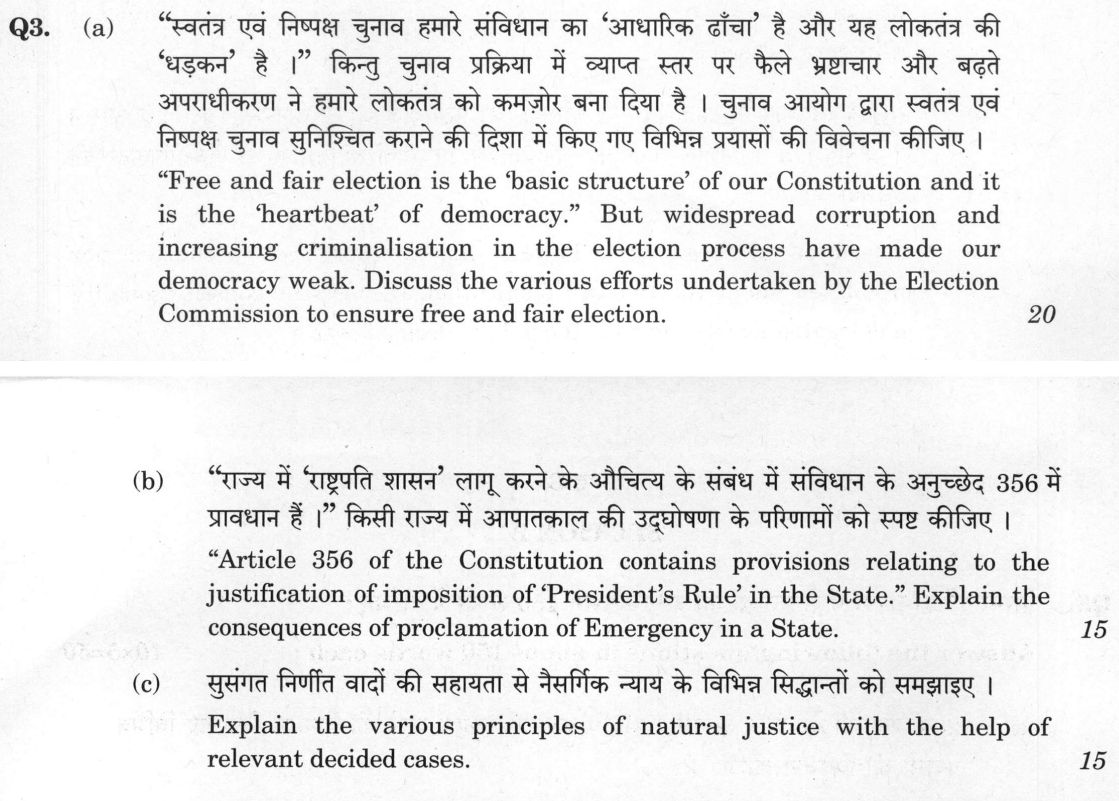
(a) "Free and fair election is the 'basic structure' of our Constitution and it is the 'heartbeat' of democracy." But widespread…
"Free and fair election is the 'basic structure' of our Constitution and it is the 'heartbeat' of democracy." But widespread corruption and increasing criminalisation in the election process have made our democracy weak. Discuss the various efforts undertaken by the Election Commission to ensure free and fair election. 20 marks
"Article 356 of the Constitution contains provisions relating to the justification of imposition of 'President's Rule' in the State." Explain the consequences of proclamation of Emergency in a State. 15 marks
Explain the various principles of natural justice with the help of relevant decided cases. 15 marks
हिंदी में प्रश्न पढ़ें
"स्वतंत्र एवं निष्पक्ष चुनाव हमारे संविधान का 'आधारिक ढांचा' है और यह लोकतंत्र की 'धड़कन' है ।" किंतु चुनाव प्रक्रिया में व्याप्त स्तर पर फैले भ्रष्टाचार और बढ़ते अपराधीकरण ने हमारे लोकतंत्र को कमजोर बना दिया है । चुनाव आयोग द्वारा स्वतंत्र एवं निष्पक्ष चुनाव सुनिश्चित करने की दिशा में किए गए विभिन्न प्रयासों की विवेचना कीजिए । 20
"राज्य में 'राष्ट्रपति शासन' लागू करने के औचित्य के संबंध में संविधान के अनुच्छेद 356 में प्रावधान हैं ।" किसी राज्य में आपातकाल की उद्घोषणा के परिणामों को स्पष्ट कीजिए । 15
सुसंगत निर्णीत वादों की सहायता से नैसर्गिक न्याय के विभिन्न सिद्धांतों को समझाइए । 15
Model answer
Written by UPSC Answer Check against this question's marking rubric, to the expected length. UPSC does not publish answers for Mains — this is one way to score well, not an official key.
On elections, the Election Commission of India (ECI) is entrusted under Article 324 with the superintendence, direction and control of elections to Parliament and State Legislatures. It issues the Model Code of Conduct, monitors expenditure, scrutinises affidavits, and, after PUCL v Union of India (2002), requires disclosure of criminal antecedents, assets, liabilities and qualifications. It has introduced VVPAT, uses SVEEP for expenditure monitoring, and the cVIGIL app to receive public complaints. It can reject nominations, cancel elections and deregister political parties under Section 29A(9) of the Representation of the People Act, 1951 on specified grounds, such as a defunct party not functioning for five years. Yet the ECI cannot deregister a party merely for corruption or disqualify candidates without statutory reform, and it must contend with rising criminalisation, visible in increasing MPs with criminal records, money power and paid news. Its efforts are significant but incomplete; electoral reforms are needed to strengthen deterrence.
On President's Rule, Article 356 permits a proclamation when the President is satisfied that the State Government cannot be carried on in accordance with the Constitution. The State Legislature may be suspended or dissolved, and elections must be held if dissolution occurs. The President may assume all executive functions of the State except those of the Governor, or direct the Governor to exercise them subject to Presidential directions. The proclamation lasts at most six months and may be extended by resolutions of both Houses, each extension not exceeding six months and the total period not exceeding three years. The 44th Amendment strengthened the clause by requiring the President's satisfaction to rest on the Governor's report or other material, and by adding conditions for extension beyond one year, including Election Commission certification where elections cannot be held. In S.R. Bommai v Union of India (1994), the Supreme Court held that the proclamation is subject to judicial review and must be based on relevant material, be objective and not arbitrary, and rest on breakdown of constitutional machinery, not maladministration. Political disagreement or poor governance does not justify President's Rule. Recent challenges in Uttarakhand (2016) and Maharashtra (2019) show that courts now test the material and objective basis of the proclamation.
On natural justice, the principle audi alteram partem requires a fair hearing: notice, an opportunity to present one's case, and, where adverse material is relied upon, an opportunity to meet it. In R.C. Cooper v Union of India (1970), the Court examined fair procedure in the context of property rights under Articles 19 and 31; in Maneka Gandhi v Union of India (1978), it held that any procedure under Article 21 must be fair, just and reasonable, not arbitrary. The principle nemo judex in causa sua prohibits bias. In Gullapalli Nageswara Rao v A. Raja Gopal (1959) and Manak Lal v Dr. Prem Chand (1957), the Court treated personal or pecuniary interest as disqualifying; in A.K. Kraipak v Union of India (1969), it extended the rule to non-statutory authorities and held that even a reasonable possibility of official bias is enough. Reasoned decisions are also essential: an order passed without reasons is not a valid order, as held in Deoman Upadhyaya v State of U.P. (1956). These rules are not absolute. They may yield to urgency, confidentiality or impracticability, and statutory procedure may exclude a hearing where it is complete, as in Union of India v T.R. Varma (1957) and Swadeshi Cotton Mills v Union of India (1981). Together, these safeguards show that constitutional governance depends on institutional discipline, fair procedure and judicial review.
What "Discuss" is asking you to do
Lay the issue out from more than one side — how it arose, what is claimed for it, what is held against it, and where it now stands. UPSC attaches discuss to broad topics with several live dimensions, so coverage of the dimensions earns more than the strength of your opinion.
Structure that answers it
Set the issue up → the case as it is made → the case against → the dimension both sides leave out → where the balance now lies
Where marks are lost
Listing facts with no thread between them, or arguing one side throughout and calling it a discussion.
How this answer will be evaluated
Approach
Framework: Issue > Rule: statute or Article > Authority > Application and conclusion. (a) discuss: intro > 3-4 dimensions > example > balanced close | (b) explain: definition/context > points in order > small example > short close | (c) explain: definition/context > points in order > small example > short close Full marks: Precise legal terminology, specific case citations with ratio, and clear application to the prompt's context.
Key points expected
- Mention Model Code of Conduct (MCC)
- Cite specific ECI notifications or guidelines
- Address criminalisation (e.g., 1989 Act amendments)
- Address corruption (e.g., NOTA, Voter Education)
- Mention suspension of Article 356
- Explain impact on State Legislature
- Explain impact on State Executive
- Mention impact on Fundamental Rights (Art 359)
Evaluation rubric
Each sub-part is marked on its own, against the marks and word limit printed on the paper.
- (a) Intro > 3-4 dimensions of ECI efforts > example > balanced close 20 marks
discuss— intro → 3-4 dimensions → example → balanced close
Must cover
- Mention Model Code of Conduct (MCC)
- Cite specific ECI notifications or guidelines
- Address criminalisation (e.g., 1989 Act amendments)
- Address corruption (e.g., NOTA, Voter Education)
Loses marks
- Generic discussion without specific ECI measures
- Ignoring the 'criminalisation' aspect of the prompt
- Outcome-only citation of cases without ratio
Earns more
- Reference to Model Code of Conduct (MCC)
- Mention of NOTA (None of the Above)
- Reference to Voter Education Programme
- Mention of Model Code of Conduct (MCC)
Extra mark
- Cite Law Commission Report on electoral reforms
- Reference to recent Supreme Court judgment on ECI powers
- (b) Definition/context > points in order > small example > short close 15 marks
explain— definition/context → points in order → small example → short close
Must cover
- Mention suspension of Article 356
- Explain impact on State Legislature
- Explain impact on State Executive
- Mention impact on Fundamental Rights (Art 359)
Loses marks
- Confusing President's Rule with National Emergency
- Failing to mention the role of the Governor
- Vague description of 'consequences' without legal basis
Earns more
- Reference to Sarkaria Commission recommendations
- Mention of 7th Schedule implications
- Reference to 44th Amendment Act
- Mention of impact on High Courts
Extra mark
- Cite S.R. Bommai v. Union of India
- Reference to specific historical instance (e.g., 1987)
- (c) Definition/context > points in order > small example > short close 15 marks
explain— definition/context → points in order → small example → short close
Must cover
- Define Audi Alteram Partem
- Define Nemo Judex In Causa Sua
- Cite relevant decided cases for each principle
- Explain the 'reasoning' requirement
Loses marks
- Listing principles without case law support
- Confusing natural justice with constitutional due process
- Failing to distinguish between the two main principles
Earns more
- Mention of 'Reasoned Order' as a principle
- Reference to Maneka Gandhi v. Union of India
- Reference to State of Punjab v. Davinder Singh
- Mention of 'Procedural Due Process'
Extra mark
- Cite a recent Supreme Court judgment on natural justice
- Reference to a specific administrative law case
Practice this exact question
Write your answer and it is marked point by point against the model answer above — what you covered, what you missed, what you got wrong.
Evaluate my answer →More from Law 2021 Paper I
- Q1 Answer the following questions in about 150 words each : 10×5=50 (a) "The Fundamental Rig…
- Q2 (a) "Pluralism is the keystone of Indian culture and religious tolerance is the bedrock o…
- Q3 (a) "Free and fair election is the 'basic structure' of our Constitution and it is the 'h…
- Q4 (a) "The provisions of the Directive Principles of State Policy are not enforceable by an…
- Q5 Answer the following questions in about 150 words each : 10×5=50 (a) Discuss the various…
- Q6 (a) Distinguish whether 'Recognition of States' is an act of policy or of law. Also disti…