Paper I — Q6
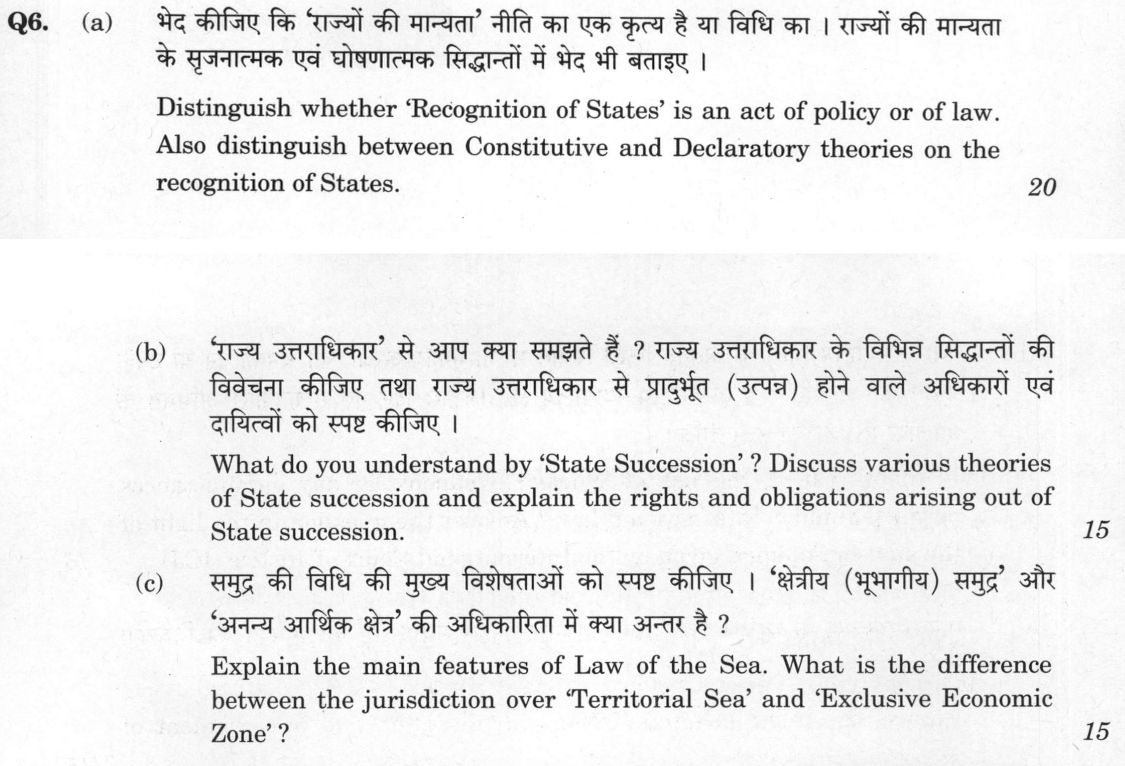
(a) Distinguish whether 'Recognition of States' is an act of policy or of law. Also distinguish between Constitutive and…
Distinguish whether 'Recognition of States' is an act of policy or of law. Also distinguish between Constitutive and Declaratory theories on the recognition of States. 20 marks
What do you understand by 'State Succession'? Discuss various theories of State succession and explain the rights and obligations arising out of State succession. 15 marks
Explain the main features of Law of the Sea. What is the difference between the jurisdiction over "Territorial Sea' and 'Exclusive Economic Zone'? 15 marks
हिंदी में प्रश्न पढ़ें
भेद कीजिए कि 'राज्यों की मान्यता' नीति का एक कृत्य है या विधि का । राज्यों की मान्यता के सृजनात्मक एवं घोषणात्मक सिद्धान्तों में भेद भी बताइए । 20
'राज्य उत्तराधिकार' से आप क्या समझते हैं ? राज्य उत्तराधिकार के विभिन्न सिद्धान्तों की विवेचना कीजिए, तथा राज्य उत्तराधिकार से प्रादुर्भूत (उत्पन्न) होने वाले अधिकारों एवं दायित्वों को स्पष्ट कीजिए । 15
समुद्र की विधि की मुख्य विशेषताओं को स्पष्ट कीजिए । 'क्षेत्रीय (भूमागीय) समुद्र' और 'अनन्य आर्थिक क्षेत्र' की अधिकारिता में क्या अंतर है ? 15 marks
Model answer
Written by UPSC Answer Check against this question's marking rubric, to the expected length. UPSC does not publish answers for Mains — this is one way to score well, not an official key.
Recognition is a contested interface between political judgment and legal consequence. As policy, it is a political decision taken in discretion, reflecting diplomacy, security or ideology. It may be granted, withheld, withdrawn or qualified without creating a legal right in the entity concerned. The Estrada doctrine illustrates this: states may maintain relations without expressly recognising, treating non-recognition as policy rather than legal denial. As law, recognition produces legal consequences, may involve legal duties, and may be governed by rules or collective institutional decisions. Admission to the United Nations is a collective act conferring membership rights and duties, and recognition can affect treaty-making, litigation and diplomatic protection. Thus policy has discretion and political effect; law has legal effect and may be collective or institutional.
Constitutive theory holds that a state comes into legal existence only when recognised; recognition creates statehood. It is associated with Oppenheim. Declaratory theory, associated with Lauterpacht and reflected in the Montevideo Convention criteria, holds that a state exists when it has a permanent population, defined territory, government and capacity to enter relations; recognition merely declares that fact. Contemporary practice is mixed: objective criteria matter, but recognition remains politically significant. Kosovo and Palestine show qualified or divided recognition, with some states conferring legal effects and others not, so neither pure theory fully explains statehood.
State succession is the transfer of responsibility for a territory’s international relations from one state to another. It differs from succession of governments, where the same state changes its internal regime but its international identity continues. Theories include Grotian/Vattelian universal succession, in which the successor inherits all rights and obligations; continuity theory, preserving legal identity; organic succession, treating succession as natural development; and clean slate or tabula rasa, especially for newly independent states, beginning with a fresh legal position.
Rights and obligations include treaties, state property, archives, debts, nationality and membership in international organisations. Treaty succession is governed by the 1978 Vienna Convention on Succession of States in respect of Treaties; newly independent states generally follow a clean-slate rule for predecessor treaties and debts, though equitable apportionment may be used in particular cases and is not universal. State property, archives and debts are addressed by the 1983 Vienna Convention, which has not entered into force, so customary rules and negotiated settlements apply. Nationality rules determine which persons become nationals of the successor. Membership in international organisations depends on practice: after 1947 India continued as a UN member while Pakistan applied and was admitted; after 1991 Russia continued the USSR’s UN seat while other republics applied.
UNCLOS 1982 codifies the Law of the Sea. Its features are maritime zones: internal waters, territorial sea, contiguous zone, EEZ, continental shelf, high seas and the deep seabed Area; regulation of navigation, resources, environment and research; and institutions such as the International Seabed Authority, ITLOS and the Commission on the Limits of the Continental Shelf. UNCLOS provides multiple dispute-settlement mechanisms, including the ICJ, ITLOS, arbitration and special arbitration.
The difference between the territorial sea and EEZ is jurisdiction. The territorial sea extends up to 12 nautical miles and is subject to coastal sovereignty, limited mainly by innocent passage. The EEZ extends up to 200 nautical miles and gives the coastal state sovereign rights over natural resources and jurisdiction over specified activities such as artificial islands, marine scientific research and environmental protection, but not full sovereignty; freedoms of navigation, overflight and laying submarine cables remain. Thus the territorial sea is a sovereignty zone with passage rights; the EEZ is a resource and regulatory zone preserving high-seas freedoms.
What "Distinguish" is asking you to do
Name the property that separates the items and say which side holds it. Distinguish is marked exactly as differentiate is, with no difference in expectation, but its stems more often line up three terms rather than two — gender equality, gender equity and empowerment — and every pair in the set has to be separated.
Structure that answers it
The category they all sit in → the property dividing the first pair → the second pair → the third → why the boundary matters in practice
Where marks are lost
Separating the two obviously different items and leaving the middle term unplaced. A description of each side from which the line must be inferred is marked as description, not as a distinction.
How this answer will be evaluated
Approach
Framework: Issue > Rule > Authority > Application. (a) compare: paired headings or table > key differences > significance > conclusion | (b) discuss: intro > 3-4 dimensions > example > balanced close | (c) explain: definition/context > points in order > small example > short close Full marks: Precise legal distinctions, specific case/statute references, clear theoretical application.
Key points expected
- Recognition as act of policy vs law
- Constitutive theory: recognition creates legal personality
- Declaratory theory: recognition confirms existing state
- Distinction between the two theories
- Definition of State Succession
- Theories: Continuity vs Clean Slate
- Rights arising from succession
- Obligations arising from succession
Evaluation rubric
Each sub-part is marked on its own, against the marks and word limit printed on the paper.
- (a) Distinguish policy vs law in recognition and constitutive vs declaratory theories. 20 marks
compare— paired headings or table → key differences → significance → conclusion
Must cover
- Recognition as act of policy vs law
- Constitutive theory: recognition creates legal personality
- Declaratory theory: recognition confirms existing state
- Distinction between the two theories
Loses marks
- Confusing recognition of government with state
- Failing to distinguish policy from law
- Vague definitions without theoretical basis
Earns more
- Reference to Montevideo Convention criteria
- Mention of 'de facto' vs 'de jure' recognition
- Reference to specific state recognition examples
Extra mark
- Reference to specific ICJ case law on recognition
- Mention of 'entitlement' vs 'act' of recognition
- (b) Define State Succession, discuss theories, and explain rights/obligations. 15 marks
discuss— intro → 3-4 dimensions → example → balanced close
Must cover
- Definition of State Succession
- Theories: Continuity vs Clean Slate
- Rights arising from succession
- Obligations arising from succession
Loses marks
- Confusing succession of government with state
- Ignoring the 'clean slate' principle
- Failing to distinguish rights from obligations
Earns more
- Reference to Vienna Convention on Succession of States
- Distinction between treaty and non-treaty obligations
- Example of a specific state succession event
Extra mark
- Reference to 'tabula rasa' doctrine
- Mention of 'continuity of state' vs 'continuity of government'
- (c) Explain Law of the Sea features and difference between Territorial Sea and EEZ. 15 marks
explain— definition/context → points in order → small example → short close
Must cover
- Main features of Law of the Sea (UNCLOS)
- Definition of Territorial Sea jurisdiction
- Definition of Exclusive Economic Zone (EEZ)
- Difference between Territorial Sea and EEZ
Loses marks
- Confusing Territorial Sea with EEZ
- Failing to mention UNCLOS
- Vague description of maritime zones
Earns more
- Reference to UNCLOS 1982
- Mention of 'sovereignty' vs 'sovereign rights'
- Reference to 12 nautical miles limit
Extra mark
- Reference to 'High Seas' vs 'EEZ'
- Mention of 'Continental Shelf' jurisdiction
Practice this exact question
Write your answer and it is marked point by point against the model answer above — what you covered, what you missed, what you got wrong.
Evaluate my answer →More from Law 2021 Paper I
- Q3 (a) "Free and fair election is the 'basic structure' of our Constitution and it is the 'h…
- Q4 (a) "The provisions of the Directive Principles of State Policy are not enforceable by an…
- Q5 Answer the following questions in about 150 words each : 10×5=50 (a) Discuss the various…
- Q6 (a) Distinguish whether 'Recognition of States' is an act of policy or of law. Also disti…
- Q7 (a) Discuss the powers of the Security Council for the maintenance of world peace and sec…
- Q8 (a) Is it a legal duty of States under international law to settle their disputes by peac…