Paper I — Q5
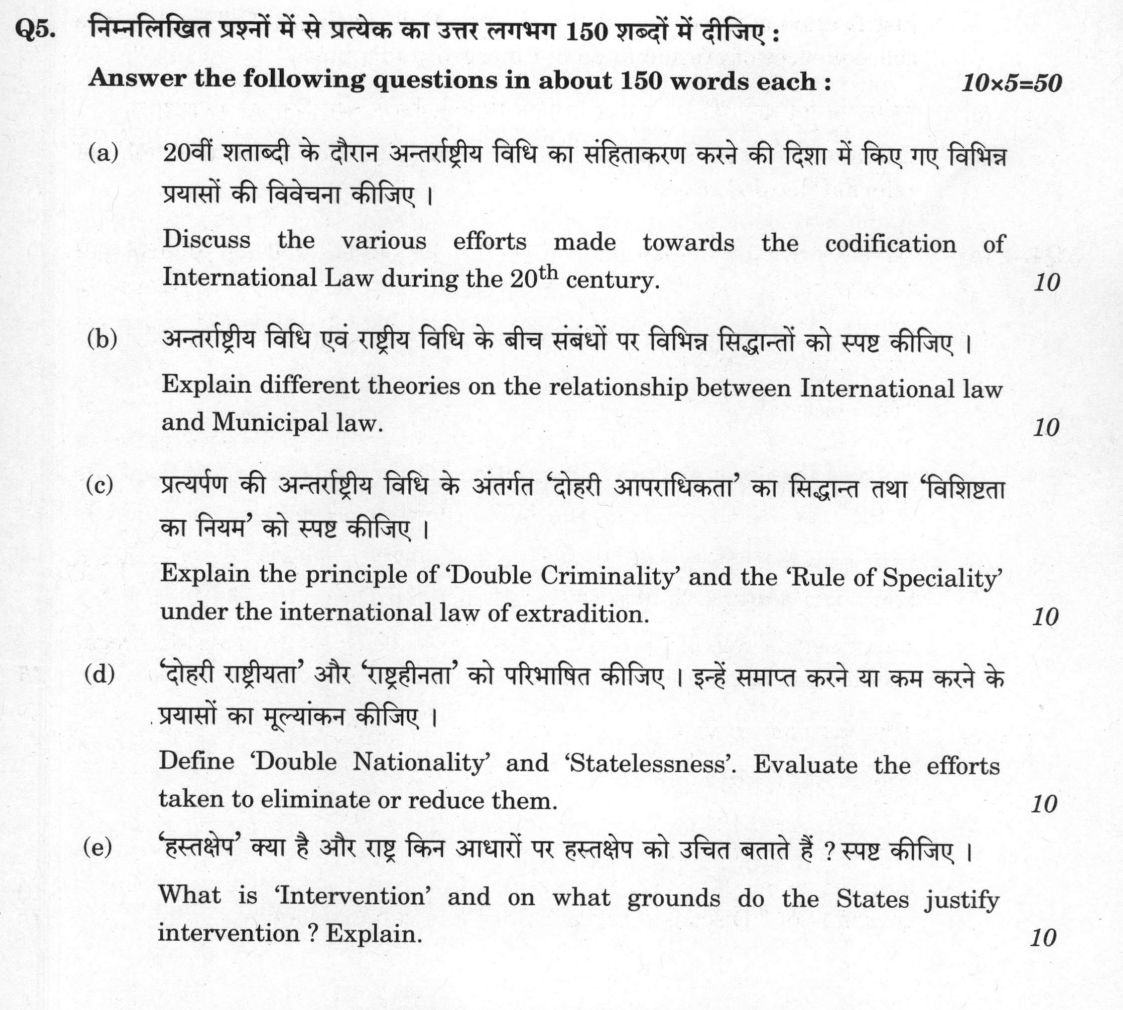
Answer the following questions in about 150 words each : 10×5=50 (a) Discuss the various efforts made towards the codification…
Answer the following questions in about 150 words each : 10×5=50
Discuss the various efforts made towards the codification of International Law during the 20th century. 10 marks
Explain different theories on the relationship between International law and Municipal law. 10 marks
Explain the principle of 'Double Criminality' and the 'Rule of Speciality' under the international law of extradition. 10 marks
Define 'Double Nationality' and 'Statelessness'. Evaluate the efforts taken to eliminate or reduce them. 10 marks
What is 'Intervention' and on what grounds do the States justify intervention ? Explain. 10 marks
हिंदी में प्रश्न पढ़ें
निम्नलिखित प्रश्नों में से प्रत्येक का उत्तर लगभग 150 शब्दों में दीजिए :
20वीं शताब्दी के दौरान अन्तर्राष्ट्रीय विधि का संहिताकरण करने की दिशा में किए गए विभिन्न प्रयासों की विवेचना कीजिए । 10
अन्तर्राष्ट्रीय विधि एवं राष्ट्रीय विधि के बीच संबंधों पर विभिन्न सिद्धान्तों को स्पष्ट कीजिए । 10
प्रत्यर्पण की अन्तर्राष्ट्रीय विधि के अन्तर्गत 'दोहरी अपराधिकता' का सिद्धान्त तथा 'विशिष्टता का नियम' को स्पष्ट कीजिए । 10
'दोहरी राष्ट्रीयता' और 'राष्ट्रीयता' को परिभाषित कीजिए । इन्हें समाप्त करने या कम करने के प्रयासों का मूल्यांकन कीजिए । 10
'हस्तक्षेप' क्या है और राष्ट्र किन आधारों पर हस्तक्षेप को उचित बताते हैं ? स्पष्ट कीजिए । 10
Model answer
Written by UPSC Answer Check against this question's marking rubric, to the 150-word length. UPSC does not publish answers for Mains — this is one way to score well, not an official key.
(a) The 20th century moved international law from customary practice toward deliberate codification. The Hague Peace Conferences of 1899 and 1907 began this process by codifying rules on the conduct of war and peaceful settlement of disputes. The 1930 Hague Codification Conference, though it did not produce a general code, identified major topics and showed the difficulty of securing broad participation. The League of Nations continued preparatory work, while the UN Charter, Article 13(1), charged the General Assembly with encouraging progressive development and codification. The International Law Commission, established in 1947, became the principal organ, drafting the Vienna Convention on Diplomatic Relations (1961), the Vienna Convention on the Law of Treaties (1969), and the Articles on State Responsibility. These instruments converted customary rules into treaty law, though their universal acceptance remains uneven. The process was not uniform: many conventions remain optional, and customary law continues to fill gaps.
(b) The relationship between international and municipal law is explained by monism and dualism. Monists treat them as one legal system; Kelsen located the ultimate norm, the grundnorm, in international law, giving it primacy. Dualists, such as Triepel and Anzilotti, regard them as distinct orders, so an international rule must enter municipal law through a domestic act. Procedural theories explain the bridge: transformation requires a legislative or executive act to adopt the norm; incorporation makes certain international rules automatically part of domestic law; delegation allows states to confer authority on international institutions; and harmonization seeks to align domestic statutes with treaty obligations. In practice, states often combine these theories, using incorporation for human rights and transformation for criminal law. India follows a transformation-like approach: Article 253 empowers Parliament to make laws implementing international obligations, while the Vishaka Guidelines show how courts can fill gaps using international norms until legislation is enacted.
(c) Double criminality requires that the conduct for which extradition is sought be criminal in both the requesting and the requested state. It is a safeguard against political or moral disagreement and appears in most extradition treaties. Double criminality may be assessed at the time of the act or at extradition, depending on the treaty. The Rule of Speciality requires that the extradited person be tried or punished only for the offence specified in the request, unless the receiving state obtains consent or the sending state permits another prosecution. R v. Governor of Pentonville Prison (Ex parte Osman) illustrates judicial scrutiny of speciality in extradition. India’s Extradition Act, 1962, gives effect to these principles: extradition is governed by the applicable treaty or the Act’s definition of an extradition offence, and Section 29 restricts trial or punishment for other offences unless consent is obtained. Together, the rules balance cooperation with individual liberty.
(d) Double nationality means a person is simultaneously a citizen of two or more states; statelessness means a person is not considered a national by any state under its law. The 1961 Convention on the Reduction of Statelessness attacks statelessness by requiring states to grant nationality to foundlings, children born on territory at risk of statelessness, and in cases of succession or marriage. Its effectiveness is limited by low ratification and by states’ reluctance to surrender control over citizenship. The 1963 European Convention on Nationality addresses double nationality within Europe, but it does not impose a universal ban; many states still regulate or permit dual citizenship. India’s Citizenship Act, 1955, reduces double nationality by terminating Indian citizenship under Section 10 when a person voluntarily acquires foreign citizenship, while Section 5 registration for persons of Indian origin helps maintain links. Yet this single-citizenship rule can create statelessness if no other state grants nationality, showing the need for coordinated treaty and domestic reform.
(e) Intervention is dictatorial interference by one state in the internal or external affairs of another. The general prohibition on State intervention is customary international law, affirmed in the Friendly Relations Declaration and the Nicaragua case, while Article 2(7) of the UN Charter only restricts UN action in matters within domestic jurisdiction. States justify intervention on several grounds: consent or invitation; collective security under Chapter VII; self-defence under Article 51; protection of nationals, as in the Tunis and Morocco incidents of 1956; and humanitarian intervention, debated after NATO’s 1999 Kosovo action. Non-forceful measures, such as diplomatic pressure, are also regulated by the non-intervention principle. The Security Council’s veto can block collective action. These grounds show tension between sovereignty and protection. A workable approach is to keep consent and Security Council authorisation as the primary bases, while developing clearer, limited humanitarian criteria to prevent abuse.
What "Discuss" is asking you to do
Lay the issue out from more than one side — how it arose, what is claimed for it, what is held against it, and where it now stands. UPSC attaches discuss to broad topics with several live dimensions, so coverage of the dimensions earns more than the strength of your opinion.
Structure that answers it
Set the issue up → the case as it is made → the case against → the dimension both sides leave out → where the balance now lies
Where marks are lost
Listing facts with no thread between them, or arguing one side throughout and calling it a discussion.
How this answer will be evaluated
Approach
Framework: Issue > Rule > Authority > Application. (a) discuss: intro > 3-4 dimensions > example > balanced close | (b) explain: definition/context > points in order > small example > short close | (c) explain: definition/context > points in order > small example > short close | (d) evaluate: criteria > evidence > balanced judgment | (e) justify: claim > 3-4 reasons > evidence > conclusion Full marks: Precise legal terminology, specific case/convention citations, clear distinction between concepts.
Key points expected
- Mention Hague Conferences (1899/1907) as precursors
- Identify ILC (1947) as primary body
- Cite specific codified conventions (e.g., Vienna 1961/1969)
- Reference UN General Assembly resolutions
- Define Monism (unity of legal systems)
- Define Dualism (separation of systems)
- Explain the 'transformation' requirement in Dualism
- Mention the 'incorporation' method in Monism
Evaluation rubric
Each sub-part is marked on its own, against the marks and word limit printed on the paper.
- (a) Chronological overview of 20th-century codification efforts. 10 marks · 150 words
discuss— intro → 3-4 dimensions → example → balanced close
Must cover
- Mention Hague Conferences (1899/1907) as precursors
- Identify ILC (1947) as primary body
- Cite specific codified conventions (e.g., Vienna 1961/1969)
- Reference UN General Assembly resolutions
Loses marks
- Listing events without explaining their legal impact
- Ignoring the role of the ILC
Earns more
- Mention Montevideo Convention 1933
- Reference Nijmegen Conference 1921
- Mention specific ILC draft conventions
Extra mark
- Reference specific ILC Special Rapporteurs
- Mention the 1930 Codification Conference
- (b) Comparison of Monist and Dualist theories. 10 marks · 150 words
explain— definition/context → points in order → small example → short close
Must cover
- Define Monism (unity of legal systems)
- Define Dualism (separation of systems)
- Explain the 'transformation' requirement in Dualism
- Mention the 'incorporation' method in Monism
Loses marks
- Confusing 'incorporation' with 'transformation'
- Failing to distinguish the two main theories
Earns more
- Reference the Lotus Case (1927)
- Mention the Asylum Case (1950)
- Reference the Barcelona Traction Case
Extra mark
- Mention the 'priority' debate (which law prevails)
- Reference specific municipal court rulings
- (c) Definition and application of extradition principles. 10 marks · 150 words
explain— definition/context → points in order → small example → short close
Must cover
- Define 'Double Criminality' (offense in both states)
- Define 'Rule of Speciality' (trial only for requested crime)
- Explain the purpose of these safeguards
- Mention the 'political offense' exception
Loses marks
- Confusing 'speciality' with 'double criminality'
- Failing to explain the 'political offense' exception
Earns more
- Reference the Extradition Act 1962 (India)
- Mention the 'proportionality' requirement
- Reference the 'non bis in idem' principle
Extra mark
- Reference the 'aut dedere aut judicare' principle
- Mention specific extradition treaties
- (d) Definitions and assessment of nationality efforts. 10 marks · 150 words
evaluate— criteria → evidence → balanced judgment
Must cover
- Define 'Double Nationality' (dual citizenship)
- Define 'Statelessness' (lack of nationality)
- Mention the 1954 Convention on Statelessness
- Mention the 1961 Convention on Double Nationality
Loses marks
- Failing to distinguish the two concepts
- Ignoring the international conventions
Earns more
- Reference the 'right to a nationality' (UDHR Art 15)
- Mention the 'jus soli' vs 'jus sanguinis' debate
- Reference the 'Nansen' passport
Extra mark
- Mention the '1999 Hague Convention' on nationality
- Reference specific national laws on dual citizenship
- (e) Definition of intervention and its legal grounds. 10 marks · 150 words
justify— claim → 3-4 reasons → evidence → conclusion
Must cover
- Define 'Intervention' (interference in internal affairs)
- Mention the 'Monroe Doctrine' (historical context)
- Explain 'Humanitarian Intervention' (R2P)
- Reference the 'UN Charter' (Art 2(7) vs Art 51)
Loses marks
- Confusing 'intervention' with 'mediation'
- Failing to mention the 'UN Charter' constraints
Earns more
- Mention the 'Kosovo' intervention (1999)
- Reference the 'Responsibility to Protect' (2005)
- Mention the 'non-intervention' principle
Extra mark
- Reference the 'UN Security Council' resolutions
- Mention the 'doctrine of necessity'
Practice this exact question
Write your answer and it is marked point by point against the model answer above — what you covered, what you missed, what you got wrong.
Evaluate my answer →More from Law 2021 Paper I
- Q2 (a) "Pluralism is the keystone of Indian culture and religious tolerance is the bedrock o…
- Q3 (a) "Free and fair election is the 'basic structure' of our Constitution and it is the 'h…
- Q4 (a) "The provisions of the Directive Principles of State Policy are not enforceable by an…
- Q5 Answer the following questions in about 150 words each : 10×5=50 (a) Discuss the various…
- Q6 (a) Distinguish whether 'Recognition of States' is an act of policy or of law. Also disti…
- Q7 (a) Discuss the powers of the Security Council for the maintenance of world peace and sec…
- Q8 (a) Is it a legal duty of States under international law to settle their disputes by peac…