Paper II — Q1
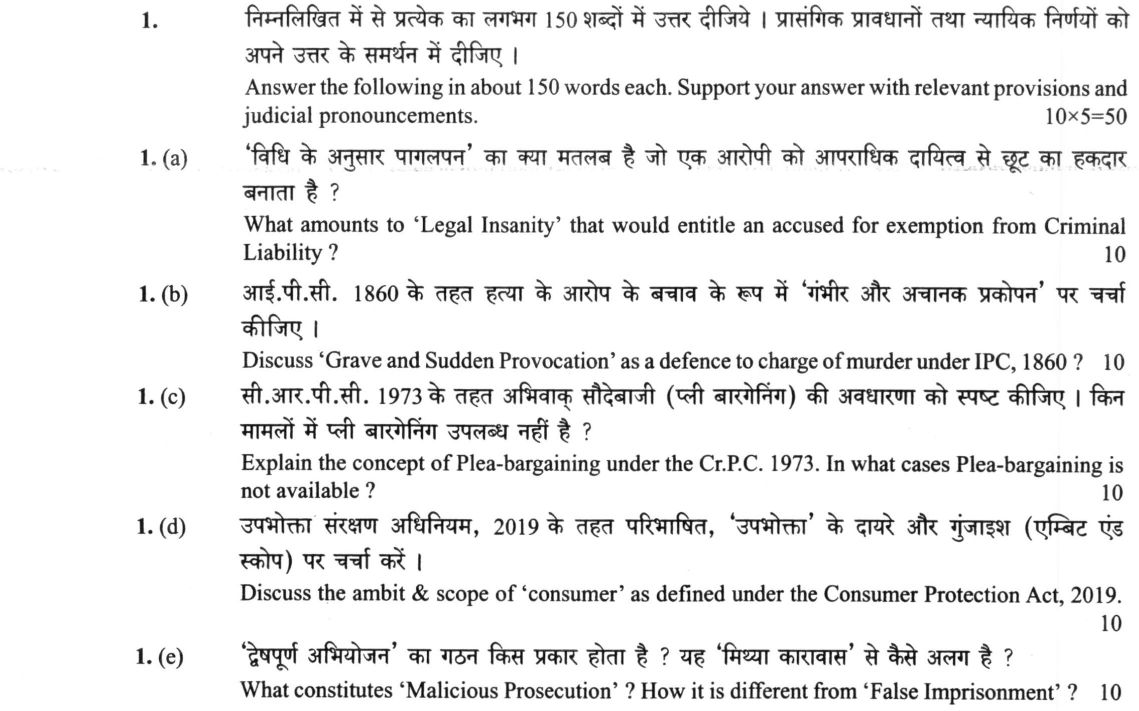
Answer the following in about 150 words each. Support your answer with relevant provisions and judicial pronouncements…
Answer the following in about 150 words each. Support your answer with relevant provisions and judicial pronouncements. 10×5=50
What amounts to 'Legal Insanity' that would entitle an accused for exemption from Criminal Liability ? 10 marks
Discuss 'Grave and Sudden Provocation' as a defence to charge of murder under IPC, 1860 ? 10 marks
Explain the concept of Plea-bargaining under the Cr.P.C. 1973. In what cases Plea-bargaining is not available ? 10 marks
Discuss the ambit & scope of 'consumer' as defined under the Consumer Protection Act, 2019. 10 marks
What constitutes 'Malicious Prosecution' ? How it is different from 'False Imprisonment' ? 10 marks
हिंदी में प्रश्न पढ़ें
निम्नलिखित में से प्रत्येक का लगभग 150 शब्दों में उत्तर दीजिए । प्रासंगिक प्रावधानों तथा न्यायिक निर्णयों को अपने उत्तर के समर्थन में दीजिए । 10×5=50
'विधि के अनुसार पागलपन' का क्या मतलब है जो एक आरोपी को आपराधिक दायित्व से छूट का हकदार बनाता है ? 10 marks
आई.पी.सी. 1860 के तहत हत्या के आरोप के बचाव के रूप में 'गंभीर और अचानक प्रकोपन' पर चर्चा कीजिए । 10
सी.आर.पी.सी. 1973 के तहत अभिव्यक्त सौदेबाजी (प्ली बारगेनिंग) की अवधारणा को स्पष्ट कीजिए । किन मामलों में प्ली बारगेनिंग उपलब्ध नहीं है ? 10 marks
उपभोक्ता संरक्षण अधिनियम, 2019 के तहत परिभाषित, 'उपभोक्ता' के दायरे और गुंजाइश (एम्बिट एंड स्कोप) पर चर्चा करें । 10
'द्वेषपूर्ण अभियोजन' का गठन किस प्रकार होता है ? यह 'मिथ्या कारावास' से कैसे अलग है ? 10 marks
Model answer
Written by UPSC Answer Check against this question's marking rubric, to the 150-word length. UPSC does not publish answers for Mains — this is one way to score well, not an official key.
Legal Insanity Section 84 of the Indian Penal Code (IPC) provides an exemption from criminal liability for acts committed by a person of unsound mind. The provision is grounded in the McNaghten Rules, which establish that the accused must be laboring under such a disorder of the mind that they were incapable of knowing the nature of the act, or that they were doing an act which was wrong or contrary to law. Crucially, this is a test of cognitive incapacity; it does not require the total destruction of conative or volitional faculties, nor does it demand that the accused be unable to control their impulses. The defense is available only if the unsoundness existed at the precise time of the act. In Surendra Mishra v. State of Jharkhand (2012), the Supreme Court clarified that "unsoundness of mind" is not synonymous with "mental illness." A person may be mentally ill yet still possess the cognitive capacity to understand the nature and wrongfulness of their conduct, thereby failing to meet the threshold for legal insanity. Thus, the exemption is narrow, focusing strictly on the absence of knowledge regarding the act’s nature or illegality.
Grave and Sudden Provocation Exception 1 to Section 300 IPC reduces murder to culpable homicide not amounting to murder if the offender, deprived of self-control by grave and sudden provocation, kills or causes death. The provocation must be grave, meaning it would cause a reasonable person to lose self-control, and sudden, leaving no time for the "cooling" of the blood. In K.M. Nanavati v. State of Maharashtra (1962), the court held that the provocation must be such that it would cause an ordinary person to lose their self-control. The defense is unavailable if the provocation is self-induced or if there is a significant interval between the provocation and the act, allowing the offender to regain composure. Furthermore, the provocation must be from the person killed or someone in their presence. This exception acts as a mitigating factor, acknowledging that human beings are not machines and may act in the heat of passion, but it strictly requires that the loss of self-control be immediate and proportionate to the provocation received.
Plea-Bargaining Introduced by the 2005 Amendment, Chapter XXIA (Sections 265A–265L) of the Code of Criminal Procedure (Cr.P.C.) facilitates plea-bargaining. It is essentially a process of sentence bargaining, where the accused pleads guilty to a lesser charge in exchange for a reduced sentence, not a reduction in the charge itself. The process is initiated by the accused and requires a mutually satisfactory disposition. However, Section 265B strictly bars plea-bargaining in specific cases. It is not available if the accused is a woman or a child below the age of fourteen years. It is also excluded for offences punishable with death, life imprisonment, or a minimum term of ten years. Additionally, it does not apply to habitual offenders, defined as those previously convicted of any offence punishable under any law with imprisonment for three years or more. The provision aims to reduce the backlog of cases while ensuring that serious crimes and vulnerable parties are protected from compromise.
Consumer Definition Section 2(7) of the Consumer Protection Act, 2019, significantly expands the definition of a "consumer" compared to the 1986 Act. It includes any person who buys goods or avails services for consideration, whether paid, promised, or partly paid. Crucially, it now explicitly covers beneficiaries of gratuitous services, provided the supplier or provider of the service has received consideration from another person. The definition also encompasses e-commerce, tele-shopping, and multi-level marketing. The exclusion for "commercial purpose" has been narrowed; a consumer is not excluded merely because they use goods or services for earning a livelihood, provided it is not for trade or business. This broadened scope ensures that individuals in the informal sector and those using digital platforms are protected. The National Consumer Disputes Redressal Commission has interpreted this to include hirers and lessees, aligning with the modern economic reality where consumption is often indirect or digital.
Malicious Prosecution vs. False Imprisonment Malicious prosecution is a tort that arises when a person institutes or continues criminal proceedings against another without reasonable and probable cause, with malice, and the proceedings terminate in favor of the accused, causing damage. The elements are: (1) institution of proceedings, (2) absence of reasonable cause, (3) malice, and (4) termination in favor of the accused, and (5) damage. In Khagendra Nath v. Jacob Chandra (1951), the court emphasized that mere ill-will is not sufficient; there must be a lack of honest belief in the guilt of the accused. False imprisonment, conversely, is the unlawful restraint of a person’s liberty without legal process. It is actionable per se, meaning damage need not be proven as a separate element, and it does not require proof of malice, only the absence of lawful authority. While malicious prosecution involves the misuse of legal processes, false imprisonment is a direct physical or legal restraint. The former requires a termination of the process to establish the tort, whereas the latter is complete upon the restraint itself.
What "Discuss" is asking you to do
Lay the issue out from more than one side — how it arose, what is claimed for it, what is held against it, and where it now stands. UPSC attaches discuss to broad topics with several live dimensions, so coverage of the dimensions earns more than the strength of your opinion.
Structure that answers it
Set the issue up → the case as it is made → the case against → the dimension both sides leave out → where the balance now lies
Where marks are lost
Listing facts with no thread between them, or arguing one side throughout and calling it a discussion.
How this answer will be evaluated
Approach
Framework: Issue > Rule > Authority > Application. (a) define: precise definition > the distinguishing feature > one example | (b) discuss: intro > 3-4 dimensions > example > balanced close | (c) explain: definition/context > points in order > small example > short close | (d) discuss: intro > 3-4 dimensions > example > balanced close | (e) compare: paired headings or table > key differences > significance > conclusion Full marks: Precise statutory citation, clear case law application, and balanced discussion of all dimensions.
Key points expected
- Cite Section 84 IPC
- State the 'disease of mind' requirement
- Mention inability to know nature of act
- Cite M'Naghten Rules or relevant case
- Cite Section 300 Exception 1 IPC
- Define 'grave' and 'sudden' provocation
- Explain reduction to Culpable Homicide (Sec 304)
- Cite relevant case law (e.g., K.M. Nanavati)
Evaluation rubric
Each sub-part is marked on its own, against the marks and word limit printed on the paper.
- (a) Define legal insanity and the test for exemption from criminal liability. 10 marks · 150 words
define— precise definition → the distinguishing feature → one example
Must cover
- Cite Section 84 IPC
- State the 'disease of mind' requirement
- Mention inability to know nature of act
- Cite M'Naghten Rules or relevant case
Loses marks
- Confusing insanity with intoxication (Sec 86)
- Failing to cite Section 84
- Vague definition without legal test
Earns more
- Reference to 'insane delusion'
- Distinction from temporary insanity
- Mention of burden of proof
Extra mark
- Reference to recent SC judgment on mental health
- Mention of Law Commission report on insanity
- (b) Explain grave and sudden provocation as a defense to murder. 10 marks · 150 words
discuss— intro → 3-4 dimensions → example → balanced close
Must cover
- Cite Section 300 Exception 1 IPC
- Define 'grave' and 'sudden' provocation
- Explain reduction to Culpable Homicide (Sec 304)
- Cite relevant case law (e.g., K.M. Nanavati)
Loses marks
- Confusing with 'grave and sudden' in other contexts
- Failing to link to Section 304
- Ignoring the 'sudden' element
Earns more
- Mention loss of self-control
- Distinction from premeditation
- Reference to 'heat of passion'
Extra mark
- Reference to Law Commission report on provocation
- Mention of specific SC judgment on 'suddenness'
- (c) Explain plea-bargaining concept and its exclusions under Cr.P.C. 10 marks · 150 words
explain— definition/context → points in order → small example → short close
Must cover
- Cite Sections 258-260 Cr.P.C.
- Define plea-bargaining
- List cases where it is not available
- Mention the role of the court
Loses marks
- Failing to list exclusions
- Confusing with 'compounding' generally
- Ignoring the 'court's role' in approval
Earns more
- Reference to 'compounding of offences'
- Mention of 'serious offences' exclusion
- Reference to 'public interest' test
Extra mark
- Reference to Law Commission report on plea bargaining
- Mention of specific SC judgment on 'abuse of process'
- (d) Discuss the ambit and scope of 'consumer' under CPA 2019. 10 marks · 150 words
discuss— intro → 3-4 dimensions → example → balanced close
Must cover
- Cite Section 2(7) CPA 2019
- Define 'consumer' broadly
- Mention 'any person' and 'beneficiary'
- Exclude 'commercial purpose' (with exceptions)
Loses marks
- Failing to cite Section 2(7)
- Ignoring the 'commercial purpose' exclusion
- Confusing with 'customer' or 'buyer'
Earns more
- Reference to 'free of cost' inclusion
- Mention of 'service' and 'goods'
- Reference to 'digital' or 'online' transactions
Extra mark
- Reference to Law Commission report on consumer protection
- Mention of specific SC judgment on 'commercial purpose'
- (e) Define malicious prosecution and distinguish it from false imprisonment. 10 marks · 150 words
compare— paired headings or table → key differences → significance → conclusion
Must cover
- Define 'malicious prosecution'
- Define 'false imprisonment'
- Highlight key differences (intent, act, result)
- Cite relevant case law for both
Loses marks
- Confusing the two concepts
- Failing to highlight 'malice'
- Ignoring the 'absence of probable cause'
Earns more
- Mention 'malice' as a key element
- Reference to 'absence of probable cause'
- Mention of 'injury' or 'damage'
Extra mark
- Reference to Law Commission report on civil wrongs
- Mention of specific SC judgment on 'malice'
Practice this exact question
Write your answer and it is marked point by point against the model answer above — what you covered, what you missed, what you got wrong.
Evaluate my answer →More from Law 2021 Paper II
- Q1 Answer the following in about 150 words each. Support your answer with relevant provision…
- Q2 (a) Has 'Attempt' been defined anywhere in the IPC, 1860 ? What are the various tests for…
- Q3 (a) From 'Mathura' to 'Nirbhaya' and beyond, discuss the development of Rape laws in Indi…
- Q4 (a) Discuss the evolution and development of rule relating to 'No-fault liability' in Ind…