Paper II — Q7
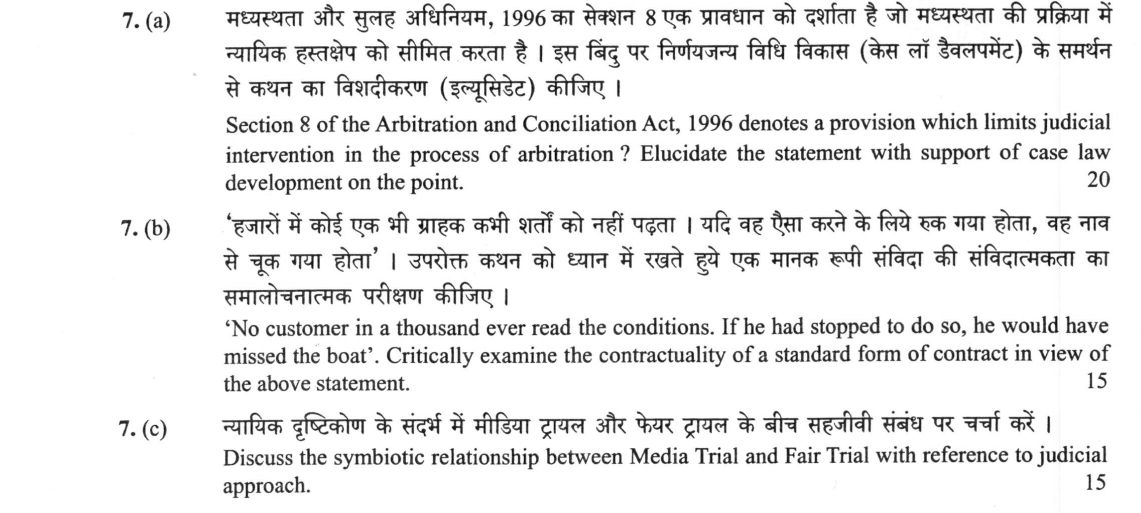
(a) Section 8 of the Arbitration and Conciliation Act, 1996 denotes a provision which limits judicial intervention in the process…
Section 8 of the Arbitration and Conciliation Act, 1996 denotes a provision which limits judicial intervention in the process of arbitration ? Elucidate the statement with support of case law development on the point. 20 marks
'No customer in a thousand ever read the conditions. If he had stopped to do so, he would have missed the boat'. Critically examine the contractuality of a standard form of contract in view of the above statement. 15 marks
Discuss the symbiotic relationship between Media Trial and Fair Trial with reference to judicial approach. 15 marks
हिंदी में प्रश्न पढ़ें
मध्यस्थता और सुलह अधिनियम, 1996 का सेक्शन 8 एक प्रावधान को दर्शाता है जो मध्यस्थता की प्रक्रिया में न्यायिक हस्तक्षेप को सीमित करता है । इस बिंदु पर निर्णयजन्य विधि विकास (केस लॉ डेवलपमेंट) के समर्थन से कथन का विशदीकरण (इल्युसिडेट) कीजिए । 20
'हजारों में कोई एक भी ग्राहक कभी शर्तों को नहीं पढ़ता । यदि वह ऐसा करने के लिए रुक गया होता, वह नाव से चूक गया होता' । उपरोक्त कथन को ध्यान में रखते हुए एक मानक रूपी संविदा की संविदात्मकता का समालोचनात्मक परीक्षण कीजिए । 15
न्यायिक दृष्टिकोण के संदर्भ में मीडिया ट्रायल और फेयर ट्रायल के बीच सहजीवी संबंध पर चर्चा करें । 15
Model answer
Written by UPSC Answer Check against this question's marking rubric, to the expected length. UPSC does not publish answers for Mains — this is one way to score well, not an official key.
Section 8 and Judicial Minimalism in Arbitration
Section 8 of the Arbitration and Conciliation Act, 1996, read alongside the non-obstante bar in Section 5, operates as a statutory mandate limiting judicial intervention by requiring courts to refer parties to arbitration where an action is brought in a matter covered by an arbitration agreement. This referral is mandatory if applied for not later than the date of submitting the first statement on the substance of the dispute. The provision preserves the kompetenz-kompetenz principle (Section 16), empowering the arbitral tribunal to rule on its own jurisdiction.
The judicial approach has progressively shifted toward minimal intervention. Although SBP & Co. v. Patel Engineering (2005) permitted extensive preliminary judicial determination of jurisdictional issues, the 2015 Amendment Act restricted the court's role under Section 8(1) and Section 11(6A) strictly to examining the prima facie "existence" of an arbitration agreement. Expanding on the pro-arbitration approach laid down in Chloro Controls India (2013), the Supreme Court in Vidya Drolia v. Durga Trading Corp. (2020) affirmed that judicial review under Section 8 is confined to a prima facie, summary standard to weed out deadwood; where the validity of the agreement remains arguable, the rule is "when in doubt, do refer."
Contractuality of Standard Form of Contracts
Standard form contracts, or "contracts of adhesion," are pre-drafted on a "take-it-or-leave-it" basis, reducing freedom of contract to a formalistic fiction because the weaker party lacks bargaining power to negotiate terms. To prevent exploitation, common law and Indian jurisprudence have developed robust judicial rescue mechanisms against unconscionable terms.
Under the reasonable notice doctrine, encapsulated in the "red hand rule" from Thornton v. Shoe Lane Parking (1971), onerous or limiting conditions must be prominently brought to the customer's attention at or before the time of contracting. Furthermore, the doctrine of fundamental breach (Karsales (Harrow) Ltd. v. Wallis) prevents a party from invoking exclusion clauses to escape the core obligation of the contract. In India, the Supreme Court in Central Inland Water Transport Corp. v. Brojo Nath Ganguly (1986) and LIC v. Consumer Education & Research Centre (1995) established that standardized contracts marked by gross inequality of bargaining power are subject to judicial review: terms that are unconscionable, unfair, and unreasonable are void as opposed to public policy under Section 23 of the Indian Contract Act, 1872, enforcing substantive fairness over classical freedom of contract.
Symbiotic Relationship: Media Trial versus Fair Trial
The relationship between media reporting and fair trials reflects a constitutional balancing act between freedom of expression under Article 19(1)(a) and the right to a fair, unprejudiced trial under Article 21. Media serves an indispensable watchdog function, fostering transparency and mobilizing access to justice in cases of public apathy (PUDR v. Union of India, and the Jessica Lal case).
However, aggressive "trial by media" creates parallel proceedings that imperil the presumption of innocence and taint witness testimony through prejudicial publicity, as witnessed in the Aarushi Talwar case. Addressing this threat, the Supreme Court in R.K. Anand v. Delhi High Court (2009) held that media actions directly prejudicing pending trials attract criminal contempt under the Contempt of Courts Act, 1971. To harmonize these competing rights, Sahara India Real Estate Corp. v. SEBI (2012) established the "postponement doctrine," allowing courts to order temporary prior restraint on reporting where a real and substantial risk of prejudice to judicial proceedings exists.
Conclusion
Arbitration minimalism under Section 8, the equitable policing of adhesion contracts, and calibrated restraints on media trials collectively converge on upholding constitutional fairness, institutional integrity, and meaningful access to justice.
What "Elucidate" is asking you to do
Make a stated proposition plain and then prove it with instances. Elucidate stems almost always carry a claim or a named concept, and very often the words “with examples” or “with suitable diagrams” — the illustration is part of the directive, not decoration.
Structure that answers it
Plain-language statement of what the proposition means → the part that is obscure, resolved → first illustration → second illustration → why the proposition holds
Where marks are lost
Adding terminology; elucidate rewards removing it. The commoner loss is a clean explanation with no example, when the stem asked for examples.
How this answer will be evaluated
Approach
Framework: Issue > Rule: statute or Article > Authority > Application and conclusion. (a) explain: definition/context > points in order > small example > short close | (b) critique: the claim > its strengths > its weaknesses > your judgment | (c) discuss: intro > 3-4 dimensions > example > balanced close Full marks: Precise statutory citation, strong case law with ratio, balanced analysis, clear application to facts
Key points expected
- Cite Section 8 of Arbitration and Conciliation Act, 1996
- Explain the mechanism of limiting judicial intervention
- Cite case law development on the point
- Apply law to the specific provision
- Address the claim about customers not reading conditions
- Analyze strengths of standard form contracts
- Analyze weaknesses/limits of standard form contracts
- Provide judgment on contractuality
Evaluation rubric
Each sub-part is marked on its own, against the marks and word limit printed on the paper.
- (a) Elucidate Section 8's limitation on judicial intervention with case law support. 20 marks
explain— definition/context → points in order → small example → short close
Must cover
- Cite Section 8 of Arbitration and Conciliation Act, 1996
- Explain the mechanism of limiting judicial intervention
- Cite case law development on the point
- Apply law to the specific provision
Loses marks
- Discussion with no authority
- Outcome-only case citation
- Restating facts without applying law
Earns more
- Mention specific Supreme Court judgments
- Discuss the ratio of cited cases
- Note dissent or conflicting authority
- Reference Law Commission report
Extra mark
- Recent Supreme Court judgment
- Law Commission report
- (b) Critically examine contractuality of standard form contracts in view of the statement. 15 marks
critique— the claim → its strengths → its weaknesses → your judgment
Must cover
- Address the claim about customers not reading conditions
- Analyze strengths of standard form contracts
- Analyze weaknesses/limits of standard form contracts
- Provide judgment on contractuality
Loses marks
- One-sided argument without balance
- No reference to the given statement
- Vague generalities without specific analysis
Earns more
- Discuss conditions/safeguards for standard forms
- Reference relevant case law
- Explain the 'missed the boat' implication
- Balanced assessment of consumer protection
Extra mark
- Specific consumer protection statute
- Recent case law on standard forms
- (c) Discuss symbiotic relationship between Media Trial and Fair Trial with judicial approach. 15 marks
discuss— intro → 3-4 dimensions → example → balanced close
Must cover
- Define Media Trial and Fair Trial
- Explain the symbiotic relationship between them
- Reference judicial approach to the issue
- Provide balanced close on the relationship
Loses marks
- No reference to judicial approach
- One-sided view without balance
- Vague discussion without specific examples
Earns more
- Cite specific Supreme Court judgments
- Discuss 3-4 dimensions of the relationship
- Provide examples of media trial cases
- Analyze competing duties of media and judiciary
Extra mark
- Recent Supreme Court judgment
- Specific statutory provision on fair trial
Practice this exact question
Write your answer and it is marked point by point against the model answer above — what you covered, what you missed, what you got wrong.
Evaluate my answer →More from Law 2021 Paper II
- Q4 (a) Discuss the evolution and development of rule relating to 'No-fault liability' in Ind…
- Q5 Answer the following in about 150 words each. Support your answers with relevant provisio…
- Q6 (a) What are the various modes in which a contract may be discharged ? Explain in the lig…
- Q7 (a) Section 8 of the Arbitration and Conciliation Act, 1996 denotes a provision which lim…
- Q8 (a) Discuss the concept and classification of 'Quasi contracts' under Indian Contract Act…